
PETROCHINA(601857)

Search documents
中国石油重要人事调整
中国能源报· 2025-11-02 06:06
Core Viewpoint - Zhou Song has resigned from his position as the chairman of the supervisory board and as a supervisor of China National Petroleum Corporation (CNPC) due to work adjustment needs, effective October 31, 2025 [1][2]. Group 1 - Zhou Song submitted his resignation to the supervisory board on October 31, 2025, citing work adjustment as the reason for his departure [1][2]. - His original term was set to end in June 2026, indicating that he will leave before the completion of his term [2]. - There is no indication that Zhou Song will continue to hold any positions in listed companies or their controlling subsidiaries [2].

千亿险资系私募基金,最新动向曝光
Zhong Guo Zheng Quan Bao· 2025-11-02 04:10
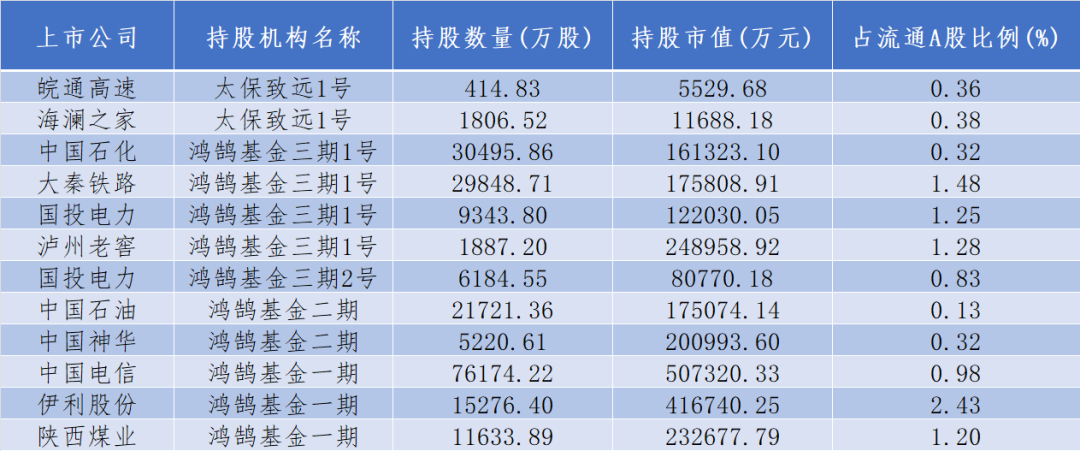
Core Insights - The trial reform for long-term investment of insurance funds has accelerated this year, with the latest holdings of insurance-related private equity funds revealed following the disclosure of listed companies' Q3 reports [1][9] - Five insurance-related private equity funds have disclosed their latest holdings, with significant investments in companies such as Sinopec, Daqin Railway, Guotou Power, Luzhou Laojiao, Anhui Expressway, and HLA [1][4] Holdings Summary - As of the end of Q3, Taibao Zhiyuan No. 1 Private Securities Investment Fund has appeared in the top ten circulating shareholders of Anhui Expressway and HLA, holding 4.1483 million shares and 18.0652 million shares respectively [3][6] - The holdings of five insurance-related private equity funds are detailed in a table, showing the number of shares, market value, and percentage of circulating A-shares for each listed company [5] - The Honghu Fund Phase III No. 1 has emerged as a major shareholder in Sinopec, Daqin Railway, Guotou Power, and Luzhou Laojiao, with holdings of 304.9586 million shares, 298.4871 million shares, 93.438 million shares, and 18.872 million shares respectively [6][7] Investment Focus - The insurance-related private equity funds are primarily concentrated in sectors such as petrochemicals, transportation, coal, public utilities, food and beverage, telecommunications, and textiles, with many holdings being industry leaders characterized by high dividends and low volatility [7][10] - The ongoing trial reform has seen the number of operational insurance-related private equity funds increase to seven, with a total approved scale of 222 billion yuan [9][10]



汇金、证金持仓动向揭秘
财联社· 2025-11-02 02:19
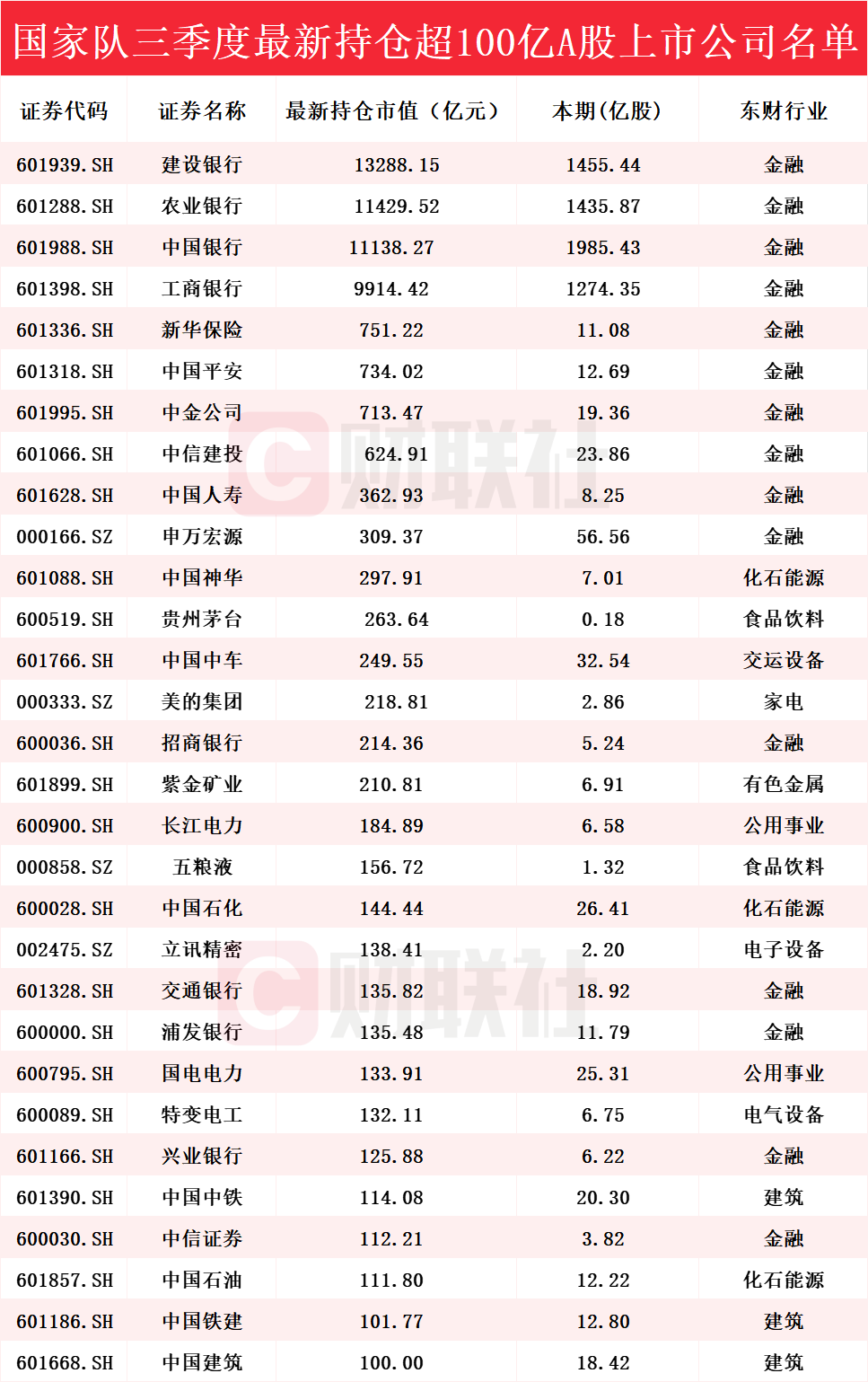
Core Viewpoint - The latest holdings of the "national team" in A-share listed companies have been revealed, with significant investments in major financial institutions and other sectors, indicating a strategic focus on stability and growth in the market [1][2]. Group 1: National Team Holdings - A total of 233 A-share listed companies have the "national team" (China Securities Finance Corporation and Central Huijin) among their top ten shareholders [1]. - There are 30 stocks with a holding value exceeding 10 billion yuan, including major banks like China Construction Bank, Agricultural Bank of China, and Bank of China, with holdings valued at 1.3288 trillion yuan, 1.1429 trillion yuan, and 1.1138 trillion yuan respectively [1][2]. - The top holdings also include companies from various sectors such as insurance, food and beverage, and energy, showcasing a diversified investment strategy [1][2]. Group 2: New Additions and Performance - Farah Electronics has been newly added to the "national team" holdings, with a market value of 158 million yuan [3]. - For the third quarter, Farah Electronics reported a revenue of 3.944 billion yuan, a year-on-year increase of 14.69%, and a net profit of 888 million yuan, also up by 14.58% [3]. - The company’s capacitor products are utilized in ultra-high voltage transmission applications, indicating a focus on high-demand technology sectors [3].







透视“三桶油”业绩:油价下跌背后,化工板块成痛点
Xin Lang Cai Jing· 2025-11-02 01:11
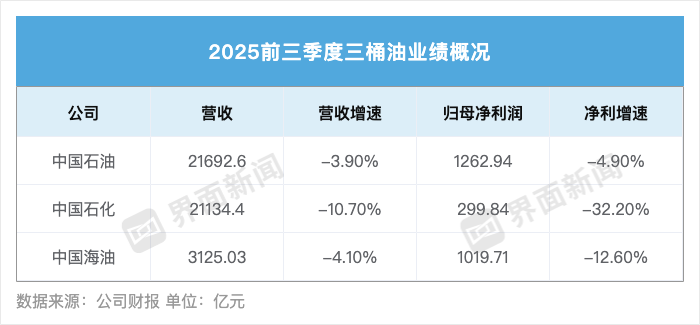
Core Viewpoint - The performance of the "Big Three" oil companies in China has declined in both revenue and net profit for the first three quarters of 2025, primarily due to falling international oil prices, continuing the trend observed in the first half of the year [1][2]. Financial Performance Summary - China National Petroleum Corporation (CNPC) reported a net profit of 126.29 billion yuan, a year-on-year decrease of 4.9%, the smallest decline among the three [1][2]. - China Petroleum & Chemical Corporation (Sinopec) had a net profit of 29.98 billion yuan, down 32.2%, marking the largest decline [1][2]. - China National Offshore Oil Corporation (CNOOC) achieved a net profit of 101.97 billion yuan, a decrease of 12.6% [1][2]. Revenue and Profitability Analysis - CNPC's revenue was 2169.26 billion yuan, with a revenue decline of 3.9% [2]. - Sinopec's revenue was 2113.44 billion yuan, experiencing a 10.7% drop [2]. - CNOOC's revenue stood at 312.50 billion yuan, down 4.1% [2]. - CNOOC had the highest net profit margin at 32.63%, compared to CNPC's 5.82% and Sinopec's 1.42% [4]. Cash Flow and Production Insights - CNPC led in net cash flow from operating activities with 343.1 billion yuan, a year-on-year increase of 3% [4]. - CNOOC followed with a net cash flow of 171.75 billion yuan, down 6% [4]. - Sinopec reported a net cash flow of 114.78 billion yuan, up 13%, the largest increase among the three [4]. - All three companies saw an increase in oil and gas equivalent production, with CNPC at 1.377 billion barrels (up 2.6%), CNOOC at 578 million barrels (up 6.7%), and Sinopec at 394 million barrels (up 2.2%) [8]. Market Conditions and Price Trends - The average price of Brent crude oil was $70.93 per barrel, down 14.3% year-on-year, while West Texas Intermediate (WTI) averaged $66.73 per barrel, a decrease of 14.1% [5]. - The average oil prices realized by the companies also fell, with CNOOC down 13.6%, CNPC down 14.7%, and Sinopec down 13.3% [6]. - Natural gas prices saw a slight increase for CNOOC (up 1%) while CNPC and Sinopec experienced declines [6]. Strategic Outlook - Sinopec and CNPC are focusing on upgrading their refining businesses, but their chemical segments have underperformed, impacting their net profit margins [9]. - Sinopec's chemical segment reported a loss of 7.43 billion yuan, worsening from a loss of 5.58 billion yuan the previous year [9]. - Domestic demand for refined oil products is declining, affecting sales for both CNPC and Sinopec [9]. - CNOOC plans to engage in hedging activities to mitigate risks associated with market price fluctuations [12].

“国家队”持仓动向揭秘!Q3持仓超100亿A股上市公司名单一览
Xin Lang Cai Jing· 2025-11-02 00:45
Core Insights - The latest holdings of the "national team" in A-share listed companies have been revealed, with 233 companies having the "national team" as one of their top ten shareholders [1][2] - In the third quarter, the "national team" held over 10 billion yuan in market value in 30 stocks, including major banks and insurance companies [1] Group 1: Major Holdings - The top three holdings by market value are: - China Construction Bank: 13,288.15 billion yuan - Agricultural Bank of China: 11,429.52 billion yuan - Bank of China: 11,138.27 billion yuan [1] - Other significant holdings include: - Industrial and Commercial Bank of China: 9,914.42 billion yuan - New China Life Insurance: 751.22 billion yuan - Ping An Insurance: 734.02 billion yuan [1][2] Group 2: New Additions - Farah Electronics is a new addition to the "national team" holdings, with a market value of 1.58 billion yuan [2] - The company reported a revenue of 3.944 billion yuan for the first three quarters, a year-on-year increase of 14.69%, and a net profit of 888 million yuan, also up 14.58% [2] - In the third quarter alone, Farah Electronics achieved a revenue of 1.445 billion yuan, reflecting a year-on-year growth of 9.31% [2]
研判2025!中国功能性碳基材料行业政策、产业链、发展现状、重点企业及未来前景展望:下游高端应用需求强劲,驱动行业规模突破两百亿元[图]
Chan Ye Xin Xi Wang· 2025-11-02 00:08
Core Insights - The functional carbon-based materials industry in China is experiencing significant growth due to increasing applications across various sectors and expanding downstream market demand. The market size is projected to grow from 7.992 billion yuan in 2019 to 23.952 billion yuan by 2024, with a compound annual growth rate (CAGR) of 24.55% [1][8]. Industry Overview - Carbon-based materials, primarily composed of carbon elements, exhibit unique physical and chemical properties, making them suitable for high-tech applications. Key types include carbon quantum dots, fullerenes, carbon fibers, carbon nanotubes, carbon nanowires, and graphene, which are essential for upgrading the new materials industry [4][8]. Market Applications - Functional carbon-based materials are widely used in high-end fields such as aerospace (rocket engine nozzles, space shuttle components), automotive (brake discs), medicine, electronics, and photovoltaic power generation. These applications are characterized by high growth rates and strong drivers for market expansion [1][8]. Industry Policies - The functional carbon-based materials industry in China is still in its early stages of industrialization, facing international trade and technological barriers. Recent government policies aim to guide and support the industry's healthy development, including the inclusion of carbon-based materials in encouraged projects [6][7]. Industry Chain - The industry chain consists of upstream raw materials (coal, oil, methane, etc.), midstream production processes, and downstream applications across various sectors such as photovoltaics, wind power, semiconductors, and aerospace [7][8]. Competitive Landscape - The global market for functional carbon-based materials is characterized by both international and domestic competition. International giants like SGL Group and Morgan Advanced Materials dominate the high-end market, while domestic companies such as Chujiang New Materials and Guangwei Composite Materials are rapidly emerging through innovation and market expansion [9][10]. Development Trends - The industry is shifting focus from scale to performance breakthroughs, emphasizing the design and synthesis of precursor structures to develop materials with superior properties. Future trends include precision applications tailored to specific markets, such as renewable energy and biomedical fields, and a transition towards green manufacturing and recycling practices [11][12][13].


每周股票复盘:中国石油(601857)Q3净利422.87亿环比增13.7%
Sou Hu Cai Jing· 2025-11-01 18:01
Core Viewpoint - China Petroleum's stock price has shown a slight increase, with a current market capitalization of 1,674.642 billion yuan, ranking 1st in the refining and trading sector and 8th in the A-share market [1] Group 1: Stockholder Changes - As of September 30, 2025, the number of shareholders for China Petroleum reached 498,807 domestic A-share holders and 5,055 overseas H-share holders, with a total of 498,862 ordinary shareholders, reflecting an increase of 4.52% from June 30, 2025 [3][7] - The average number of shares held per shareholder decreased from 339,300 shares to 324,600 shares, with an average holding value of 2.6164 million yuan [3] Group 2: Performance Disclosure Highlights - For the first three quarters of 2025, China Petroleum reported a total revenue of 2,169.256 billion yuan, a year-on-year decrease of 3.92%, and a net profit attributable to shareholders of 126.279 billion yuan, down 4.9% year-on-year [4] - In Q3 2025, the company achieved a revenue of 719.157 billion yuan, a year-on-year increase of 2.34%, while the net profit attributable to shareholders was 42.286 billion yuan, a decrease of 3.86% year-on-year [4][7] - The company's debt ratio stands at 38.38%, with investment income of 12.732 billion yuan and financial expenses of 8.929 billion yuan, resulting in a gross profit margin of 21.09% [4] Group 3: Company Announcements Summary - The 15th meeting of the 9th Board of Directors was held on October 30, 2025, where the Q3 report was approved, and a proposal to cancel the supervisory board was passed [5] - Song Dayong was appointed as the Senior Vice President, with his election as a director to be submitted to the upcoming extraordinary shareholders' meeting [5][7] - The supervisory board's 12th meeting approved the Q3 report and the cancellation of the supervisory board, with all votes in favor [5] Group 4: Production and Operational Highlights - In the first three quarters of 2025, China Petroleum's crude oil production reached 714.3 million barrels, an increase of 0.8% year-on-year, while marketable natural gas production was 3,977.2 billion cubic feet, up 4.6% year-on-year [6][7] - The company reported an oil and gas equivalent production of 1,377.2 million barrels, reflecting a year-on-year growth of 2.6% [6][7] - The unit operating cost for oil and gas was $10.79 per barrel, a decrease of 6.1% year-on-year [6]
新疆油田迎来勘探开发70周年 累计生产原油4.7亿吨
Jing Ji Ri Bao· 2025-11-01 13:18
Core Insights - The Xinjiang Oilfield, marking its 70th anniversary, has produced a total of 470 million tons of crude oil and 112.1 billion cubic meters of natural gas, establishing itself as a significant energy base in China [1][2] - Technological innovation is now the core driver of development for the Xinjiang Oilfield, with substantial investments in research and breakthroughs in various fields [2] Group 1: Historical Achievements - The discovery of the Karamay Oilfield in 1955 marked the beginning of China's first major oilfield, leading to the establishment of multiple oil and gas fields across 130,000 square kilometers [1] - Significant milestones include the discovery of the Luliang Oilfield in 2002, which was the first major oil discovery in the new century, and the Karamay Gas Field in 2008, which has over 100 billion cubic meters of reserves [1] - The Mahu Oilfield, discovered in 2017, is recognized as the world's largest tight sandstone oilfield, and the first 1 billion-ton shale oil demonstration area was established in 2012 [1] Group 2: Technological and Environmental Initiatives - The Xinjiang Oilfield has increased its research investment, achieving breakthroughs in deep detection and enhanced oil recovery, with technologies reaching international leading levels [2] - The company is actively pursuing a green and low-carbon transformation, implementing measures such as energy conservation, carbon capture, utilization, and storage (CCUS), with the largest CCUS project in China established in 2021 [2] - Plans for a CCUS/CCS project aiming for a cumulative carbon injection of over 10 million tons are underway, with over 1 million tons of carbon already captured [2]
LP圈发生了什么
投资界· 2025-11-01 07:54
Core Insights - The article highlights the establishment of various investment funds across different regions in China, focusing on strategic industries and innovation-driven sectors. Group 1: Fund Establishments - A central enterprise strategic emerging industry development fund was launched in Beijing with an initial scale of 510 billion RMB, involving major state-owned enterprises as contributors [2] - The Zhejiang Social Security Science and Technology Innovation Fund was established with an initial scale of 500 billion RMB, aimed at supporting key areas of technological innovation [3] - The first biomanufacturing industry fund in Shanghai was initiated, combining resources from industry leaders and venture capital to drive technological breakthroughs [4] Group 2: Regional Funds - Chengdu established a high-level talent innovation and entrepreneurship fund, focusing on early-stage investments to support talent and technology transfer [5][6] - Dongguan's Songshan Lake completed the registration of a 100 billion RMB mother fund to promote technological finance and regional industrial upgrades [7] - Wuhan launched its first concept verification fund group with an annual funding pool of 112.5 million RMB to support startup projects [8] Group 3: Sector-Specific Funds - The Hebei Xiong'an concept verification fund was set up with a focus on aerospace information and biotechnology, with an initial scale of 20 million RMB [9] - The Jilin Province Ice and Snow Economy Fund was established with a total scale of 500 million RMB, targeting the ice and snow tourism and technology sectors [11] - The Zhuhai Zuguang New Intelligence Fund was launched to support high-end intelligent manufacturing, marking a significant step in the region's industrial investment [12] Group 4: Investment Strategies - The Chengdu fund emphasizes market-oriented operations to facilitate talent and technology commercialization [6] - The Dongguan fund aims to create a comprehensive fund system covering the entire lifecycle of enterprises through collaboration with various investment institutions [7] - The Jiangsu Yangzhou Aerospace Industry Fund focuses on strategic emerging industries, leveraging a significant capital structure to enhance investment capabilities [14]


中国石油广西石化公司乙烯工程建成投产
Jing Ji Ri Bao· 2025-10-31 21:07
Core Insights - The completion and commissioning of the ethylene project by China National Petroleum Corporation (CNPC) in Guangxi marks a significant transition from refining to integrated refining and chemical operations [1] - The project represents a total investment exceeding 30 billion yuan, making it the largest million-ton ethylene project in Southwest China [1] - The project is expected to reduce oil products by 3.49 million tons annually and increase chemical production [1] Investment and Economic Impact - The ethylene project is a key component of China's petrochemical industry planning and layout [1] - It includes a core ethylene unit with a capacity of 1.2 million tons per year, along with 14 chemical units and 2 refining units [1] - The project aims to transform Guangxi's chemical industry from basic chemicals to high-end chemical new materials [1] Market Reach and Strategic Importance - The project leverages the Western Land-Sea New Corridor, allowing products to reach markets in Southwest China, South China, and ASEAN [1] - It is positioned to help create a trillion-yuan green chemical new materials industry cluster aimed at the ASEAN market [1]