
PETROCHINA(601857)

Search documents
港股“三桶油”走强,中国石油股份(00857.HK)涨3.3%,中国海洋石油(00883.HK)涨2.9%,中国石油化工股份(00386.HK)涨1.8%。
Jin Rong Jie· 2026-01-22 02:18
本文源自:金融界AI电报 港股"三桶油"走强,中国石油股份(00857.HK)涨3.3%,中国海洋石油(00883.HK)涨2.9%,中国石油化工 股份(00386.HK)涨1.8%。 ...


2026年中国丁二烯生产工艺、发展历程、产业链图谱、供需现状、进出口贸易、竞争格局及发展趋势分析:产能集中度较高[图]
Chan Ye Xin Xi Wang· 2026-01-22 01:21
Core Viewpoint - The demand for butadiene, a key raw material for synthetic rubber and ABS resin, remains stable due to its strong ties with major industries such as automotive, home appliances, and construction. The market is expected to see a consumption volume of 4.862 million tons in 2024, a year-on-year increase of 2.8%, with production reaching 4.556 million tons, up 4.2% year-on-year, indicating a reliance on imports to meet demand [1][9]. Industry Overview - Butadiene, chemically known as 1,3-butadiene (C₄H₆), is a colorless gas with a slight aromatic odor, insoluble in water but soluble in many organic solvents. It is a core raw material in the petrochemical industry [2][6]. - The main production methods for butadiene are C4 extraction and butene oxidative dehydrogenation, with the former being the dominant global process due to its efficiency and lower environmental impact [2][4]. Development History - The butadiene industry in China is undergoing a transformation due to stricter environmental policies, leading to the elimination of outdated capacities and a focus on high-end derivatives. The industry is also diversifying raw material sources beyond traditional petroleum-based inputs [4][6]. Current Market Situation - The demand for butadiene is closely linked to the automotive, home appliance, and construction sectors. The growth of lightweight electric vehicles and upgrades in home appliances are driving stable demand. In 2024, the apparent consumption of butadiene in China is projected to reach 4.862 million tons, with a production of 4.556 million tons, indicating a reliance on imports to fill the gap [1][9]. Competitive Landscape - The global butadiene market is highly concentrated, with the top ten producers accounting for 48.3% of total capacity. China Petrochemical Corporation leads with a 12.0% share, followed by China National Petroleum Corporation at 5.8% and Shell at 5.5% [12][13]. - In China, the total butadiene capacity is expected to reach 7.577 million tons per year by the end of 2025, with China Petrochemical Corporation holding a 24.69% market share [13][14]. Future Trends - The butadiene industry is expected to focus on green and low-carbon technologies, optimizing traditional processes while developing new methods such as butane dehydrogenation and bio-based synthesis [16]. - Policies will likely drive the industry towards more intensive and standardized operations, encouraging low-carbon technology upgrades and resource recycling projects [17]. - Demand will diversify, with traditional sectors stabilizing and new areas like lithium battery materials and high-end resins driving growth [18]. - Competition will shift from capacity to integrated supply chain strengths, with leading companies enhancing their raw material self-sufficiency and cost control [19].



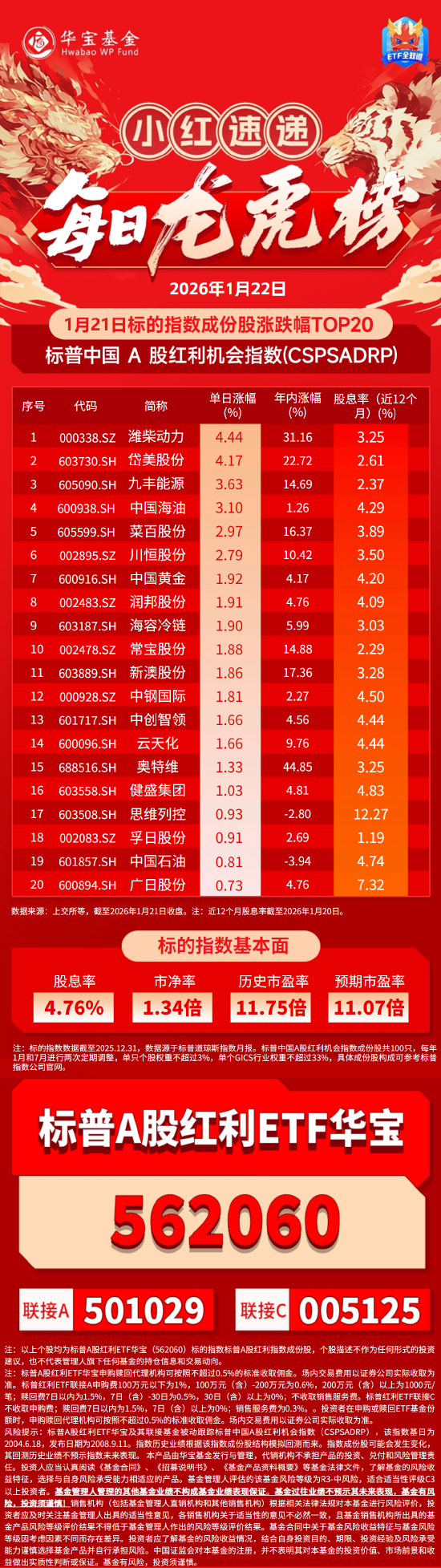
小红日报 | 标普A股红利ETF华宝(562060)标的指数小幅回调,资金持续布局红利资产
Xin Lang Cai Jing· 2026-01-22 01:18
Group 1 - The article highlights the top 20 stocks in the S&P China A-Share Dividend Opportunity Index (CSPSADRP) based on their daily and year-to-date performance as of January 21, 2026 [1][5] - Weichai Power (000338.SZ) leads with a daily increase of 4.44% and a year-to-date increase of 31.16%, with a dividend yield of 3.25% [1][5] - Other notable performers include Daimei Co. (603730.SH) with a daily increase of 4.17% and a year-to-date increase of 22.72%, and Jiufeng Energy (605090.SH) with a daily increase of 3.63% and a year-to-date increase of 14.69% [1][5] Group 2 - The overall dividend yield for the index is reported at 4.76%, with a price-to-book ratio of 1.34 times and a historical price-to-earnings ratio of 11.75 times, while the expected price-to-earnings ratio is 11.07 times [2] - The data is sourced from the Shanghai Stock Exchange and reflects the closing prices as of January 21, 2026, with the dividend yield calculated up to January 20, 2026 [2]


破“三低”困局 走“三分”之路
Xin Lang Cai Jing· 2026-01-21 20:32
Core Viewpoint - Jilin Oilfield is undergoing a transformation towards a diversified energy model, focusing on oil, natural gas, and renewable energy, while aiming for high-quality development and sustainability by 2030 [2][4][11]. Group 1: Historical Development - Jilin Oilfield was established in 1961, marking the beginning of oil exploration in Jilin Province, which had previously been oil-free [4]. - The oilfield has a rich history of overcoming challenges, including resource scarcity and high development costs, while contributing significantly to national energy security [5][11]. - The oilfield's production milestones include reaching an annual output of 186 million tons by 1979 and over 400 million tons by 1997, establishing itself as one of China's major oilfields [5]. Group 2: Current Operations and Goals - Jilin Oilfield is implementing a "325" development strategy, focusing on maintaining stable production, enhancing operational efficiency, and fostering a collaborative work environment [2]. - The company aims to achieve a production equivalent of 600 million tons by 2025, 800 million tons by 2028, and over 1 billion tons by 2030, marking a significant growth trajectory [2]. Group 3: Green Energy Initiatives - The oilfield has made strides in renewable energy, producing 1.47 billion kilowatt-hours of green electricity by 2025, which has led to significant cost savings and reduced carbon emissions [7][8]. - Jilin Oilfield is developing a CCUS (Carbon Capture, Utilization, and Storage) project, expected to transport 4.3 million tons of CO2 annually, contributing to both carbon reduction and enhanced oil recovery [8]. Group 4: Technological Innovation - The company is leveraging technology to enhance operational efficiency, including the use of smart sensors and data management systems to monitor production in real-time [10][11]. - Investment in technology has increased from 430 million yuan to 510 million yuan between 2021 and 2025, underscoring the company's commitment to innovation as a core driver of transformation [11].
多家能源化工央企董事长涨薪
第一财经· 2026-01-21 13:36
Core Viewpoint - The article discusses the salary information of executives from seven major energy and chemical state-owned enterprises in China for the year 2024, revealing that their pre-tax salaries are generally below 1 million yuan, with a range from 650,000 to 1 million yuan [3][4]. Salary Overview - The total pre-tax salary of the executives consists of three components: annual salary, social insurance and other benefits, and additional monetary income [3]. - The disclosed salaries for the seven energy and chemical SOE chairpersons range from 800,000 to 1,260,000 yuan [4]. Executive Salary Details - The top three earners among the "Big Three" oil companies are: - Dai Houliang (China National Petroleum Corporation) - 978,500 yuan - Wang Dongjin (China National Offshore Oil Corporation) - 966,900 yuan - Ma Yongsheng (China Petroleum and Chemical Corporation) - 935,500 yuan [5]. - The lowest salary is held by Mo Dingge (China Chemical Engineering Group), who will assume office in March 2024, with a salary of 635,600 yuan [5]. Year-on-Year Salary Changes - The total salary changes for 2024 compared to 2023 are as follows: - China National Petroleum Corporation: 1.89% increase - China Petroleum and Chemical Corporation: 0.38% increase - China National Offshore Oil Corporation: 3.57% increase - China National Coal Group: 1.61% increase - National Oil and Gas Pipeline Group: 3.27% decrease [6]. Performance Correlation - The salary increases for the chairpersons of China National Petroleum Corporation and China National Offshore Oil Corporation align with their companies' performance, as both companies reported significant profits in 2024 [7]. - China National Offshore Oil Corporation achieved a net profit of 137.94 billion yuan, a 11.4% increase year-on-year, while China National Petroleum Corporation reported a net profit of 164.68 billion yuan, a 2.0% increase despite a 2.5% decrease in revenue [8].

多家能源化工央企董事长涨薪
Di Yi Cai Jing· 2026-01-21 11:48
Core Insights - The State-owned Assets Supervision and Administration Commission (SASAC) disclosed the 2024 salary information for 87 central enterprise leaders, including seven energy and chemical companies [1] Group 1: Salary Information - The pre-tax salary of central enterprise leaders consists of three parts: payable annual salary, employer contributions to social insurance, enterprise annuities, supplementary medical insurance, and housing provident fund, as well as other monetary income [1] - The disclosed salaries for the seven energy and chemical central enterprise leaders range from 650,000 to 1,000,000 yuan, with the total annual salary for these leaders falling between 800,000 and 1,260,000 yuan [2][3] Group 2: Top Earners - The top three earners among the seven energy and chemical central enterprise leaders are from the "Big Three" oil companies: China National Petroleum Corporation (CNPC) Chairman Dai Houliang (978,500 yuan), China National Offshore Oil Corporation (CNOOC) Chairman Wang Dongjin (966,900 yuan), and China Petroleum and Chemical Corporation (Sinopec) Chairman Ma Yongsheng (935,500 yuan) [3] - The remaining leaders' salaries are as follows: China Coal Energy Group Chairman Wang Shudong (910,200 yuan), National Oil and Gas Pipeline Group Chairman Zhang Wei (872,900 yuan), China Sinochem Holdings Chairman Li Fanrong (650,700 yuan), and China Chemical Engineering Group Chairman Mo Dingge (635,600 yuan) [3] Group 3: Salary Changes - The total salary for the leaders of the seven energy and chemical central enterprises has shown an increase, with the exception of the National Oil and Gas Pipeline Group Chairman's salary, which declined compared to 2023 [3] - The top three salary increases for 2024 were recorded by China Sinochem Holdings Chairman Li Fanrong (4.08%), CNPC Chairman Dai Houliang (3.89%), and CNOOC Chairman Wang Dongjin (3.57%) [4] Group 4: Company Performance - In 2024, the "Big Three" oil companies collectively achieved a net profit of over 352.93 billion yuan, averaging approximately 964 million yuan per day [5] - CNOOC reported a revenue of 420.51 billion yuan, a year-on-year increase of 0.9%, and a net profit of 137.94 billion yuan, up 11.4%, marking the second-highest performance in the company's history [5] - CNPC's revenue was 2.94 trillion yuan, a decrease of 2.5% year-on-year, primarily due to falling prices of oil, natural gas, and refined oil products, while achieving a net profit of 164.68 billion yuan, a 2.0% increase [6]

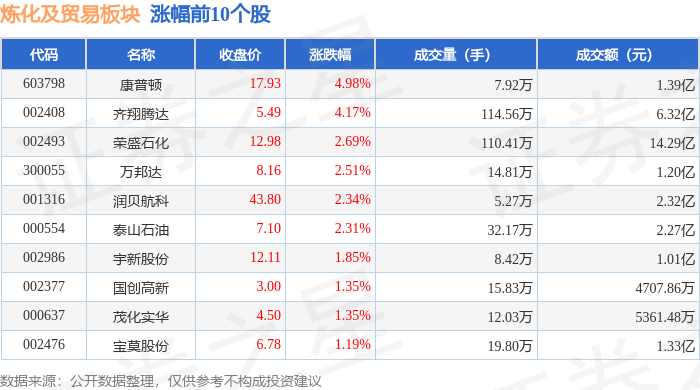
炼化及贸易板块1月21日涨0.28%,康普顿领涨,主力资金净流入1.41亿元
Zheng Xing Xing Ye Ri Bao· 2026-01-21 09:08
Group 1 - The refining and trading sector increased by 0.28% on January 21, with Compton leading the gains [1] - The Shanghai Composite Index closed at 4116.94, up 0.08%, while the Shenzhen Component Index closed at 14255.12, up 0.7% [1] - Key stocks in the refining and trading sector showed various performance, with Compton rising by 4.98% to a closing price of 17.93 [1] Group 2 - Major stocks that declined included Bohai Chemical, which fell by 3.51% to a closing price of 4.67, and Hengyi Petrochemical, down 2.40% to 11.39 [2] - The overall net inflow of funds in the refining and trading sector was 141 million yuan, with retail investors showing a net outflow of 212 million yuan [2] - The stock performance table indicates significant trading volumes, with Qixiang Tengda achieving a trading volume of 1.1456 million hands and a transaction amount of 632 million yuan [1][2] Group 3 - In terms of fund flow, China Petroleum had a net inflow of 29.2 million yuan, while China Petrochemical saw a net inflow of 10.4 million yuan [3] - Compton experienced a net inflow of 13.6 million yuan, indicating strong institutional interest despite retail outflows [3] - The data shows that retail investors were net sellers in several key stocks, including China Petrochemical and Compton, highlighting a shift in investor sentiment [3]


中国科技再迎“丰收年” ——2025科技工作新亮点之一
Ke Ji Ri Bao· 2026-01-21 06:50
Group 1 - China's fusion energy research has made a significant leap from basic science to engineering practice, supported by a new type of national system that has enabled breakthroughs in superconducting magnet design and manufacturing [1] - The successful drilling of the deep exploration well in Sichuan, reaching a depth of over 10,000 meters, marks another important milestone for China National Petroleum Corporation (CNPC) in deep earth exploration [1] - A collaborative innovation consortium formed by nine state-owned enterprises, including CNPC and China National Petroleum Corporation, is driving technological advancements in deep oil and gas exploration [1] Group 2 - The new type of national system has demonstrated its advantages in major technological breakthroughs across various fields, including the Beidou system and lunar exploration, showcasing the effectiveness of coordinated efforts [2] - The 14th Five-Year Plan emphasizes the need for a new type of national system to achieve decisive breakthroughs in key core technologies across critical sectors [2] - The transition from quantitative accumulation to qualitative leaps in technology reflects the strengths of the new type of national system in addressing external technological blockades and fostering new productive forces [2] Group 3 - The rapid development of emerging industries such as artificial intelligence, industrial robotics, and clean energy is evident, with significant advancements in smart manufacturing and container operations at Tianjin Port [3] - By 2025, China's production and sales of new energy vehicles are expected to exceed 16 million units, maintaining its position as the global leader for 11 consecutive years [3] - The low-altitude economy is projected to surpass a market scale of 1.5 trillion yuan, indicating the formation of a new strategic emerging industry cluster [3] Group 4 - The successful clinical trial of a brain-machine interface for precise tumor boundary localization represents a key step in the clinical application and industrialization of this technology [5] - By 2025, China is expected to approve 76 innovative drugs, leading the world in the number of new drug approvals, with a total transaction value of over 130 billion USD for innovative drug licensing [5] - Technological advancements are increasingly integrated into daily life, enhancing various sectors such as smart agriculture and digital cultural heritage [5] Group 5 - The Ministry of Science and Technology emphasizes the importance of independent innovation in advancing high-quality development and enhancing the overall effectiveness of the national innovation system [6] - The focus for 2026 will be on strengthening strategic planning and resource allocation to foster new driving forces and lead the development of new productive forces [6]
中国石油申请自动化管线焊接设备及方法专利,能实现对待焊接的两管件焊前以及焊接过程中的对正
Sou Hu Cai Jing· 2026-01-21 06:36
中国石油集团工程材料研究院有限公司,成立于2021年,位于西安市,是一家以从事专用设备制造业为 主的企业。企业注册资本67911万人民币。通过天眼查大数据分析,中国石油集团工程材料研究院有限 公司共对外投资了4家企业,参与招投标项目1701次,财产线索方面有商标信息15条,专利信息853条, 此外企业还拥有行政许可16个。 国家知识产权局信息显示,中国石油天然气集团有限公司;中国石油集团工程材料研究院有限公司;西安 三环石油管材科技有限公司申请一项名为"自动化管线焊接设备及方法"的专利,公开号 CN121339608A,申请日期为2024年7月。 专利摘要显示,本发明为一种自动化管线焊接设备及方法,其中,自动化管线焊接设备包括:支撑座, 其包括两底座和中间弧形座;夹持装置,其包括两夹持装置,其中一夹持装置能轴向移动并能周向旋 转;图形采集装置,其包括第一探头和第二探头,第一探头能在两管件夹持在两夹持装置后伸入两管件 之间,并对两管件的坡口端面轮廓进行拍照采集;第二探头能绕管件的外周旋转并能对对接后的两管件 的对接位置进行拍照采集;焊接装置,能绕管件的外周旋转;控制系统,其与其中一夹持装置、图形采 集装置以及焊 ...
中国石油申请碳酸盐岩潜山油气藏储层物性分布模型建立方法专利,提升碳酸盐岩潜山油气藏储层物性分布模型的构建精度
Sou Hu Cai Jing· 2026-01-21 04:16
国家知识产权局信息显示,中国石油天然气股份有限公司申请一项名为"一种碳酸盐岩潜山油气藏储层 物性分布模型的建立方法"的专利,公开号CN121351325A,申请日期为2024年7月。 专利摘要显示,本发明属于油气开采技术领域,具体涉及一种碳酸盐岩潜山油气藏储层物性分布模型的 建立方法、系统,旨在解决现有技术构建的碳酸盐岩潜山油气藏储层物性分布模型精度较低的问题。本 方法包括:建立碳酸盐岩潜山的顶面构造、内幕地层构造的三维网格体,作为第一、第二网格体;构建 第一网格体的裂缝分布模型;构建第二网格体的沉积层段索引参数模型及各沉积层段岩石成分分布模 型,并赋值到第一网格体;得到主要影响因素;对第一网格体的非过井网格进行条件模拟,生成非过井 网格的物性参数;非过井网格的物性参数赋值至对应的第二网格体的网格,得到碳酸盐岩潜山油气藏储 层物性分布模型。本发明提升了碳酸盐岩潜山油气藏储层物性分布模型的构建精度。 天眼查资料显示,中国石油天然气股份有限公司,成立于1999年,位于北京市,是一家以从事石油和天 然气开采业为主的企业。企业注册资本18302097万人民币。通过天眼查大数据分析,中国石油天然气股 份有限公司共对外投 ...