
YONGHUI SUPERSTORES(601933)

Search documents
永辉超市员工分红3100万
Shen Zhen Shang Bao· 2025-10-14 23:24
Core Viewpoint - Yonghui Supermarket is experiencing significant improvements in customer traffic and profitability due to quality growth initiatives, with an average traffic increase of 80% in remodeled stores and over 60% of these stores achieving profitability levels surpassing the highest in the past five years [1] Group 1: Store Management and Strategy - In response to losses, Yonghui Supermarket has implemented a strategy of closing underperforming stores, shutting down 232 poorly performing locations in 2024 [1] - The company has initiated the "Fat Donglai" remodeling plan, indicating that Yonghui is in the early learning phase of this strategy [1] Group 2: Employee Engagement and Performance - From January to August 2025, Yonghui Supermarket distributed over 31 million yuan in employee bonuses, with the highest single-store monthly bonus exceeding 300,000 yuan [1] - The company encourages skill enhancement among employees, with nearly 5,000 employees participating in technical certification programs, achieving a professional pass rate of 78.2% by August 31, 2025 [1] Group 3: Sales Performance - During the National Day and Mid-Autumn Festival holidays, the overall sales of remodeled stores increased by over 100% year-on-year, with customer transactions rising by over 80% [1] - Sales of 16 popular products saw a year-on-year increase of over 10 times [1]

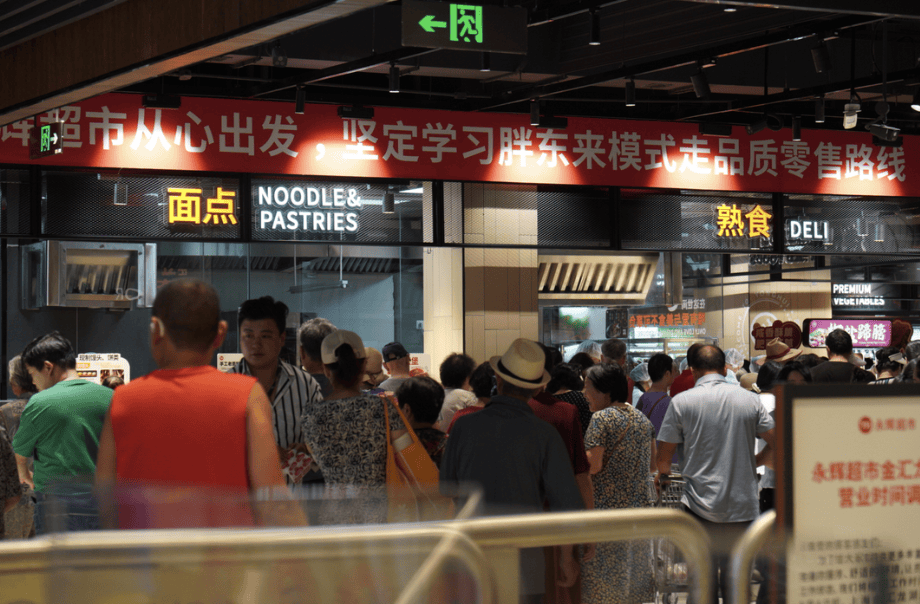
“胖东来”式改造后,永辉公布阶段性运营数据:已调改门店客流暴涨80%
Sou Hu Cai Jing· 2025-10-14 15:04
Core Insights - Yonghui Supermarket has initiated a transformation under the "Fat Donglai" model, showing positive early results in customer traffic and profitability [1][3] - The company aims to enhance its focus on "people" and "products," transitioning from broad horizontal adjustments to refined, in-depth upgrades [1][3] Performance Metrics - Since the launch of the transformation in May 2024, average customer traffic in transformed stores has increased by 80%, with over 60% of these stores entering a stable phase [3] - The profitability of these stores has surpassed the highest levels seen in the past five years [3] - During the recent National Day and Mid-Autumn Festival, overall sales in transformed stores increased by over 100% year-on-year, with customer traffic also rising by over 80% [3] Financial Challenges - Despite initial positive indicators, Yonghui Supermarket continues to face significant financial difficulties, having reported losses for several consecutive years [3] - The company plans to close some long-term loss-making stores by mid-2025 [3] - The CEO expressed a goal to guide the company through its financial challenges over the next 2 to 3 years [3] Mechanism Reform - The transformation includes deep-seated mechanism reforms aimed at ensuring product value, with a focus on transparency and win-win cooperation with suppliers [4] - Yonghui plans to reduce its supplier base from 2,300 to 800 core strategic partners and implement a bare-price direct procurement model to lower costs [4] - Employee welfare is emphasized, with over 31 million yuan distributed in bonuses to employees from January to August 2025 [4] Product Strategy - The management has outlined a core direction focusing on a comprehensive product-centric transformation, aiming to identify 200 core strategic partners and develop 100 billion-yuan-level products within three years [6] - The company is launching two major product lines: "Yonghui Custom" for collaborations with well-known brands and "Quality Yonghui" as its private label, adhering to high standards [6] - Over 20 new products were showcased at the recent event, covering various categories, with plans to introduce 60 private label products this year and expand to 500 within five years [6] Industry Context - The transformation is seen as a critical move for Yonghui Supermarket to navigate challenges posed by membership stores, discount stores, and instant retail in the traditional supermarket sector [6] - The effectiveness of this strategy in converting initial operational improvements into sustained financial profitability will be a focal point for market observers [6]

Third Space获投资;八马茶业通过上市聆讯;复朗集团总裁将辞任
Sou Hu Cai Jing· 2025-10-14 14:41
Investment Dynamics - Yonghui Supermarket has established a new trading company in Beijing with a registered capital of 10 million yuan, focusing on food internet sales, telecommunications, and internet information services, which could create additional revenue streams for the company in the long term [3] - Third Space, a luxury gym in London, secured a £75 million bank loan from OakNorth, following a previous loan of £38.5 million in June 2023, indicating investor confidence in the gym's growth potential amid increasing consumer health demands [5] - Guizhou Southern Dairy announced the suspension of its listing application on the Beijing Stock Exchange due to the need for supplementary audit matters, with projected 2024 revenue of 1.817 billion yuan and net profit of 209 million yuan, ranking 20th among 36 listed dairy companies [7] - Eight Horse Tea has passed the listing hearing at the Hong Kong Stock Exchange, aiming for a main board listing with projected revenues of 1.818 billion yuan, 2.122 billion yuan, and 2.143 billion yuan from 2022 to 2024, showing growth rates of 16.8% and 1.0% for 2023 and 2024 respectively [10][11] - Haidilao has opened a budget conveyor sushi restaurant in Hangzhou, indicating its strategy to diversify into the sushi market, leveraging its supply chain to create a differentiated product offering [13] Brand Dynamics - Luckin Coffee has launched a venue leasing cooperation across 39 cities, focusing on school locations, which is expected to enhance brand coverage in a rapidly growing coffee market [19] - LOEWE and Swiss sports brand On have collaborated to launch a limited edition Cloudsolo sneaker, which is anticipated to generate high-margin revenue for LOEWE while attracting high-net-worth customers for On [16] Personnel Dynamics - Cargill appointed Andrew MacPherson as the new CEO of Teys, coinciding with Cargill's acquisition of Teys, which is expected to enhance operational capabilities and market reach [22][23] - China Resources Beer announced a management reshuffle, appointing Jin Hanquan as executive director and president, which aims to strengthen leadership amid increasing competition in the premium beer segment [26] - The global luxury fashion group, Richemont, announced the resignation of its CEO and CFO, Chen Jiyu, who will leave on October 27, 2025, raising questions about the future leadership and performance of the group [28]



八马茶业通过港交所上市聆讯 | 10月14日早报
Sou Hu Cai Jing· 2025-10-14 02:16
Star Brands - Ye Guofu, the founder of Miniso and non-independent director of Yonghui Supermarket, emphasized the importance of direction in the company's transformation, stating that progress is key and that they will achieve great success [2] - Yonghui Supermarket's CEO Wang Shoucheng reported an average customer traffic increase of 80% in the transformed stores, with 102 stores achieving a net promoter score (NPS) average exceeding 40, and 19 stores surpassing 50 [3] - Yonghui plans to develop 100 billion-yuan-level flagship products over the next three years, collaborating with 200 core strategic partners to create compelling reasons for consumers to choose Yonghui [4] Consumer Platforms - Alibaba's cross-border e-commerce platform Lazada has integrated with Tmall to facilitate easier access for Tmall merchants to Southeast Asian markets, indicating a growing trend in cross-border e-commerce [5] - AliExpress has reported over 100,000 artificial Christmas trees being shipped overseas in preparation for the Double 11 and Black Friday sales, marking a new high in holiday inventory [6] - A report on outdoor sports consumption revealed that 60% of users on the Dewu app spend over 8,000 yuan annually, with a significant portion of users being from Generation Z [7] Investment and Financial Reports - Nanchao Foods reported a September consolidated revenue of 276 million yuan, reflecting a slight year-on-year increase of 0.0016% [12] - Eight Horses Tea has passed the listing hearing at the Hong Kong Stock Exchange, with joint sponsors including Huatai International and Agricultural Bank of China International [13] Macro News - The General Administration of Customs reported that China exported over 50 billion yuan worth of holiday goods, dolls, and animal-shaped toys in the first three quarters, highlighting the global appeal of domestic products [15]
永辉超市跌2.04%,成交额2.64亿元,主力资金净流出1976.34万元
Xin Lang Cai Jing· 2025-10-14 01:56
Core Viewpoint - Yonghui Supermarket's stock has experienced a significant decline of 24.45% year-to-date, with recent trading activity showing mixed results in terms of price movement and trading volume [2] Group 1: Stock Performance - As of October 14, Yonghui Supermarket's stock price was 4.79 yuan per share, down 2.04% during the trading session, with a total market capitalization of 43.469 billion yuan [1] - The stock has seen a slight increase of 0.84% over the last five trading days, but a decline of 7.88% over the last 20 days and a minor decrease of 0.62% over the last 60 days [2] Group 2: Financial Performance - For the first half of 2025, Yonghui Supermarket reported a revenue of 29.948 billion yuan, representing a year-on-year decrease of 20.73%, and a net profit attributable to shareholders of -241 million yuan, a significant decline of 187.38% [2] - The company has not distributed any dividends in the last three years, with a total payout of 7.101 billion yuan since its A-share listing [3] Group 3: Shareholder Information - As of June 30, 2025, Yonghui Supermarket had 359,800 shareholders, a decrease of 6.24% from the previous period, with an average of 25,220 circulating shares per shareholder, an increase of 6.66% [2] - Among the top ten circulating shareholders, Hong Kong Central Clearing Limited holds 104 million shares, an increase of 11.8954 million shares from the previous period, while the Southern CSI 500 ETF is a new entrant with 67.3567 million shares [3]
永辉超市发布自有品牌 调改店平均客流增长超过80%
Xin Lang Cai Jing· 2025-10-13 14:18
Core Insights - Yonghui Supermarket has achieved an average customer traffic growth of 80% in its remodeled stores, with over 60% of these stores entering a stable profitability phase that surpasses the highest levels seen in the past five years [1] - As of now, Yonghui Supermarket has 102 remodeled stores with an average Net Promoter Score (NPS) exceeding 40, and 19 of these stores have an NPS above 50 [1] Summary by Categories - **Store Performance** - Average customer traffic growth of remodeled stores is 80% [1] - More than 60% of remodeled stores have reached stable profitability levels exceeding the highest in the last five years [1] - **Customer Satisfaction** - 102 remodeled stores have an average NPS greater than 40 [1] - 19 stores have an NPS exceeding 50, indicating high customer satisfaction [1]
合川合阳城街道:双节商贸劲增 消费活力释放
Sou Hu Cai Jing· 2025-10-13 13:18
Core Insights - The article highlights the successful integration of commerce and culture in the Hechuan District during the National Day and Mid-Autumn Festival, showcasing a vibrant consumer economy and enhanced public welfare [1] Group 1: Consumer Activity - Key commercial hubs such as Fortune Plaza, Chongqing Department Store, and Baolong Plaza saw a total foot traffic of 2 million, a 200% increase compared to regular days, and sales exceeded 60 million yuan, marking a 150% rise [3] - The upgraded Yonghui Supermarket achieved sales of nearly 6 million yuan during the holidays, a fivefold increase year-on-year, with approximately 100,000 customers served, reflecting a 600% growth [5] Group 2: Night Economy - Eleven featured commercial streets, including Yashijie Food Street and Zuofu Commercial Street, contributed to a 60% increase in nighttime economic activity, driven by diverse offerings in food, culture, and leisure [5] Group 3: Thematic Events - The integration of commerce and culture through events like fashion shows and home exhibitions attracted 200,000 visitors and stimulated a 30% increase in related consumption [6] - The article emphasizes the ongoing efforts to enhance the consumer environment and unlock market potential, aiming to create a vibrant commercial core in Hechuan District [6]
一般零售板块10月13日涨1.04%,国光连锁领涨,主力资金净流入7.06亿元
Zheng Xing Xing Ye Ri Bao· 2025-10-13 12:45
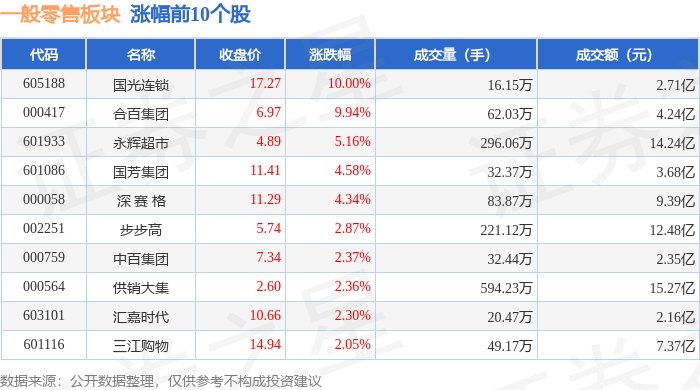
Core Insights - The general retail sector experienced a rise of 1.04% on October 13, with Guoguang Chain leading the gains [1] - The Shanghai Composite Index closed at 3889.5, down 0.19%, while the Shenzhen Component Index closed at 13231.47, down 0.93% [1] Retail Sector Performance - Guoguang Chain (605188) saw a closing price of 17.27, with a significant increase of 10.00% and a trading volume of 161,500 shares, amounting to a transaction value of 271 million yuan [1] - HeBai Group (000417) closed at 6.97, up 9.94%, with a trading volume of 620,300 shares and a transaction value of 424 million yuan [1] - Yonghui Supermarket (601933) closed at 4.89, increasing by 5.16%, with a trading volume of 2,960,600 shares and a transaction value of 1.424 billion yuan [1] - Other notable performers included Guofang Group (601086) with a 4.58% increase and a closing price of 11.41, and Bubu Gao (002251) with a 2.87% increase and a closing price of 5.74 [1] Capital Flow Analysis - The general retail sector saw a net inflow of 706 million yuan from institutional investors, while retail investors experienced a net outflow of 470 million yuan [2] - The main capital inflow was observed in Yonghui Supermarket, which had a net inflow of 227.1 million yuan, accounting for 15.93% of its total capital [3] - Guoguang Chain also had a significant net inflow of 101 million yuan, representing 37.22% of its total capital [3] - Conversely, retail investors showed a net outflow in several companies, including Guoguang Chain and HeBai Group, indicating a shift in investor sentiment [3]


永辉超市“商品中心化”战略成零售转型新方向
Zheng Quan Ri Bao Wang· 2025-10-13 12:03
Core Insights - Yonghui Supermarket has successfully implemented a transformation strategy since May 2024, leading to significant improvements in customer satisfaction, foot traffic, and profitability [1] - During the recent National Day and Mid-Autumn Festival, Yonghui's overall sales from remodeled stores increased by over 100% year-on-year, with customer foot traffic rising by over 80% [1] - The company aims to focus on "people" and "products" in its future transformation efforts, emphasizing high-quality and refined upgrades [1] Group 1: Sales Performance - Yonghui's remodeled stores achieved an average customer foot traffic growth of 80%, with over 60% of these stores entering a stable profitability phase, surpassing the highest levels in the past five years [1] - The sales of 16 popular products increased by over ten times year-on-year, highlighting the effectiveness of the transformation strategy [1] Group 2: Product Strategy - Yonghui Supermarket launched two major product lines: "Yonghui Custom" and its private label "Quality Yonghui," covering various categories such as fresh produce, baked goods, beverages, and daily necessities [2] - The company plans to introduce 60 new products within the year and aims to develop 500 private label products over the next five years to support quality retail [2] Group 3: Supply Chain and Partnerships - Yonghui is committed to optimizing its supply chain and has initiated measures to combat corruption and gray market transactions, establishing a transparent and win-win cooperation mechanism with suppliers [2] - The company aims to identify 200 core strategic partners and develop 100 billion-level flagship products within three years to meet diverse consumer quality demands [2] Group 4: Market Trends - Consumer preferences are shifting towards healthier and more cost-effective products, prompting retail companies to enhance their product development capabilities [3] - Companies are encouraged to establish clear product strategies, implement systematic quality management, and strengthen collaboration with manufacturers to support private label development [3]
永辉超市CEO王守诚:已调改门店客流平均增长80%
Zheng Quan Shi Bao Wang· 2025-10-13 09:49
Core Insights - Yonghui Supermarket has successfully implemented the "Fat Donglai" model, leading to increased customer satisfaction, foot traffic, and profitability since its launch in May 2024 [1] - The company aims to enhance its focus on "people" and "products" for future improvements, transitioning from broad adjustments to more refined strategies [1] Group 1: Performance Metrics - As of now, 102 modified stores have an average Net Promoter Score (NPS) exceeding 40%, with 19 stores surpassing 50%, indicating strong customer loyalty [1] - Average foot traffic in modified stores has increased by 80%, and over 60% of these stores have achieved profitability levels surpassing their highest in the past five years [1] Group 2: Strategic Initiatives - Yonghui Supermarket announced a "Product Centered" strategy, planning to collaborate with 200 core strategic partners to develop 100 billion-level flagship products over the next three years [2] - The product structure will include high-quality products from top domestic and international brands, customized products, and a proprietary brand system called "Quality Yonghui" [2] Group 3: Supply Chain and Transparency - The company emphasizes the importance of a transparent supply chain to enhance product and service quality, committing to a cooperative model with its partners that includes shared risks and rewards [3] - In July, Yonghui Supermarket took a strong stance against corruption and gray market practices within its supply chain, establishing a "sunshine, transparency, and win-win" cooperation mechanism [3]