
CCB(601939)

Search documents
重庆水务拟以2.55亿元收购污水处理项目;太阳电缆股东拟合计减持不超3%公司股份|公告精选
Mei Ri Jing Ji Xin Wen· 2025-12-04 13:49
Group 1: Company Announcements - Chongqing Water intends to acquire wastewater treatment projects for a total of 255 million yuan, including assets and related debts from three wastewater treatment plant expansion projects [1] - Beijiete plans to acquire controlling interest in Yunnan Wenye Nonferrous Metals Co., Ltd. through a share acquisition agreement [2] - Suhao Huihong is set to conduct an asset swap with its controlling shareholder, Suhao Holdings, involving the transfer of a 2.33% stake in Zijin Property Insurance for 262 million yuan [3] Group 2: Shareholding Changes - Sun Cable's major shareholder, Xiamen Xiangyu Group, and its concerted parties plan to reduce their holdings by up to 3%, totaling no more than 21.67 million shares [4] - Haike Xinyuan's shareholder, a strategic asset management plan, intends to reduce its stake by up to 2.50%, equating to 557.41 million shares [5] - Dongwang Times' shareholder, Dongyang Xinling Technology Co., Ltd., plans to reduce its holdings by up to 1.20%, amounting to 10.13 million shares [6] Group 3: Fundraising and Dividend Distribution - Meilixin plans to raise no more than 1.2 billion yuan through a private placement to fund semiconductor equipment projects and supplement working capital [7] - China Construction Bank has approved a cash dividend distribution of approximately 48.605 billion yuan for the first half of 2025, with a per-share dividend of 0.1858 yuan [8]



存款争夺熄火:有银行下架1年期及以上产品
3 6 Ke· 2025-12-04 10:37
Core Viewpoint - The banking industry is facing pressure on net interest margins, leading to a control on liabilities and a reduced likelihood of a deposit competition by the end of 2025 [1][6]. Group 1: Deposit Products and Interest Rates - Some banks have temporarily suspended the issuance of term deposits of 1 year and above, with current rates for shorter-term deposits ranging from 1.25% to 1.45% [1][3]. - Six major state-owned banks have collectively removed 5-year large certificates of deposit (CDs) from their offerings, while still providing various term deposit products with maximum rates of 1.3% [1][4]. - The interest rates for 1-year, 2-year, 3-year, and 5-year term deposits from state-owned banks are approximately between 0.95% and 1.3% [4][5]. Group 2: Net Interest Margin and Loan Quality - As of the end of Q3 2025, the net interest margin for commercial banks was 1.42%, remaining stable compared to Q2 but down by 11 basis points year-on-year [6][7]. - The non-performing loan ratio for commercial banks was 1.52%, an increase of 0.03 percentage points from the previous quarter [1]. - The net interest margin for joint-stock banks and rural commercial banks was relatively higher at 1.56% and 1.58%, respectively, while state-owned banks and city commercial banks had lower margins of 1.31% and 1.37% [7]. Group 3: Strategic Adjustments in Banking - Banks are optimizing their liabilities as a core strategy, with many large and medium-sized banks ceasing the issuance of long-term large CDs since Q2 2024 [4][6]. - The banking sector is focusing on aligning loan pricing with business risks to maintain reasonable net interest margins, amidst concerns of a potential "inversion" between non-performing rates and net interest margins [6][7]. - The trend of deposit rates being lowered has been ongoing, with the latest adjustments occurring on May 20, 2025, marking the seventh reduction since September 2022 [5].



建设银行(00939) - 2025年半年度A股分红派息实施公告
2025-12-04 09:36
( 於 中 華 人 民 共 和 國 註 冊 成 立 的 股 份 有 限 公 司 ) (A joint stock company incorporated in the People's Republic of China with limited liability) (股份代號:00939) 2025年半年度A股分紅派息實施公告 本公告乃根據《香港聯合交易所有限公司證券上市規則》第13.10B條刊登。茲載列 該公告(於上海證券交易所網站刊登)如下,僅供參閱。 特此公告。 中國建設銀行股份有限公司 董事會 2025年12月4日 於本公告日期,本行的執行董事為張金良先生、張毅先生和紀志宏先生,本行的 非執行董事為辛曉岱女士、劉芳女士、李璐女士、李莉女士和竇洪權先生,本行 的獨立非執行董事為威廉 • 科恩先生、梁錦松先生、詹誠信勛爵、林志軍先生和 張為國先生。 香港交易及結算所有限公司及香港聯合交易所有限公司對本公告之內容概不負責,對其準確性 或完整性亦不發表任何聲明,並明確表示,概不對因本公告全部或任何部分內容而產生或因依 賴該等內容而引致之任何損失承擔任何責任。 证券代码:601939 证券简称:建设银行 ...
建设银行(601939) - 建设银行2025年半年度A股分红派息实施公告
2025-12-04 09:30
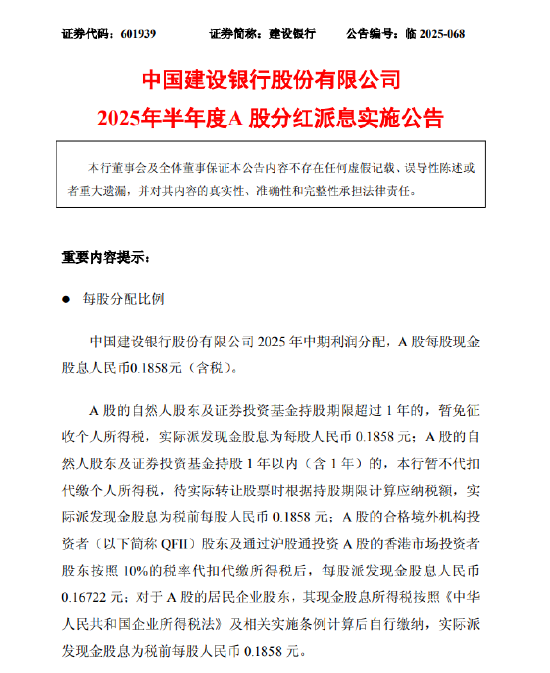
证券代码:601939 证券简称:建设银行 公告编号:临 2025-068 中国建设银行股份有限公司 2025年半年度A 股分红派息实施公告 本行董事会及全体董事保证本公告内容不存在任何虚假记载、误导性陈述或 者重大遗漏,并对其内容的真实性、准确性和完整性承担法律责任。 重要内容提示: 每股分配比例 中国建设银行股份有限公司 2025 年中期利润分配,A 股每股现金 股息人民币0.1858元(含税)。 A 股的自然人股东及证券投资基金持股期限超过 1 年的,暂免征 收个人所得税,实际派发现金股息为每股人民币 0.1858 元;A 股的自 然人股东及证券投资基金持股 1 年以内(含 1 年)的,本行暂不代扣 代缴个人所得税,待实际转让股票时根据持股期限计算应纳税额,实 际派发现金股息为税前每股人民币 0.1858 元;A 股的合格境外机构投 资者(以下简称 QFII)股东及通过沪股通投资 A 股的香港市场投资者 股东按照 10%的税率代扣代缴所得税后,每股派发现金股息人民币 0.16722 元;对于 A 股的居民企业股东,其现金股息所得税按照《中华 人民共和国企业所得税法》及相关实施条例计算后自行缴纳,实际派 ...
建设银行:2025年半年度拟派发现金股息486.05亿元
Xin Lang Cai Jing· 2025-12-04 09:17
12月4日金融一线消息,建设银行公告称,2025年半年度利润分配方案已获2025年第二次临时股东会会 议通过。本次以总股本261,600,381,459股为基数,每股派发现金股息0.1858元(含税),共计派发 现金股息约486.05亿元,其中A股股息约39.36亿元。股权登记日为2025年12月10日,除权(息)日和现 金红利发放日为2025年12月11日。不同类型股东扣税政策有别。 责任编辑:秦艺 12月4日金融一线消息,建设银行公告称,2025年半年度利润分配方案已获2025年第二次临时股东会会 议通过。本次以总股本261,600,381,459股为基数,每股派发现金股息0.1858元(含税),共计派发 现金股息约486.05亿元,其中A股股息约39.36亿元。股权登记日为2025年12月10日,除权(息)日和现 金红利发放日为2025年12月11日。不同类型股东扣税政策有别。 责任编辑:秦艺 ...

广东建行行长朱斌晨:发挥优势助力“百千万工程”走深走实
Zhong Guo Jin Rong Xin Xi Wang· 2025-12-04 08:17
转自:新华财经 此外,分行不断丰富涉农信贷增信方式。重点推进以涉农押品为抵质押的产品创新,先后推出"农村承 包土地经营权抵押贷款""农村集体经营性建设用地使用权抵押贷款""集体三资贷款"等特色贷款产品, 为盘活农村产权融资业务拓宽了渠道。今年7月,分行创新落地系统内首笔村组集体三资集建地贷款, 累计发放农村集体土地融资贷款超9亿元,发放林权抵押贷款、生猪活体抵押贷款等特色业务超1亿元。 新华财经:加强重点领域信贷资源投放力度是促进乡村产业提质升级、加力提速推进"百千万工程"的关 键抓手。在这方面,贵行如何通过重点领域、重大项目给予助力? 朱斌晨:围绕"建设乡村的建设银行"目标,建行广东分行紧跟省委、省政府部署导向,在支持产业园转 移、发展新质生产力和乡村振兴对口帮扶等重点方面,持续发挥金融赋能作用。 今年是广东"百千万工程"实现"三年初见成效"之年,建行广东省分行行长朱斌晨说,该行深入贯彻落 实"百千万工程"的工作部署,积极履行社会责任,立足做"建设乡村的建设银行",下一步,将持续发挥 自身优势,多措并举做好金融"五篇大文章",不断加大对"百千万工程"的金融支持力度。 新华财经:在贵行赋能"百千万工程"、助力 ...
建设银行吉林省分行“金融+消费”激发市场活力
Zhong Guo Jin Rong Xin Xi Wang· 2025-12-04 08:13
Core Viewpoint - China Construction Bank's Jilin Branch is actively enhancing financial empowerment in response to national policies, focusing on stimulating consumer market vitality through collaborative efforts on both supply and demand sides [1] Group 1: Automotive Sector Initiatives - The Jilin Branch organized 17 unique test drive events for new energy vehicles in April, attracting numerous customers and providing information on vehicle performance and financing options [2] - The bank has partnered with major brands like Tesla, Li Auto, and BYD to offer installment financing for new energy vehicles, achieving a transaction volume of 530 million yuan by the end of October, representing a 36% year-on-year increase [3] Group 2: Home Renovation Support - The bank launched a "Home Renovation Consumption Season" to assist customers like Mr. Li in securing renovation loans, integrating government subsidies and preferential rates [4] - By the end of October, the bank's home renovation installment transactions reached 147 million yuan, benefiting from a three-dimensional support system of government subsidies, financial benefits, and merchant promotions [5] Group 3: Consumer Engagement and Promotions - The bank has implemented various promotional activities across major shopping districts in Jilin Province, offering discounts and benefits through credit card usage and third-party payments [6] - A strategy of "precise marketing + scene engagement + process optimization" has been adopted to enhance credit card payment convenience and user experience, targeting diverse consumer needs [7]
大额存单“一票难求”!专家:多样稳健类投资方式可替代长期储蓄
Sou Hu Cai Jing· 2025-12-04 06:19
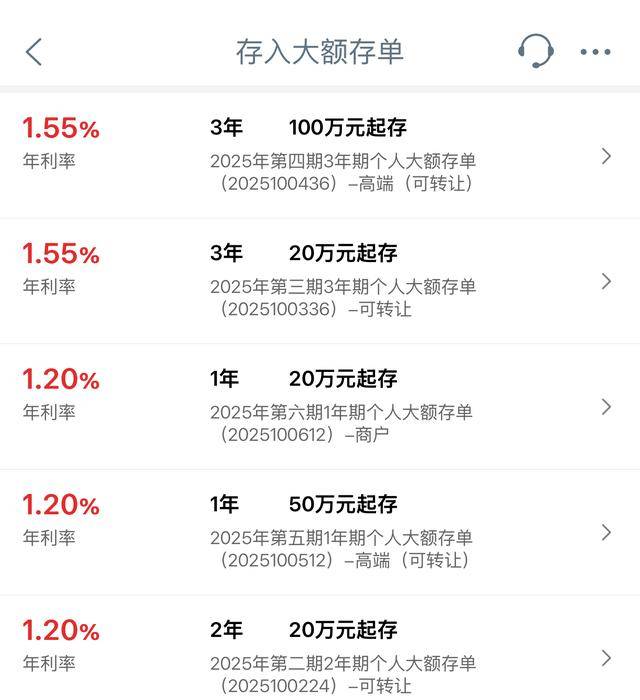
Core Viewpoint - The recent adjustments by state-owned banks regarding large-denomination certificates of deposit (CDs) have drawn market attention, with a notable shift in the availability and minimum deposit amounts for these products [1][2]. Group 1: Changes in Large-Denomination CDs - All six major state-owned banks have removed five-year large-denomination CDs from their mobile banking platforms and websites, with the longest available term now being three years [2]. - Some banks, such as Citic Bank and China Merchants Bank, have reduced the maximum term for their large-denomination CDs to two years, offering an annual interest rate of 1.40% [2]. Group 2: Minimum Deposit Adjustments - The minimum deposit amount for large-denomination CDs has been significantly adjusted, with some banks setting the threshold at 1 million yuan for certain products, while others maintain a lower threshold of 200,000 yuan [3]. - This adjustment is seen as a normal operation for banks managing their liabilities, aiming to balance growth, cost reduction, and risk management [3]. Group 3: Market Implications and Expert Opinions - Experts suggest that the primary driver behind these adjustments is the pressure from narrowing net interest margins in the banking sector, which aligns with policy directions to allow banks to respond more flexibly to the needs of the real economy [7]. - The removal of five-year large-denomination CDs is viewed as a rational choice for banks to optimize their liability structure and shift focus from scale expansion to quality and efficiency [7]. Group 4: Shifts in Consumer Behavior - As the availability of long-term CDs decreases, consumers are encouraged to diversify their asset allocation strategies, moving away from reliance on long-term deposits [8]. - A survey indicates that 18.5% of residents are inclined to invest more, with non-guaranteed bank wealth management products being the most favored investment option at 36% [8]. Group 5: Alternative Investment Suggestions - Financial experts recommend that consumers consider various investment strategies, such as staggered deposits across different terms to balance yield and liquidity [9]. - Other low-risk investment options include government bonds, low-risk wealth management products, and specialized deposit products from smaller banks, which may offer competitive rates [10].
【福利】36元优惠券获取攻略等您查收
中国建设银行· 2025-12-04 05:56
Group 1 - The article promotes a series of discounts and benefits through the "建行生活" app, including WeChat discount coupons starting from 0.99 yuan for purchases over 36 yuan [2][5] - The promotional activities are scheduled from August 1, 2025, to December 31, 2025, targeting winter dining experiences [2] - Various WeChat discount coupons are available for different spending thresholds, such as 3 yuan off for purchases over 2.01 yuan and 10 yuan off for purchases over 10.01 yuan [7][9] Group 2 - Users can participate in the WeChat discount activities through the "中国建设银行" app or the "建行生活" app, with specific instructions provided for accessing the discount sections [12] - Refund policies for the WeChat discount coupons are outlined, indicating that full refunds will return the discount amounts if the order is fully refunded, while partial refunds will return the discount proportionally [13][14] - The article includes customer service contact information for issues related to the discount cards, available daily from 9:00 to 23:00 [17]

六家国有大行将在2026年年初派发2000亿红包!
Zhong Guo Jing Ying Bao· 2025-12-04 04:56
12月2日晚间,邮储银行发布公告,将于2026年2月13日派发中期股息每10股1.23元,合计派息约147.72 亿元,占2025年上半年归母净利润的30%。 部分银行分红比例提升 银行中期分红从"可选项"逐渐转变为"常规动作",与近年来监管层的持续倡导密不可分。 2023年12月中旬,中国证监会发布《上市公司监管指引第3号——上市公司现金分红》,该指引修订内 容主要有三个方面,其中包括简化中期分红程序,推动进一步优化分红方式和节奏。鼓励公司在条件允 许的情况下增加分红频次。新"国九条"也提出,"加大对分红优质公司的激励力度,多措并举推动提高 股息率。增强分红稳定性、持续性和可预期性,推动一年多次分红、预分红、春节前分红。" 尽管面临净息差持续收窄等周期性挑战,但上市银行,尤其是国有大行和部分优质股份制银行,依然展 现出较强的盈利韧性和分红意愿。且记者注意到,部分上市银行此次提出的中期分红比例进一步提升。 如上海银行2025年中期现金分红比例进一步提升至32.22%;沪农商行2025年中期分红比例为33.14%, 较2024年的中期分红比例继续小幅提升。 《中国经营报》记者梳理发现,除邮储银行外,其他五家国有 ...
