
CCB(601939)

Search documents
六家国有大行将在2026年年初派发2000亿红包!
Zhong Guo Jing Ying Bao· 2025-12-04 04:56
12月2日晚间,邮储银行发布公告,将于2026年2月13日派发中期股息每10股1.23元,合计派息约147.72 亿元,占2025年上半年归母净利润的30%。 部分银行分红比例提升 银行中期分红从"可选项"逐渐转变为"常规动作",与近年来监管层的持续倡导密不可分。 2023年12月中旬,中国证监会发布《上市公司监管指引第3号——上市公司现金分红》,该指引修订内 容主要有三个方面,其中包括简化中期分红程序,推动进一步优化分红方式和节奏。鼓励公司在条件允 许的情况下增加分红频次。新"国九条"也提出,"加大对分红优质公司的激励力度,多措并举推动提高 股息率。增强分红稳定性、持续性和可预期性,推动一年多次分红、预分红、春节前分红。" 尽管面临净息差持续收窄等周期性挑战,但上市银行,尤其是国有大行和部分优质股份制银行,依然展 现出较强的盈利韧性和分红意愿。且记者注意到,部分上市银行此次提出的中期分红比例进一步提升。 如上海银行2025年中期现金分红比例进一步提升至32.22%;沪农商行2025年中期分红比例为33.14%, 较2024年的中期分红比例继续小幅提升。 《中国经营报》记者梳理发现,除邮储银行外,其他五家国有 ...



大额存单起存门槛升高,工行存100万与存20万利率相同,农行存500万利率1.55%
Sou Hu Cai Jing· 2025-12-04 03:59
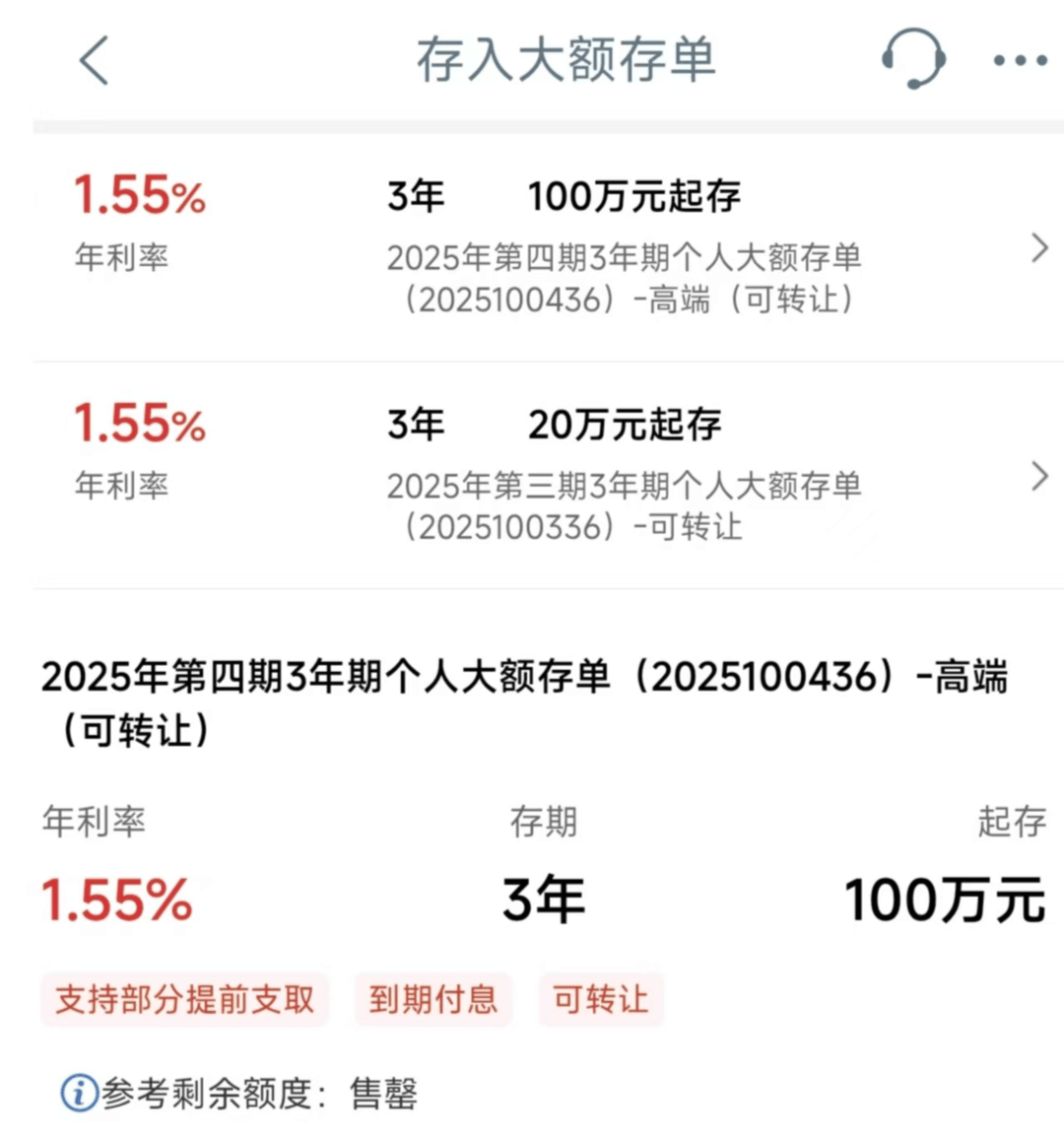
Core Viewpoint - The latest issuance of 3-year large-denomination certificates of deposit (CDs) by Industrial and Commercial Bank of China (ICBC) has seen the minimum deposit requirement raised to 1 million yuan, with an interest rate of 1.55%, which is currently sold out [1][4]. Group 1: Large-Denomination CDs - The interest rate for the 3-year large-denomination CDs is set at 1.55% with a minimum deposit of 1 million yuan [2][3]. - Previously, ICBC offered a 3-year large-denomination CD with a minimum deposit of 200,000 yuan, also at an interest rate of 1.55% [1][4]. - Other banks, including China Construction Bank, Agricultural Bank of China, and Bank of China, are also offering 3-year large-denomination CDs with a minimum deposit of 200,000 yuan at the same interest rate of 1.55% [4]. Group 2: Market Dynamics and Strategies - The increase in the minimum deposit requirement for large-denomination CDs without a corresponding increase in interest rates reflects banks' proactive liability management strategies in a low-interest-rate environment [4]. - By raising the minimum deposit amount, banks are effectively tightening the supply of large-denomination CDs, aiming to optimize their liability structure and reduce reliance on high-cost deposits [4]. - The main advantages of large-denomination CDs over regular deposits, despite the current interest rate trends, include higher liquidity and flexibility, such as transferability and collateral options, making them suitable for large depositors with short-term capital needs [4].


西南证券、建设银行等新设私募股权投资基金
Zheng Quan Shi Bao Wang· 2025-12-04 03:31
人民财讯12月4日电,企查查APP显示,近日,重庆建源西证私募股权投资基金合伙企业(有限合伙) 成立,出资额10亿元,经营范围包含以私募基金从事股权投资。企查查股权穿透显示,该企业由西南证 券全资子公司西证股权投资有限公司、建设银行全资子公司建信金融资产投资有限公司等共同出资。 ...

烟台金融监管分局:辖区大型银行创新举措助推绿色低碳高质量发展
Qi Lu Wan Bao· 2025-12-04 02:09
2025年,是"绿水青山就是金山银山"理念提出20周年,是"双碳"目标提出5周年,也是中央金融工作会 议明确"绿色金融"等五篇大文章2周年。近年来,烟台金融监管分局紧紧围绕烟台市绿色低碳高质量发 展大局,深入贯彻落实国家及省市相关政策部署,坚持监管引领与服务实体相结合,引导辖区大型银行 切实发挥"头雁"作用,持续聚焦重点领域、优化金融服务、深化金融创新,为打造绿色低碳高质量发展 示范城市注入强劲动力。 引领信贷总量稳步增长 实现绿色规模"新突破" 烟台金融监管分局通过制定工作指引、开展季度监测、实施差异化监管等措施,引导大型银行持续加大 绿色信贷投放力度。截至2025年10月末,辖区大型银行绿色贷款余额突破1300亿元大关,较年初增幅达 20.8%,高于各项贷款平均增速9.73个百分点。在规模稳步增长的同时,信贷质量保持优异水平,绿色 贷款不良率仅为0.006%,远低于各项贷款平均水平。绿色贷款客户覆盖面显著扩大,存量户数突破1.65 万户,较年初增幅12.05%。绿色贷款占全部贷款比重提升至25.6%,较年初提高2.07个百分点,绿色金 融已成为信贷增长的重要引擎。 推动流程体系健全优化 构建绿色融资"新格 ...

银行业持续强化金融法治建设
Jin Rong Shi Bao· 2025-12-04 02:00
Group 1 - The core viewpoint emphasizes the importance of legal construction in supporting the high-quality development of the financial industry in China, as highlighted by the Central Financial Work Conference [1] - The legal construction is an essential part of the socialist legal system with Chinese characteristics, as stated in the suggestions for the 15th Five-Year Plan [1] - Financial institutions are increasingly integrating legal principles into their management practices to enhance risk prevention, business innovation, and customer rights protection [1] Group 2 - Agricultural Bank of China is strengthening compliance management and incorporating legal education into leadership assessments to enhance legal awareness among all employees [2] - Industrial and Commercial Bank of China in Qinghai has established a legal education leadership group to coordinate legal education efforts across the bank [2] - Bank of Communications in Shanghai is focusing on employee legal education through various training activities to promote compliance awareness [2] Group 3 - Minsheng Bank in Chongqing is integrating legal construction with its operational development, establishing a leadership group to oversee legal initiatives [3] Group 4 - Legal compliance is viewed as the first line of defense in risk management for commercial banks, marking a significant shift in operational focus towards legality [4] - Banks are embedding legal and compliance principles throughout their business processes to ensure orderly and compliant operations [4] - Minsheng Bank in Zhengzhou emphasizes strict adherence to legal protocols in business operations to support the real economy [4] Group 5 - Postal Savings Bank is enhancing the anti-fraud capabilities of frontline staff through customized legal training conducted by practicing lawyers [5] Group 6 - The financial industry is focusing on protecting consumer rights as a reflection of its political and social responsibilities [6] - Financial institutions are actively engaging in public legal education to help citizens understand and protect their legal rights [6] - Industrial and Commercial Bank of China in Suzhou is conducting public legal education activities to enhance community awareness of financial safety [6] Group 7 - Construction Bank in Guangdong is participating in public awareness campaigns to expose illegal financial activities and educate the public on potential risks [7]

银期合作共筑服务实体经济新范式(下)——“银期保”为农民打造全周期“安全网”
Qi Huo Ri Bao Wang· 2025-12-04 01:05
Core Viewpoint - The "Yinqi Bao" model developed by the Dalian Commodity Exchange addresses the long-standing issue of farmers facing difficulties in obtaining loans, which has hindered the modernization and scale of agriculture in China. This model creates a comprehensive safety net for farmers by integrating banks, insurance companies, futures companies, and leading enterprises, allowing for shared risks and benefits in the agricultural value chain [1][7]. Group 1: Loan Accessibility and Risk Management - Farmers have historically struggled with low loan limits, strict approval processes, and high interest rates due to a lack of effective collateral and unstable production [3]. - The "Yinqi Bao" model enhances farmers' creditworthiness by using income insurance policies and orders from leading enterprises as collateral, allowing banks to increase credit limits from around 500,000 yuan to 3 million yuan [3][4]. - The model shifts banks from being mere fund providers to integral partners in the agricultural value chain, thus improving risk management and financial support for farmers [2][7]. Group 2: Project Implementation and Financial Innovation - The "Yinqi Bao" project in Xinjiang's Tacheng covers 30,000 acres of corn cultivation with a project amount of 48 million yuan, increasing the insurance coverage to 1,600 yuan per acre [4]. - The project utilizes financial technology to ensure efficient fund flow, with a platform established for timely payments to farmers, thereby reducing operational costs and risks associated with traditional payment methods [5][6]. - The integration of data from various sources, including insurance and land transfer information, allows for a comprehensive assessment of farmers' credit profiles, facilitating better loan terms and conditions [4][6]. Group 3: Systematic Support for Agricultural Development - The "Yinqi Bao" model represents a shift from isolated financial support to a systematic approach that combines various financial instruments to support rural revitalization [7]. - By embedding a dual guarantee mechanism of "insurance + orders," the model fosters a cycle of risk-sharing, credit-building, and benefit-sharing among all stakeholders involved [6][7]. - The success of the Tacheng project illustrates the potential for replicating this financial model across different regions and agricultural sectors in China, promoting increased farmer income and industry efficiency [7].
国有行五年期大额存单集体“隐身”
Nan Fang Du Shi Bao· 2025-12-03 23:07
Core Viewpoint - The five-year large denomination certificates of deposit (CDs) have been collectively removed from the offerings of major state-owned banks in China, leaving only three-year products available, reflecting ongoing pressure on the banking sector's net interest margins [2][3][4]. Group 1: Market Changes - Major state-owned banks, including ICBC, ABC, and BOC, have removed five-year large denomination CDs from their online platforms, with the focus now on three-year and shorter-term products [3][4]. - The interest rate for three-year large denomination CDs has decreased to approximately 1.55%, while one-year and two-year products have been reduced to 1.20% [3][4]. - The removal of five-year products is part of a broader trend in the banking industry, which has been experiencing a tightening of available quotas for large denomination CDs since last year [4]. Group 2: Interest Rate Trends - The interest rates for large denomination CDs have been on a downward trajectory, with the three-year rate dropping from 2.15% to 1.55% over the past year, a decline of 60 basis points [4]. - The net interest margin for commercial banks was reported at 1.42% as of the end of Q3 this year, showing a year-on-year decrease of 11 basis points, indicating ongoing pressure on profitability [7]. Group 3: Product Differentiation - There is a common misconception among depositors that the removal of five-year large denomination CDs means the closure of all five-year deposit options; however, regular five-year fixed deposits remain available with a lower entry threshold [5][6]. - The minimum deposit for five-year fixed deposits is only 50 yuan, contrasting sharply with the 200,000 yuan minimum for large denomination CDs, providing a stable option for those with limited funds [6]. Group 4: Strategic Adjustments - The adjustments in the offerings of large denomination CDs reflect banks' strategies to manage liabilities and control costs in a low-interest-rate environment [7][8]. - Analysts suggest that banks are responding to the pressures of maintaining net interest margins by reducing the availability of high-cost large denomination CDs and increasing entry barriers for these products [7][8].


三年期大额存单门槛大幅提升,存银行与投资银行股谁更划算?
Sou Hu Cai Jing· 2025-12-03 22:58
Core Viewpoint - The article discusses the current low interest rate environment in China, highlighting the challenges for conservative investors in preserving asset value through traditional bank deposits and suggesting alternative investment strategies. Group 1: Interest Rate Environment - The five-year large-denomination certificates of deposit (CDs) have been gradually withdrawn, and three-year CDs have become scarce, with some state-owned banks raising the minimum investment to 1 million yuan and offering an annual interest rate of only 1.55% [2] - There is a general scarcity of investment products with annual interest rates above 3%, including money market funds, savings treasury bonds, fixed deposits, bank wealth management products, and pure bond funds, with most yielding between 1% and 2% [2] - The difficulty of preserving asset value in a low interest rate environment is increasing, prompting conservative investors to consider changing their investment strategies or risk preferences [2] Group 2: Investment Strategies - For risk-averse investors, bank deposits may be the best choice, but they are encouraged to diversify their investments into products like savings treasury bonds, money market funds, and pure bond funds to enhance overall returns [3] - Investors with a tolerance for risk and idle funds for over three years are advised to consider high-quality equities for better asset appreciation, defined as stocks with strong financial health, competitive industry positioning, and consistent dividend capabilities [4] - Value-type high-quality equities, characterized by low valuations and high dividends (average dividend yield above 3%), are suitable for price-sensitive investors seeking returns primarily through dividends [4] - Growth-type high-quality equities, which have growth expectations and provide both dividends and capital appreciation, are recommended for those not limited to dividend income [5] - The performance of leading bank stocks in the A-share market over the past three years suggests that investing in bank stocks may be more advantageous than traditional bank deposits, despite the current valuations of these stocks [5]

六大国有银行全面停售5年期大额存单
Mei Ri Shang Bao· 2025-12-03 22:55
Core Insights - The long-term large-denomination certificates of deposit (CDs) are gradually disappearing, with major state-owned banks ceasing to offer 5-year CDs, reflecting a shift in banks' liability management strategies in a low-interest-rate environment [1][2][4] Group 1: Changes in Product Offerings - Six major state-owned banks, including ICBC, ABC, BOC, CCB, BOCOM, and PSBC, have completely removed 5-year large-denomination CDs from their offerings [2][3] - The remaining products from these banks have shifted towards shorter terms, with ICBC offering rates of 1.55% for 3-year CDs and 1.20% for 1-year and 2-year CDs [2][3] - The absence of 5-year CDs has been noted across other banks, with Agricultural Bank of China also not listing any 5-year products in its catalog from 2018 to 2025 [3] Group 2: Impact on Interest Margins - The reduction of long-term high-cost CDs is seen as a direct method for banks to optimize their liability structure and stabilize net interest margins [4] - As of Q3 2025, the net interest margin for commercial banks in China was reported at 1.42%, remaining at a historical low [4] - Since the establishment of the market-oriented deposit rate adjustment mechanism in April 2022, major banks have reduced deposit rates in seven rounds, with the latest cuts occurring in May 2025 [4] Group 3: Shifts in Investment Behavior - With declining interest rates, there is a growing need for depositors to adopt rational expectations and consider diversified asset allocations, such as government bonds and low-risk investment products [5] - A survey indicated that 62.3% of urban residents preferred "more savings," a decrease of 1.5 percentage points from the previous quarter, while 18.5% favored "more investments," an increase of 5.6 percentage points [5] - The scale of the banking wealth management market reached 32.13 trillion yuan by the end of Q3 2025, reflecting a year-on-year increase of 9.42% [5]
既润“供给之木”又灌“需求之田” 建设银行双向发力激活消费市场
Zheng Quan Ri Bao· 2025-12-03 22:27
Core Viewpoint - The article emphasizes the role of consumption as a key driver of economic growth in China, highlighting the strategic initiatives by China Construction Bank (CCB) to enhance consumer finance and support national policies aimed at boosting consumption [1][3][12]. Group 1: Consumer Finance Initiatives - CCB has deployed POS terminals in over 4,200 key merchants in Chongqing to facilitate global card acceptance, resulting in over 16 million yuan in foreign card transactions [1]. - By the end of October 2025, CCB aims to exceed 1 trillion yuan in loans for key consumer sectors, with approximately 810 billion yuan in personal consumer loans projected for that year [2]. - CCB launched a "Consumer Finance Special Action" in February, focusing on integrating various financial services to support consumption and enhance the financial supply structure [3]. Group 2: Policy Implementation and Support - CCB has actively implemented government consumption subsidy policies, distributing over 20.9 billion yuan in consumer vouchers across 309 cities, which has directly stimulated consumption by 151.1 billion yuan [4]. - The bank has established a dedicated team to ensure the smooth implementation of fiscal subsidy policies, signing nearly 1 million agreements for interest subsidies and recognizing over 1.8 million transactions [4]. Group 3: Supply-Side Support - CCB is increasing credit support for key consumer sectors, including tourism, culture, sports, health, education, and elderly care, with loans in these areas growing over 60% since the end of 2022 [6]. - The bank has issued over 160 billion yuan in loans to modern logistics, enhancing the efficiency of the consumption flow system [7]. Group 4: Enhancing Consumer Experience - CCB is building a comprehensive consumer finance service system, with approximately 35 million personal consumer loan clients and a loan balance of 652.7 billion yuan by the end of October 2025 [8]. - The bank has introduced innovative payment solutions, such as quick payment functions for consumer loans, facilitating immediate access to funds [9]. Group 5: Collaborative Ecosystem Development - CCB is fostering a new consumption ecosystem by collaborating with various stakeholders, including e-commerce platforms, to enhance consumer experiences and drive consumption growth [11]. - The bank is focusing on providing integrated services to group chain customers, enhancing their operational efficiency and supporting the overall consumption ecosystem [12].