CCB(601939)

Search documents
上市公司前三季度“成绩单”出炉!
Jin Rong Shi Bao· 2025-11-04 11:35
Core Insights - The overall performance of listed companies in China has shown continuous improvement in the first three quarters of 2025, with significant growth in both revenue and net profit [2][3] Group 1: Overall Performance - Total revenue for listed companies reached 53.46 trillion yuan, with a net profit of 4.70 trillion yuan, representing year-on-year growth of 1.36% and 5.50% respectively [2] - In the third quarter alone, revenue and net profit increased by 3.82% and 11.45% year-on-year, and by 2.40% and 14.12% quarter-on-quarter, indicating a solid upward trend [2] - Approximately 4183 companies reported profits, with nearly 80% of the market achieving positive earnings [2] Group 2: Industry Performance - The semiconductor and hardware equipment sectors experienced the fastest revenue growth at 20.9% and 16.8% respectively, while several other industries, including non-bank financials and automotive, saw growth rates above 7% [3] - In terms of net profit growth, the steel, software services, and semiconductor industries led with increases of 402.0%, 121.6%, and 46.6% respectively [3] Group 3: Major Companies - China National Petroleum Corporation topped the revenue list with 2.17 trillion yuan, followed closely by Sinopec at 2.11 trillion yuan and China State Construction at 1.56 trillion yuan [3] - Excluding financial and oil companies, China Mobile led with a net profit of 1154 billion yuan, followed by Kweichow Moutai with 646 billion yuan [3] Group 4: High-Quality Development - The role of technology innovation has become more prominent, with significant revenue and profit growth reported by companies in the ChiNext, STAR Market, and Beijing Stock Exchange [4] - The total market capitalization reached 107.32 trillion yuan, with the electronics sector leading, accounting for 12.42% of the total market [4] Group 5: R&D Investment - Listed companies collectively invested 1.16 trillion yuan in R&D, marking a year-on-year increase of 3.88%, with 168 companies investing over 1 billion yuan [6] - The overall R&D intensity across the market was 2.16%, with the ChiNext and STAR Market showing higher intensities of 4.54% and 11.22% respectively [6] Group 6: Shareholder Returns - A total of 1033 companies announced cash dividend plans, with a total cash dividend amounting to 734.9 billion yuan, an increase from the previous year [7] - The market has seen a total of 1525 share repurchase plans announced, with completed repurchases amounting to 92.3 billion yuan [7]





金工定期报告20251104:预期高股息组合跟踪
Soochow Securities· 2025-11-04 09:34
- The "Expected High Dividend Portfolio" model is constructed using a two-stage process: first, calculating the dividend yield based on annual report profit distribution data, and second, predicting and calculating the dividend yield using historical dividend data and fundamental indicators. Additionally, two short-term factors, the reversal factor and the profitability factor, are used to assist in stock selection. The portfolio is optimized within the CSI 300 constituents, holding 30 stocks per period and rebalancing monthly[3][8][13] - The stock selection process for the "Expected High Dividend Portfolio" involves: (1) excluding suspended and limit-up stocks from the CSI 300 constituents, (2) removing the top 20% of stocks with the highest short-term momentum (21-day cumulative returns), (3) excluding stocks with declining profitability (quarterly net profit growth rate < 0), and (4) ranking the remaining stocks by expected dividend yield and selecting the top 30 stocks to construct an equally weighted portfolio[9][13] - The backtesting results of the "Expected High Dividend Portfolio" from February 2, 2009, to August 31, 2017, show a cumulative return of 358.90% relative to the CSI 300 Total Return Index, with a cumulative excess return of 107.44%. The annualized excess return is 8.87%, the maximum rolling one-year drawdown of excess return is 12.26%, and the monthly excess win rate is 60.19%[11] - In October 2025, the "Expected High Dividend Portfolio" achieved an average return of 5.47%, outperforming the CSI 300 Index by 5.93% and the CSI Dividend Index by 2.50% during the same period[3][14][19]




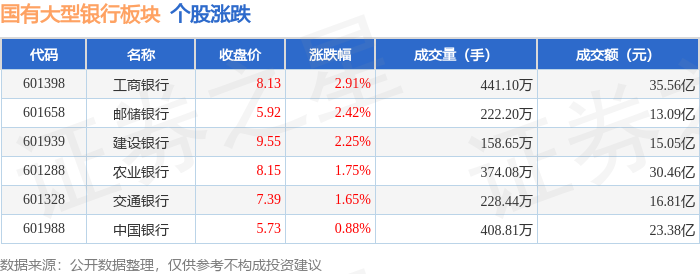
国有大型银行板块11月4日涨2.01%,工商银行领涨,主力资金净流入10.82亿元
Zheng Xing Xing Ye Ri Bao· 2025-11-04 08:48
Core Insights - The state-owned large bank sector experienced a 2.01% increase on November 4, with Industrial and Commercial Bank of China (ICBC) leading the gains [1] - The Shanghai Composite Index closed at 3960.19, down 0.41%, while the Shenzhen Component Index closed at 13175.22, down 1.71% [1] Bank Performance - ICBC's closing price was 8.13, up 2.91%, with a trading volume of 4.41 million shares and a transaction value of 35.56 billion [1] - Postal Savings Bank closed at 5.92, up 2.42%, with a trading volume of 2.22 million shares and a transaction value of 1.309 billion [1] - Construction Bank closed at 9.55, up 2.25%, with a trading volume of 1.5865 million shares and a transaction value of 15.05 billion [1] - Agricultural Bank closed at 8.15, up 1.75%, with a trading volume of 3.7408 million shares and a transaction value of 30.46 billion [1] - Bank of Communications closed at 7.39, up 1.65%, with a trading volume of 2.2844 million shares and a transaction value of 16.81 billion [1] - Bank of China closed at 5.73, up 0.88%, with a trading volume of 4.0881 million shares and a transaction value of 2.338 billion [1] Fund Flow Analysis - The state-owned large bank sector saw a net inflow of 1.082 billion in main funds, while retail funds experienced a net outflow of 565 million [1] - The main fund inflow for ICBC was 605 million, representing 17.00% of its total, while retail funds saw a net outflow of 274 million [2] - Agricultural Bank had a main fund inflow of 210 million, accounting for 6.88%, with retail funds experiencing a net outflow of 36.73 million [2] - Postal Savings Bank recorded a main fund inflow of 130 million, with retail funds seeing a net outflow of 74.73 million [2] - Construction Bank had a main fund inflow of 116 million, while retail funds experienced a net outflow of 122 million [2] - Bank of Communications saw a main fund inflow of 113 million, with retail funds experiencing a net outflow of 91.44 million [2] - Bank of China had a net outflow of 91.14 million in main funds, while retail funds saw a net inflow of 80.96 million [2]




大行积存金业务暂停又恢复,已有银行金条价格含税上调
第一财经· 2025-11-04 07:04
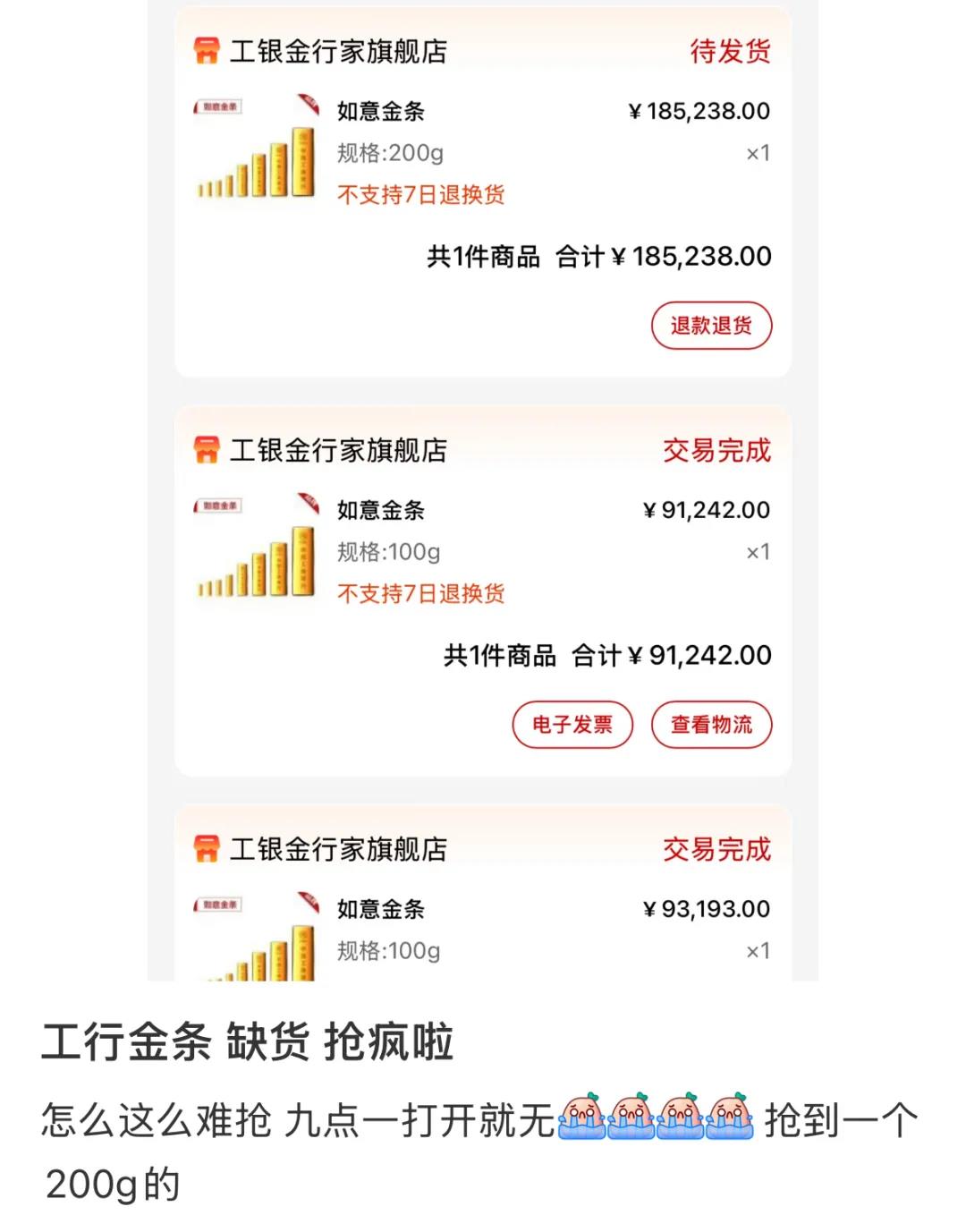
Core Viewpoint - The recent changes in gold tax policies have led to multiple banks, including Industrial and Commercial Bank of China (ICBC), China Construction Bank, and Agricultural Bank of China, temporarily suspending their gold accumulation and physical exchange services, with some banks adjusting their product offerings and pricing in response to the new regulations [3][5][12]. Group 1: Impact of New Tax Policies - The new gold tax policy has prompted banks to pause gold accumulation services and adjust their product offerings, with ICBC and China Construction Bank announcing suspensions on November 3, 2025 [5][6]. - ICBC quickly resumed its gold accumulation services on the evening of the same day, indicating a rapid response to the regulatory changes [7][8]. - The adjustments made by banks are primarily due to system upgrades and the need to comply with the new tax regulations, rather than a significant impact on their gold business [12][14]. Group 2: Changes in Product Offerings - Banks like China Merchants Bank have shifted some of their self-operated gold products to a consignment model, reducing the range of physical gold products available for exchange [8][15]. - The new tax policy has led to an increase in the prices of physical gold products, with banks adjusting their pricing structures accordingly [12][15]. - The changes in tax regulations mean that banks will now face different invoicing rules, which could affect their cost structures and pricing strategies for gold products [13][14]. Group 3: Market Reactions and Future Outlook - The market for gold products has seen a tightening of inventory, with certain gold bars becoming unavailable for purchase [9][12]. - Industry experts suggest that while the immediate impact on banks' gold businesses may be limited, the overall product and operational structures will undergo adjustments in response to the new tax policies [14].

工行建行暂停部分如意金积存业务申请
Shen Zhen Shang Bao· 2025-11-04 06:22
Core Viewpoint - The recent announcements by Industrial and Commercial Bank of China (ICBC) and China Construction Bank (CCB) to suspend certain gold accumulation services are responses to macroeconomic policy directions and market volatility, aiming to regulate market order and manage risk exposure [1][2]. Group 1: Bank Actions - ICBC has suspended the acceptance of new accounts, proactive accumulation, new fixed accumulation plans, and applications for physical gold extraction from November 3, while existing customers' fixed accumulation plans remain unaffected [1]. - CCB has also suspended real-time purchases, new investment purchases, and physical gold exchanges for its easy storage gold business, effective from November 3, while existing investment plans and account operations remain intact [1]. Group 2: Market Regulation - The banks' actions are seen as routine measures to align with macroeconomic policies aimed at curbing irrational trading and preventing systemic risks associated with price volatility in the precious metals market [2]. - The recent announcement by the Ministry of Finance and the State Taxation Administration regarding gold tax policies, effective from November 1, 2025, is expected to further influence the market dynamics [2]. Group 3: Consumer Impact - The decision to reduce new fund inflows is intended to guide investors towards more rational participation in precious metal trading, thereby avoiding excessive speculation that could heighten market volatility [3]. - Existing customers' rights regarding active accumulation plans, redemptions, and account closures remain unchanged, indicating that the new policies do not adversely affect current users [3].
大行积存金业务暂停又恢复,已有银行金条价格含税上调
Di Yi Cai Jing· 2025-11-04 06:08
Core Viewpoint - The recent changes in gold tax policies have led multiple major banks, including Industrial and Commercial Bank of China (ICBC), China Construction Bank, and Agricultural Bank of China, to suspend gold accumulation and physical exchange services, with some banks making significant adjustments to their offerings [1][2][3]. Group 1: Bank Responses - ICBC announced the suspension of its gold accumulation services effective November 3, 2025, due to macroeconomic policy impacts, but existing customers' plans remain unaffected [2]. - China Construction Bank also suspended its gold accumulation services, including real-time purchases and physical gold exchanges, while allowing existing plans to continue [2][3]. - Agricultural Bank of China halted its gold accumulation services and physical gold exchanges, citing the new tax policy as the reason for the suspension [3]. Group 2: Adjustments in Gold Products - China Merchants Bank has shifted some of its self-operated gold products to a consignment model and temporarily removed certain products from sale, with the current prices reflecting the new tax-inclusive rates [1][4]. - The availability of physical gold products has decreased, with some banks reporting limited inventory, particularly for investment gold bars [4][5]. Group 3: Tax Policy Implications - The new tax policy, effective from November 1, 2023, clarifies the VAT rules for gold transactions, impacting how banks and their partners handle gold sales and pricing [5][6]. - The policy change means that banks may face increased costs when selling gold bars due to the shift from VAT exemptions to standard VAT rates for certain transactions [6][7]. - The overall impact on banks' gold business is expected to be limited, but adjustments in product offerings and pricing strategies are anticipated as banks adapt to the new regulations [5][7][8].
建设银行涨2.03%,成交额10.73亿元,主力资金净流入4338.62万元
Xin Lang Zheng Quan· 2025-11-04 05:35
资金流向方面,主力资金净流入4338.62万元,特大单买入1.76亿元,占比16.44%,卖出1.28亿元,占比 11.94%;大单买入2.50亿元,占比23.34%,卖出2.55亿元,占比23.79%。 建设银行今年以来股价涨13.63%,近5个交易日涨1.49%,近20日涨10.81%,近60日跌0.21%。 11月4日,建设银行盘中上涨2.03%,截至13:28,报9.53元/股,成交10.73亿元,换手率1.18%,总市值 24930.52亿元。 截至9月30日,建设银行股东户数34.32万,较上期增加15.34%;人均流通股31217股,较上期减少 15.05%。2025年1月-9月,建设银行实现营业收入0.00元;归母净利润2573.60亿元,同比增长0.62%。 分红方面,建设银行A股上市后累计派现12750.04亿元。近三年,累计派现2980.13亿元。 机构持仓方面,截止2025年9月30日,建设银行十大流通股东中,中国证券金融股份有限公司位居第三 大流通股东,持股21.89亿股,持股数量较上期不变。香港中央结算有限公司位居第七大流通股东,持 股5.77亿股,相比上期减少2.02亿股。 责任 ...
上市公司三季报的几点债市信号:A股上市公司三季报分析
Hua Yuan Zheng Quan· 2025-11-04 05:17
Report Industry Investment Rating - The report is bullish on the bond market, predicting that the yield of the 10Y Treasury bond will return to around 1.65% this year, the 30Y Treasury bond to 1.9%, and the 5Y Tier 2 capital bonds of large banks to 1.9% (for bonds without VAT) [74]. Core Viewpoints - The revenue growth rate of the entire A-share market and the net profit growth rate of the parent company are at a low level, indicating that the economic growth rate may have stabilized at a low level but still faces downward pressure. The yield of the 10-year Treasury bond is more closely related to the revenue growth rate of the entire A-share market than the nominal GDP growth rate [1][4]. - The loan growth rate has been declining, and the proportion of loans in the bank's asset side is decreasing. The demand for personal and corporate loans may be weak in the long term, while the scale of government bonds may significantly expand. The asset structure of the banking system may face long-term changes, with the proportion of loans likely to decline significantly [21][24]. - Since the beginning of 2023, the proportion of financial investments of large banks has rebounded, and the growth rate of bond investments has increased. The cost rate of interest-bearing liabilities of listed banks has been decreasing quarter by quarter, and it is expected to further decline in the future [1][49]. - The decline in bank liability costs will support the downward oscillation of bond yields. Given the current economic situation, the rapid decline in bank liability costs, and the loose capital situation, the report is bullish on the bond market [70][74]. Summary by Directory 1. Analyzing Economic and Bank Operating Pressures from the Q3 Reports of the Entire A-share Market - **Economic Insights from the Entire A-share Performance**: The revenue growth rate of the entire A-share market can reflect the nominal GDP growth rate to some extent. The revenue growth rate of the entire A-share market and the 10-year Treasury bond yield have a similar trend. The performance growth rate of the entire A-share market is still under pressure, and the growth rate of the real economy also faces significant pressure [5][6][9]. - **Economic Insights from the Bank Sector Performance**: The performance of the banking sector is closely related to the economy. In recent years, the performance growth of the banking sector has been under significant pressure, and the net interest margin of commercial banks has been continuously declining [11][12][15]. - **Financing Demand from the Entire A-share Liabilities**: Since Q1 2024, the long-term borrowing growth of the entire A-share market (excluding finance, petroleum, and petrochemicals) has almost stagnated, reflecting the weak financing demand of market-oriented enterprises. The social financing growth rate generally leads the nominal GDP growth rate by 1 - 2 quarters, but its guiding role may decline in the future [18][20]. 2. Changes in Bank Asset and Liability Situations - **Declining Loan Growth Rates of Large and Small Banks**: The loan growth rate has significantly declined. The growth of personal housing loans is facing negative growth pressure, which significantly drags down the growth rate of personal loans. The loan growth rates of both large and small banks have declined, and the proportion of loans is also decreasing. In the long term, the asset structure of the banking system may change, with the proportion of loans likely to decline and the proportion of bond investments likely to increase [21][25][36]. - **Decreasing Deposit Proportion on the Liability Side of Large Banks and Stable Deposit Proportion of Small Banks**: The growth of corporate deposits of large banks has slowed down. In recent years, the proportion of deposits on the liability side of large banks has decreased, while the average deposit proportion of listed joint-stock banks has increased [37][48]. 3. Banks with Significant Financial Investment Growth in Q3 2025 - Since the beginning of 2023, the proportion of financial investments of large banks has rebounded. In Q3 2025, the financial investments of some banks, such as ICBC and CCB, increased significantly, while those of a few banks decreased. The financial investment increments of large banks, joint-stock banks, and city and rural commercial banks were all significant, and the bond investment growth rates of the Big Four banks and small and medium-sized banks were also relatively high [49][56][59]. 4. Decrease in Bank Interest-Bearing Liability Costs - In 2025, the decline of the current deposit proportion slowed down. Since the beginning of 2024, the deposit interest payment rate has significantly decreased, and the interest-bearing liability cost rate has been decreasing quarter by quarter. It is expected to further decline in the future [60][63][66]. 5. Investment Recommendations - The decline in bank liability costs will support the downward oscillation of bond yields. In the future, the liability costs of commercial banks are expected to decline year by year, which will drive the yield of the 10-year Treasury bond to decline. Given the current economic situation and the value of government bond allocation, it is recommended that commercial bank self-operated departments increase the allocation of government bonds. The report is bullish on the bond market [70][73][74].

大行评级丨中银国际:上调建设银行H股目标价至10.44港元 维持“买入”评级
Ge Long Hui A P P· 2025-11-04 03:48
Core Viewpoint - China Construction Bank (CCB) reported a year-on-year net profit growth of 4.2% in the third quarter, reversing the negative growth of 1.4% in the first half of the year [1] - The bank is expected to report positive earnings growth in the fourth quarter due to a slowdown in the decline of net interest margin and stable asset quality [1] Financial Performance - CCB's net profit for the third quarter increased by 4.2% year-on-year, contrasting with a 1.4% decline in the first half of the year [1] - The bank anticipates maintaining solid asset quality in the fourth quarter, contributing to positive earnings growth [1] Valuation and Investment Outlook - CCB is considered undervalued based on its robust scale expansion, stable asset quality, and decent return on equity [1] - The average return on equity is projected to reach 9.9% by 2025 [1] - The target price for CCB's H-shares has been raised from HKD 8.95 to HKD 10.44, maintaining a "Buy" rating based on approximately 0.7 times the expected price-to-book ratio for 2025 [1]
暂停实物金提取不到1天 工行刚刚恢复!周大福:应有关税收政策 今起部分产品涨价
Mei Ri Jing Ji Xin Wen· 2025-11-04 03:19
Core Viewpoint - The recent suspension of gold-related services by major banks, including Industrial and Commercial Bank of China (ICBC) and China Construction Bank (CCB), is a response to new tax policies affecting the gold market, leading to significant fluctuations in gold prices and impacting retail businesses [1][3][4]. Group 1: Bank Operations - ICBC and CCB announced the suspension of certain gold investment services on November 3, 2025, due to market volatility and risk management requirements [3][8]. - ICBC quickly resumed its "Ruyi Gold" accumulation services within a day after the initial suspension, indicating a rapid response to customer demand [4][10]. - CCB's announcement regarding the suspension of its "Easy Storage Gold" services was not found on its official website at the time of reporting, suggesting a lack of communication or updates [3][10]. Group 2: Market Reactions - Following the announcement of the new tax policies, shares of several gold and jewelry retailers, including Chao Hong Ji and Chow Tai Fook, experienced significant declines, with losses of nearly 10% for some companies [3][4]. - The price of gold in the Shenzhen Shui Bei market surged dramatically, with prices rising from approximately 930 yuan per gram to over 996 yuan per gram within hours on November 3, 2025 [18][19]. Group 3: Tax Policy Impact - The new tax policy, effective from November 1, 2025, exempts value-added tax (VAT) on standard gold transactions through designated exchanges until December 31, 2027, but imposes VAT on physical gold transactions outside these exchanges [4][12]. - The policy is expected to increase procurement costs for retailers by approximately 7%, leading to price adjustments for gold products [14][19]. - Retailers like Chow Tai Fook have already begun adjusting their prices in response to the new tax regulations, with significant price increases reported [15][19].