
CCB(601939)

Search documents
中国建设银行股份有限公司原党委委员、副行长章更生受贿、违法发放贷款案一审宣判
Xin Lang Cai Jing· 2026-01-21 09:03
2026年1月21日,山东省淄博市中级人民法院一审公开宣判中国建设银行股份有限公司原党委委员、副 行长章更生受贿、违法发放贷款案,对被告人章更生以受贿罪判处有期徒刑十三年,并处罚金人民币四 百万元,以违法发放贷款罪判处有期徒刑十年,并处罚金人民币十万元,决定执行有期徒刑十八年,并 处罚金人民币四百一十万元;追缴在案的章更生受贿所得财物及孳息依法上缴国库,不足部分继续追 缴。 现场图。(山东省淄博 市中级人民法院供图) 经审理查明:2006年至2019年9月,被告人章更生利用担任中国建设银行股份有限公司集团客户部(营 业部)总经理,中国建设银行股份有限公司党委委员、副行长等职务上的便利,为有关单位和个人在贷 款授信、贷款审批、职务调整等方面谋取利益,非法收受上述单位和个人给予的财物共计折合人民币 4064万余元。2016年下半年至2017年4月,时任中国建设银行股份有限公司党委委员、副行长章更生在 明知有关单位不符合贷款发放条件的情况下,违反国家规定,安排向相关单位发放巨额贷款,造成特别 重大损失。 淄博市中级人民法院认为,被告人章更生的行为构成受贿罪、违法发放贷款罪。章更生受贿数额特别巨 大,违法发放贷款数额 ...



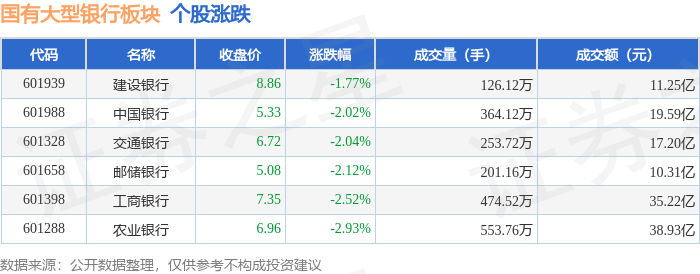
国有大型银行板块1月21日跌2.53%,农业银行领跌,主力资金净流出12.7亿元
Zheng Xing Xing Ye Ri Bao· 2026-01-21 08:54
证券之星消息,1月21日国有大型银行板块较上一交易日下跌2.53%,农业银行领跌。当日上证指数报收 于4116.94,上涨0.08%。深证成指报收于14255.12,上涨0.7%。国有大型银行板块个股涨跌见下表: | 代码 | 名称 | 收盘价 | 涨跌幅 | 成交量(手) | 成交额(元) | | --- | --- | --- | --- | --- | --- | | 666109 | 建设银行 | 8.86 | -1.77% | 126.12万 | 11.25 Z | | 601988 | 中国银行 | 5.33 | -2.02% | 364.12万 | 19.59亿 | | 601328 | 交通银行 | 6.72 | -2.04% | 253.72万 | 17.20亿 | | 601658 | 邮储银行 | 5.08 | -2.12% | 201.16万 | 10.31亿 | | 601398 | 工商银行 | 7.35 | -2.52% | 474.52万 | 35.22 亿 | | 601288 | 农业银行 | 6.96 | -2.93% | 553.76万 | 38.93亿 | | 代码 ...



并购贷款新规实施20天 四大行率先落地首批项目
2 1 Shi Ji Jing Ji Bao Dao· 2026-01-21 08:23
Core Viewpoint - The implementation of the new merger and acquisition loan management regulations by the National Financial Supervision Administration has enabled major state-owned banks to quickly respond and support the real economy through targeted financing solutions, enhancing the effectiveness of financial services in the context of China's economic transformation [1][6]. Group 1: Regulatory Changes - The new regulations, effective from January 1, 2026, introduce several key features, including the inclusion of equity-based merger loans and an increase in the upper limit of controlling merger loans from 60% to 70% of the transaction price [1][6]. - The loan term for controlling merger loans has been extended from seven years to ten years, providing a compliant and efficient financing path for non-controlling strategic investments [1][6]. Group 2: Bank Responses - Major state-owned banks, including ICBC, ABC, BOC, and CCB, have quickly launched equity-based merger loans in various provinces, demonstrating their ability to adapt to regulatory changes and support local economic needs [2][5]. - ICBC's Anhui branch has focused on green industry investments, while ABC and BOC have successfully issued loans to support local enterprises in strategic sectors such as environmental protection and semiconductors [2][5]. Group 3: Market Impact - The new regulations are expected to stimulate the merger and acquisition market by facilitating industry consolidation and transformation, particularly as traditional industries undergo optimization and new industries continue to grow [6][7]. - The financial support for equity investments is seen as a crucial innovation to enhance capital flow, promote resource optimization, and improve the overall efficiency of financial services to the real economy [6][7].

马年贺岁纪念币钞开启兑换
Bei Jing Wan Bao· 2026-01-21 07:11
Core Viewpoint - The 2026 Year of the Horse commemorative coins and banknotes began centralized exchange from yesterday until the 26th, with the China Industrial and Commercial Bank and China Construction Bank in Beijing responsible for the exchange process [1] Group 1: Exchange Process - The exchange of the commemorative coins and banknotes is being conducted by the China Industrial and Commercial Bank and China Construction Bank in Beijing [1] - Customers have shown significant interest, with many arriving early to queue for the exchange [1] Group 2: Customer Sentiment - Customers expressed a desire to collect the commemorative coins and banknotes, highlighting their aesthetic appeal and craftsmanship [1] - One customer, Mr. Wang, shared his excitement after successfully exchanging for the commemorative items, indicating a positive sentiment towards the collection [1]
建设银行盐城分行以金融赋绿潮,向海逐新章
Sou Hu Cai Jing· 2026-01-21 06:25
在黄海之滨的盐阜大地,一幅经济提质、生态向好、创新涌动的高质量发展画卷正徐徐展开。建设银行盐城分行始终坚守金融工作的政治性与人民性,深 度融入地方发展大局,将金融"活水"精准滴灌到绿色经济、海洋经济、科技创新等关键领域,用专业、高效、创新的金融服务,为盐城经济社会高质量发 展注入强劲动能,书写国有大行服务地方发展的责任与担当。 绘就生态与经济共生新图景 绿色是高质量发展的鲜明底色。建设银行盐城分行深刻践行"绿水青山就是金山银山"的新发展理念,将绿色金融作为战略重点,以体系化布局、产品化创 新、精准化投放,全力支持绿色低碳示范区建设,让绿色成为盐城发展最动人的色彩。 制度先行,筑牢绿色金融发展根基。该行先后制定《深化绿色金融服务行动方案》《支持绿色低碳示范区建设实施方案》等一系列专项文件,明确将节能 环保、清洁能源、生态环境、绿色服务、绿色产品等领域作为重点支持方向,同时紧扣盐城"5+2"战略性新兴产业、23条重点产业链发展规划,构建了目 标清晰、导向明确、举措有力的绿色金融发展框架。通过顶层设计与基层落实的同频共振,确保绿色金融政策精准落地,形成了"政策引导+市场运作"的 良性发展模式。 支持重大项目发展 创 ...

摩根大通银行、浙江稠州商业银行获批资格!FT账户密集扩容
2 1 Shi Ji Jing Ji Bao Dao· 2026-01-21 03:49
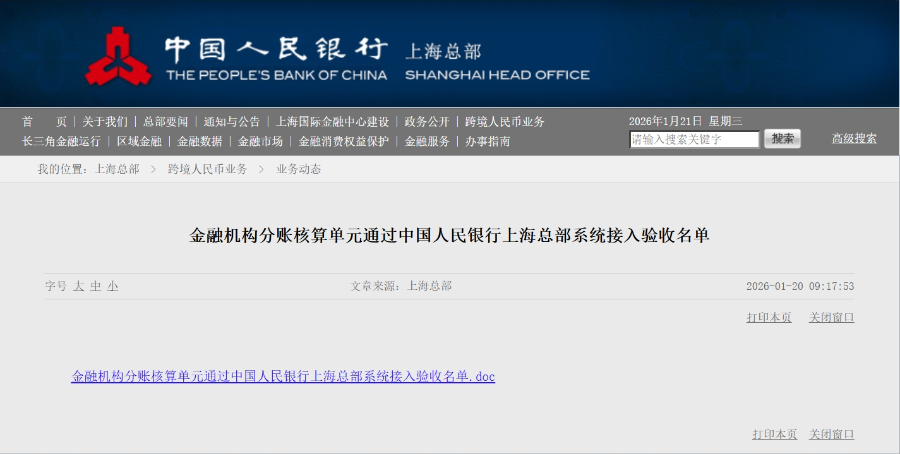
Group 1 - The Shanghai Free Trade Account (FT Account) has seen significant developments recently, with the approval of new financial institutions and upgrades to existing accounts, indicating a potential increase in foreign participation in China's cross-border financial activities [1][2] - Morgan Stanley Bank (China) Limited's Shanghai branch has been approved as the first new FT account financial institution in over five years, marking a notable opportunity for foreign banks in the region [1] - As of the latest update, there are 62 financial institutions with FT account qualifications in Shanghai, with 49 being banks, reflecting a growing trend in the FT system [1] Group 2 - The implementation of the "Implementation Measures for the Function Upgrade of Free Trade Accounts" by the People's Bank of China on December 5 has introduced significant policy upgrades, allowing for more flexible cross-border fund transfers [2][4] - The new regulations enable trial enterprises to conduct capital account business without the constraints of external debt quotas or prior registration with foreign exchange authorities, enhancing operational efficiency [2][4] - Major banks, including state-owned and foreign banks, have quickly responded to the new policy by facilitating the opening of upgraded FT accounts for clients, indicating strong market interest and potential for increased cross-border trade [3][4] Group 3 - The recent policy changes are expected to create a multiplier effect for cross-border trade and investment, improving the efficiency of capital allocation for enterprises [4] - The expansion of the FT account system is anticipated to continue, with more financial institutions likely to be added to the list of qualified entities in the future [5]






工行、农行等多家银行,“首单”火速落地!
Jin Rong Shi Bao· 2026-01-21 03:18
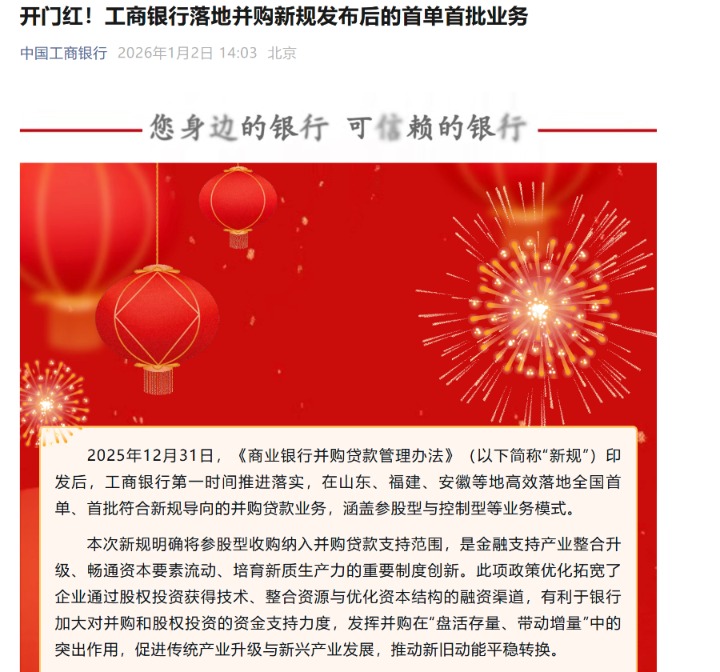
在新规正式发布后的第二天,建行安徽省分行采用"直接投资+基金投资"相结合的模式,成功为池州市 某国有投资平台投放1亿元并购贷款,专项支持其参股苏州某半导体领域企业。 《商业银行并购贷款管理办法》(以下简称"新规")落地近一个月,多家银行纷纷落地"首单""首批"并 购贷款业务。 《金融时报》记者注意到,紧跟新规导向,工商银行(601398)、农业银行(601288)、中国银行 (601988)、建设银行(601939)等国有大行率先完成了新规发布后的首笔并购贷款。 "在新规印发后,工商银行第一时间推进落实,在山东、福建、安徽等地高效落地全国首单、首批符合 新规导向的并购贷款业务,涵盖参股型与控制型等业务模式。"工商银行表示。 1月5日,工商银行福建省分行为某企业发放并购贷款2.99亿元,专项用于支持该企业收购某产业园核心 资产。据悉,这是新规正式实施后,全国银行业落地的首笔 控制型 并购贷款。 作为服务"三农"的主力军,1月9日,中国农业银行南京分行针对江苏省内某大型粮食集团完善产业链、 提升运营效能的诉求,为企业量身定制并购贷款方案,助力企业提升粮食全链条运营及应急保供能力。 值得一提的是,各家银行在参股型并 ...
中小微企业贷款贴息、民间投资专项担保……财政部连发五项重要政策
Sou Hu Cai Jing· 2026-01-21 03:12
Group 1 - The Ministry of Finance and other departments have released five policy documents aimed at optimizing financial support for personal consumption loans, equipment updates, private investment guarantees, service industry loans, and small and micro enterprise loans [1][9][29] - The personal consumption loan subsidy policy has been extended until December 31, 2026, with adjustments to the subsidy standards and an expanded range of supported financial institutions [4][5][6] - The equipment update loan subsidy policy includes a 1.5% subsidy on fixed asset loans for equipment updates, applicable for up to two years, and has been expanded to include various sectors such as construction, aviation, and digital technology [10][11][12] Group 2 - The private investment guarantee plan has a total quota of 500 billion yuan, to be implemented over two years, focusing on supporting small and micro enterprises in various sectors including technology upgrades and service industry enhancements [17][18] - The plan includes a risk-sharing mechanism where banks will bear at least 20% of the loan risk, while the government guarantee fund will cover up to 80% [19] - The government will also reduce guarantee fees and increase the compensation limit for the guarantee fund to enhance support for private investments [20] Group 3 - The service industry loan subsidy policy has been extended to December 31, 2026, with an increased subsidy cap of 10 million yuan per loan and a 1% annual subsidy rate [23][24] - The policy now includes additional sectors such as digital, green, and retail industries, expanding the scope of financial support [24][25] - The implementation of these policies will involve streamlined processes for fund allocation and enhanced collaboration among financial institutions and regulatory bodies [26][28]




A股银行年度盘点:2025告别普涨,2026拥抱分化
3 6 Ke· 2026-01-21 00:59
Core Insights - In 2025, A-share listed banks in China experienced a significant shift in development logic, moving from scale competition to value creation, focusing on core business and providing precise financial services to support high-quality economic development [1][2] Group 1: Market Performance - The A-share banking sector showed notable structural differentiation in 2025, with the Shanghai Composite Index and Shenzhen Component Index rising by 18.41% and 29.87% respectively, while the banking sector index increased by 12.04% [1] - By the end of 2025, the total market capitalization of A-share banks reached 14.65 trillion yuan, with 35 out of 42 listed banks seeing their stock prices rise, and 19 banks experiencing gains exceeding 10% [1] - In contrast to the broad market rally in 2024, where the banking sector index rose by 43.56%, 2025 marked a transition to a more selective investment environment [1] Group 2: Performance of Major Banks - Agricultural Bank of China led the sector with a stock price increase of 52.66% in 2025, while other major banks like Industrial Bank, China Construction Bank, and Bank of China saw increases of 21.54%, 12.87%, and 10.75% respectively [4] - The total market capitalization of the four major state-owned banks remains dominant, with Industrial Bank at 2.63 trillion yuan and Agricultural Bank at 2.61 trillion yuan [4] - The performance of other major banks was hindered by large capital increases, as several banks announced plans to raise a total of 520 billion yuan through stock issuance [4][5] Group 3: Performance of Joint-Stock Banks - Joint-stock banks exhibited further performance differentiation in 2025, with Shanghai Pudong Development Bank leading with a 24.56% increase, while banks like Huaxia Bank, Everbright Bank, and Minsheng Bank saw declines of 9.82%, 5.59%, and 3.09% respectively [6][7] - The decline in stock prices for these banks can be attributed to poor operating performance, with Huaxia Bank and Everbright Bank reporting revenue and profit declines [8] - Regulatory penalties also impacted these banks, with Huaxia Bank facing over 120 million yuan in fines, indicating ongoing compliance pressures [10][12] Group 4: Regional and Cooperative Banks - City and rural commercial banks showed mixed performance, with Xiamen Bank rising by 35.78%, while others like Zhengzhou Bank and Beijing Bank experienced declines [11] - Regulatory penalties for city commercial banks were significant, with Shanghai Bank and Beijing Bank facing fines exceeding 3.8 million yuan and 3.6 million yuan respectively [12] Group 5: Investment Outlook for 2026 - The investment logic for bank stocks is expected to evolve towards value reassessment, with a focus on performance growth and compliance levels becoming critical for individual stock performance [19] - The banking sector is anticipated to transition from a "growth weak cycle" to a "reform deep water zone," suggesting a dual strategy of holding stable, high-dividend large banks while selectively investing in high-potential regional banks [18][19] - The average price-to-book ratio for the banking sector was approximately 0.73, indicating a structural recovery, with Agricultural Bank exceeding 1.0, while others remained below this threshold [13]


黄金投资带火银行“小众”业务
Zheng Quan Ri Bao· 2026-01-20 23:20
Core Insights - The demand for bank safe deposit boxes is surging due to the increasing interest in gold investments among residents, leading to a significant supply-demand imbalance in the market [1][4][5] - Many banks are experiencing a shortage of available safe deposit boxes, with waiting times for larger boxes extending up to 3 to 5 years [2][3][5] - The safe deposit box rental business, traditionally a niche service, is gaining mainstream attention as more customers seek to store physical gold and other valuables [3][4] Demand Factors - The rising trend of gold investment among residents has led to a marked increase in the demand for safe deposit boxes to store physical gold and precious metals [4][5] - Customers prefer physical gold over other investment products due to its perceived stability and security [4] Supply Factors - The supply of safe deposit boxes is constrained by the fixed capacity of bank facilities, making it difficult to expand the number of available boxes [5][6] - The rental process is slow, with many customers opting for long-term leases, which further limits the turnover of available boxes [5][6] Business Dynamics - The safe deposit box rental service is characterized by high initial investment and ongoing operational costs, which may deter banks from expanding this service [6][7] - Some banks have ceased offering safe deposit box services due to business adjustments and the high costs associated with maintaining security standards [6][7] Technological Advancements - The integration of digital and intelligent technologies is revitalizing the traditional safe deposit box business, enhancing security and customer experience [7][8] - Innovations such as biometric verification and automated safe deposit boxes are being introduced, allowing for more efficient and secure access [7][8]