BANK OF CHINA(601988)

Search documents
南京盛航海运股份有限公司关于为控股子公司提供担保的进展公告
Shang Hai Zheng Quan Bao· 2025-11-20 19:12
Overview of Guarantee Situation - The company approved a guarantee limit of up to RMB 30 million for its subsidiary, Shenghang Haoyuan, for the year 2025, covering various credit activities [2] - The guarantee can be in the form of credit guarantees, mortgage guarantees, pledge guarantees, or a combination of these [2] Progress of Guarantee - Recently, the company provided a joint liability guarantee for a RMB 20 million working capital loan to Shenghang Haoyuan from China Bank Shenzhen Nantou Branch [2] - The principal amount of the guarantee is RMB 15.66632 million, and the remaining guarantee balance for Shenghang Haoyuan is RMB 65.44322 million, with an unused guarantee limit of RMB 245.16788 million [2] Main Content of Guarantee Agreement - The principal amount of the guarantee is RMB 15.66632 million [3] - The performance period for the principal debt is from November 20, 2025, to November 20, 2026 [4] - The guarantee covers all costs associated with the principal debt, including interest, penalties, and legal fees [4] Guarantee Responsibility - The company assumes joint liability for the guarantee [5] - The guarantee period for each debt is three years from the maturity date of that debt [5] Total Guarantee Amount - As of the announcement date, the total guarantee amount provided by the company and its subsidiaries is RMB 410.6111 million, with an actual guarantee balance of RMB 70.29822 million, representing 3.40% of the company's latest audited net assets [7] - There are no overdue guarantees or legal issues related to the guarantees provided [7]


A股延续“二八分化” 银行、地产板块携手冲高
Shang Hai Zheng Quan Bao· 2025-11-20 18:25
Group 1: Market Overview - The A-share market continues to show a "two-eight differentiation" trend, with banking and real estate sectors leading, while technology stocks, particularly those related to AI, have shown weakness [1] - As of the market close, the Shanghai Composite Index fell by 0.40% to 3931.05 points, the Shenzhen Component Index decreased by 0.76% to 12980.82 points, and the ChiNext Index dropped by 1.12% to 3042.34 points [1] - The total trading volume in the Shanghai and Shenzhen markets was 170.81 billion yuan, a decrease of 17.7 billion yuan from the previous day, with over 3800 stocks declining [1] Group 2: Banking Sector Performance - Bank stocks have been a key factor in stabilizing the market, with China Bank and Industrial and Commercial Bank of China reaching historical highs, with market capitalizations of over 2 trillion yuan and 2.9475 trillion yuan respectively [1] - The report from Kaiyuan Securities emphasizes the importance of focusing on banks' growth potential and long-term value, suggesting a base allocation in large state-owned banks and flexible allocation in quality regional banks [2] Group 3: Real Estate Sector Insights - The real estate sector showed positive movement, with the Shenwan Real Estate Index rising by 0.33% and the construction materials index increasing by 1.40% [2] - Data from the Ministry of Housing and Urban-Rural Development indicates that from January to October, the transaction area of second-hand homes increased by 4.7% year-on-year, with second-hand homes accounting for 44.8% of total transactions [2] Group 4: Technology Sector Analysis - Recent fluctuations in the technology sector have raised concerns about valuation bubbles and the sustainability of AI investments, with a focus on valuation corrections rather than fundamental changes [4] - Despite the volatility, leading tech companies' revenue growth has met expectations, and the return on AI investments continues to accelerate, indicating ongoing potential in the underlying technology [4]

招商均衡配置混合型证券投资基金基金份额发售公告
Shang Hai Zheng Quan Bao· 2025-11-20 18:21
登录新浪财经APP 搜索【信披】查看更多考评等级 基金管理人:招商基金管理有限公司 基金托管人:中国银行股份有限公司 登记机构:招商基金管理有限公司 重要提示 1、招商均衡配置混合型证券投资基金(以下简称"本基金")的发售已获中国证监会证监许可〔2025〕 2071号文准予注册。 2、本基金类型为契约型开放式、混合型证券投资基金。 3、本基金的管理人为招商基金管理有限公司(以下简称"招商基金"或"本公司"),托管人为中国银行 股份有限公司,登记机构为招商基金管理有限公司。 4、本基金自2025年12月1日至2025年12月19日(具体办理业务时间见各销售机构的相关业务公告或拨打 客户服务电话咨询)通过销售机构公开发售。基金管理人根据认购的情况可适当调整募集时间,并及时 公告,但最长不超过法定募集期限。 5、募集规模上限 本基金首次募集规模上限为80亿元人民币(不含募集期利息,下同)。 基金募集过程中,募集规模接近、达到或超过80亿元时,基金可提前结束募集。 在募集期内任何一日(含首日),若当日募集截止时间后基金份额累计有效认购申请金额(不包括利 息,下同)合计超过80亿元,基金管理人将采取末日比例确认的方式实 ...
如果光刻胶断供,A股谁能国产替代?| 1120 张博划重点
Hu Xiu· 2025-11-20 15:09
Core Viewpoint - The A-share market experienced fluctuations with a significant rise in bank stocks, particularly China Bank, which reached a historical high, indicating strong investor interest in the banking sector [1][3]. Market Performance - On November 20, the three major indices opened significantly higher but later fell into a volatile downward trend, with the ChiNext Index initially rising nearly 2% before dropping over 1% [1]. - The total trading volume in the Shanghai and Shenzhen markets was 1.71 trillion yuan, a decrease of 17.7 billion yuan compared to the previous trading day [1]. Banking Sector Highlights - Bank stocks collectively performed well, with China Bank showing remarkable strength, rising over 5% during the day and maintaining a 4% increase at the time of reporting, surpassing a market capitalization of 2 trillion yuan [3]. - Since October 9, China Bank has seen a cumulative increase of 20% in its stock price [4].

中国银行推出“惠军贷”专属服务 支持退役军人创业创新
Xin Lang Cai Jing· 2025-11-20 15:08
Core Viewpoint - The Ministry of Veterans Affairs is enhancing financial services for veterans by collaborating with financial institutions to launch entrepreneurial loan products, aimed at supporting veterans in entrepreneurship and innovation [1] Group 1: Financial Services Collaboration - The Ministry of Veterans Affairs has signed a financial service cooperation agreement with Bank of China [1] - Bank of China will introduce a dedicated service called "Hui Jun Loan" for veterans [1] - A green approval channel will be established to facilitate the loan process for veterans [1] Group 2: Support for Entrepreneurship - The financial services will provide support in terms of collateral guarantees, interest rates, and credit limits for veterans [1] - The services will target high-tech enterprises founded by veterans and companies that employ a significant number of veterans [1] - Comprehensive financial services will be offered throughout the entire lifecycle of the businesses [1]
A股市场银行股涨幅继续扩大 中国银行、工商银行均创历史新高
Xin Lang Cai Jing· 2025-11-20 14:07
Core Viewpoint - The A-share market has seen a significant increase in bank stocks, with both Bank of China and Industrial and Commercial Bank of China reaching historical highs on November 20, 2023 [1] Group 1: Stock Performance - Bank of China rose over 4%, while Postal Savings Bank and China Construction Bank increased by over 3% [1] - Other banks such as Minsheng Bank, Huaxia Bank, Everbright Bank, Nanjing Bank, and Bank of Communications saw gains exceeding 2%, and Shanghai Pudong Development Bank and Industrial and Commercial Bank rose over 1% [1] - Year-to-date, Bank of China has accumulated a 19% increase, and Industrial and Commercial Bank has risen by 26% [1] Group 2: Market Position - Industrial and Commercial Bank has surpassed Agricultural Bank of China in market capitalization, reclaiming the top position [1]
中国银行董事长葛海蛟与退役军人事务部部长裴金佳举行工作会谈
Xin Lang Cai Jing· 2025-11-20 13:11
11月20日,中国银行党委书记、董事长葛海蛟与退役军人事务部党组书记、部长裴金佳在京举行工作会 谈,共同见证双方签署金融服务合作、专属保险和公益资金捐赠协议。 ...
共话中国经济新机遇丨综述:中欧金融界期待财金合作再升级
Xin Hua Wang· 2025-11-20 12:12
Core Viewpoint - The event titled "Capital Connectivity - The New Silk Road of Financial Investment" highlighted the growing willingness and potential for cooperation between China and Europe in the financial sector amidst a volatile international environment [1][2]. Group 1: Event Overview - The high-level interactive event attracted nearly 200 representatives from government agencies, financial, and legal sectors from Germany, China, Italy, and Ireland [1]. - Key topics discussed included capital market connectivity, green investment cooperation, and alignment of asset management regulations [1]. Group 2: Statements from Key Figures - Thomas Richter, CEO of the German Federal Association for Investment and Asset Management, emphasized the importance of building trust and understanding between the financial markets of China and Europe [1]. - Huang Dingyang, Consul General of China in Frankfurt, noted that financial cooperation is one of the most professional and mutually beneficial areas of China-Europe collaboration [2]. - Chen Longjian, head of the Bank of China Frankfurt branch, expressed hopes for better understanding of market needs and the exploration of new cross-border investment opportunities [2]. Group 3: Strategic Opportunities - Nicholas Zipelius, a member of the German Bundestag, highlighted the importance of ongoing dialogue between Germany, Europe, and China, especially in global development and third-party market investment cooperation [2]. - The collaboration in sustainable agriculture in Ethiopia and Kenya was cited as a strategic opportunity for both Germany and Europe [3]. - The general consensus among attendees was that enhancing connectivity between China and Europe’s financial markets is essential for deepening bilateral economic cooperation and stabilizing global market expectations [3].
A股“银伟大”火出圈,中行、工行携手新高!英伟达业绩爆表,创业板人工智能逆市四连涨,新一轮行情启动?
Xin Lang Ji Jin· 2025-11-20 11:57
Market Overview - A-shares experienced a collective high opening followed by a decline, with the Shanghai Composite Index dropping 0.4% to 3931.05 points, and the ChiNext Index closing down 1.12% after an initial rise of 1.61% [1][2] - The total market turnover was 1.72 trillion yuan, marking a continuous decrease in trading volume over two days [1] Major Events - A significant merger in the brokerage industry was announced, with China International Capital Corporation (CICC) planning to absorb Dongxing Securities and Xinda Securities, creating a new brokerage giant with nearly 1 trillion yuan in total assets [2] - Nvidia reported better-than-expected earnings, with Q3 revenue reaching $51.2 billion, a 66% year-on-year increase, indicating strong global demand for computing power [12][13] Sector Performance - The banking sector showed strong performance, with major banks like Bank of China and Industrial and Commercial Bank of China reaching historical highs, supported by over 200 billion yuan in mid-term dividends [4][8] - The largest banking ETF (512800) saw a price increase of 1.9% during the day, marking a new high since October, with a trading volume of 1.49 billion yuan [5][6] ETF Highlights - The AI-focused ETF (159363) opened 3% higher and maintained high trading activity, ultimately closing with a 0.71% increase, marking its fourth consecutive rise [10][12] - The Hong Kong innovation drug ETF (520880) managed to rise against the market trend, ending the day with a gain after previously experiencing four consecutive declines [15][16] Future Outlook - Analysts expect a continuation of the current market consolidation pattern as institutions balance their portfolios ahead of year-end [4] - The banking sector is anticipated to remain attractive due to its low valuation and high dividend yield, with a significant amount of mid-term dividends expected to be distributed [8][9]

到处点火 又不拉板
Datayes· 2025-11-20 11:49
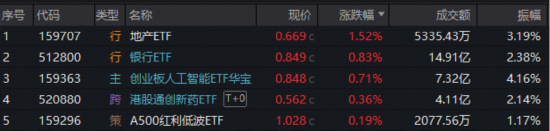
Core Viewpoint - The article discusses the current state of the A-share market, highlighting the mixed performance of various sectors and the impact of external factors such as Nvidia's earnings report. It emphasizes the ongoing volatility and the potential for investment opportunities, particularly in bank stocks and storage leaders, while also noting the challenges faced by the broader market. Market Performance - A-shares experienced a collective decline, with the Shanghai Composite Index down 0.40%, Shenzhen Component down 0.76%, and ChiNext down 1.12% on November 20. The total trading volume was 17,227.98 billion yuan, a decrease of 200.48 billion yuan from the previous day, with over 3,800 stocks declining [12]. - The banking sector showed resilience, with major banks like China Bank and Industrial and Commercial Bank of China reaching historical highs, each exceeding a market capitalization of 20 billion yuan [12]. Sector Analysis - The storage sector saw significant gains, with six major storage leaders experiencing a surge in total market capitalization approaching 7 trillion yuan, influenced by Nvidia's Q3 performance exceeding expectations [3]. - The real estate sector is expected to receive a boost from potential new stimulus policies, including mortgage subsidies for first-time homebuyers, which could enhance market sentiment [6]. Investment Trends - The article notes a shift in investment behavior, with high-net-worth individuals driving new A-share account openings, contrasting with lower participation from ordinary residents. The number of new A-share accounts rose from 1.65 million to 2.94 million between June and September, indicating a potential focus on wealthier investors [4]. - The concept of "deposit migration" is gaining traction, as investors move funds from low-yield savings accounts to higher-yield stock investments, which could enhance market liquidity and consumer confidence through the "wealth effect" [4]. Technical Indicators - The market is currently in a tug-of-war around the 4,000-point mark, with concerns about a potential peak in the bull market. Various indicators, including equity risk premium and trading volume, suggest a short-term correction may be imminent, although no definitive signals of a market top have emerged [10][11]. - The article highlights that while some technical indicators show signs of overbought conditions, the overall valuation metrics remain within reasonable ranges, suggesting that the bull market may continue with support from retail deposits and public funds [11].