
BANK OF CHINA(601988)

Search documents
金价暴跌,深圳水贝挤满了人,扎堆买金!多家银行提示风险
Sou Hu Cai Jing· 2026-02-02 03:23
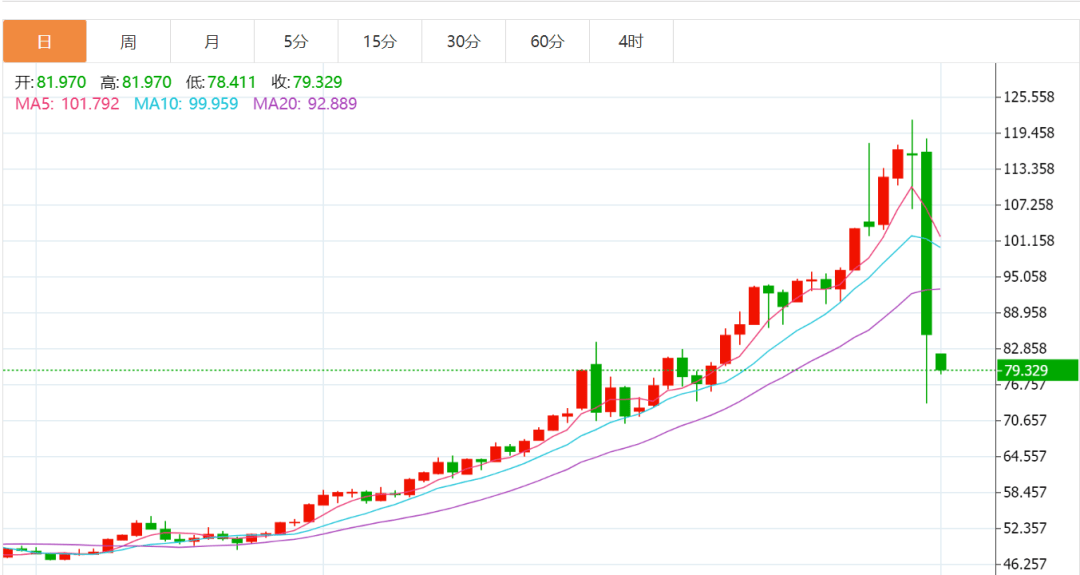
Group 1 - Spot silver prices dropped by 5% to $79.4 per ounce on Monday [1] - Spot gold fell by 1.4%, with significant fluctuations noted in the market [3] - On January 30, international gold prices experienced the largest single-day drop in 40 years [3] Group 2 - Following the drop in gold prices, there was a surge of consumers in Shenzhen's Shui Bei market buying gold, with prices for gold jewelry generally below 1200 yuan [4][5] - A notable increase in gold purchases was observed, particularly among couples preparing for weddings, with plans to spend around 50,000 yuan on gold jewelry [7] - A large gold bracelet weighing approximately 202 grams was priced at around 260,000 yuan, indicating high consumer interest in wedding-related gold items [10] Group 3 - Some merchants in Shui Bei reported a shortage of gold bars due to reduced supply from wholesalers, with gold bar prices dropping over 50 yuan to 1,141.5 yuan per gram [12][13] - Merchants indicated that they are cautious about selling gold due to the volatile market conditions, with some choosing not to sell at all [13][14] - Banks such as ICBC and ABC have adjusted their gold accumulation business and issued risk warnings due to the significant price fluctuations in precious metals [15][16]




金价银价创纪录暴跌,深圳水贝挤满“抄底客”!五大行紧急出手
Huan Qiu Wang· 2026-02-02 03:07
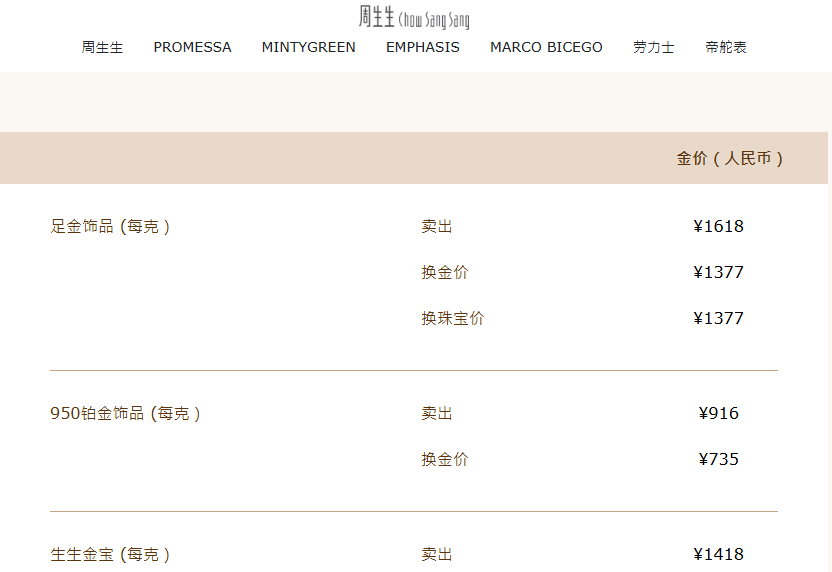
Market Overview - The precious metals market experienced extreme volatility, with international gold prices plummeting from historical highs, leading to significant impacts on domestic futures, stocks, funds, and consumer markets [1] - On January 30, international gold prices fell sharply, losing over 11% in a single day, while silver prices dropped by 31.37%, marking the worst single-day performance since March 1980 [1] - Weekly performance showed a cumulative decline of 4.71% for gold and 22.50% for silver [1] Price Movements - Domestic gold prices also saw a significant drop, with the Shanghai Gold Exchange spot gold price falling to 1070.01 RMB per gram, a decrease of around 10% [3] - Major brands adjusted their gold jewelry prices from over 1700 RMB per gram to between 1500-1600 RMB per gram [3][4] - For instance, Chow Sang Sang reported a drop in the price of its gold jewelry from 1708 RMB to 1618 RMB per gram within two days [3] Consumer Behavior - Following the price drop, there was a surge in consumer interest in purchasing gold, particularly in Shenzhen's Shui Bei market, where prices fell below 1200 RMB per gram [6] - Many consumers expressed that buying gold now is significantly cheaper compared to previous days [6] Investor Reactions - Investors are increasingly concerned about further declines in precious metal prices, leading many to sell gold and silver items to cash out [10] - Reports indicated that some businesses experienced a rapid decline in gold buyback prices, with a drop from 1142 RMB to 1081 RMB per gram in just one day [10] - The volatility in gold prices has led to a cautious approach among investors, with many hesitating to sell due to fears of missing potential price recoveries [10] Market Supply Dynamics - Some suppliers in Shenzhen's Shui Bei market reported shortages of gold bars, attributing this to the recent price drop and the reluctance of suppliers to sell at lower prices [12] - Suppliers indicated that they are not willing to sell gold bars during such volatile conditions, leading to a decrease in available inventory [12] Banking Sector Adjustments - Several major banks, including ICBC, ABC, and CCB, have adjusted their gold investment services in response to the market volatility, issuing risk warnings to investors [14][16] - ICBC announced changes to its gold accumulation business, including limits on transactions during non-trading days [15] - CCB raised the minimum amount for personal gold accumulation to 1500 RMB, reflecting the increased market risks [16][19]

涉黄金业务调整,六大行公告!
Jing Ji Wang· 2026-02-02 02:27
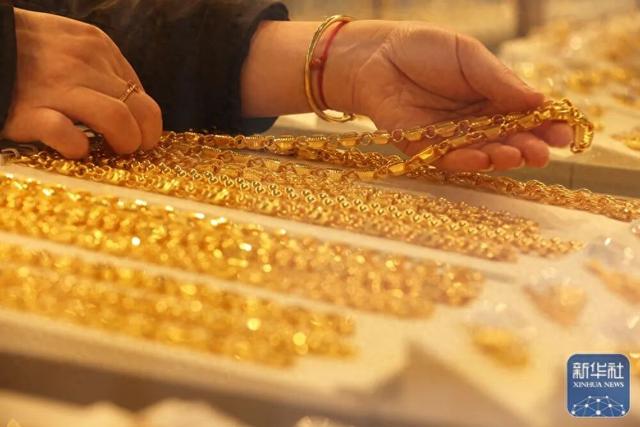
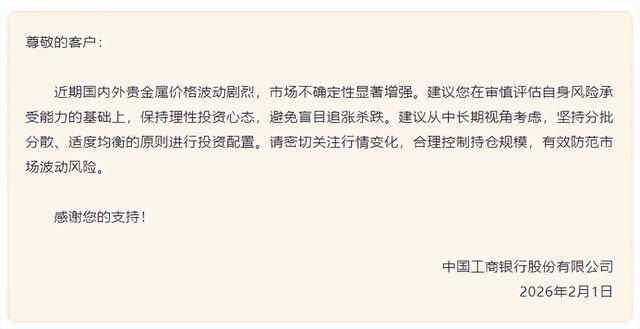
Core Viewpoint - Recent fluctuations in gold prices have prompted major banks to take urgent measures to control risks associated with gold-related businesses [1] Group 1: Bank Responses - Industrial and Commercial Bank of China (ICBC) issued a risk warning on February 1, advising clients to maintain a rational investment mindset and avoid impulsive trading due to significant price volatility [2] - Agricultural Bank of China (ABC) announced an increase in margin requirements for gold trading contracts from 44% to 60% starting January 30, emphasizing the need for clients to manage their positions carefully [3] - Bank of China (BOC) highlighted the uncertainties in the precious metals market and urged clients to conduct transactions based on their financial status and risk tolerance [4] - China Construction Bank (CCB) raised the minimum investment amount for gold accumulation business to 1500 yuan, advising clients to enhance their risk awareness amid increased market volatility [5] - Bank of Communications and Postal Savings Bank also issued trading alerts, with the latter increasing margin requirements for various gold contracts from 80% to 120% [6] Group 2: Market Outlook - The chief economist of Zhaolian emphasized the need for investors to have appropriate risk tolerance amid increased short-term volatility in gold prices, while the long-term upward trend in gold prices remains intact [7]
中国银行_存款流失_规模几何_流向何方_是否持续-China Banks_ Deposit outflow_ how much_ to where_ will it continue_
2026-02-02 02:22
Summary of Key Points from the Conference Call Industry Overview - **Industry**: Chinese Banking Sector - **Context**: The report discusses the implications of significant deposit maturities in 2026 and the potential outflow of deposits from banks to financial investments. Core Insights and Arguments 1. **Deposit Growth and Outflow Concerns**: Chinese households accumulated approximately Rmb8 trillion in excess savings from 2020 to 2025, leading to a retail deposit growth of Rmb17 trillion per year in 2022-2023. Concerns have risen regarding the potential unwinding of this deposit growth in 2026 due to a large volume of maturing deposits and reduced attractiveness of time deposit rates after several cuts since 2022 [2][3][4]. 2. **Maturity Cycle Peak**: 2026 is expected to be the peak year for maturing deposits, with an estimated Rmb55-60 trillion (about 18% of total deposits) set to mature. This concentration of longer-tenor deposits will create significant outflow pressure [3][9]. 3. **Limited Impact on Consumption**: Despite the accumulation of excess savings, consumer sentiment remains cautious, leading to limited spending. Most maturing deposits are expected to be rolled over into new time deposits rather than being used for consumption [4][12]. 4. **Reallocation to Financial Investments**: It is estimated that Rmb2-4 trillion of maturing deposits may migrate into various financial products, including WMPs (Rmb600 billion-1.3 trillion), mutual funds (Rmb300-600 billion), equities (Rmb400-800 billion), and insurance products (Rmb200-500 billion) [11]. 5. **Implications for Banks**: The maturity wave is projected to lower overall funding costs by approximately 14 basis points due to the repricing of high-rate deposits. This could enhance fee income generation for banks, although outflow risks remain a concern, particularly for banks with high loan-to-deposit ratios [5][13]. 6. **Stock Performance Outlook**: Despite the positive effects of deposit repricing, bank stocks may continue to underperform in a strong equity market due to moderate profit growth expectations and sector rotation pressures. High dividend yield banks and those with fast growth and high ROE are viewed favorably [5][14]. Additional Important Insights 1. **Household Saving Rates**: The household saving rate averaged 33% during 2020-2022 and 32% during 2023-2025, higher than the pre-COVID normal of around 30%. This indicates a significant accumulation of excess savings during the pandemic [7]. 2. **Regulatory and Market Factors**: Regulatory tightening and financial market turmoil have contributed to a shift in asset allocation from investments in WMPs and equities to bank deposits, as banks offered more attractive time deposit rates [8]. 3. **Future Consumption Growth**: The report anticipates modest household consumption growth in 2026, with limited release of excess savings for consumption purposes due to ongoing cautious sentiment [12]. 4. **Deposit Rate Cuts**: Following seven rounds of rate cuts since April 2022, demand deposit rates have fallen significantly, which may lead to increased outflow pressure in 2026 as higher-rate deposits reprice to current lower levels [10]. 5. **Long-term Outlook**: The report suggests that while the banking sector may face challenges, the overall impact of deposit maturities will be manageable, and banks with strong fundamentals may still perform well in the medium term [5][14].
黄金、白银继续大跌!刚买的金饰能退吗?多品牌声明
Nan Jing Ri Bao· 2026-02-02 01:41
Group 1 - The core point of the article highlights a significant drop in gold and silver prices, with silver experiencing a daily decline of 10% to $76.89 per ounce and gold falling below $4,700, down 3.33% [1][2][4] - Domestic gold jewelry prices have adjusted in response to the falling gold prices, with brands like Chow Sang Sang reporting a decrease from 1,708 yuan per gram to 1,618 yuan per gram, a drop of 90 yuan per gram within two days [2] - Another brand, Lao Miao Gold, reported a decrease from 1,706 yuan per gram to 1,546 yuan per gram, marking a decline of 160 yuan per gram over the same period [4] Group 2 - Retailers are implementing strict return policies, with some stating that returns will incur a fee of 500 yuan regardless of the reason, and many physical stores do not accept returns once the product is purchased [6] - Online return policies vary by platform, with most not accepting returns for investment gold products like coins and bars, and some brands allowing returns only within 24-48 hours after receipt [8][10] - Consumers have reported experiences of being charged significant fees for returns, with some facing deductions exceeding 1,000 yuan, raising concerns about the transparency of return policies [10] Group 3 - Legal experts indicate that gold jewelry and bars purchased in physical stores generally do not qualify for a 7-day no-reason return policy, while online purchases often specify that they do not support such returns due to the nature of the products [11] - The article emphasizes the importance of consumer awareness regarding return policies, suggesting that platforms should provide clearer notifications about potential fees associated with returns [11] Group 4 - Financial institutions, including major banks, are issuing risk warnings regarding the volatility in the precious metals market, advising investors to assess their risk tolerance and avoid impulsive trading [14][15][17] - The Agricultural Bank of China has adjusted its gold accumulation business, requiring customers to complete a risk assessment before engaging in transactions [15] - The China Construction Bank has raised the minimum investment amount for gold accumulation products to 1,500 yuan, reflecting the increased market risks [18]
工行等五大行紧急预警 调整贵金属投资业务
Mei Ri Shang Bao· 2026-02-02 00:37
Core Viewpoint - The recent sharp decline in gold and silver prices has sparked significant market discussion, primarily driven by expectations of a hawkish policy from the newly appointed Federal Reserve chairman, alongside profit-taking and liquidity issues in the market [1][3]. Group 1: Price Movements - On January 31, spot gold prices fell by 12.92%, dropping below $4,700 per ounce to a low of $4,695, marking the largest single-day decline since April 1980 [1] - Spot silver prices experienced a dramatic drop of up to 36%, reaching a low of $77.7 per ounce, the largest single-day decline since February 1983 [1][2]. - The closing price for spot gold was reported at $4,894.49 per ounce, reflecting a decline of over 9%, while spot silver closed at $84.63 per ounce, down nearly 27% [2]. Group 2: Market Reactions - Following the price drop, several banks, including ICBC and CCB, issued risk warnings and adjusted their gold investment services, advising investors to assess their risk tolerance and maintain a rational investment approach [4][5]. - Major jewelry brands have also adjusted their gold prices, with many returning to the range of 1,500-1,600 yuan per gram, reflecting the international price drop [2]. Group 3: Future Outlook - Analysts from China International Capital Corporation (CICC) remain optimistic about the long-term prospects for gold, suggesting that the bull market may not be over despite the recent volatility [3]. - The core reasons for the recent decline include signals from the Federal Reserve regarding delayed interest rate cuts and personnel changes, leading to panic selling [3]. - The long-term support for gold prices is expected to come from continued central bank purchases, anticipated rate cuts by the Federal Reserve, and geopolitical risk factors [3].
近期金价持续创造历史,国有六大银行提示风险
Sou Hu Cai Jing· 2026-02-01 23:26
Core Viewpoint - Recent fluctuations in gold prices have prompted major banks in China to adjust their gold-related business operations and issue risk warnings to clients [1][3][4]. Group 1: Bank Announcements - The Industrial and Commercial Bank of China (ICBC) has issued a risk warning, advising clients to assess their risk tolerance and adopt a rational investment approach amid significant price volatility in precious metals [1]. - Agricultural Bank of China (ABC) has increased the margin requirement for gold trading contracts from 44% to 60%, effective January 30, and has implemented stricter risk assessment measures for clients engaging in gold accumulation transactions [3]. - China Construction Bank (CCB) has raised the minimum investment amount for its gold accumulation business to 1500 yuan, effective February 2, and has warned clients about the heightened market risks due to increased price volatility [4]. Group 2: Risk Management Recommendations - Banks are advising clients to control their positions and conduct transactions based on their financial situation and risk tolerance to mitigate potential losses from gold price fluctuations [4][5]. - The banks emphasize the importance of a diversified investment strategy and suggest clients avoid impulsive trading behaviors such as chasing price increases or following market trends blindly [1][5]. Group 3: Market Outlook - Despite recent volatility, the long-term outlook for gold prices remains positive, supported by various factors, according to industry experts [5].



金价大幅震荡!多家银行紧急发布公告
Sou Hu Cai Jing· 2026-02-01 23:14
Core Viewpoint - Several major Chinese banks have adjusted their gold accumulation business and issued risk warnings due to significant fluctuations in gold prices and increased market uncertainty [1][2][7]. Group 1: Bank Adjustments - Industrial and Commercial Bank of China (ICBC) has modified its gold accumulation business rules, implementing limit management for transactions on non-trading days starting February 7 [3]. - The minimum investment amount for ICBC's gold accumulation was raised from 1,000 yuan to 1,100 yuan as of January 8 [4]. - China Construction Bank increased the minimum investment amount for its gold accumulation business to 1,500 yuan starting February 2 [5]. - Agricultural Bank of China requires clients to complete a risk assessment and achieve at least a cautious rating to engage in gold accumulation activities starting January 30 [14]. Group 2: Risk Warnings - ICBC advises investors to assess their risk tolerance and maintain a rational investment approach, suggesting a diversified investment strategy [2]. - China Bank has highlighted the uncertainties in the precious metals market since 2026 and urges clients to manage their exposure to prevent potential losses [7]. - Bank of Communications has set restrictions on gold wallet transactions based on clients' risk assessment results, allowing only those with higher risk profiles to engage in all business activities [10].
政法骨干精准护航“政银企”对接
Xin Lang Cai Jing· 2026-02-01 22:24
本报讯(沈阳日报、沈报全媒体记者周贤忠)1月30日下午,市委政法委会同市法院、市检察院、市公 安局,依托沈阳中央法务区法治服务体系,组织金融审判、知识产权保护、公安经侦、民事执行等方面 业务骨干,在沈阳创新天地参加"政银企"对接活动(第二场)。 活动期间,各单位负责同志通过面对面交流、点对点对接,先后为中国银行、工商银行、邮储银行、民 生银行等金融机构及相关企业,解答了金融借款诉讼、金融犯罪防范等方面的法律问题,并发放了《法 官说法》《风险防范指引》等实用资料,为参与单位提供了"一站式""全链条"法治服务。参与此次活动 的政法机关表示,将以此次活动为契机,精准对接金融机构和企业法治需求,持续创新服务举措,不断 优化服务方式,提供更加优质、高效、精准的法治服务保障。 转自:沈阳日报 (来源:沈阳日报) ...


如何稳增长促转型? 2026年银行业经营工作“划重点”
Shang Hai Zheng Quan Bao· 2026-02-01 18:14
Core Viewpoint - The banking industry is focusing on stable growth, risk prevention, and digital transformation in a low-interest-rate environment for 2026 [1] Group 1: State-owned Banks - State-owned banks emphasize "stability while seeking progress," prioritizing support for national strategies and the real economy [2] - They plan to increase financial support for key areas such as technological innovation and inclusive finance, with a focus on major projects and consumer services [2] - Risk prevention is highlighted, with banks like China Bank focusing on managing credit risk concentration and anticipating trend risks [2][3] Group 2: Joint-stock Banks - Joint-stock banks are prioritizing structural adjustments and efficiency improvements, aiming to optimize income structure and increase the proportion of light capital businesses [4] - Wealth management, investment banking, and other intermediary businesses are seen as key growth areas amid narrowing interest margins [4] - Technology empowerment is emphasized, with banks aiming to enhance risk control, marketing efficiency, and operational levels through technological advancements [4] Group 3: City and Rural Commercial Banks - City and rural commercial banks are focusing on deepening local integration and providing tailored financial services to regional industries [6] - There is a strong emphasis on maintaining asset quality and enhancing internal control and compliance management [6] - Some institutions are actively improving interest margin management and optimizing asset-liability structures to ensure sustainable development [6]
