Hygon Information Technology (688041)

Search documents
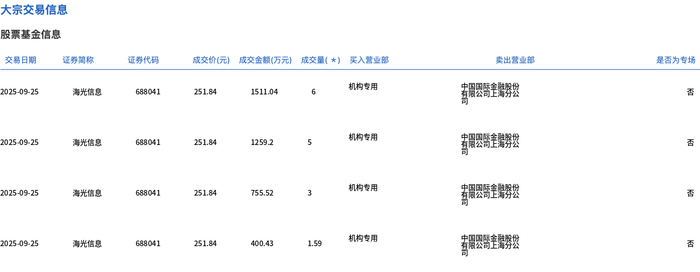
海光信息今日大宗交易折价成交15.59万股,成交额3926.19万元
Xin Lang Cai Jing· 2025-09-25 09:41
Summary of Key Points Core Viewpoint - On September 25, Haiguang Information executed a block trade of 155,900 shares, amounting to 39.26 million yuan, which represented 0.3% of the total trading volume for the day. The transaction price was 251.84 yuan, reflecting a 6% discount compared to the market closing price of 267.92 yuan [1]. Transaction Details - The block trade occurred on September 25, 2025, for Haiguang Information (stock code: 688041) at a price of 251.84 yuan per share [2]. - The total transaction amount was 15.59 million shares, with a total value of 39.26 million yuan [1]. - The trade was primarily conducted by institutional investors, with multiple buying departments involved [2].


【深原创】-政策汇总-重磅!2025年中国及31省市光电芯片行业政策汇总及解读(全)
Qian Zhan Wang· 2025-09-25 08:01
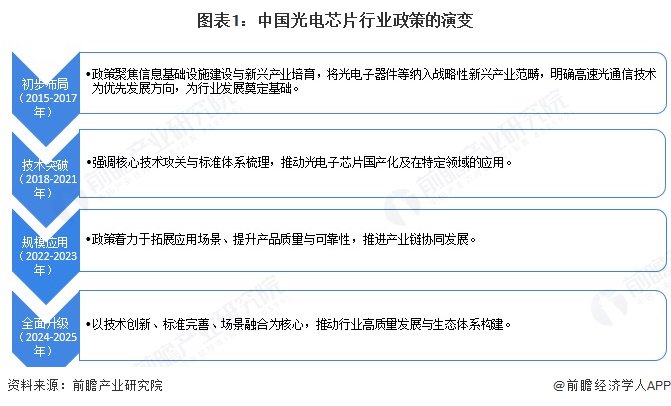
Core Viewpoint - The article discusses the development stages and policies of China's optoelectronic chip industry, highlighting the transition from initial layout to large-scale application and quality improvement, with future goals set for comprehensive upgrades and ecosystem construction by 2025 [1][2]. Policy Development Stages - The optoelectronic chip industry in China has undergone four stages: 1. Initial layout (2015-2017) focusing on infrastructure and emerging industry cultivation 2. Technological breakthroughs and application exploration (2018-2021) emphasizing core technology and localization 3. Large-scale application and quality enhancement (2022-2023) aimed at expanding scenarios and improving quality 4. Comprehensive upgrade and ecosystem construction (2024-2025) centered on technological innovation and standard improvement [1]. National Policy Summary - The optoelectronic chip is crucial for optical signal conversion, offering advantages such as small size, low power consumption, and high integration, which enhance transmission efficiency in optical communication systems [2]. - Since 2016, multiple policies have been issued by the State Council and the Ministry of Industry and Information Technology to support the development of the optoelectronic chip industry [2]. Key Policies and Plans - A summary of key policies and plans until 2025 includes: - Guidelines for updating and transforming production and testing equipment in electronic components [4]. - Implementation of the future industry innovation development plan to address foundational component shortages [4]. - Standardization initiatives for electronic information manufacturing and high-end chip standards [4][8]. - Plans to enhance the reliability of electronic components and promote the development of high-performance power semiconductors [5][6]. Impact of National Policies - National policies influence the optoelectronic chip industry through: - Encouragement of common key technology and frontier technology research [11]. - Implementation of industrial foundation reconstruction projects to strengthen supply chain resilience [11]. - Development of standard systems and expansion of application scenarios in various fields [11][13]. Provincial Policies Overview - Various provinces have introduced policies to support the optoelectronic chip industry, focusing on: - Technological breakthroughs in silicon photonic chips and high-speed optical communication chips [14][20]. - Financial subsidies and the establishment of innovation platforms, such as Guangdong's plan to create over ten innovation platforms [14]. - Collaborative development of industrial clusters and expansion into applications in 5G and quantum technology [20][18].


中国人工智能:华为的人工智能雄心-China AI_ Huawei's AI ambition
2025-09-25 05:58
Summary of Huawei's AI Roadmap and Implications for the Semiconductor Industry Industry Overview - The focus is on the **semiconductor industry** in China, particularly regarding **Huawei's AI ambitions** and its impact on the local semiconductor ecosystem [1][2][3]. Key Points and Arguments Huawei's AI Roadmap - Huawei unveiled its AI roadmap on **September 18, 2025**, which includes: - Next-generation **Ascend AI chip roadmap** - Open-source **UnifiedBus (UB) protocol** for connecting numerous chips in a **SuperPoD** - Development of the most powerful **SuperPoDs and SuperClusters** globally [1]. - The roadmap indicates a need for **16 times more chips**, which is expected to be inflationary for **Foundry/WFE** and benefits the entire semiconductor value chain [1]. Confidence in Local Foundry Supply - Huawei's public articulation of its AI roadmap signals confidence in the resilience of its local foundry supply, contrasting its previous cautious approach post-U.S. sanctions [2]. - The company appears to have secured reliable manufacturing capabilities, marking a significant milestone in building a robust local semiconductor ecosystem [2]. Demand for Advanced Logic Capacity - The ambitious scale of Huawei's AI SuperPoDs and SuperClusters indicates a **surge in demand** for local advanced logic capacity [3]. - Huawei's **Ascend 950 chip** has only **6%** of the performance of Nvidia's **VR200**, but through innovative networking protocols, Huawei can deploy **114 times more chips** than Nvidia in a single SuperPoD, achieving **6.8 times higher total computing power** [3]. Positive Impacts on Local Semiconductor Companies - The developments are positive for the entire local AI supply chain, benefiting: - **Foundries** like **SMIC**, which is expanding its **7nm capacity** to support Huawei's production [4]. - **Semicap vendors** such as **NAURA**, **AMEC**, and **Piotech**, which are expected to see substantial benefits from capacity expansion plans [4]. - **Hygon**, a leading domestic x86 server CPU provider, may face increased competition from Huawei but remains a necessary alternative [4]. Investment Implications - **SMIC** is rated **Outperform** with a price target of **HKD 30** for H-shares and **CNY 110** for A-shares, based on a valuation of **1.5x NTM P/B multiple** [6]. - **Hua Hong** is also rated **Outperform** with a price target of **HKD 60** for H-shares and **CNY 85** for A-shares, driven by its acquisition of Fab 5 [7]. - **NAURA**, **AMEC**, and **Piotech** are rated **Outperform**, benefiting from domestic WFE substitution in China [8][9][10]. - **Hygon** is rated **Outperform** with a price target of **CNY 220**, leveraging its AI accelerator for growth [11]. - **Cambricon**, while a leading AI accelerator ASIC chip provider, is rated **Market-Perform** due to high valuation concerns [12]. Additional Important Insights - The local AI production capacity is projected to **triple by 2026**, indicating strong capital expenditure trends in China [3]. - The developments create a **virtuous cycle of innovation and investment** that will strengthen China's AI ecosystem for years to come [4]. This summary encapsulates the critical insights from Huawei's AI roadmap and its implications for the semiconductor industry, highlighting the potential for growth and investment opportunities within the local ecosystem.




双创ETF(588300)开盘跌0.75%,重仓股宁德时代跌0.88%,中芯国际跌1.47%
Xin Lang Cai Jing· 2025-09-25 04:40
Group 1 - The core point of the article highlights the performance of the Double Innovation ETF (588300), which opened down by 0.75% at 0.932 yuan on September 25 [1] - Major holdings in the Double Innovation ETF include companies like CATL, which fell by 0.88%, SMIC down by 1.47%, and Mindray Medical down by 0.09% [1] - The ETF's performance benchmark is the CSI Science and Technology Innovation 50 Index, managed by China Merchants Fund Management Co., with a return of -6.22% since its inception on June 25, 2021, and a return of 23.84% over the past month [1] Group 2 - The article lists the performance of various stocks within the ETF, including Haiguang Information unchanged, Zhongji Xuchuang down by 1.77%, Xinyisheng down by 1.81%, and Huichuan Technology up by 0.78% [1] - The overall market sentiment appears to be cautious, as indicated by the mixed performance of the ETF's holdings [1]



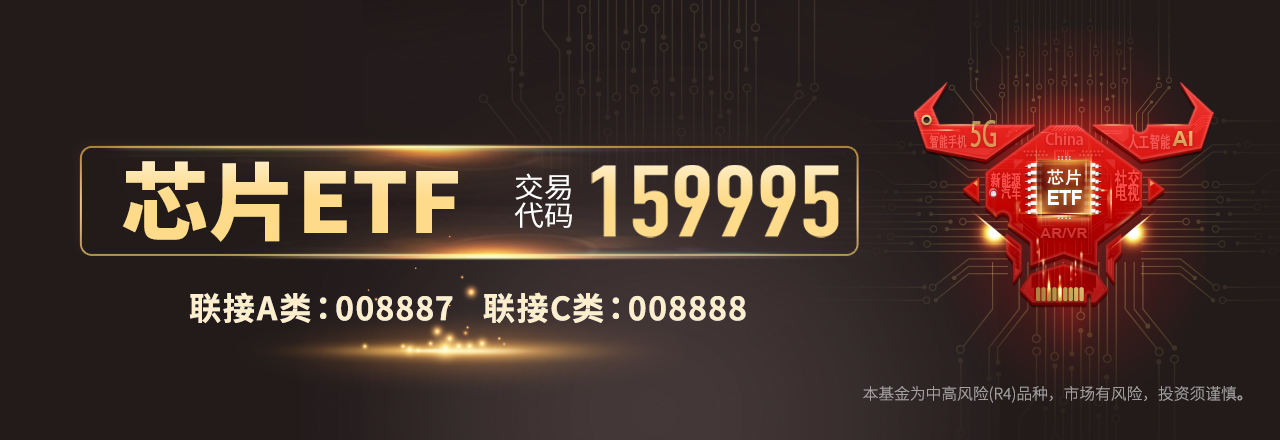
国产替代趋势明确!,芯片ETF(159995)震荡走强,晶合集成涨超13%
Mei Ri Jing Ji Xin Wen· 2025-09-25 04:40
Market Performance - On September 25, A-shares saw a collective rise in the three major indices, with the Shanghai Composite Index increasing by 0.14% during the session [1] - The sectors that performed well included comprehensive, communication equipment, and computer hardware, while gas and engineering machinery sectors faced declines [1] Chip Sector Developments - The chip technology stocks continued to strengthen, with the Chip ETF (159995) rising by 0.81% as of 10:53 AM [1] - Notable individual stock performances included: - Jinghe Integrated rising by 13.17% - Jing Sheng Machinery increasing by 5.59% - Tongfu Microelectronics up by 4.85% - Changdian Technology rising by 3.71% - Haiguang Information increasing by 3.63% [1] Huawei's Chip Roadmap - At the 2025 Full Connection Conference, Huawei announced its Ascend chip roadmap for the next three years, including: - Launching the 950PR and 950DT in 2026 - Doubling specifications for the 960 in 2027, including a self-developed 4-bit solution - Upgrading the 970 in 2028 in terms of computing power and memory bandwidth, aiming to catch up with NVIDIA's Blackwell [1] Domestic AI Chip Advancements - Dongfang Securities reported that domestic AI chips are achieving breakthroughs, with the scale of super nodes continuously improving [1] - The performance of domestic AI chips and switching chips is on the rise, and the commercialization process is advancing [1] - Investor confidence in China's AI computing power development is expected to continue to grow [1] Chip ETF Overview - The Chip ETF (159995) tracks the National Chip Index, comprising 30 constituent stocks from the A-share chip industry, including leading companies in materials, equipment, design, manufacturing, packaging, and testing [1] - Notable constituent companies include SMIC, Cambricon, Changdian Technology, and Northern Huachuang [1] - The off-market linked funds for the ETF are A class: 008887 and C class: 008888 [1]



半导体ETF南方(159325)开盘跌0.06%,重仓股中芯国际跌1.47%,北方华创涨1.88%
Xin Lang Cai Jing· 2025-09-25 03:54
Group 1 - The semiconductor ETF Southern (159325) opened with a slight decline of 0.06%, priced at 1.586 yuan [1] - Key holdings in the ETF showed mixed performance, with SMIC down 1.47%, Northern Huachuang up 1.88%, and other notable movements including Huagong Information unchanged, Cambrian down 0.34%, and Zhaoyi Innovation down 0.40% [1] - The ETF's performance benchmark is the CSI Semiconductor Industry Select Index return, managed by Southern Fund Management Co., with a return of 58.40% since its inception on October 31, 2024, and a monthly return of 19.33% [1]


单日获资金净流入4.56亿元,科创芯片ETF(588200)连续4日上涨
Xin Lang Cai Jing· 2025-09-25 03:50
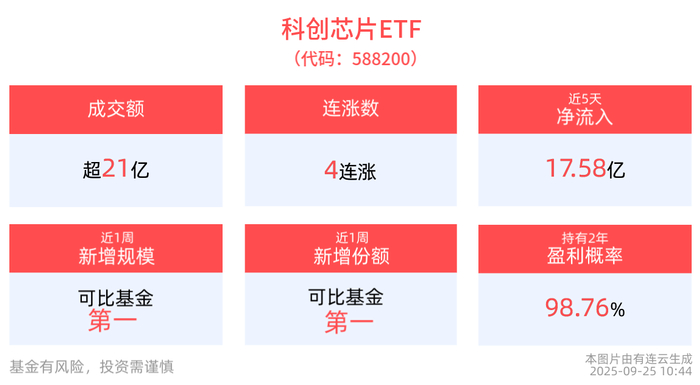
Group 1 - The core index of the Shanghai Stock Exchange Science and Technology Innovation Board for chips rose by 0.64%, with notable increases in stocks such as Jinghe Integrated (up 13.37%) and Huahong Semiconductor (up 5.67) [1] - The Science and Technology Innovation Chip ETF (588200) experienced a 0.48% increase, marking its fourth consecutive rise, and has accumulated a 9.88% increase over the past week [1][4] - The trading volume of the Science and Technology Innovation Chip ETF reached 2.172 billion yuan, with a turnover rate of 5.76% [4] Group 2 - The Science and Technology Innovation Chip ETF saw a significant growth in scale, increasing by 3.829 billion yuan over the past week, ranking first among comparable funds [4] - The ETF's net inflow of funds was 456 million yuan, with a total of 1.758 billion yuan net inflow over the last five trading days [4] - The net value of the Science and Technology Innovation Chip ETF has increased by 124.89% over the past two years, ranking 8th out of 2331 index equity funds [4] Group 3 - Alibaba Group's CEO announced plans to invest 380 billion yuan in cloud computing and AI infrastructure over the next three years, with potential for additional investments [5] - The increase in AI computing power infrastructure investments by leading tech companies indicates a shift towards a competition focused on computing power, which may boost demand in upstream hardware industries [5] - The strategic moves of leading companies may serve as a market indicator, reinforcing expectations for long-term growth in the AI computing sector [5] Group 4 - The top ten weighted stocks in the Science and Technology Innovation Board chip index account for 62.02% of the total index, with companies like Cambricon and Huagong Information leading the list [4][7] - Investors without stock accounts can access domestic chip investment opportunities through the Science and Technology Innovation Chip ETF linked fund (017470) [7]
新“新三样”来了!为什么是它们?
2 1 Shi Ji Jing Ji Bao Dao· 2025-09-25 03:12
Core Insights - The new "new three items" in China's economy are robotics, artificial intelligence (AI), and innovative pharmaceuticals, which are now driving high-quality economic development [1][2] - The market for these sectors is experiencing significant growth, with A-share companies in robotics and AI seeing substantial increases in market capitalization [2][3] - China's position in these sectors is evolving from "catching up" to "leading," particularly in robotics, while AI is in a competitive position and innovative pharmaceuticals are gaining international recognition [3][4] Robotics Sector - The humanoid robotics field is viewed as a potential game-changer, with leading A-share companies like Huichuan Technology exceeding a market cap of 200 billion and significant first-day gains for companies like Sanxie Electric [2][3] - The robotics industry is advancing rapidly, with China entering the global first tier, although high-end components still require imports [3] Artificial Intelligence Sector - Several companies in the AI sector have market capitalizations exceeding 100 billion, with strong demand for AI computing chips and infrastructure leading to impressive performance [2][3] - China has strong competitiveness in application areas like computer vision and speech recognition, but still faces challenges in foundational chips and ecosystem development [3] Innovative Pharmaceuticals Sector - Companies like Hengrui Medicine are approaching a market cap of 500 billion, with others like WuXi AppTec and Innovent Biologics also exceeding 100 billion [2] - The innovative pharmaceutical sector is experiencing explosive growth in international transactions, indicating improved R&D capabilities, though challenges remain in target discovery and basic research translation [3] Market Dynamics - The shift from traditional growth drivers to technology-intensive, high-value-added production is essential for overcoming the challenges of traditional industries [1][3] - The advantages of a large-scale market, strong engineering capabilities, and an improving policy environment are critical for these sectors [3] Policy Recommendations - There is a need for policies that promote data openness, optimize review processes, and increase investment in computing infrastructure [3] - Focus on interdisciplinary talent development and encourage long-term capital investment in foundational research is essential for sustaining growth [3]




上纬新材“20CM”涨停,机器人ETF(159770)获实时净申购1200万份,科创综指ETF天弘(589860)涨近1%
2 1 Shi Ji Jing Ji Bao Dao· 2025-09-25 03:12
Group 1 - The A-share technology stocks continue to strengthen, with the Sci-Tech Innovation Index rising nearly 1% on September 25, 2023 [1] - The Tianhong Sci-Tech Innovation Index ETF (589860) increased by 0.90%, with a trading volume exceeding 28 million yuan, indicating active trading [1] - In the robotics sector, the Robotics ETF (159770) rose by 0.44%, with a trading volume exceeding 200 million yuan and a turnover rate of over 2.5% [1] Group 2 - The Robotics ETF (159770) received a net subscription of 12 million units, reflecting strong investor interest [2] - The Tianhong Sci-Tech Innovation Index ETF closely tracks the Sci-Tech Innovation Index, which covers approximately 97% of the market capitalization of the Sci-Tech Innovation Board, focusing on small-cap hard technology companies [2] - The Robotics ETF tracks the CSI Robotics Index, which includes companies involved in system solutions, digital workshops, automation equipment manufacturing, and other robotics-related sectors [2] Group 3 - Alibaba Cloud and NVIDIA have reached a collaboration in the Physical AI field, integrating NVIDIA's software stack into Alibaba's AI platform to enhance development cycles for applications like embodied intelligence and assisted driving [3] - Qualcomm's China Chairman indicated that the future scale of robotics and wearable devices could equal or exceed that of smartphones, highlighting the growth potential in these sectors [3] - Recent developments in the robotics industry, including Tesla's announcement of a compensation plan linked to the delivery of 1 million Optimus humanoid robots, have boosted market sentiment [3] Group 4 - CITIC Securities noted that the humanoid robotics index's performance is significantly influenced by Tesla's advancements in robotics, with a shift from theme investment to production expectations [4] - The upcoming Gen3 hardware release is expected to provide clearer production guidance and present historic opportunities for the sector [4] - The focus on supply chain certainty and new hardware directions is crucial for the industry, along with attention to the progress of domestic applications [4]




新“新三样”来了!为什么是它们?
21世纪经济报道· 2025-09-25 03:04
Core Viewpoint - The article emphasizes that the new "new three items" for China's economy are robotics, artificial intelligence (AI), and innovative pharmaceuticals, which are now driving high-quality economic growth, surpassing traditional sectors like finance and real estate [1][2]. Group 1: Robotics - The robotics sector, particularly humanoid robots, is seen as the next potential world-changing technology after computers, smartphones, and electric vehicles. Leading companies like Huichuan Technology have a market capitalization exceeding 200 billion, with some stocks experiencing significant price increases [2]. - China is making rapid progress in robotics, moving from "catching up" to "leading" on a global scale, with a complete industrial chain and the largest market, although high-end components still rely on imports [2][3]. Group 2: Artificial Intelligence - The AI sector has several companies with market capitalizations over 100 billion, focusing on AI computing chips and infrastructure. Companies like Cambricon and Industrial Fulian are experiencing explosive growth in orders and performance [2]. - China is competitive in application-level AI, particularly in computer vision and speech recognition, but still lags in foundational chips and ecosystem frameworks [3]. Group 3: Innovative Pharmaceuticals - The innovative pharmaceutical sector is witnessing significant growth, with companies like Hengrui Medicine nearing a market cap of 500 billion. The business model is shifting from "burning money" to "making money," gaining global market recognition [2]. - China's innovative drugs are moving from "following" to "keeping pace," with explosive growth in overseas transactions, although challenges remain in target discovery and basic research translation [3]. Group 4: Advantages and Challenges - China's advantages include a large-scale market providing scenario dividends, strong engineering and industrialization capabilities, and a continuously improving policy environment. However, there are risks of being "choked" if key segments are controlled by external entities [3]. - The article suggests that policy improvements are needed to create an open data ecosystem, optimize review processes, and increase investment in foundational research [4].