Allist(688578)

Search documents
国泰海通医药 2026年1月第三周周报:JPM 大会落幕,推荐创新药械产业链-20260118
GUOTAI HAITONG SECURITIES· 2026-01-18 12:07
Investment Rating - The report maintains an "Overweight" rating for the pharmaceutical sector [6][26]. Core Insights - The report emphasizes the continuous recommendation of innovative pharmaceuticals and medical devices, highlighting the high growth potential in the sector. It maintains "Overweight" ratings for companies such as Heng Rui Medicine, Hansoh Pharmaceutical, Sanofi, Kelun Pharmaceutical, and Enhua Pharmaceutical. It also recommends Biopharma/Biotech companies like Kelun Biotech, BeiGene, and others, as well as CXO and upstream pharmaceutical companies [6][3]. Summary by Sections 1. Continuous Recommendation of Innovative Pharmaceuticals and Medical Devices - The report highlights the high growth potential of innovative drugs and recommends several companies for investment, including Heng Rui Medicine, Hansoh Pharmaceutical, Sanofi, Kelun Pharmaceutical, and Enhua Pharmaceutical. It also suggests Biopharma/Biotech companies like Kelun Biotech, BeiGene, and others, as well as CXO and upstream pharmaceutical companies [6][7]. 2. A-share Pharmaceutical Sector Performance - In the third week of January 2026, the A-share pharmaceutical sector underperformed the broader market, with the Shanghai Composite Index declining by 0.4% and the SW Pharmaceutical and Biotech index falling by 0.7% [8][11]. 3. Hong Kong and US Market Performance - The Hong Kong pharmaceutical sector performed in line with the market, while the US pharmaceutical sector underperformed. In the same week, the Hang Seng Healthcare index rose by 2.4%, and the S&P 500 healthcare sector fell by 1.1% [19][20].





艾力斯跌2.01%,成交额3.57亿元,主力资金净流出1483.23万元
Xin Lang Cai Jing· 2026-01-15 06:22
Core Viewpoint - The stock price of Ailis has experienced a decline of 3.84% year-to-date, with a notable drop of 3.89% over the last five trading days, indicating a bearish trend in the market [2]. Company Overview - Ailis Pharmaceutical Technology Co., Ltd. was established on March 22, 2004, and went public on December 2, 2020. The company is primarily engaged in the research, production, and sales of innovative drugs [2]. - The main revenue source for Ailis is drug sales, accounting for 99.93% of total revenue, with promotional services contributing 0.06% and other sources at 0.00% [2]. Financial Performance - For the period from January to September 2025, Ailis reported a revenue of 3.733 billion yuan, representing a year-on-year growth of 47.35%. The net profit attributable to shareholders was 1.616 billion yuan, reflecting a 52.01% increase compared to the previous year [2]. - Since its A-share listing, Ailis has distributed a total of 653 million yuan in dividends [3]. Shareholder and Market Activity - As of September 30, 2025, the number of Ailis shareholders increased by 46.82% to 19,100, while the average circulating shares per person decreased by 31.89% to 23,551 shares [2]. - The stock's trading activity showed a net outflow of 14.83 million yuan from main funds, with significant buying and selling activity from large orders [1].
艾力斯跌2.07%,成交额3.30亿元,主力资金净流出2359.09万元
Xin Lang Cai Jing· 2026-01-14 05:33
Core Viewpoint - The stock price of Ailis has experienced fluctuations, with a recent decline of 1.47% year-to-date and a 5.33% drop over the last five trading days, indicating potential volatility in the market [2]. Group 1: Stock Performance - As of January 14, Ailis's stock price decreased by 2.07%, trading at 102.62 CNY per share, with a total market capitalization of 46.179 billion CNY [1]. - Year-to-date, Ailis's stock has dropped by 1.47%, while it has seen a 5.33% decline over the past five trading days [2]. - Over the last 20 days, the stock has increased by 1.48%, but it has decreased by 0.71% over the last 60 days [2]. Group 2: Financial Performance - For the period from January to September 2025, Ailis reported a revenue of 3.733 billion CNY, reflecting a year-on-year growth of 47.35%, and a net profit attributable to shareholders of 1.616 billion CNY, which is a 52.01% increase [2]. - The company has distributed a total of 653 million CNY in dividends since its A-share listing [3]. Group 3: Shareholder and Institutional Holdings - As of September 30, 2025, Ailis had 19,100 shareholders, an increase of 46.82% from the previous period, with an average of 23,551 circulating shares per shareholder, down by 31.89% [2]. - Among the top ten circulating shareholders, Hong Kong Central Clearing Limited holds 20.9471 million shares, an increase of 10.5693 million shares from the previous period [3]. - Other notable institutional shareholders include China Europe Medical Health Mixed A and E Fund Shanghai Stock Exchange Sci-Tech Innovation Board 50 ETF, with varying changes in their holdings [3].
艾力斯:针对C797S突变NSCLC患者的治疗,公司有新一代的EGFR-TKI处于I期临床试验阶段
Mei Ri Jing Ji Xin Wen· 2026-01-12 10:35
Core Viewpoint - The company,艾力斯 (688578.SH), emphasizes its commitment to innovation as a core competitive advantage and outlines its strategic focus on the development of its key product,伏美替尼, along with other innovative drug candidates [2]. Group 1: Product Development - The company is conducting in-depth research on伏美替尼, exploring multiple application scenarios beyond the already approved indications for second-line and first-line treatments [2]. - Ongoing clinical registrations for伏美替尼 include auxiliary treatment for classic EGFR mutations, second-line and first-line treatments for 20 exon mutations, PACC mutation indications, brain metastasis indications, and auxiliary treatment for non-classic EGFR mutations [2]. - The NDA application for the second-line treatment of the 20 exon mutation has been accepted and prioritized for review, while the PACC mutation NSCLC first-line treatment indication is expected to be classified as a breakthrough therapy by December 2025 [2]. Group 2: New Product Introductions - In August 2024, the company introduced the KRAS G12C inhibitor,戈来雷塞, and the SHP2 inhibitor, taking full responsibility for their subsequent development [2]. - The second-line treatment indication for戈来雷塞 in NSCLC was officially approved in May 2025, and ongoing studies are being conducted for its use in pancreatic cancer and other solid tumors [2]. - Clinical trials are progressing smoothly for the combination of戈来雷塞 with the SHP2 inhibitor for first-line treatment of KRAS G12C mutation non-small cell lung cancer [2]. Group 3: Research and Development Enhancements - The company is advancing its new drug discovery platform, enhancing its capabilities in both large and small molecule research, and strengthening team development [2]. - Several innovative drugs are currently in the preclinical research stage, indicating a robust pipeline for future growth [2]. - The company is committed to promoting the internationalization of its products, aiming to make innovative drugs accessible to patients worldwide [2].


1月12日科创板主力资金净流出69.33亿元
Zheng Quan Shi Bao Wang· 2026-01-12 10:00
Group 1 - The main point of the news is that the net outflow of capital from the Shanghai and Shenzhen markets reached 27.468 billion yuan, with the STAR Market experiencing a net outflow of 6.933 billion yuan [1] - A total of 241 stocks saw net inflows of capital, while 359 stocks experienced net outflows [1] - Among the stocks with net inflows, Guoke Military Industry led with a net inflow of 252.43 million yuan, followed by Zhuoyi Information and Yuntian Lefe-U with net inflows of 177.01 million yuan and 155.75 million yuan respectively [3] Group 2 - There are 65 stocks that have seen continuous net inflows for more than three trading days, with Foxit Software leading at nine consecutive days of inflow [2] - On the other hand, 166 stocks have experienced continuous net outflows, with Transsion Holdings leading at 14 consecutive days of outflow [2] Group 3 - The top stocks by net inflow include Guoke Military Industry (252.43 million yuan), Zhuoyi Information (177.01 million yuan), and Yuntian Lefe-U (155.75 million yuan) [3][4] - The stocks with the highest net outflows include SMIC with 909 million yuan, followed by Shijia Photon and Dongxin Shares with net outflows of 675 million yuan and 658 million yuan respectively [1]



1月9日科创板主力资金净流出54.49亿元
Zheng Quan Shi Bao Wang· 2026-01-09 09:28
Group 1 - The main point of the news is that the net outflow of main funds in the Shanghai and Shenzhen markets reached 24.126 billion yuan, with the Sci-Tech Innovation Board experiencing a net outflow of 5.449 billion yuan [1] - A total of 224 stocks on the Sci-Tech Innovation Board saw net inflows, while 376 stocks experienced net outflows [1] - Among the stocks with significant net inflows, Haiguang Information led with a net inflow of 457 million yuan, followed by Xinke Mobile-U and Qiangyi Co., with net inflows of 337 million yuan and 323 million yuan respectively [1] Group 2 - There are 56 stocks that have seen continuous net inflows for more than three trading days, with Anxu Bio leading at 10 consecutive days of inflow [2] - The stock with the longest continuous net outflow is Dameng Data, which has seen outflows for 23 consecutive trading days [2] - The top stocks by net inflow include Haiguang Information, Xinke Mobile-U, and Qiangyi Co., with respective inflows of 457.4 million yuan, 337.4 million yuan, and 323.1 million yuan [2][3]




解密主力资金出逃股 连续5日净流出387股


Zheng Quan Shi Bao Wang· 2026-01-09 09:28
Core Viewpoint - The report highlights a significant outflow of main capital from various stocks in the Shanghai and Shenzhen markets, with 387 stocks experiencing net outflows for five consecutive days or more, indicating potential investment risks in these companies [1][2][3][4]. Group 1: Main Capital Outflow Statistics - The stock with the longest continuous net outflow is Dameng Data, with 23 days of outflows [1]. - Daqin Railway follows with 20 days of net outflows, totaling 2.711 billion yuan [1]. - The total net outflow for Daqin Railway over 20 days is the highest at 2.711 billion yuan, while Xiechuang Data has a net outflow of 1.914 billion yuan over five days [1][2]. Group 2: Stocks with Significant Outflows - The top stocks by net outflow duration include: - Daqin Railway: 20 days, 2.711 billion yuan, 18.68% of trading volume, -6.22% cumulative change [1]. - Dameng Data: 23 days, 0.503 billion yuan, 7.58% of trading volume, 14.15% cumulative change [2]. - Haima Automobile: 12 days, 1.626 billion yuan, 8.26% of trading volume, -18.59% cumulative change [1]. Group 3: Other Notable Stocks - Other stocks with notable outflows include: - Wuzhou Xinchun: 5 days, 1.574 billion yuan, 5.24% of trading volume, 11.62% cumulative change [1]. - Dongshan Precision: 6 days, 1.512 billion yuan, 6.91% of trading volume, -6.80% cumulative change [1]. - Shengtai Electronics: 10 days, 1.377 billion yuan, 8.47% of trading volume, -8.71% cumulative change [1].
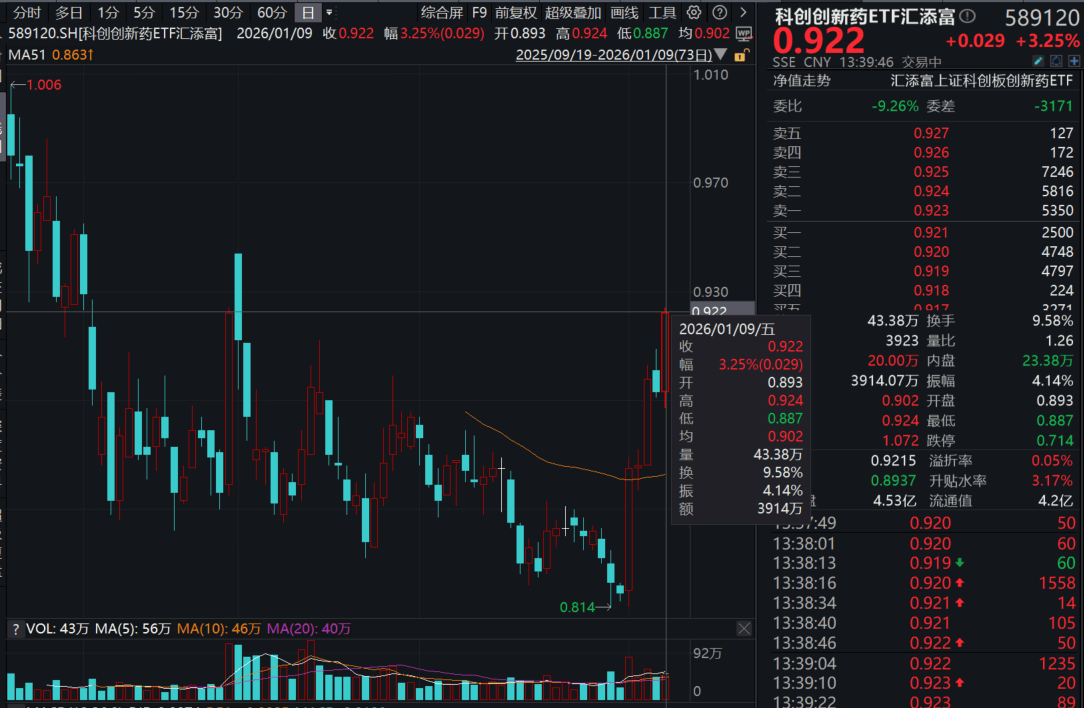
创新药午后蹿升!骨髓瘤注射液获上市审批,智翔金泰大涨超8%,科创创新药ETF汇添富(589120)涨超3%,强势反包!创新药2026投资前瞻来了
Sou Hu Cai Jing· 2026-01-09 06:05
Core Viewpoint - The A-share market is experiencing a significant upward trend, with the Shanghai Composite Index returning to 4100 points for the first time in 10 years, driven by a strong performance in the innovative pharmaceutical sector, particularly the Sci-Tech Innovation Drug ETF Huatai (589120) which rose over 3% [1] Group 1: Market Performance - The Sci-Tech Innovation Drug ETF Huatai (589120) saw most of its constituent stocks surge, with notable increases such as Yuekang Pharmaceutical up over 10%, Zhixiang Jintai up over 8%, and Micron Biologics up over 6% [3] - The top ten constituent stocks of the ETF include major players in the pharmaceutical sector, with BeiGene (688235) rising by 1.77% and Aier Eye Hospital (688578) increasing by 2.18% [3] Group 2: Regulatory Support - A national drug supervision conference held from January 6 to 7 emphasized the need to actively support the pharmaceutical industry in enhancing quality and efficiency, alongside comprehensive reforms in drug regulation [4] Group 3: Innovation and Drug Approvals - Innovation remains a key theme in the Sci-Tech Innovation Drug sector, with recent announcements including Zhixiang Jintai's conditional listing application for a dual-antibody drug and Micron Biologics receiving approval for clinical trials of a new drug for pancreatic cancer [5] - BeiGene announced the conditional approval of its new BCL2 inhibitor, providing new treatment options for patients with chronic lymphocytic leukemia [6] - Rongchang Biologics is seeking breakthrough therapy designation for a new indication of its drug, which would mark a significant regulatory achievement for domestic ADC products [7] Group 4: Future Outlook - The Pacific Securities report anticipates that by 2026, the innovative drug sector will benefit from enhanced international capabilities and supportive industry policies, leading to increased market confidence and investment [8] - The report highlights that the average deal value for innovative drugs purchased from China by top multinational corporations is significantly higher than those from overseas, indicating a growing recognition of the value of Chinese innovative drugs in the global market [9]




艾力斯涨2.02%,成交额2.20亿元,主力资金净流出4475.75万元
Xin Lang Zheng Quan· 2026-01-09 03:25
Group 1 - The core viewpoint of the news is that Ailis has shown a positive performance in stock price and financial results, indicating growth potential in the pharmaceutical sector [1][2][3] - As of January 9, Ailis's stock price increased by 2.02% to 106.30 CNY per share, with a total market capitalization of 47.835 billion CNY [1] - The company reported a revenue of 3.733 billion CNY for the first nine months of 2025, representing a year-on-year growth of 47.35%, and a net profit of 1.616 billion CNY, up 52.01% year-on-year [2] Group 2 - Ailis has a total of 19,100 shareholders as of September 30, 2025, which is an increase of 46.82% compared to the previous period [2] - The company has distributed a total of 653 million CNY in dividends since its A-share listing [3] - The top ten circulating shareholders include significant institutional investors, with Hong Kong Central Clearing Limited holding 20.9471 million shares, an increase of 10.5693 million shares from the previous period [3]
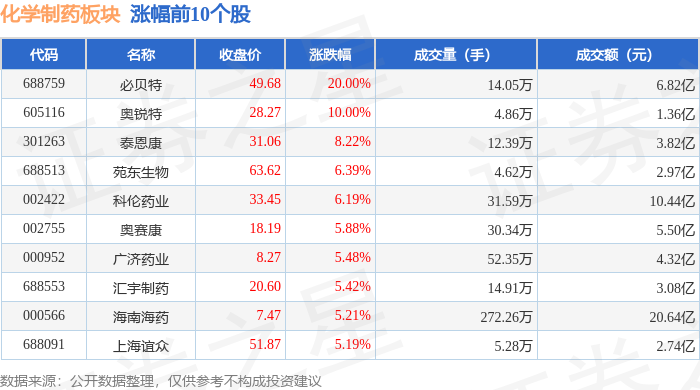
化学制药板块1月8日涨0.24%,必贝特领涨,主力资金净流出1.91亿元
Zheng Xing Xing Ye Ri Bao· 2026-01-08 08:51
Group 1 - The chemical pharmaceutical sector increased by 0.24% on January 8, with Bibete leading the gains [1] - The Shanghai Composite Index closed at 4082.98, down 0.07%, while the Shenzhen Component Index closed at 13959.48, down 0.51% [1] - Notable gainers in the chemical pharmaceutical sector included Bibete, which rose by 20.00% to a closing price of 49.68, and Qijingt, which increased by 10.00% to 28.27 [1] Group 2 - The chemical pharmaceutical sector experienced a net outflow of 191 million yuan from institutional investors, while retail investors saw a net inflow of approximately 84.42 million yuan [2] - The trading volume for Bibete was 140,500 shares, with a transaction value of 682 million yuan, indicating strong market interest [1] - The sector's overall trading activity showed a mix of inflows and outflows, with specific stocks like Hainan Haiyao and Xinyu Pharmaceutical seeing significant institutional interest [3]