
TRINA(688599)

Search documents
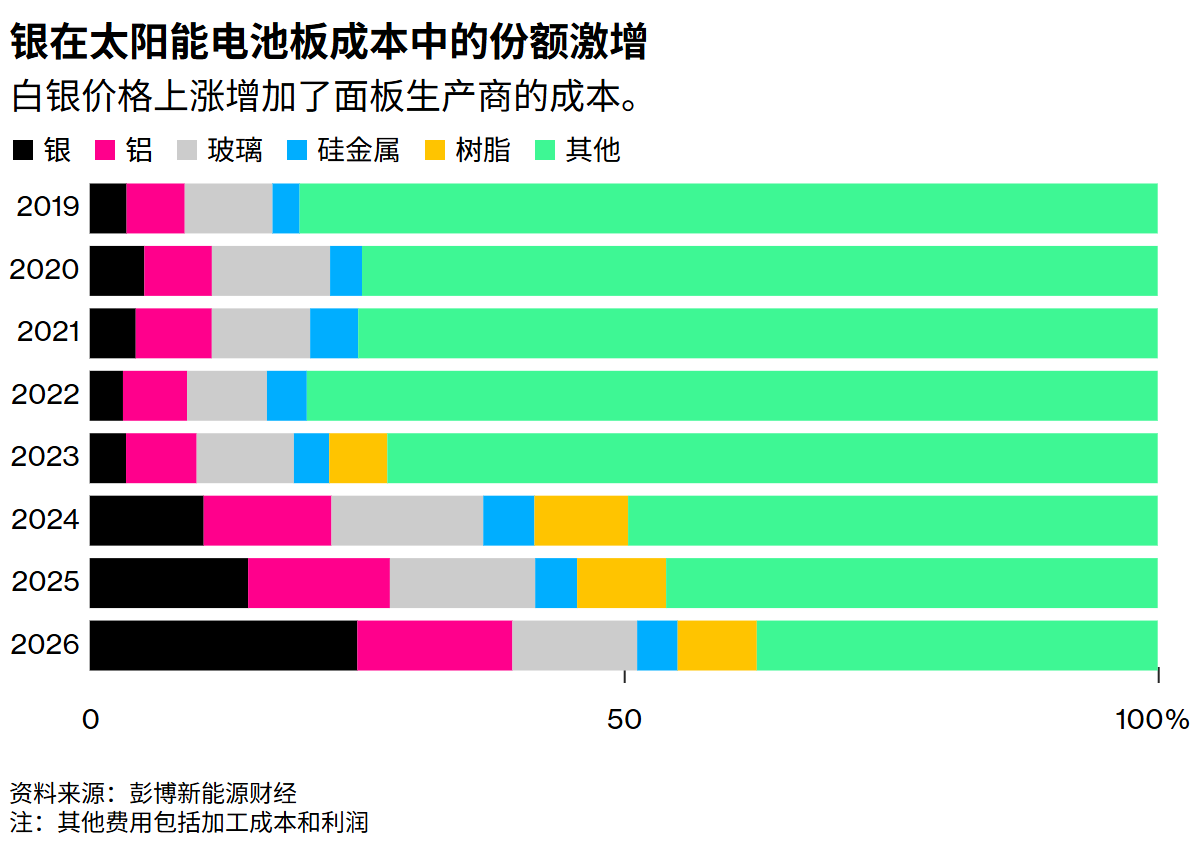
白银占成本从3%飙升至29%!光伏巨头“血亏”求生:涨价能救命吗?
Zhi Tong Cai Jing· 2026-01-16 02:56
Core Viewpoint - The surge in silver prices is exacerbating the financial struggles of solar panel manufacturers, who are facing intensified competition and ongoing losses. The industry is implementing a dual strategy to cope with rising costs: increasing product prices and accelerating the transition to cheaper materials like copper to replace silver [1][4]. Group 1: Industry Challenges - Solar panel manufacturers are experiencing significant cost pressures due to soaring silver prices, which have tripled over the past year, reaching over $93 per ounce [1][4]. - The use of silver in solar cells now accounts for 29% of the total component cost, a sharp increase from 3.4% in 2023 and 14% last year [1]. - Major solar companies, including Trina Solar, have warned of expected net losses through 2025, indicating that the industry downturn has not yet reached its lowest point despite efforts to curb overcapacity and price wars [4]. Group 2: Price Adjustments and Market Response - In response to rising silver prices, Chinese component manufacturers have raised prices to over 0.8 yuan per watt, reflecting a 1.4% to 3.8% increase from the previous week, resulting in typical 500-watt component prices around 400 yuan ($57) [4]. - The silver market is experiencing a record streak, with prices around $91 per ounce, potentially marking the longest consecutive monthly increase since records began in 1950 [4]. Group 3: Material Substitution Efforts - Manufacturers are actively working to reduce silver paste usage in solar cells to lower costs, with projections indicating an average usage of 8.96 milligrams per watt by 2025, down from 11.2 milligrams in 2024 [5]. - Longi Green Energy has announced plans to begin replacing silver with cheaper metals in their solar cells [5]. - The solar industry accounted for approximately 17% of total silver demand last year, a significant increase from a decade ago, but a slowdown in consumption could threaten the long-term price increase of silver [5][6].



太空光伏概念热度飙升,企业抢滩布局正酣!钙钛矿成潜力方向
Shang Hai Zheng Quan Bao· 2026-01-16 00:46
Core Insights - The space photovoltaic concept has gained significant attention in 2026, with brokerages predicting a "trillion-level market" and companies like JinkoSolar, Trina Solar, and Junda Co. actively disclosing their plans and progress in this field [1][2] - Industry experts highlight the potential of space photovoltaics amid the maturation of commercial space technology and the growing energy demands of AI computing centers, while also acknowledging the challenges of commercialization [1][4] Company Developments - Elon Musk discussed the future of space photovoltaics, emphasizing solar energy as the key to human energy freedom, with plans for 8,000 launches per year to deploy AI satellites that maximize sunlight utilization [2] - JinkoSolar signed a strategic cooperation agreement with Jingtai Technology to establish a joint venture focused on AI-based high-throughput perovskite tandem solar cells [2] - Junda Co. announced an investment of 30 million yuan to acquire a stake in Xingyi Chip Energy, aiming to expand into the space photovoltaic sector [2] Technological Advancements - GCL-Poly's chairman stated plans to collaborate with aerospace research institutions to test perovskite components in thin atmosphere regions, exploring commercial applications [3] - Lightyear Technology has been conducting ground simulations and space environment tests, having already sent perovskite components into orbit for testing [3] - Mingyang Smart Energy, a wind power leader, plans to acquire Dehua Chip, which focuses on space solar cells, indicating a cross-industry move into space photovoltaics [3] Market Potential - The interest in space photovoltaics is driven by the maturation of commercial space technology and the increasing value of the "space economy," which provides a solid foundation for development [4] - The main battery technologies for space photovoltaics include gallium arsenide, crystalline silicon, and perovskite, with perovskite being favored for its high efficiency and potential for lightweight and flexible applications [5][6] Commercialization Challenges - Despite the promising future, the commercialization of space photovoltaics faces significant challenges, including high launch costs and the stability of equipment in extreme space environments [7] - Analysts predict that large-scale commercial power supply from space photovoltaics may not be realized until after 2040, emphasizing the need for phased development and testing [8]


储能行业跟踪报告:渠道与场景加持,光伏组件企业大举进入储能领域
EBSCN· 2026-01-16 00:12
Investment Rating - The report indicates a positive outlook for the solar component companies entering the energy storage sector, suggesting a new growth space for these companies [4]. Core Insights - Leading solar component companies are accelerating their entry into the energy storage market, with notable players like Canadian Solar, Trina Solar, Jinko Solar, JA Solar, and LONGi Green Energy making significant moves [3][9]. - The entry of these companies into the energy storage sector is supported by two main advantages: strong customer channels and the ability to leverage existing global networks [3][13]. - The energy storage market is characterized by a strong binding trend between solar and storage projects, particularly in regions with rapidly growing electricity demand [21]. Summary by Sections 1. Accelerated Layout of Leading Component Companies in Energy Storage - Major solar component companies are focusing on large-scale energy storage, with significant market potential and a trend towards joint development of solar-storage projects [9][11]. 2. Competitive Advantages: Reusing Global Networks in Customer and Channel - Solar and energy storage customers overlap significantly, providing solar companies with inherent customer acquisition advantages [13][17]. - Leading solar companies have established global sales and service systems, enhancing their ability to develop energy storage businesses [17][20]. 3. Competitive Advantages: Strong Binding of Scenarios and Applications - The trend of integrating solar and energy storage projects is becoming mainstream, especially in countries with less developed electricity markets [21]. 4. Investment Recommendations - The report emphasizes that the entry of solar component companies into the energy storage sector is expected to open new growth opportunities, with a focus on three key indicators for assessing growth potential: commitment to energy storage, overseas market expansion in the next 1-2 years, and profitability contributions [4][24]. - Specific companies to watch include Canadian Solar, which has already seen significant profit contributions from its energy storage business, and Trina Solar, which is rapidly expanding its overseas energy storage operations [24].


后退税时代,组件龙头谁在“裸泳”?
Xin Lang Cai Jing· 2026-01-15 14:09
Core Viewpoint - The photovoltaic industry is facing a critical turning point in 2026, with major companies like JA Solar, JinkoSolar, and Trina Solar forecasting significant losses for 2025, compounded by the cancellation of export tax rebates that previously supported their profits and operational cash flow [1][11]. Group 1: Financial Impact - The cancellation of export tax rebates is expected to severely impact cash flow for photovoltaic companies, which had relied on these rebates as a stable source of income [2][12]. - In the first three quarters of 2025, the total tax refunds for the four leading module manufacturers approached 10 billion yuan, while the top ten companies received over 20 billion yuan in tax refunds for the 2024 fiscal year [1][12]. - The sudden loss of this crucial cash flow source is likened to cutting off an external lifeline during a time of industry "blood loss," forcing companies to rely more on their operational cash generation capabilities [2][12]. Group 2: Cash Flow Analysis - A clear differentiation in cash flow status among photovoltaic companies has emerged, with some companies struggling significantly as the industry faces a downturn [3][13]. - The cash flow rankings of listed photovoltaic companies over the past five years show that Tongwei Co. leads with a total cash generation of 860 million yuan, while companies like LONGi Green Energy and Aiko Solar are also notable [4][14]. - The abrupt policy change regarding export tax rebates has had the most severe impact on companies with already thin profit margins, necessitating a restructuring of financial management strategies [4][14]. Group 3: Market Dynamics - In an effort to capitalize on the last window of opportunity, major module manufacturers are stockpiling inventory while also clearing existing stock, leading to market chaos with contract breaches and price hikes becoming common [5][15]. - Current market prices for photovoltaic modules show fluctuations, with companies like JinkoSolar and Trina Solar adjusting their prices upward, indicating a volatile market environment [7][17]. - Companies are urged to maintain their reputations while seizing opportunities for recovery, emphasizing the importance of balancing profit-seeking with brand integrity [7][17]. Group 4: Strategic Responses - Leading companies are adopting various strategies to survive the cash flow challenges, such as technological innovation and product differentiation [9][19]. - LONGi and Aiko are promoting BC battery technology to achieve higher premiums in overseas markets, while JA Solar is implementing a "three-pole management system" to reduce production costs [9][19]. - Trina Solar is collaborating with financial institutions to utilize accounts receivable for cash flow supplementation, and JinkoSolar is launching new TOPCon products to enhance market competitiveness [9][19].

光伏行业预亏警报大响,这些龙头连亏两年成定局
第一财经· 2026-01-15 13:23
Core Viewpoint - The photovoltaic industry is currently in a downward cycle, with major listed companies facing significant losses in their 2025 performance forecasts due to overcapacity, intense price competition, and a complex overseas trade environment [3][4]. Group 1: Industry Performance - Major photovoltaic companies such as Daqo New Energy, JinkoSolar, and Trina Solar have announced expected losses for 2025, indicating ongoing pressure in the industry [4][5]. - Daqo New Energy reported a net profit loss of 1.073 billion yuan for the first three quarters of the previous year, and the forecast indicates consecutive losses for 2024 and 2025 [5]. - JinkoSolar and Trina Solar are also expected to continue facing losses in 2025, with net profit losses of 3.92 billion yuan and 4.2 billion yuan respectively for the first three quarters of 2025 [6]. Group 2: Market Dynamics - The photovoltaic industry is experiencing a dual challenge of overcapacity and aggressive price wars, leading to compressed profit margins [11]. - The market is currently in a state of supply-demand imbalance, with the supply side undergoing significant reductions while demand growth remains uncertain [8][10]. - The recent rebound in polysilicon prices, which increased by over 50% from approximately 34,400 yuan/ton to 53,200 yuan/ton, has helped to narrow losses for Daqo New Energy [5]. Group 3: Future Outlook - Analysts predict that the photovoltaic industry will continue to face overcapacity issues and price wars in 2025, with a potential restructuring of supply and demand expected in 2026 [11]. - The implementation of export tax rebates for photovoltaic products may provide short-term support, but the actual demand impact remains limited [10]. - The rising costs of production due to high silver prices and polysilicon price increases are expected to continue pressuring the profitability of battery and module manufacturers [10][11].


光伏行业预亏警报大响,这些龙头连亏两年成定局
Di Yi Cai Jing· 2026-01-15 12:08
Core Viewpoint - The photovoltaic industry is currently experiencing a downturn, with major companies reporting significant losses due to overcapacity, intense price competition, and a complex overseas trade environment [1][2]. Group 1: Company Performance - Major photovoltaic companies such as Daqo New Energy, JinkoSolar, and Trina Solar have announced expected losses for 2025, indicating a prolonged period of financial strain [1][2]. - Daqo New Energy reported a net profit loss of 1.073 billion yuan for the first three quarters of the previous year, and it is expected to face consecutive losses in 2024 and 2025 [2]. - JinkoSolar and Trina Solar are projected to incur net losses of 3.92 billion yuan and 4.2 billion yuan respectively for the first three quarters of 2025, with no significant recovery expected in their annual performance [3]. Group 2: Market Dynamics - The photovoltaic industry is facing a dual challenge of overcapacity and price wars, leading to a significant decline in stock prices for leading companies [4]. - The market is currently in a state of supply-demand imbalance, with the supply side undergoing significant contraction while demand growth remains uncertain [4][6]. - The recent rebound in polysilicon prices, driven by production cuts, has helped narrow losses for some companies, but the overall demand remains weak [2][6]. Group 3: Future Outlook - Analysts predict that the overcapacity issue will persist into 2025, with ongoing price wars continuing to pressure profit margins [7]. - The implementation of export tax rebates may temporarily boost demand, but the long-term effects on the market remain uncertain [5][6]. - The industry is expected to undergo a transformation in 2026, with potential recovery in pricing and profitability as supply-demand dynamics are reshaped [7].
光伏退税取消引发"抢货潮"!业内: 都在备货,个别厂家发货涨至8毛/W
Hua Xia Shi Bao· 2026-01-15 09:17
近日,财政部、税务总局发布了一项新政策,自2026年4月1日起,取消光伏等产品增值税出口退税。这 意味着,我国光伏行业自2013年首次获得这项出口支持政策以来,将正式告别出口退税红利。 不过,为了给企业留出适应时间,政策对电池类产品设置了"缓冲期"。2026年4月1日到2026年12月31日 期间,将电池产品的增值税出口退税率由9%下调至6%;2027年1月1日起,取消电池产品增值税出口退 税。 SMM光伏分析师陈家辉告诉《华夏时报》记者,本次取消出口退税事件的影响将不亚于去年"531"事 件。2026年1至3月,电池组件出口量或将呈翻倍增长,光伏企业将利用这段窗口期合法取得退税。 市场出现抢货 值得关注的是,此次出口退税取消,具体包括四个商品名称:一是直径在15.24厘米以上,厚度在220微 米以上的经掺杂用于电子工业的单晶硅切片;二是直径在15.24厘米以上,厚度在220微米及以下的经掺 杂用于电子工业的单晶硅切片;三是未装在组件内或组装成块的光电池;四是已装在组件内或组装成块的 光电池,波及硅片、电池片、组件等产品。 另外,如果这些产品涉及征收消费税,出口消费税政策不作调整,继续适用消费税退(免)税政策 ...

锚定太空光伏,天合光能再刷世界纪录
中国能源报· 2026-01-15 08:05
Core Viewpoint - The article highlights the significant advancements in photovoltaic technology by Trina Solar, particularly in space photovoltaic applications, establishing new world records and positioning itself as a leader in the industry [1][5]. Group 1: Technological Advancements - Trina Solar's photovoltaic laboratory achieved a world record with a power output of 886 W for a 3.1㎡ perovskite/silicon tandem module [1]. - The laboratory has made breakthroughs in the efficiency of perovskite/P-type heterojunction (HJT) tandem cells, contributing to a total of 38 world records set by Trina Solar [1][6]. - The laboratory's HJT cells have reached a conversion efficiency of 27.08%, the highest in the industry, while the perovskite/silicon tandem cells have achieved efficiencies exceeding 35% [6]. Group 2: Market Potential and Strategic Positioning - The global space photovoltaic market is projected to reach a trillion-dollar scale by 2030, driven by the increasing demand for energy in space applications [3]. - Trina Solar is strategically positioned in the space photovoltaic sector, having conducted research on silicon solar cells in space environments for over a decade, which has provided valuable data and experience [5]. - The company has filed 698 patent applications in the perovskite and tandem cell fields, ranking first globally, and has secured exclusive patent licensing from Oxford PV in China, establishing a competitive advantage [8]. Group 3: Future Outlook - Trina Solar aims to continue its leadership in photovoltaic technology by focusing on a comprehensive technology matrix that includes various solar cell types, enabling customized green energy solutions for different applications [8]. - The company's chairman emphasized the commitment to advancing energy solutions for space data centers and ensuring energy security in the context of space computing [8].

天合储能再签拉美GWh级大单
鑫椤锂电· 2026-01-15 06:10
Group 1 - The core viewpoint of the article highlights Trina Storage's significant business progress in the Latin American market, having signed battery energy storage system (BESS) supply contracts with T-Power and YPF Luz, totaling a capacity of 1.203 GWh [1] - Prior to this, Trina Storage had already delivered a 1.2 GWh storage project in the Latin American region, indicating a strong foothold in the market [1] - The new collaboration includes projects in Chile (722 MWh) and Argentina (481 MWh), further solidifying Trina Storage's strategic position as a core supplier of large-scale storage solutions [1]
天合光能:再次刷新纪录并在钙钛矿/P型异质结叠层电池研发效率上取得突破
Zhong Guo Jin Rong Xin Xi Wang· 2026-01-15 02:37
Core Insights - Trina Solar has achieved a significant breakthrough in photovoltaic technology by setting a new world record with a power output of 886W for a 3.1㎡ large-area perovskite/silicon tandem module [1] - The advancement in space photovoltaic technology is expected to create new development opportunities for the photovoltaic industry, with the potential for a sustainable energy solution involving "space power generation - wireless transmission - ground reception" [1] - The global space photovoltaic market is projected to reach a trillion-dollar scale by 2030, driven by advancements in reusable rocket technology and the increasing demand for space-based energy solutions [1] Company Developments - Trina Solar has been actively investing in core photovoltaic technologies and has strategically positioned itself in the space photovoltaic sector, with research dating back ten years [2] - The company has developed a comprehensive technology system covering crystalline silicon, perovskite, and gallium arsenide (GaAs) solar cells, focusing on lightweight and high-reliability requirements for space applications [2] - The laboratory has achieved a conversion efficiency of 27.08% for large-size HJT cells and over 35% for small-size perovskite/silicon tandem cells, with the highest efficiency for large-area perovskite/silicon tandem solar cells reaching 32.6% [2] Industry Trends - The mainstream technology for space applications is currently gallium arsenide batteries, but crystalline silicon and newly developed perovskite batteries are expected to enter the application phase rapidly due to the growth of low Earth orbit communications and space computing [2] - The International Telecommunication Union (ITU) has received an application from China for frequency and orbital resources for 203,000 new satellites, covering 14 satellite constellations, indicating a significant expansion in space infrastructure [1]