SMIC(688981)

Search documents
算力需求强劲,AI投资机会由点及面
Orient Securities· 2026-01-25 00:45
Investment Rating - The report maintains a "Positive" investment rating for the electronic industry, indicating a favorable outlook for the sector [5]. Core Insights - Strong demand for computing power driven by AI is creating investment opportunities across various segments of the industry [2][8]. - The report highlights a supply-demand imbalance in hardware related to AI, with significant growth expected in the semiconductor and storage sectors [7]. Summary by Sections Investment Recommendations and Targets - Key investment targets include: - **AI Computing Hardware**: - Wafer Manufacturing: SMIC (688981, Buy), Hua Hong Semiconductor (01347, Buy) - Testing and Packaging: Changdian Technology (600584, Buy), Tongfu Microelectronics (002156, Buy), and others - Server Storage: Lanke Technology (688008, Buy) - CPU: Haiguang Information (688041, Buy), Loongson Technology (688047, Not Rated), and others - Passive Components: Sanhua Group (300408, Buy), Fenghua Advanced Technology (000636, Not Rated) - Server Manufacturing: Industrial Fulian (601138, Buy), Huaqin Technology (603296, Buy) - Analog and Power Chips: Naxin Micro (688052, Buy), and others - Semiconductor Equipment: Zhongwei Company (688012, Buy), and others [3][8]. AI Applications and Edge Computing - Investment opportunities in edge AI applications are expected to grow, with significant advancements in hardware integration across consumer electronics like PCs, TVs, and smartphones [7][9]. - The report anticipates that major tech companies will launch innovative AI products, enhancing user interaction and creating new growth opportunities for related businesses [7].



【数智周报】中芯国际等巨头集体提价;风投资金涌入Anthropic,新一轮融资250亿美元;DeepMind CEO:中国头部AI企业只比前沿水平落后六个月,但中国AI基础创新仍存短板
Sou Hu Cai Jing· 2026-01-25 00:26
【数智周报将整合本周最重要的企业级服务、云计算、大数据领域的前沿趋势、重磅政策及行研报 告。】 观点 黄仁勋谈AI泡沫:泡沫产生是因为投资规模空前庞大,巨额投资是为了构建AI基础设施 黄仁勋在达沃斯论坛上表示,泡沫产生是因为投资规模空前庞大,巨额投资是为了构建AI基础设施, 机会非常巨大,每个人都该参与进来。人工智能行业虽然看起来像泡沫,但它并不是泡沫。他指出,人 工智能正引发一场"平台级变革",人类即将迎来史上规模最大的基础设施投资,总规模将达数万亿美 元。人工智能基础设施在未来几年需要"数万亿美元"的额外投资。否则,最终将走向失败。 微软CEO纳德拉直言AI泡沫隐现,资本堆砌难掩生产率短板 微软CEO萨提亚·纳德拉发出警告,若人工智能的发展仅依赖资本堆砌而缺乏真实的生产率改善,市场 很可能正在形成泡沫。纳德拉指出,判断AI泡沫的一个明显信号,是行业讨论过度聚焦科技公司与技 术供给侧,却忽视实际需求与落地应用。AI的核心价值不在于持续加大资本投入,而在于推动企业改 变工作方式,让组织运作与AI的结构性特征相匹配。 DeepMind与Anthropic达沃斯交锋:AGI逼近,5年内或迎劳动力市场剧变 Deep ...





【广发金工】从长线重仓股看2025Q4基金权益配置变化
广发金融工程研究· 2026-01-23 09:20
Group 1 - The core viewpoint of the article is the analysis of long-term heavy holdings by funds, identifying key stocks that are consistently held over multiple reporting periods, such as Ningde Times, Tencent Holdings, Zijin Mining, Kweichow Moutai, and Midea Group [4][5] Group 2 - In the long-term heavy holdings change, stocks like Xiaomi Group and Poly Developments have a high termination ratio in Q4 2025, while stocks like Baillie Tianheng and Zijin Mining have a low termination ratio [2][6] Group 3 - Industry-wise, the media, food and beverage, and electric equipment sectors show relatively low termination ratios for long-term holdings, indicating a positive outlook from fund managers for these sectors [3][9]




港股科技30ETF(513160)涨近1%,阿里巴巴-W涨超3%,机构:港股短期有望延续结构性上涨
2 1 Shi Ji Jing Ji Bao Dao· 2026-01-23 02:16
Group 1 - The Hong Kong stock market opened high on January 23, with the Hong Kong Technology 30 ETF (513160) rising by 0.88% and trading volume exceeding 1 billion yuan [1] - Major constituents of the Hong Kong Technology 30 ETF include leading tech companies such as Alibaba-W, Meituan-W, and Tencent Holdings, with Alibaba-W increasing by over 3% [1] - The ETF has attracted over 110 million yuan in capital over the last 10 trading days, indicating strong investor interest [1] Group 2 - Haitong International Securities suggests that Hong Kong tech stocks will benefit from an upcoming window of intensive AI product releases, with companies like Alibaba and Tencent integrating AI into their business ecosystems [1] - The market sentiment is supported by expectations of a Federal Reserve interest rate cut and a recovery in A-share sentiment, leading to a structural upward trend in the Hong Kong stock market [2] - The long-term outlook for the AI and semiconductor industries remains positive, with a vibrant IPO market in Hong Kong, particularly in the new economy sector, providing structural opportunities for investors [2]

464只科创板股现身基金重仓股名单
Zheng Quan Shi Bao Wang· 2026-01-23 02:05
Group 1 - In the fourth quarter of last year, 464 Sci-Tech Innovation Board stocks appeared in the fund's heavy holdings list, with 60 new additions, 193 increased holdings, and 207 reduced holdings compared to the previous quarter [1] - The total shareholding amount for these stocks reached 4.801 billion shares, with a total market value of 536.151 billion yuan at the end of the period [1] - Major stocks held by funds include SMIC, Hu Silicon Industry, and Lanke Technology, with respective holdings of 377 million shares, 295 million shares, and 268 million shares [1] Group 2 - The stocks with the highest fund holdings include Baijie Shenzhou, Baili Tianheng, and Zhongke Feicai, with fund ownership ratios of 26.20%, 25.07%, and 24.51% respectively [2] - A total of 184 stocks were held by more than 10 funds, while 80 stocks saw collective new investments from 5 to 9 funds [1][2] - The stock with the most fund holders is Cambricon, with 1,067 funds collectively holding 5.935 million shares, accounting for 14.19% of its circulating shares [1][2] Group 3 - In terms of new investments, 60 stocks were newly added, with Frontier Biotech, Baio Saitu, and New Xiangwei having the largest new holdings of 11.3733 million shares, 7.7342 million shares, and 7.1080 million shares respectively [2] - The stocks with the highest increase in holdings include Shenkong Co., Fangyuan Co., and Longda Co., with Shenkong Co. seeing a staggering increase of 59,020.96% in holdings [2] - Significant reductions were noted in stocks such as Tiejian Heavy Industry, Sikan Technology, and Electric Wind Power, with reductions of 100.00%, 99.91%, and 99.63% respectively [2]

恒生科技重回20日线!多因素共振,港股科技资产迎补涨
Mei Ri Jing Ji Xin Wen· 2026-01-23 01:43
Group 1 - The Hang Seng Tech Index has returned above the 20-day moving average, indicating a short-term bullish trend, with notable stock movements from major companies like Baidu, Alibaba, Bilibili, Kuaishou, SMIC, Hua Hong Semiconductor, and Li Auto [1] - Since October of last year, Hong Kong tech assets have been under pressure due to structural industry differences, negative impacts from delivery subsidies, and year-end liquidity constraints. However, these factors are expected to improve by 2026, driven by AI industry growth, a cycle of overseas interest rate cuts, foreign capital inflows, and the return of southbound funds, suggesting a potential rebound for undervalued Hong Kong tech stocks [1] - Year-to-date, southbound funds have seen a cumulative net inflow of nearly 68 billion HKD into the Hong Kong stock market. Looking ahead to 2026, domestic AI models like DeepSeek are expected to launch around the Chinese New Year, while major domestic companies are increasing capital expenditures to enhance overall model capabilities [1] Group 2 - The National Securities Hong Kong Stock Connect Technology Index includes biotech leaders such as BeiGene, Innovent Biologics, and WuXi Biologics, currently trading at a rolling P/E ratio of only 27 times, which is below the 50th percentile of the past decade, indicating significant mean reversion potential [2]


“旭易”东升 基金重仓股变迁 折射中国资本市场深刻变化
Shang Hai Zheng Quan Bao· 2026-01-22 18:42
Group 1 - The A-share market experienced fluctuations at relatively high levels in Q4 2025, with a slight decrease in overall equity positions of public funds compared to Q3 2025 [1][2] - The average equity positions for stock and mixed funds were 89.06% and 81.05%, respectively, showing a minor decline from the previous quarter [2] - Major holdings in public funds included leading light module companies, with Zhongji Xuchuang and Xinyi Sheng surpassing Ningde Times and Tencent Holdings to become the top two heavyweights [1][4] Group 2 - Several actively managed equity funds significantly increased their positions, with notable examples including Bosera Huixing and GF Chengxiang, which raised their equity positions by 12.31 and 10.3 percentage points, respectively [2] - Fund managers expressed optimism about the A-share market for 2026, citing potential dual benefits from domestic and international liquidity [3][9] - The focus on technology sectors continued, with managers identifying investment opportunities in storage chips, solid-state batteries, and humanoid robots [7][10] Group 3 - The top 50 heavyweights in public funds were primarily concentrated in information technology, consumer goods, and investment sectors, with 18 stocks in the information technology sector [4][6] - AI-related stocks gained prominence, with Zhongji Xuchuang, Xinyi Sheng, and Hanwujing entering the top seven heavyweights due to the AI boom [4][6] - The number of innovative drug companies in the top 50 heavyweights decreased from eight to five by the end of Q4 2025, indicating a shift in investment focus [5] Group 4 - Fund managers anticipate that the AI investment theme will continue to be a primary focus, with expectations for rapid growth in AI applications in the coming years [9][10] - The investment strategy is shifting towards AI applications, including smart driving, edge AI, and humanoid robots, as the industry matures [9][10] - The overall sentiment among fund managers is that the AI-driven technology market will remain a significant area of investment for the next several years [9][10]




国产显示芯片独角兽云英谷再闯港交所,台积电是最大供应商
Guan Cha Zhe Wang· 2026-01-22 14:10
Core Viewpoint - Yunyinggu Technology Co., Ltd. is seeking to list on the Hong Kong Stock Exchange after a tumultuous journey, including attempts to list on the A-share market and a near acquisition by another company. The firm specializes in semiconductor design, particularly display driver chips for AMOLED and Micro-OLED technologies [1][2]. Company Overview - Established in 2012 and headquartered in Shenzhen, China, Yunyinggu focuses on the design and sale of display driver chips. The company has raised over 1.3 billion RMB through multiple funding rounds, with notable investors including BOE Technology Group and Qualcomm China [1]. - As of August 2024, the company's valuation reached approximately 8.33 billion RMB [1]. Product Portfolio - The company primarily offers two product categories: AMOLED display driver chips for smartphones and Micro-OLED display driver/backplane for AR/VR devices [1]. - In 2024, Yunyinggu ranked as the fifth largest supplier of AMOLED display driver chips globally, with a market share of about 5.7%, and the largest in mainland China with a 12.4% market share [2]. Financial Performance - Revenue for the years 2022, 2023, and 2024 was reported at 551.29 million RMB, 720.40 million RMB (30.7% YoY growth), and 891.30 million RMB (23.8% YoY growth), respectively, with a compound annual growth rate of 27.1% from 2022 to 2024 [4]. - The company reported net losses of 124 million RMB, 232 million RMB, and 309 million RMB for the respective years, totaling approximately 722 million RMB in cumulative losses [4]. Pricing and Margins - The average selling price of AMOLED display driver chips has decreased significantly from 25.7 RMB in 2022 to 15.9 RMB in 2024, reflecting a nearly 40% decline [5]. - The gross margin for AMOLED chips plummeted to 0.3% in 2024, with a negative gross margin of -1.4% in 2023 due to falling prices and inventory devaluation [5][6]. Market Strategy - To maintain market share amid fierce competition, the company adopted a pricing strategy that involved lowering the average selling price of its products [7]. - The shift from direct sales to a dealer-based sales model has increased the proportion of revenue from dealers from 4.8% in 2022 to 73.7% in 2024, aimed at improving cash flow management [8][9]. Supply Chain and Production - As a fabless company, Yunyinggu relies heavily on third-party foundries, with TSMC being a key partner. The procurement from TSMC accounted for a significant portion of total purchases [10]. - The company is gradually shifting towards domestic foundries like SMIC to mitigate supply chain risks amid geopolitical tensions [10]. Investment Outlook - Despite having a strong customer base and market presence, the company faces challenges in profitability and cash flow, necessitating funds from the secondary market to alleviate financial pressures and continue R&D investments [10].


宏观对话行业-科技叙事还能走多远
2026-01-22 02:43
Summary of Key Points from Conference Call Records Industry Overview - **Macro Industry**: The discussion centers around the technology sector, particularly the impact of AI on the macroeconomic landscape in the U.S. and China, as well as investment opportunities in various sub-sectors like commercial aerospace and humanoid robotics [1][3][17][19]. Core Insights and Arguments AI and Economic Growth - AI capital expenditures are projected to drive U.S. economic growth, with major tech companies expected to spend approximately $350 billion to $360 billion by 2025, accounting for about 1% of GDP and growing at a rate of 60%-70% [1][3]. - The contribution of AI to macroeconomic growth is estimated to be around 0.6%-0.7% [1][3]. - By 2026, capital expenditures from the top five U.S. tech companies are expected to reach $500 billion to $510 billion, indicating sustained investment-driven growth, albeit at a potentially slower pace [3][5]. AI's Impact on Various Industries - AI technology is having a comprehensive impact on the semiconductor industry, leading to price increases in mature processes and the rise of domestic computing power [1][12][14]. - The storage sector is also benefiting from AI, with new technologies driving demand for NAND and DRAM [11][12]. - In the commercial aerospace sector, investment opportunities are concentrated in rocket assembly, core aerospace engines, and satellite payloads, with companies like BoLite and Zhenlei Technology highlighted as key players [1][17]. Concerns and Risks - There are growing concerns about a potential bubble in the AI sector, particularly as discussions around the transition from short-term to long-term economic benefits intensify [6][9][13]. - The stability of macroeconomic policies is crucial to ensure a smooth transition and to mitigate risks associated with the AI narrative [5][6]. China's Technological Landscape - China has surpassed Japan in R&D spending, becoming the second-largest globally, and leads in PCT patent applications, indicating significant advancements in technology [8][7]. - However, the impact of these advancements on labor productivity remains limited, primarily reflecting in capital markets rather than the real economy [7][8]. Additional Important Insights - The humanoid robotics industry is transitioning from component manufacturing to key assembly stages, with companies in Tesla's supply chain, such as Sanhua and Topband, being noteworthy [2][20][21]. - Investment opportunities in the commercial aviation sector are expected to rise due to increased domestic production capabilities, particularly in engine manufacturing [18]. - AI applications in retail are opening new growth avenues, with companies leveraging AI tools to enhance operational efficiency and consumer engagement [25]. - The development of AI glasses is anticipated to grow significantly, with a projected increase in global shipments and sales exceeding 50% over the next five years [26]. Conclusion - The overall sentiment is cautiously optimistic regarding the future of AI and its integration into various industries, with a focus on the importance of stable macroeconomic policies and the potential for significant technological advancements to drive productivity and economic growth [15][16].


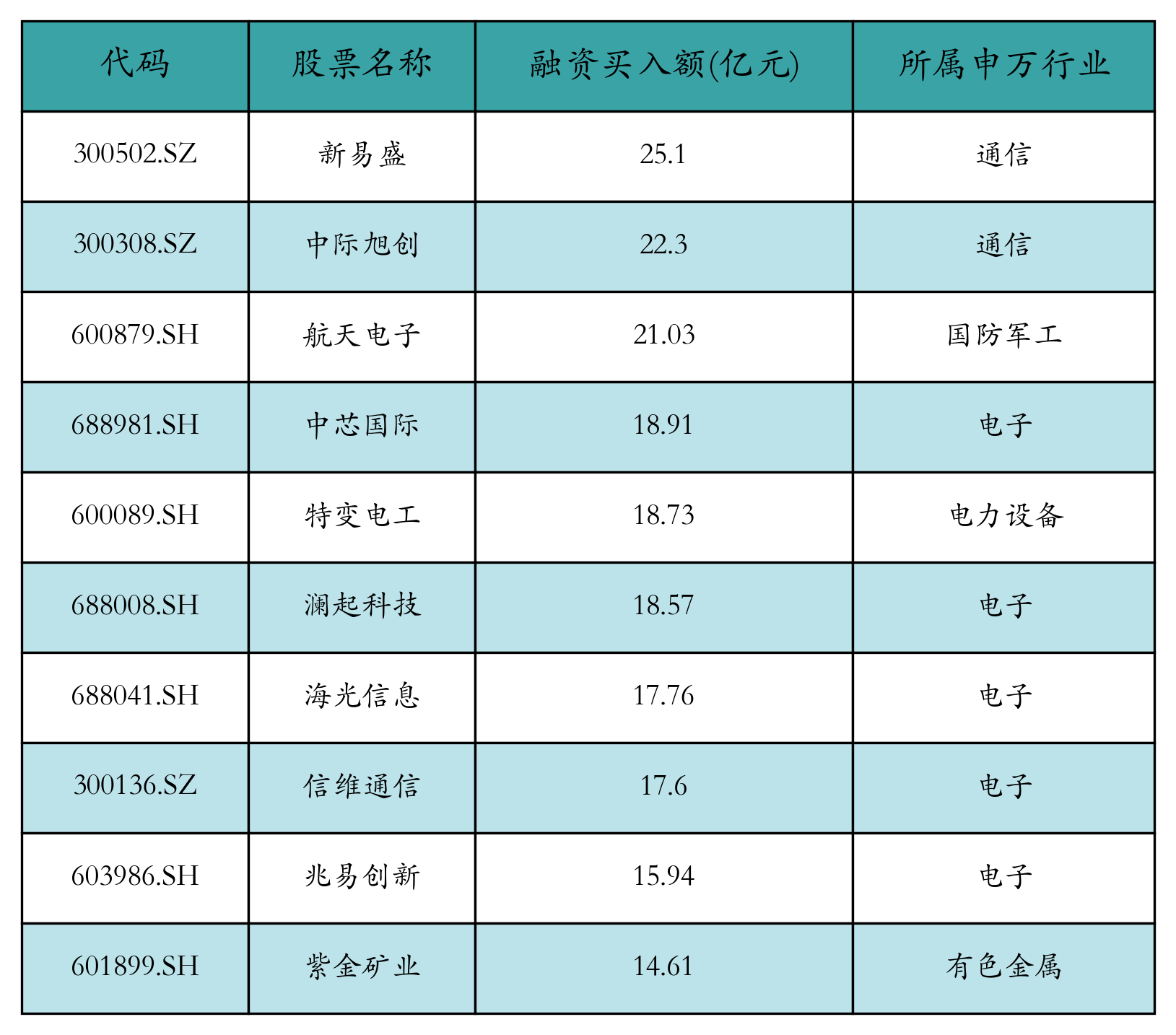
融资资金继续买入新易盛、中际旭创丨资金流向日报
2 1 Shi Ji Jing Ji Bao Dao· 2026-01-22 02:20
Market Overview - The Shanghai Composite Index rose by 0.08% to close at 4116.94 points, with a daily high of 4135.96 points [1] - The Shenzhen Component Index increased by 0.7% to close at 14255.12 points, reaching a peak of 14320.94 points [1] - The ChiNext Index gained 0.54%, closing at 3295.52 points, with a maximum of 3329.5 points [1] Margin Trading and Securities Lending - The total margin trading and securities lending balance in the Shanghai and Shenzhen markets reached 27119.75 billion yuan, with a financing balance of 26945.23 billion yuan and a securities lending balance of 174.52 billion yuan [2] - This represents an increase of 115.92 billion yuan compared to the previous trading day [2] - The Shanghai market's margin trading balance was 13746.08 billion yuan, up by 101.13 billion yuan, while the Shenzhen market's balance was 13373.67 billion yuan, increasing by 14.8 billion yuan [2] Fund Issuance - Seven new funds were launched yesterday, including: - E Fund Hong Kong Stock Connect Consumer Mixed A - E Fund Hong Kong Stock Connect Consumer Mixed C - Huitianfu Gain Return Bond A - Huaxia CSI 500 Free Cash Flow ETF Link C - Huitianfu Gain Return Bond C - Huaxia CSI 500 Free Cash Flow ETF Link A - E Fund Shanghai Composite ETF [4] Top Net Purchases on the Dragon and Tiger List - The top 10 net purchases on the Dragon and Tiger list included: - Zhongtung High-tech with a net purchase of 57664.7 million yuan - Longxin Technology with 26946.73 million yuan - Dazhu CNC with 25319.57 million yuan - Zhongrong Electric with 21762.39 million yuan - Tongfu Microelectronics with 20382.62 million yuan [6]