SMIC(688981)

Search documents
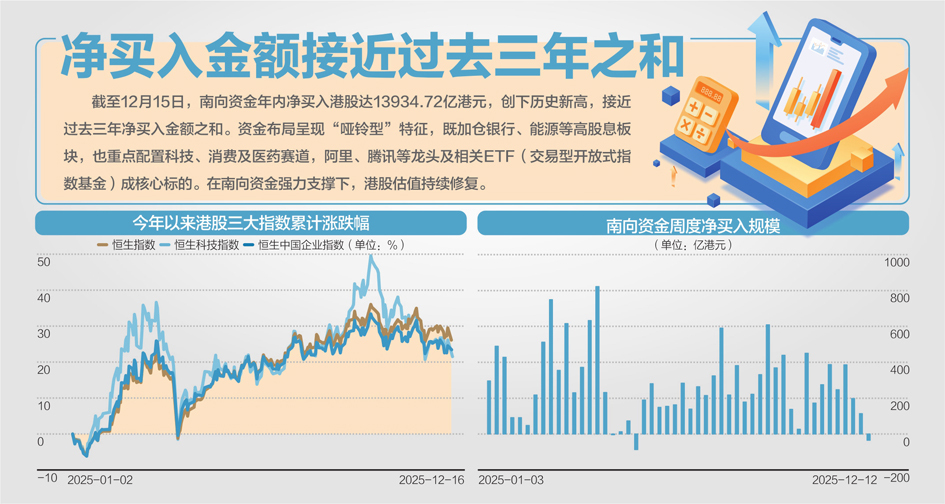
南向资金累计净买入1.39万亿港元
Mei Ri Jing Ji Xin Wen· 2025-12-16 12:16
Group 1 - The core viewpoint of the articles highlights that 2025 has seen unprecedented inflows of southbound capital into the Hong Kong stock market, with a cumulative net purchase amount reaching 50,912.63 billion HKD as of December 15, 2025, and a record annual net purchase of 13,934.72 billion HKD [1][3] - The Hang Seng Index has performed exceptionally well, with a year-to-date increase of over 27%, making it the top-performing global index [3] - Major stocks favored by southbound capital include Tencent Holdings and Alibaba, with Tencent holding a market value of 6,204 billion HKD and Alibaba at 3,422 billion HKD [4] Group 2 - Despite significant purchases by southbound capital, not all companies have seen corresponding stock price increases, as evidenced by the performance of certain stocks that have declined despite increased holdings [5][6] - Southbound long-term capital is becoming a key driver for the restructuring of liquidity and optimization of valuation in the Hong Kong stock market, with expectations of continued inflows and improvements in market conditions [7]





资金动向 | 北水加仓小米集团、小鹏汽车,连续6日甩卖中芯国际
Sou Hu Cai Jing· 2025-12-16 11:16
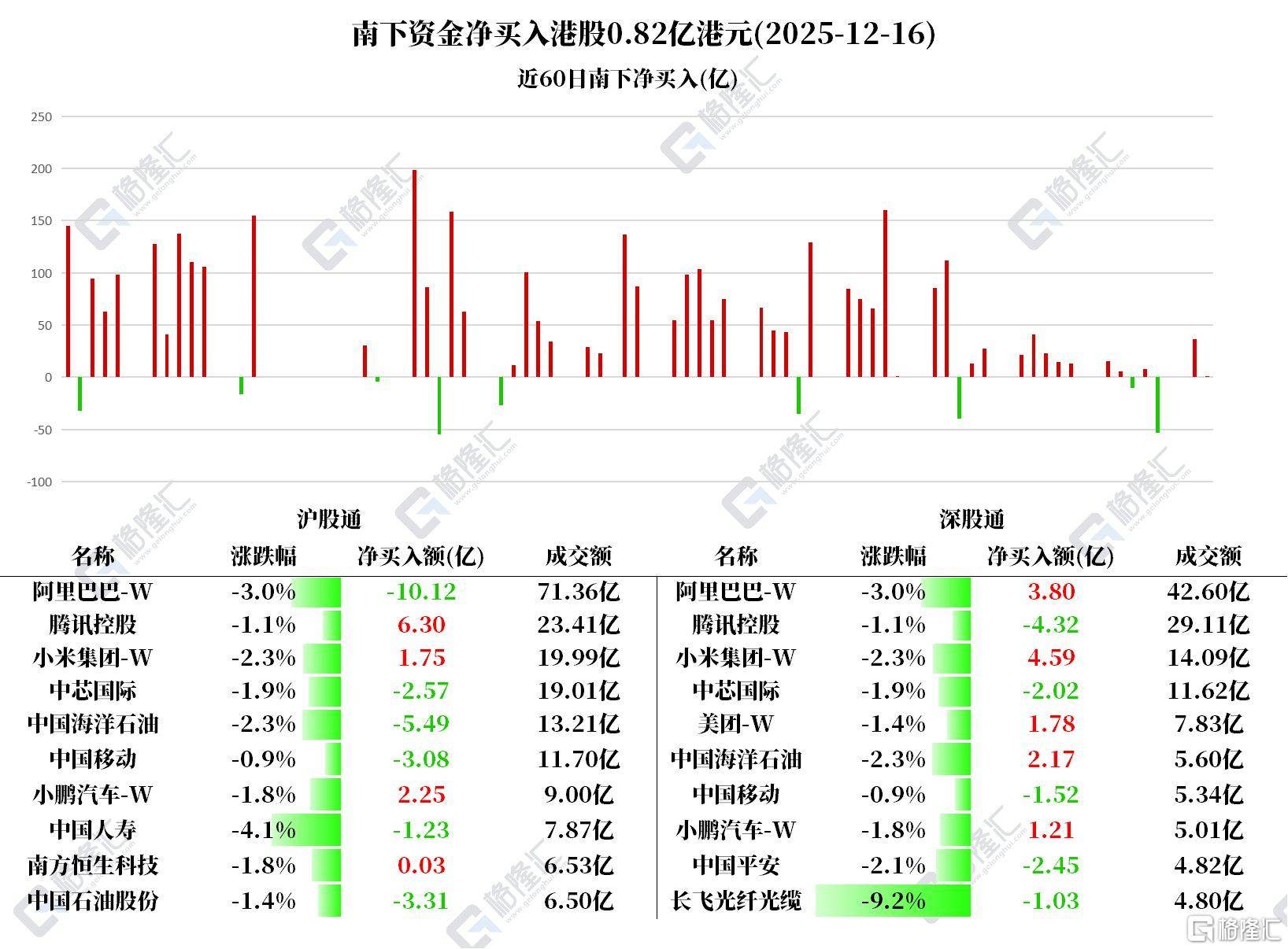
Group 1: Market Activity - Net purchases included Xiaomi Group at 633 million HKD, Xpeng Motors at 345 million HKD, Tencent Holdings at 197 million HKD, and Meituan at 177 million HKD [1] - Net sales included Alibaba at 631 million HKD, China Mobile at 460 million HKD, SMIC at 459 million HKD, CNOOC at 332 million HKD, PetroChina at 330 million HKD, Ping An at 245 million HKD, China Life at 123 million HKD, and Yangtze Optical Fibre at 102 million HKD [1] - Southbound funds have continuously net purchased Xiaomi for 13 days, totaling 12.78378 billion HKD, and Meituan for 5 days, totaling 4.80742 billion HKD [1] Group 2: Stock Performance - Alibaba saw a decline of 3.0% with a net outflow of 1.012 billion HKD [2] - Tencent Holdings experienced a decrease of 1.1% with a net inflow of 630 million HKD [2] - Xiaomi Group declined by 2.3% with a net inflow of 175 million HKD [2] Group 3: Company Developments - Xiaomi Group repurchased approximately 294 million HKD worth of 7.2 million B shares at a price range of 40.36 to 41 HKD per share [3] - Xpeng Motors received an L3 autonomous driving road test license in Guangzhou and plans to launch L4 capable vehicles by 2026 [3] - Tencent Holdings repurchased approximately 640 million HKD worth of 1.067 million shares [3] - Meituan announced the suspension of its "Tuan Hao Huo" business to focus on exploring new retail formats [3]
图解丨南下资金净买入小米,净卖出阿里
Ge Long Hui A P P· 2025-12-16 10:02
Group 1 - Southbound funds net bought Hong Kong stocks worth 82.029 million HKD today [1] - Notable net purchases included Xiaomi Group-W at 633 million, Xpeng Motors-W at 345 million, Tencent Holdings at 197 million, and Meituan-W at 177 million [1] - Significant net sales were observed for Alibaba-W at 631 million, China Mobile at 460 million, SMIC at 459 million, CNOOC at 332 million, and PetroChina at 330 million [1] Group 2 - Southbound funds have net bought Xiaomi for 13 consecutive days, totaling 12.78378 billion HKD [1] - Meituan has seen net purchases for 5 consecutive days, amounting to 4.80742 billion HKD [1] - SMIC has experienced net sales for 6 consecutive days, totaling 2.44528 billion HKD [1] - CNOOC has faced net sales for 4 consecutive days, amounting to 1.73379 billion HKD [1]



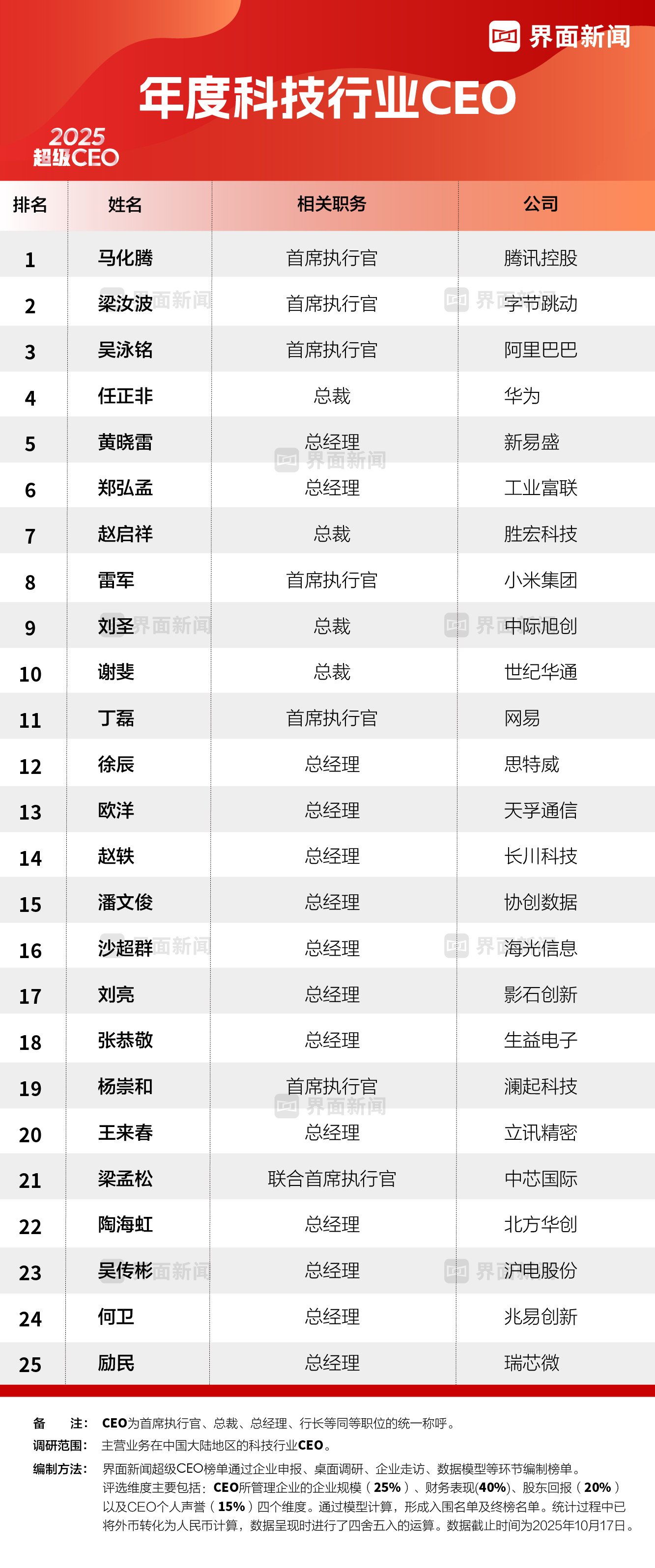
界面新闻2025年度科技行业CEO榜单发布:腾讯马化腾登顶
Xin Lang Cai Jing· 2025-12-16 08:07
Core Insights - The article highlights the release of the "Annual Super CEO" list by Zhito Finance, recognizing outstanding leaders in various industries who have achieved financial growth and shareholder returns while maintaining personal reputation [1][9] - The technology sector is emphasized, with a focus on CEOs leading companies in China's mainland technology industry, showcasing their exceptional performance in a challenging economic environment [1][9] Industry Overview - The technology industry, as defined by Zhito Finance, includes information and communication technology (ICT) and its derivative application sectors, with significant developments in artificial intelligence, cloud computing, the metaverse, and semiconductors [2] - China's R&D investment is projected to exceed 3.63 trillion yuan, with an R&D intensity of 2.69%, indicating a strong focus on innovation and technological advancement [7] CEO Performance - The 25 CEOs on the list achieved a median revenue growth of 45.06% and a median net profit growth of 71.96%, with median return on equity and total asset return at 15.99% and 10.10% respectively [9] - The average market capitalization of these companies reached 632.997 billion yuan, reflecting their significant market presence [9] Notable CEOs - Tencent's CEO, Ma Huateng, ranked first, with the company achieving a revenue of 660.257 billion yuan in 2024, a year-on-year increase of 8.41%, and a net profit of 194.073 billion yuan, up 68.44% [18] - Huawei's CEO, Ren Zhengfei, ranked fourth, with the company reporting a revenue of 862.1 billion yuan, a 22.42% increase, and R&D investment of 179.1 billion yuan, accounting for 20.8% of total revenue [19] - Zhao Qixiang, CEO of Shenghong Technology, ranked seventh, with a revenue of 10.731 billion yuan, a 35.31% increase, and a net profit of 1.154 billion yuan, up 71.96% [20] Gender and Education Representation - Among the 25 CEOs, only four are women, indicating a male-dominated leadership landscape [9] - Nearly 50% of the CEOs have advanced degrees, with eight holding master's degrees and four holding doctorates [13] Sector Distribution - The semiconductor sector leads with seven companies represented, followed by five internet-related companies [15]



港股科技公司掀“回购热潮”,恒生科技ETF易方达(513010)近一个月“吸金”近35亿元
Mei Ri Jing Ji Xin Wen· 2025-12-16 06:57
Core Viewpoint - The Hong Kong stock market, particularly the technology sector, is experiencing a period of low volatility and correction, yet companies are actively engaging in share buybacks, signaling confidence in future industry developments [1]. Group 1: Market Performance - As of December 16, the Hang Seng Technology Index has declined by 2.3% [1]. - Nearly 260 Hong Kong-listed companies have implemented buybacks this year, totaling approximately 170 billion HKD [1]. Group 2: Company Actions - Major technology firms such as Tencent Holdings, Xiaomi Group, and Kuaishou are among the top companies in terms of buyback amounts, indicating strong corporate confidence in the sector's future [1]. Group 3: Investment Insights - Minsheng Securities maintains a positive outlook on the revaluation of AI in China, suggesting investors focus on platform-based internet companies with computational resources and application capabilities [1]. - The Hang Seng Technology Index consists of the 30 largest stocks related to technology themes, focusing on sectors like semiconductors and robotics, with key companies including Meituan, Tencent Holdings, Alibaba, and SMIC [1]. - The current rolling price-to-earnings ratio of the index is 23 times, which is at the 31.7% percentile since its inception in 2020, indicating potential long-term investment value [1]. Group 4: ETF Performance - The Hang Seng Technology ETF (E Fund, 513010) has seen a net inflow of nearly 3.5 billion CNY over the past month, with a total product size of approximately 26 billion CNY, reflecting good liquidity for investors looking to access core Hong Kong technology companies [2].



阿里巴巴、商汤、中芯国际、小米,集体大跌
Di Yi Cai Jing Zi Xun· 2025-12-16 05:54
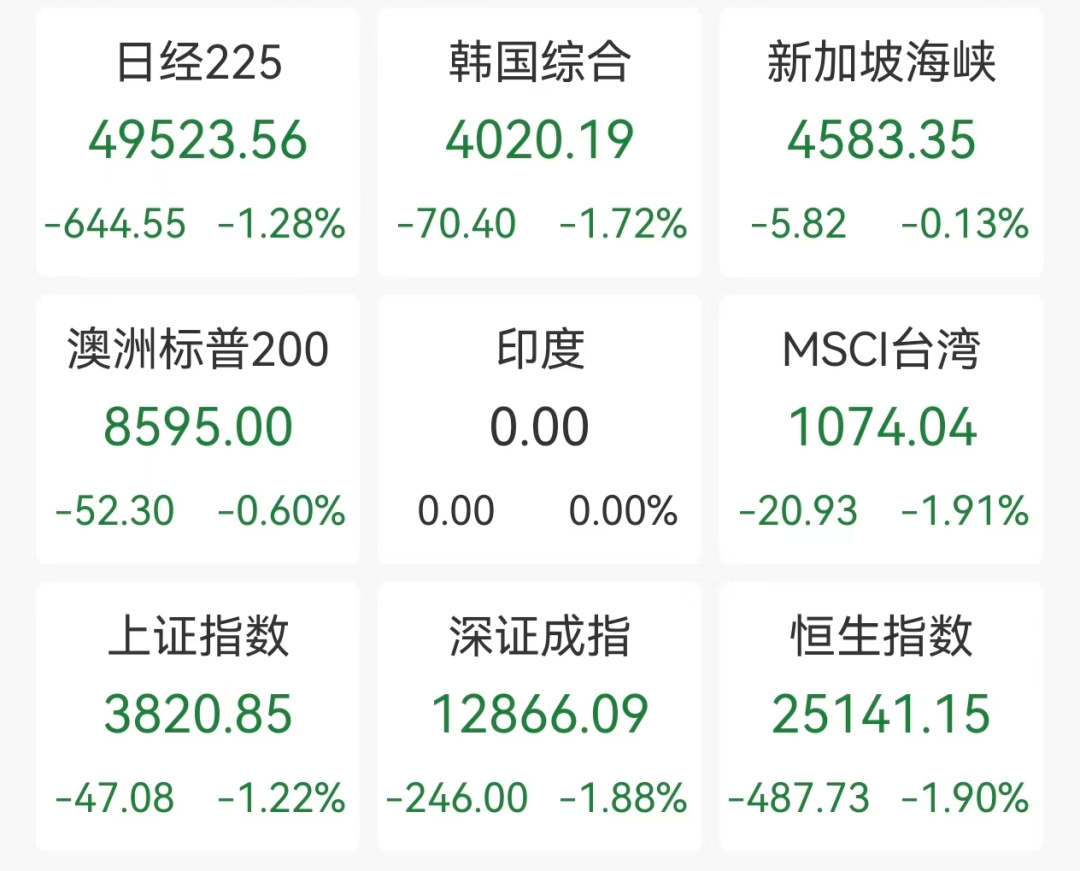
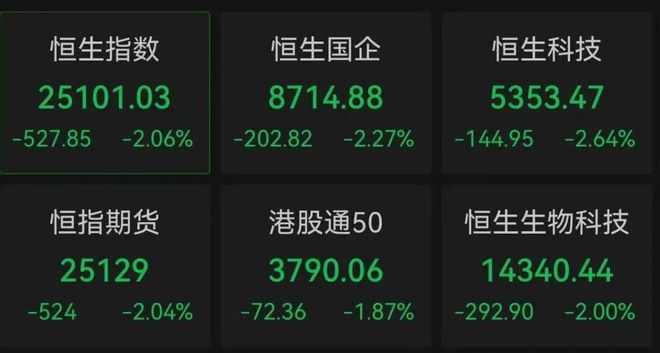
Market Overview - The Hong Kong stock market experienced a significant decline, with the Hang Seng Index dropping over 2% and the Hang Seng Tech Index falling by 2.6% [1] - Major tech stocks in Hong Kong saw widespread losses, with SenseTime down over 5%, Alibaba and Xpeng Motors down over 4%, and Tencent Music, SMIC, Xiaomi, and JD Health all down over 3% [2][3] Index Performance - The Hang Seng Index closed at 25,101.03, down 527.85 points or 2.06% - The Hang Seng China Enterprises Index (H-shares) fell to 8,714.88, down 202.82 points or 2.27% - The Hang Seng Tech Index ended at 5,353.47, down 144.95 points or 2.64% [2] Notable Stock Movements - SenseTime (stock code: 0020.HK) closed at 2.010, down 5.63% - Xpeng Motors (stock code: 9868.HK) closed at 70.150, down 4.88% - Alibaba (stock code: 9988.HK) closed at 142.200, down 4.31% - Tencent Music (stock code: 1698.HK) closed at 68.600, down 3.58% - SMIC (stock code: 0981.HK) closed at 62.400, down 3.55% [3][4] Regional Market Trends - The broader Asia-Pacific market also showed negative trends, with major indices such as the Nikkei 225, KOSPI, MSCI Taiwan Index, Shanghai Composite Index, and Shenzhen Component Index all declining by over 1% [4][5]
亚太股市全线下跌 港股阿里、中芯国际跌近4% 金银跳水
2 1 Shi Ji Jing Ji Bao Dao· 2025-12-16 04:50
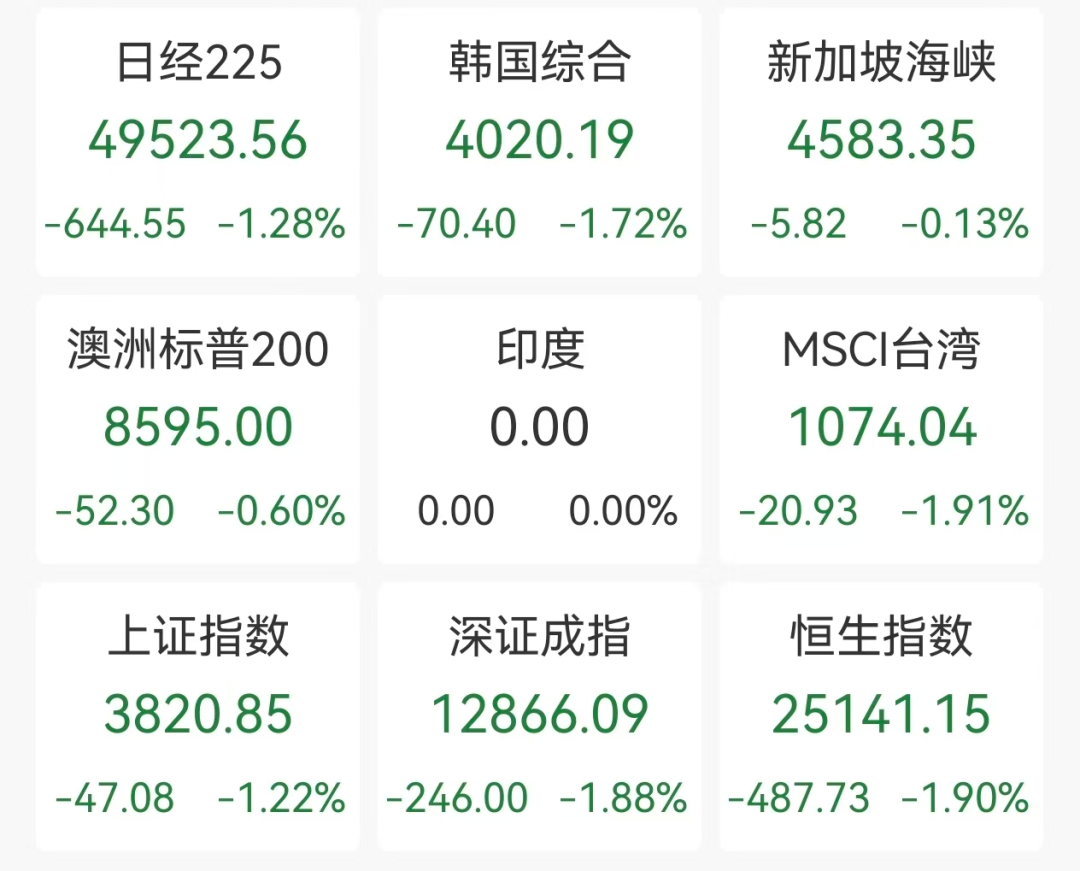
Market Overview - Major Asia-Pacific stock indices experienced a decline, with the Nikkei 225 and the KOSPI both dropping over 1% [1] - A-shares and Hong Kong's Hang Seng Index also fell, with the FTSE China A50 futures down more than 1% [1] A-Shares Performance - A-shares showed volatility in early trading, with the Shanghai Composite Index and Shenzhen Component Index both down over 1%, while the ChiNext Index fell over 2% [2][3] - The total number of declining stocks in the market reached 4,464, with a trading volume of 1.14 trillion yuan, slightly below the predicted 1.81 trillion yuan [3] Sector Performance - The photovoltaic and energy storage sectors continued to adjust, with stocks like Dongfang Risheng dropping over 10% and others like Zhongli Group nearing their daily limit down [3] - Precious metals sector saw significant declines, with companies like Western Gold and Xiaocheng Technology falling over 6% [4][5] Cryptocurrency Market - The cryptocurrency market continued to experience sharp declines, with Bitcoin dropping below $86,000 and over 180,000 traders facing liquidation in the past 24 hours [9][10] Retail and Technology Sectors - The retail sector showed resilience, with stocks like Baida Group achieving four consecutive trading limit ups, and Hongqi Chain and Guangbai Co. both achieving two consecutive limit ups [6] - The smart driving sector gained strength, with companies like BAIC Blue Valley hitting the daily limit up, supported by news of L3-level conditional autonomous driving testing in Shenzhen [7] Hong Kong Market - The Hang Seng Index fell by 1.8%, with the Hang Seng Tech Index down approximately 2.5%, and major stocks like Alibaba and SMIC dropping nearly 4% [7][8]
中芯国际12月15日获融资买入5.21亿元,融资余额127.43亿元
Xin Lang Cai Jing· 2025-12-16 04:48
Group 1 - On December 15, SMIC's stock fell by 3.24% with a trading volume of 3.934 billion yuan, and the net financing buy was -16.3162 million yuan [1] - As of December 15, the total margin balance for SMIC was 12.768 billion yuan, with a financing balance of 12.743 billion yuan, accounting for 5.64% of the circulating market value, indicating a high level compared to the past year [1] - In terms of securities lending, on December 15, SMIC repaid 20,300 shares and sold 10,000 shares, with a selling amount of 1.1308 million yuan, and the securities lending balance was 24.6562 million yuan, also indicating a high level compared to the past year [1] Group 2 - As of September 30, SMIC had 336,200 shareholders, an increase of 33.27% from the previous period, while the average circulating shares per person decreased by 25.41% [2] - For the period from January to September 2025, SMIC achieved operating revenue of 49.51 billion yuan, a year-on-year increase of 18.22%, and a net profit attributable to shareholders of 3.818 billion yuan, a year-on-year increase of 41.09% [2] - Among the top ten circulating shareholders as of September 30, 2025, several ETFs reduced their holdings, while new shareholders entered the list, indicating changes in institutional ownership [2]
港股科技股集体下挫,恒生科技跌2.5%,阿里跌4%,中芯国际、腾讯音乐、阿里健康、小米、华虹半导体跌超3%


Ge Long Hui· 2025-12-16 04:37
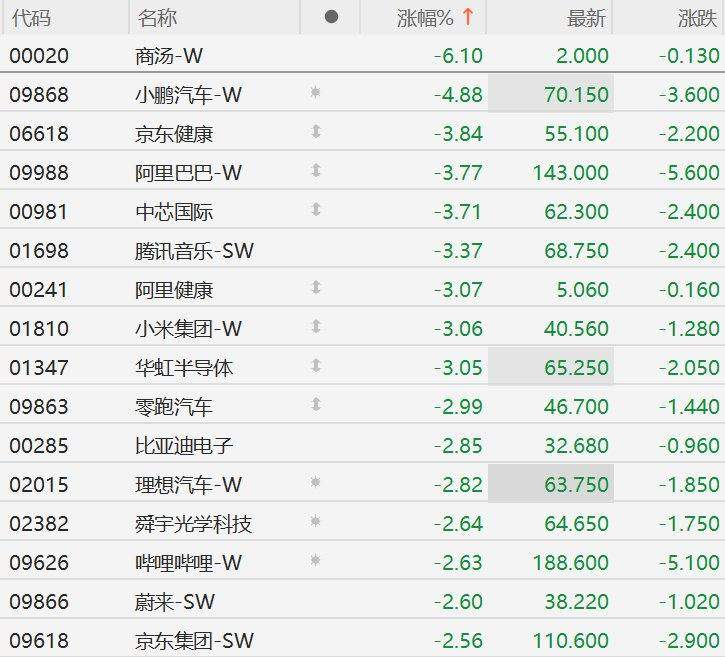
Core Viewpoint - The Hong Kong technology stocks experienced a collective decline, with the Hang Seng Technology Index dropping by 2.5% Group 1: Stock Performance - SenseTime (商汤) fell over 6%, closing at 2.000, down by 0.130 [1][2] - Xpeng Motors (小鹏汽车) decreased by 4.88%, with a latest price of 70.150, down by 3.600 [1][2] - Alibaba (阿里巴巴) saw a decline of 3.77%, trading at 143.000, down by 5.600 [1][2] - JD Health (京东健康) dropped by 3.84%, with a price of 55.100, down by 2.200 [1][2] - Semiconductor Manufacturing International Corporation (中芯国际) fell by 3.71%, closing at 62.300, down by 2.400 [1][2] - Tencent Music (腾讯音乐) decreased by 3.37%, with a latest price of 68.750, down by 2.400 [1][2] - Alibaba Health (阿里健康) dropped by 3.07%, trading at 5.060, down by 0.160 [1][2] - Xiaomi (小米) fell by 3.06%, closing at 40.560, down by 1.280 [1][2] - Huahong Semiconductor (华虹半导体) decreased by 3.05%, with a price of 65.250, down by 2.050 [1][2] - Li Auto (理想汽车) saw a decline of 2.82%, trading at 63.750, down by 1.850 [1][2] - NIO (蔚来) fell by 2.60%, closing at 38.220, down by 1.020 [1][2]
亚太股市全线下跌,港股阿里、中芯国际跌近4%,金银跳水
2 1 Shi Ji Jing Ji Bao Dao· 2025-12-16 04:21
Market Overview - Major Asia-Pacific stock indices experienced a decline, with the Nikkei 225 and the KOSPI both dropping over 1% as of midday [1] - The A-share indices and the Hong Kong Hang Seng Index also fell, with the FTSE China A50 futures down more than 1% [1] A-Share Market - The A-share market showed volatility, with the Shanghai Composite Index and Shenzhen Component Index both down over 1%, while the ChiNext Index fell over 2% [2] - A total of 4,464 stocks in the market declined, indicating a broad-based sell-off [2] - Specific sectors such as photovoltaic and energy storage continued to adjust, with companies like Dongfang Risheng (300118) dropping over 10% and Zhongli Group (002309) nearing a trading halt [2] Precious Metals - The precious metals sector saw significant declines, with companies like Western Gold (601069) and Xiaocheng Technology (300139) falling over 6% [3] - International gold and silver prices also dropped, with spot silver plunging over 2% and spot gold decreasing approximately 0.4%, while New York futures gold fell below $4,310 per ounce [3] Retail and Technology Sectors - The retail sector showed resilience, with Baida Group (600865) achieving four consecutive trading limits, and Hongqi Chain (002697) and Guangbai Shares (002187) both securing two consecutive trading limits [5] - The smart driving sector gained momentum, with companies like BAIC Blue Valley (600733) hitting the upper limit, and multiple stocks such as Duolun Technology (603528) and Luchang Technology (002813) also reaching trading limits [5] Hong Kong Market - The Hong Kong Hang Seng Index fell by 1.8%, with the Hang Seng Tech Index down approximately 2.5% [5] - Major companies like Alibaba and SMIC saw their stock prices drop nearly 4% [5] Cryptocurrency Market - The cryptocurrency market continued to decline, with Bitcoin dropping below $86,000, and over 180,000 traders facing liquidation in the past 24 hours [7] - Specific price movements included Bitcoin at $85,738.7 (-4.05%), Ethereum at $2,932.23 (-6.00%), and XRP at $1.8613 (-6.67%) [8]