PAB(000001)

Search documents
2026年国有大行、股份行怎么干?
券商中国· 2026-01-30 04:45
1月以来,银行业机构陆续召开2026年经营工作会议,总结过去一年乃至整个"十四五"时期的经营 成绩,为新的一年谋篇布局。 谈及2025年经营,"高质量发展"成为高频词。多家银行透露,各项工作"稳中有进""稳中提质",且"综合实力 迈上新台阶",为下一个五年发展打下了坚实基础。 2026年是"十五五"开局之年。多家银行强调,将加大对重点领域金融支持,做实做细金融"五篇大文章",有效 防范化解重点领域风险,支持巩固经济稳中向好态势。 其中,包括工行、建行、农行、交行在内,多家银行明确将加快推动数智化转型。"降本提质增效"等表述也出 现在工行、农行、建行、交行、平安银行的工作部署中。 工商银行:做强主业、做优质效、做大贡献 工商2026年党建暨经营管理工作会议强调,要打造一流银行、领军银行、清廉银行、现代银行,持续做强主 业、做优质效、做大贡献。 一是提升防风险成效,推动全面风险管理取得新进步,加快智能化风控平台进业务进场景。 二是提升强合规能力,确保内控管理实现新跃升,把依法合规经营打造为核心竞争力。 二要加大重点领域融资供给,助力巩固拓展经济稳中向好势头。持续加大"两重""两新"和民生、消费等领域金 融支持;进 ...








平安银行取得编程接口确定方法专利
Sou Hu Cai Jing· 2026-01-30 03:50
Group 1 - The core point of the article is that Ping An Bank has obtained a patent for a method and device related to programming interfaces, indicating its focus on technological innovation [1] - The patent was granted with the announcement number CN115599376B, and the application date was October 2022 [1] - Ping An Bank, established in 1987 and located in Shenzhen, primarily engages in monetary financial services, with a registered capital of approximately 11.42 billion RMB [1] Group 2 - According to data from Tianyancha, Ping An Bank has made investments in 11 companies and participated in 1,146 bidding projects [1] - The bank holds 497 trademark registrations and 4,651 patent records, showcasing its active engagement in intellectual property [1] - Additionally, Ping An Bank possesses 71 administrative licenses, reflecting its compliance and operational capabilities [1]
11 家大行去年理财代销增超万亿
Jing Ji Guan Cha Wang· 2026-01-30 02:45
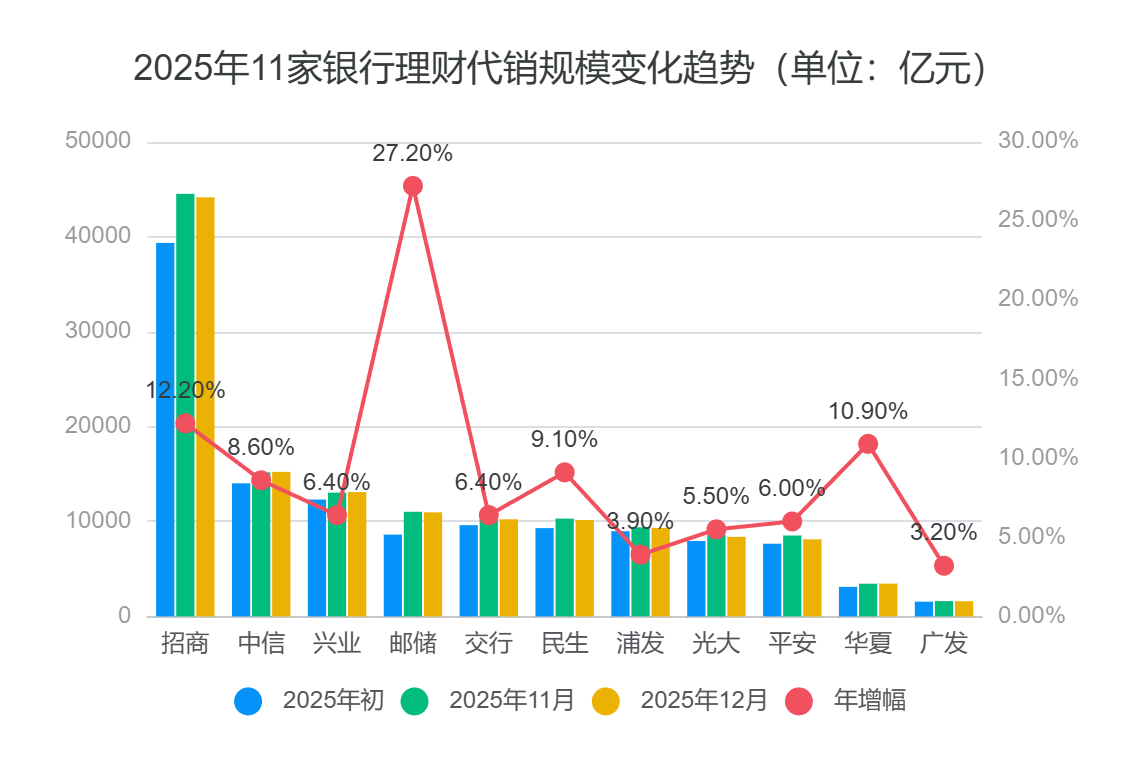
Core Viewpoint - The report highlights a decline in the scale of bank wealth management sales in December 2025, with a total of 13.46 trillion yuan, a decrease of 1.05% from November, but an increase of 10% from the beginning of the year. The growth is attributed to a "deposit migration" logic, indicating a shift in customer preferences towards wealth management products [2][6]. Group 1: Bank Performance - Postal Savings Bank showed a remarkable growth rate of 27.2%, leading among the 11 national banks, while China Merchants Bank followed with a 12.2% increase [2][4]. - In absolute terms, China Merchants Bank led with a wealth management sales scale of 4.41 trillion yuan, followed by CITIC Bank and Industrial Bank, each exceeding 1 trillion yuan [2][4]. - The ranking of the 11 banks remained relatively stable, with Postal Savings Bank rising from 7th to 4th place by the end of the year [2][4]. Group 2: Market Dynamics - The overall wealth management sales scale of the 11 banks increased by 1.22 trillion yuan, reflecting a 10% growth from the beginning of the year, with three banks (Postal Savings, China Merchants, and Huaxia) achieving growth rates above 10% [5][6]. - The average yield of wealth management products fell below 2% for the first time, at 1.98%, yet the number of investors increased by 14.37%, indicating a strong demand for stable-return products [8][9]. - The "deposit migration" narrative remains a key driver for the growth of wealth management, as banks focus on deeper market penetration and optimizing customer service [9][10]. Group 3: Future Outlook - Predictions suggest that by the end of 2026, the wealth management scale could reach approximately 38 trillion yuan, with a growth rate of around 12% [11]. - The average risk index is expected to gradually rise, and the proportion of long-term products is anticipated to increase, while T+0 products will decrease [11].



平安银行取得日志脱敏方法专利
Sou Hu Cai Jing· 2026-01-30 02:32
Group 1 - The core point of the article highlights that Ping An Bank has obtained a patent for a "log desensitization method, device, electronic equipment, and storage medium," with the authorization announcement number CN115600238B and an application date of September 2022 [1] - Ping An Bank, established in 1987 and located in Shenzhen, primarily engages in monetary financial services, with a registered capital of approximately 11.42 billion RMB [1] - According to data analysis from Tianyancha, Ping An Bank has made investments in 11 companies, participated in 1,146 bidding projects, holds 497 trademark information records, and has 4,651 patent records, in addition to possessing 71 administrative licenses [1]
平安久瑞回报混合型证券投资基金基金份额发售公告
Zhong Guo Zheng Quan Bao - Zhong Zheng Wang· 2026-01-29 23:47
Group 1 - The fund being launched is called "Ping An Jiurui Return Mixed Securities Investment Fund," which is a mixed-type securities investment fund [18][19] - The fund's management company is Ping An Fund Management Co., Ltd., and the custodian is Ping An Bank Co., Ltd. [18][65] - The fund will be publicly offered from February 26, 2026, to March 13, 2026, with a maximum fundraising limit of 3 billion RMB [2][23] Group 2 - The fund has two classes of shares: Class A and Class C, with different fee structures. Class A shares do not charge subscription fees when purchased directly from the fund management company, while Class C shares charge a service fee instead [25][28] - The minimum subscription amount for Class A shares through direct sales is 50,000 RMB, while for Class C shares, it is 1 RMB [4][5] - The fund's total fundraising limit is set at 30 billion RMB, and if the subscription requests exceed this limit, a "last day proportion confirmation" method will be used to control the effective scale [7][23] Group 3 - Investors can subscribe multiple times during the fundraising period, and the subscription fee will be calculated separately for each application [10][35] - The fund will not impose a limit on the total number of shares that a single investor can hold, but if an investor's holdings reach or exceed 50% of the total fund shares, the management company may restrict further subscriptions [9][35] - The fund's assets will be verified by a qualified accounting firm after the fundraising period, and if the contract conditions are met, the fund will be officially established [64]
银行积存金从“赚利息”转向“看行情”
Mei Ri Shang Bao· 2026-01-29 23:23
根据宁波银行手机银行的介绍,定存金业务是客户在该行开立个人结算账户,通过柜面或网银渠道,与 该行签订定存金协议,约定定存金数量、期限、价格等要素,购入该行以黄金资产为标的的相关定存金 份额,进行定存操作,到期后获得以人民币计的定存金利息,并可对定存份额进行续存、赎回或提取的 业务。 据悉,"定存金"是一款R3中风险理财产品,其收益与金市波动相关。市场分析认为,此次利率调整主 要背景是近期国际金价持续处于高位且波动显著,银行方面为合理对冲风险、控制资金与运营成本所采 取的措施,也提醒投资者应充分关注黄金市场波动及该类产品的自身风险属性。 商报讯 (记者 苗露) 近日,宁波银行发布公告,决定自今年1月28日起调整定存金产品定存利率。调 整后的定存金产品定存利率活期降为0%。事实上,在近期金价高位运行背景下,银行已然着手调整相 关业务定价。除却宁波银行外,近期还有平安银行也曾发布公告下调黄金积存业务利率。 业内人士建议,投资者应更关注黄金的长期配置价值和波动风险,通过定投方式平摊成本,而非过度在 意微薄的利息差异,也要避免单纯因"存款+利息"的简单考量而盲目入场。 银行下调黄金积存利率 从宁波银行发布的公告来看,1 ...

金价继续飙升 多家银行调整积存金业务
Nan Fang Du Shi Bao· 2026-01-29 23:11
Core Insights - The price of spot gold has surged, breaking the $5,500 per ounce mark, continuing its upward trend [2] - Banks are adjusting their gold accumulation business, with some lowering interest rates to 0% for demand deposits and increasing minimum investment amounts [3][4] - Experts emphasize that gold should be viewed as a risk hedge rather than a speculative investment tool [6] Summary by Category Gold Price Movement - As of January 29, 2026, spot gold reached a peak of $5,598.75 per ounce, marking a significant increase of nearly 30% since the beginning of the year [5][6] - The price has consistently broken through key levels, including $5,000, $5,100, $5,200, $5,300, and $5,400 in a short span [5] Bank Adjustments - Ningbo Bank announced changes to its gold accumulation product interest rates, with demand deposit rates dropping to 0% and various term rates adjusted [3] - Ping An Bank also revised its rates, with demand deposit rates set at 0.01% and term deposits adjusted accordingly [4] - Other banks, including Agricultural Bank and Industrial and Commercial Bank, have implemented similar measures, requiring risk assessment for clients engaging in gold accumulation [5] Investment Guidance - Experts advise that gold should serve as a "ballast" and "insurance" in asset allocation, primarily to hedge against extreme risks and stabilize overall portfolio volatility [6] - New investors are cautioned against treating gold as a means for quick wealth accumulation and are encouraged to adopt a disciplined investment approach, such as regular fixed investments [6]

金价一路飙涨突破5500美元/盎司,有银行将黄金账户活期利率下调至0%
Mei Ri Jing Ji Xin Wen· 2026-01-29 14:28
Core Viewpoint - The price of gold has surged, breaking through the $5,500 per ounce mark, prompting banks to adjust their gold-related business practices, reflecting a cautious approach to compliance and risk management [1][6]. Group 1: Bank Adjustments - Banks are making adjustments in three main areas: lowering gold account interest rates, increasing investment thresholds, and strengthening risk assessments [1][4]. - For instance, Ningbo Bank has reduced its fixed deposit gold product rates, with current rates ranging from 0% for demand deposits to 0.5% for 12-month deposits, down from previous rates [2]. - Similarly, Ping An Bank is adjusting its gold accumulation business rates, with a decrease of 19-30 basis points across various terms [2][3]. Group 2: Increased Investment Thresholds - Several banks have raised the minimum investment amounts for gold accumulation products, such as Everbright Bank increasing its minimum from 1,000 yuan to 1,200 yuan within a short period [3]. - Agricultural Bank has also implemented a risk assessment requirement for clients wishing to engage in gold accumulation, necessitating a cautious risk profile [4]. Group 3: Risk Assessment Enhancements - Banks are enhancing risk assessment protocols, with institutions like ICBC requiring clients to achieve a minimum risk tolerance level of C3 (balanced) for gold accumulation products, up from C1 (conservative) [3][4]. - This shift indicates a significant increase in the risk profile required for clients, reflecting banks' concerns over market volatility and compliance [4]. Group 4: Market Dynamics and Investor Guidance - The recent surge in gold prices is attributed to heightened geopolitical risks and a weakening dollar, which has increased demand for gold as a safe-haven asset [6]. - Analysts suggest that while investing in gold remains viable, investors should be cautious of high volatility and avoid chasing prices, focusing instead on long-term strategies and asset allocation [7].

21独家|去年银行理财代销大增 邮储劲增27%超越交行等
2 1 Shi Ji Jing Ji Bao Dao· 2026-01-29 09:49
Core Insights - The report highlights a decline in the scale of bank wealth management sales, with a total of 13.46 trillion yuan by December 2025, down 1.05% from November but up 10% from the beginning of the year [1][7] - Postal Savings Bank showed remarkable growth, leading with a 27.2% increase, while China Merchants Bank followed with a 12.2% increase [1][5] - The overall growth in wealth management sales is attributed to a "deposit migration" trend, where customers are shifting their funds into wealth management products [7][10] Group 1: Bank Performance - By December 2025, China Merchants Bank led with a wealth management sales scale of 4.41 trillion yuan, followed by CITIC Bank and Industrial Bank, both exceeding 1 trillion yuan [1][2] - Postal Savings Bank's rise in ranking from 7th to 4th among the 11 banks indicates a significant shift in market dynamics [2][4] - The total growth in wealth management sales among the 11 banks amounted to 1.22 trillion yuan, with a year-on-year increase of 10% [7][6] Group 2: Factors Driving Growth - The growth of Postal Savings Bank's wealth management sales is linked to strategic reforms and an expansion of distribution channels, with approximately 40,000 outlets enhancing customer reach [5][6] - The shift in focus from "product sales" to "product configuration" aims to cater to high-net-worth clients, which is seen as a crucial strategy for growth [5][10] - The demand for stable, low-volatility wealth management products remains strong, particularly in a low-interest-rate environment, driving customer interest [9][10] Group 3: Market Trends - The report notes a seasonal pattern in bank wealth management, characterized by "quarter-end contraction" and "quarter-beginning recovery," influenced by regulatory requirements [8][10] - Despite a slight contraction in December, the overall wealth management scale showed resilience, indicating strong underlying demand [8][9] - Predictions suggest that the wealth management scale could reach approximately 38 trillion yuan by the end of 2026, with a projected growth rate of around 12% [12]

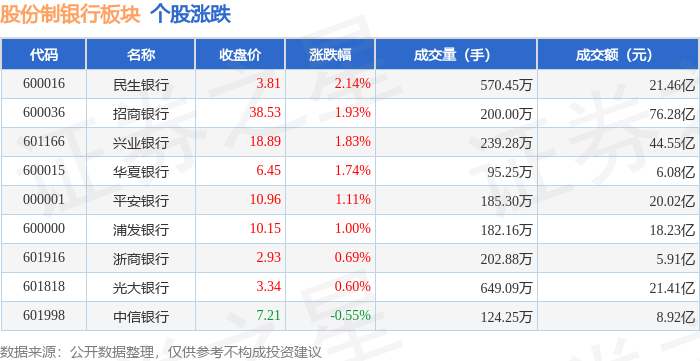
股份制银行板块1月29日涨1.31%,民生银行领涨,主力资金净流入1.17亿元
Zheng Xing Xing Ye Ri Bao· 2026-01-29 09:03
| 代码 | 名称 | 主力净流入(元) | 主力净占比 游资净流入 (元) | | 游资净占比 散户净流入 (元) | | 散户净占比 | | --- | --- | --- | --- | --- | --- | --- | --- | | 600036 招商银行 | | 5.44(Z ﻋ | 7.13% | -3.86 Z | -5.06% | -1.58 Z | -2.07% | | 600016 民生银行 | | 3.00 Z | 14.00% | -9790.09万 | -4.56% | -2.03 Z | -9.44% | | 600015 华夏银行 | | 5298.26万 | 8.72% | -1942.12万 | -3.20% | -3356.14万 | -5.52% | | 601916 浙商银行 | | -729.54万 | -1.24% | 971.12万 | 1.64% | -241.58万 | -0.41% | | 000001 平安银行 | | -1.13 Z | -5.63% | 6444.83万 | 3.22% | 4825.40万 | 2.41% | | 601166 兴 ...