ZTE(000063)

Search documents
近4400只个股上涨
第一财经· 2025-12-05 07:37
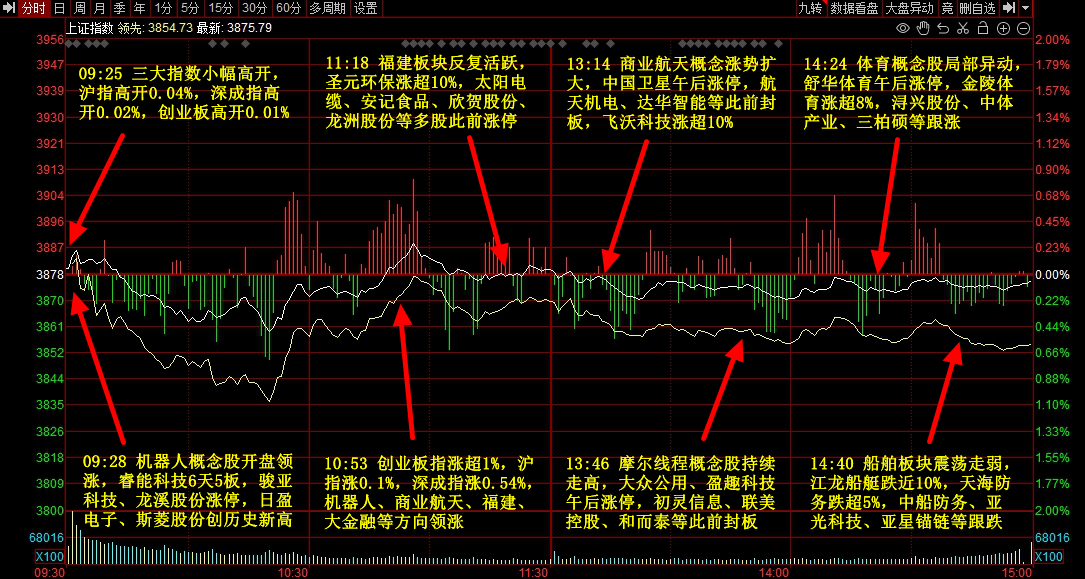
Market Overview - A-shares experienced a rebound with the Shanghai Composite Index rising by 0.7%, the Shenzhen Component Index increasing by 1.08%, and the ChiNext Index up by 1.36% [3][4]. Sector Performance - The financial sector saw significant gains, particularly in insurance, brokerage, and fintech, with notable stocks like China Pacific Insurance rising nearly 7% [5]. - The computing hardware supply chain also showed strength, especially in CPO and high-speed copper connection sectors [4]. - Commercial aerospace stocks surged, leading to a wave of limit-up stocks [4]. Notable Stocks - Major gainers in the financial sector included: - Bank of China Securities: +10.02% [6] - Industrial Securities: +5.57% [6] - Dongfang Wealth: +4.11% [6] - In the Fujian local stocks, nearly 20 stocks hit the daily limit-up, including: - Hongxiang Co.: +20.00% [7] - Qianzhao Optoelectronics: +13.93% [7] Trading Volume - The total trading volume in the Shanghai and Shenzhen markets reached 1.73 trillion yuan, an increase of 176.8 billion yuan compared to the previous trading day, with nearly 4,400 stocks rising [8]. Capital Flow - Main capital inflows were observed in sectors such as securities, non-ferrous metals, and telecommunications, while outflows were noted in banking, real estate, and consumer electronics [10]. - Specific stocks with significant net inflows included: - N-Mole-U: +2.495 billion yuan [10] - China Ping An: +1.075 billion yuan [10] - Conversely, stocks like Heertai and Sanhua Intelligent Control faced substantial net outflows [10]. Market Outlook - Analysts suggest that after a period of consolidation, the market may see structural recovery opportunities, with many sectors showing valuation attractiveness for medium to long-term investments [11]. - Predictions for 2026 indicate a potential slow bull market driven by structural earnings recovery, transitioning from a liquidity-driven valuation expansion in 2025 [11].







豆包抢入口,捅了马蜂窝
硬AI· 2025-12-05 06:45
Core Insights - The article highlights the competition for the "super entry point" in the AI era, emphasizing that the ability to control data and traffic is shifting from traditional apps to system-level AI agents [2][17] - The recent developments surrounding the Doubao AI assistant reveal the challenges faced by AI companies in navigating existing app ecosystems and data security regulations [5][19] Group 1: Doubao AI Assistant Launch and Challenges - Doubao AI assistant was launched on December 1, enabling cross-application operations, which generated significant market excitement [7][4] - Shortly after its launch, Doubao announced a temporary suspension of its ability to operate financial apps due to security concerns, highlighting the need for clear AI operation guidelines [3][4] - Major apps like WeChat, Taobao, and banks implemented measures to prevent Doubao AI from functioning properly, indicating a defensive response to the new technology [8][10] Group 2: Industry Dynamics and Competitive Landscape - The conflict between AI companies, hardware manufacturers, and app developers illustrates a complex interplay of interests and poses challenges to existing data security frameworks [5][12] - Goldman Sachs identified three core obstacles for third-party AI agents: system-level operation permissions, memory capabilities, and cross-application interface connections [12][14] - The dominance of major smartphone manufacturers in the Chinese market, which hold over 90% market share, makes it difficult for new players to disrupt the ecosystem [14][15] Group 3: Future of AI and App Ecosystem - The article suggests that as voice interaction becomes the primary entry point, traditional app operations may collapse, making it crucial to establish a default system entry point [17][20] - The ongoing battle for AI agents signifies a broader struggle involving major tech companies and highlights the potential for significant shifts in the internet landscape over the next decade [19][20]





豆包手机上线5日紧急调整,价格从3499元被炒至1.29万
2 1 Shi Ji Jing Ji Bao Dao· 2025-12-05 06:09
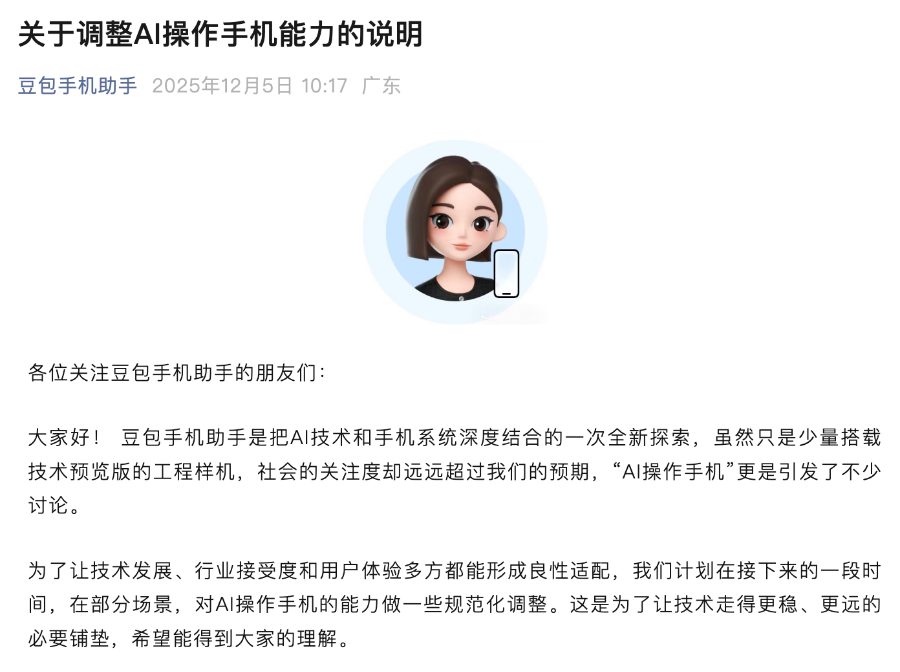
Core Viewpoint - Doubao Mobile Assistant has adjusted its AI capabilities to restrict usage in three specific scenarios: score manipulation, financial applications, and gaming applications [1][7]. Group 1: Product Launch and Market Response - Doubao Mobile Assistant was launched on December 1, in collaboration with ZTE, using the Nubia M153 model as a customized technology showcase [3]. - The product's main selling point is its automation capabilities for daily apps, including food delivery, flight booking, and price comparison [3]. - Within four days of launch, the AI phone sold out, with resale prices on second-hand platforms reaching as high as 12,900 yuan for a device originally priced at 3,499 yuan [3]. - Rental services for the Doubao phone are also emerging, with daily rental fees reaching 1,600 yuan [3]. Group 2: Restrictions and Compliance Issues - Users have reported using Doubao Mobile Assistant for activities like video watching for rewards and gaming, which have now been restricted by the company [7]. - The official explanation for these restrictions is to maintain the integrity of user interactions and ensure fairness in gaming scenarios [7]. - Financial applications such as Taobao and major banks have encountered issues where Doubao Mobile Assistant cannot log in or complete transactions, leading to a temporary suspension of its operational capabilities in these areas [7]. - The initial warning came from WeChat, which flagged users for abnormal login environments, prompting Doubao to disable related functionalities [7]. Group 3: Technical and Compliance Challenges - The AI assistant relies on screen reading and simulation operations, utilizing large model recognition and Robotic Process Automation (RPA) [8]. - Most apps have not participated in the authorization process, leading to security measures that restrict automated tools [8]. - The isolation system in mobile operating systems prevents apps from accessing each other's data, which the AI assistant's screen reading capabilities bypass [8]. - Doubao is actively seeking to communicate with application developers to establish clearer rules and avoid blanket restrictions on AI usage [8].
豆包手机上线5日紧急调整,价格从3499元被炒至1.29万
21世纪经济报道· 2025-12-05 05:58
Core Viewpoint - The article discusses the recent announcement by Doubao Mobile Assistant regarding the limitations imposed on its AI capabilities in three specific scenarios: score manipulation, financial applications, and gaming usage [1]. Group 1: Product Launch and Market Response - Doubao Mobile Assistant was launched on December 1, in collaboration with ZTE, using the Nubia M153 model as a customized technology demonstration device [3]. - The core selling point of the AI phone is its ability to automate daily app operations, such as ordering food, booking flights, and price comparison shopping [3]. - Within four days of its release, the AI phone sold out, with resale prices on second-hand platforms reaching as high as 12,900 yuan for a device originally priced at 3,499 yuan [3][4]. Group 2: Limitations and Restrictions - Users have reported using Doubao Mobile Assistant for activities like video watching on Pinduoduo to earn rewards and attempting to use AI for gaming in "Honor of Kings," but these functionalities have been restricted [9]. - In financial applications, Doubao Mobile Assistant has faced obstacles, with users unable to log in or complete payments on apps like Taobao and major banks due to security measures [10]. - The assistant's reliance on screen reading and simulated operations has led to security concerns, as many apps have not authorized this type of automation, resulting in restrictions on its capabilities [10][11]. Group 3: Compliance and Industry Impact - Compliance experts have raised concerns about the risks associated with the AI's screen reading capabilities, which bypass the sandbox mechanisms that ensure data isolation between apps [11]. - The ability of AI to replace user operations could potentially disrupt the genuine traffic and monetization models of apps, impacting user data integrity [11]. - Doubao is actively seeking deeper communication with application developers to establish clearer and more predictable rules, aiming to avoid blanket restrictions on the reasonable use of AI by users [11].

小K播早报|国产GPU两大龙头一申购一上市 豆包手机二代产品或2026年底出货
Xin Lang Cai Jing· 2025-12-05 00:12
《科创板日报》12月5日讯 今日科创板早报主要内容有:商务部:中国政府依法依规开展稀土相关物项 出口管制;中国贸促会会长任鸿斌率团出席美国半导体行业协会;巴西:TikTok将在巴投建其在拉美地 区首座数据中心。 《科创板日报》主播小K为您播报。 市场动态 商务部:中国政府依法依规开展稀土相关物项出口管制 今天下午,商务部召开例行新闻发布会,新闻发言人就开展稀土相关物项出口管制进行了回应。商务部 新闻发言人何亚东:中国政府依法依规开展稀土相关物项的出口管制工作,据我所知,只要是用于民用 用途的,合规的出口申请,中国政府都及时予以了批准。同时,中国政府积极适用通用许可等便利化措 施,促进两用物项合规贸易,切实维护全球产供链的安全稳定。 中国贸促会会长任鸿斌率团出席美国半导体行业协会及会员企业座谈会 据中国贸易报,12月3日,中国贸促会会长任鸿斌率中国企业家代表团出席美国半导体行业协会及会员 企业座谈会,与美国半导体行业协会总裁兼首席执行官诺伊弗就推动中美半导体领域合作、深化多边领 域合作、维护全球产业链供应链稳定畅通等议题深入交流。美国半导体行业协会全球政策副总裁桑顿, 以及高通公司、格芯公司、安森美半导体公司、 ...


AI手机给谁开了窗
Bei Jing Shang Bao· 2025-12-04 16:13
Core Insights - The collaboration between ByteDance's Doubao model and ZTE has officially launched, with the Nubia M153 smartphone selling out quickly at a price of 3499 yuan, leading to a surge in ZTE's stock price and market capitalization [1][3][6] - ZTE's partnership with ByteDance is seen as a significant opportunity to enhance its market position, especially as it has been in the second tier of the industry for a long time [5][6] - The market response has been overwhelmingly positive, with the Doubao smartphone experiencing significant price premiums in the second-hand market, indicating strong demand [4][6] Company Performance - ZTE's 2024 financial report shows a revenue of 121.3 billion yuan, a year-on-year decline of 2.38%, and a net profit of 8.43 billion yuan, down 9.66%, with a significant drop in Q4 net profit by 65.08% [6][8] - The collaboration with ByteDance is viewed as a critical opportunity for ZTE to alleviate financial pressures and improve its market visibility [6][8] Market Dynamics - The smartphone market is experiencing a shift, with leading brands like Huawei, Xiaomi, and others maintaining a significant market share, while the "other" segment is gradually increasing from 15.3% in 2022 to an expected 20.8% in 2024 [3][10] - The partnership allows ZTE to leverage ByteDance's AI capabilities while providing a hardware platform for the Doubao model, creating a complementary relationship between software and hardware [5][10] Competitive Landscape - The collaboration highlights a broader trend in the industry where smaller manufacturers are seeking partnerships to integrate AI capabilities, contrasting with larger brands that are developing their own systems [10][11] - The future competition in the smartphone market will focus on the depth of AI integration, adaptability to various scenarios, and overall user experience satisfaction [12]

豆包首批AI手机快速售罄,端侧硬件生态受关注
Xuan Gu Bao· 2025-12-04 14:47
Group 1 - Doubao phone has generated significant market interest, with initial stock of approximately 30,000 units already sold out, indicating limited supply and high demand [1] - ByteDance is collaborating with ZTE on the second-generation product, which is expected to be shipped by the end of 2026, assuming no unforeseen variables arise [1] - The introduction of the AI phone assistant preview version by Doubao is seen as a step towards integrating AI large models into mobile technology, potentially leading to the emergence of a new hardware ecosystem [1] Group 2 - ZTE is recognized as a global provider of comprehensive communication information solutions, recently launching innovative terminals such as the flagship nubia Z70 Ultra and the Red Magic 10 Pro series [2] - Desay Battery is identified as a leading enterprise in the lithium battery industry chain, with products primarily used in consumer electronics, including smartphones [2]
晚报 | 12月5日主题前瞻
Xuan Gu Bao· 2025-12-04 14:40
Group 1: Gallium Nitride (GaN) - GaN power modules developed by Jiufengshan Laboratory can save nearly 300 million kWh of electricity annually, equivalent to approximately 240 million yuan in electricity costs [1] - The GaN market is expected to grow significantly, with a projected market size of approximately 3.228 billion yuan in 2024, representing an 83.4% year-on-year increase, and reaching 50.142 billion yuan by 2028 [1] Group 2: Tungsten Prices - Tungsten prices have been rising, with 65% black tungsten concentrate priced at 350,000 yuan/ton, up 3,000 yuan/ton, a 144.8% increase since the beginning of the year [2] - The market is influenced by supply-side constraints and sentiment, with expectations for continued high prices depending on downstream demand and macroeconomic conditions [2] Group 3: Future Network Experiment Facility - China's first major national technology infrastructure in information and communication, the Future Network Experiment Facility (CENI), has been officially accepted and is now operational [3] - CENI aims to support intelligent scheduling and collaborative use of computing resources across regions, addressing key challenges in high-precision remote control and smart manufacturing [3] Group 4: Industrial Internet - The Ministry of Industry and Information Technology emphasizes the need for innovation in the industrial internet, integrating it with AI, 5G, big data, and cloud computing [4] - The core industry scale of the industrial internet is expected to reach 2.3 trillion yuan by 2025, with a compound annual growth rate of over 18% [4] Group 5: Chlorosulfonic Acid - Chlorosulfonic acid prices have surged, increasing by 9.87% to 2,382 yuan/ton, a 66.69% rise from the previous month [6] - The demand for chlorosulfonic acid is boosted by its role as a key intermediate in lithium battery electrolyte production, alongside tightening environmental regulations affecting supply [6] Group 6: Commercial Space - The successful test of the domestic largest pin-style liquid oxygen kerosene engine marks a significant milestone in China's commercial space sector [7] - The upcoming flight tests aim to validate key technologies for payload recovery and precision landing control [7] Group 7: AI Mobile Phones - The launch of Doubao mobile phone has generated significant market interest, with the initial batch of 30,000 units sold out [8] - The development of the second-generation product is underway, expected to be released by the end of 2026 [8]
被豆包砸中的中兴手机
Bei Jing Shang Bao· 2025-12-04 14:37
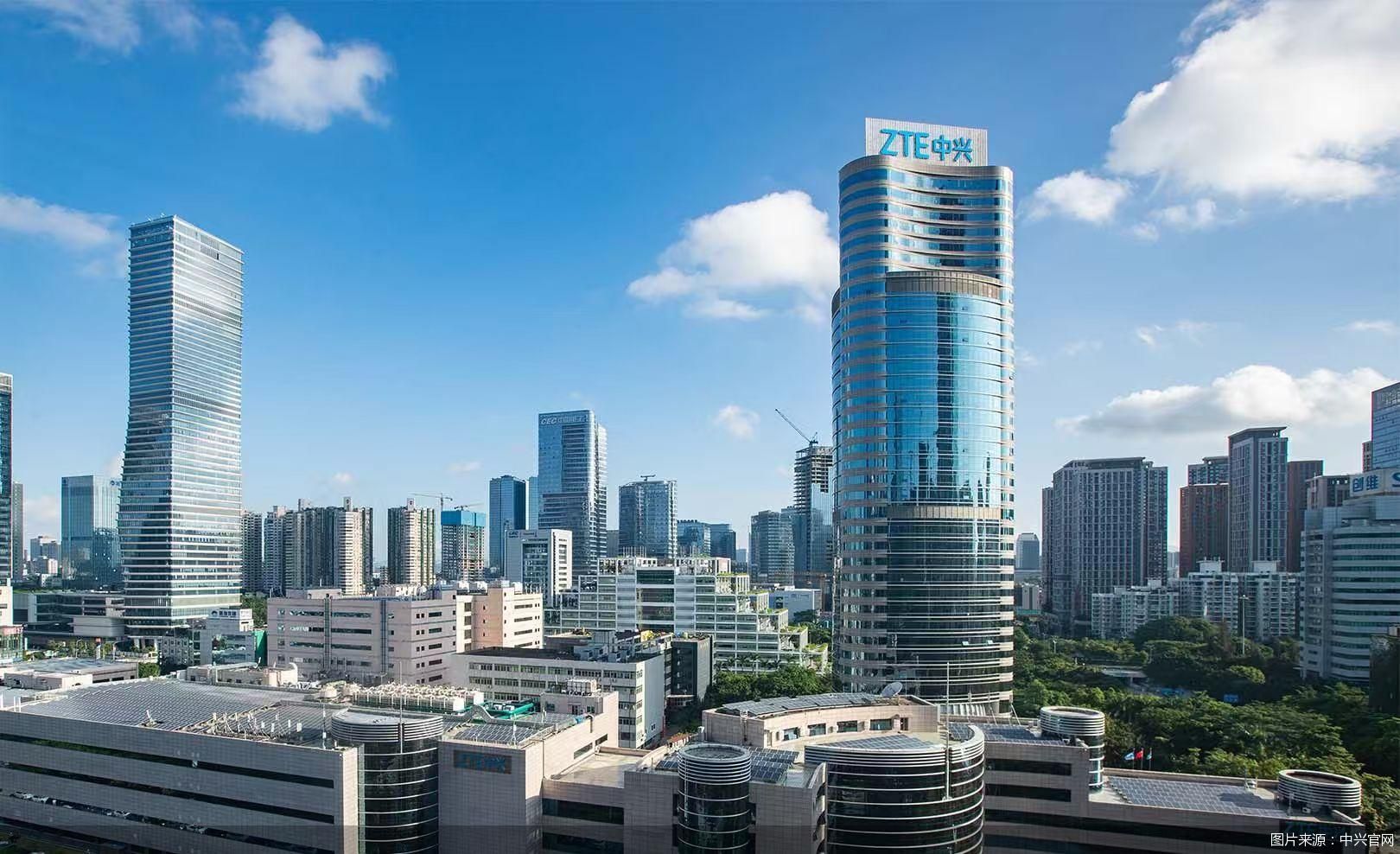
Core Insights - The collaboration between ByteDance's Doubao model and ZTE has officially launched, resulting in the Nubia M153 smartphone selling out quickly at a price of 3499 yuan, generating significant market buzz [1] - The secondary market has seen prices for the Nubia M153 exceed expectations, with some listings reaching up to 9999 yuan, indicating a premium of over 100% [1] - ZTE's stock surged, hitting a market cap of over 210 billion yuan following the announcement, marking a significant milestone for the company [1] Group 1: Market Dynamics - The Nubia M153 is positioned as an "engineering sample" aimed at industry professionals needing to experience the Doubao assistant, highlighting ZTE's strategic focus on niche markets [2] - ZTE's long-standing position in the second tier of the smartphone market makes this collaboration with a leading AI model provider particularly beneficial, although the opportunity may be fleeting [2][6] - The collaboration is seen as a potential game-changer for ZTE, which has struggled to break into the top tier of smartphone brands [4][5] Group 2: Competitive Landscape - The partnership allows ZTE to leverage ByteDance's AI capabilities while providing a hardware platform for the Doubao model, creating a mutually beneficial relationship [5][9] - The smartphone market is increasingly competitive, with leading brands like Huawei and Xiaomi developing their own AI ecosystems, which poses a challenge for ZTE [5][13] - The collaboration is viewed as a way for ZTE to enhance its brand image and market presence, particularly as it aims to recover from declining revenues [6][10] Group 3: Future Outlook - The partnership is expected to drive ZTE's mobile business revenue growth by over 40% in 2024, as the company introduces innovative AI-enabled devices [9] - Analysts suggest that to convert short-term gains into long-term competitiveness, ZTE must deepen the integration of AI with its communication technology and enhance its marketing strategies [10][12] - The evolving smartphone market is likely to see AI as a central competitive factor, with companies needing to effectively integrate AI capabilities into their hardware and software ecosystems [12][14]
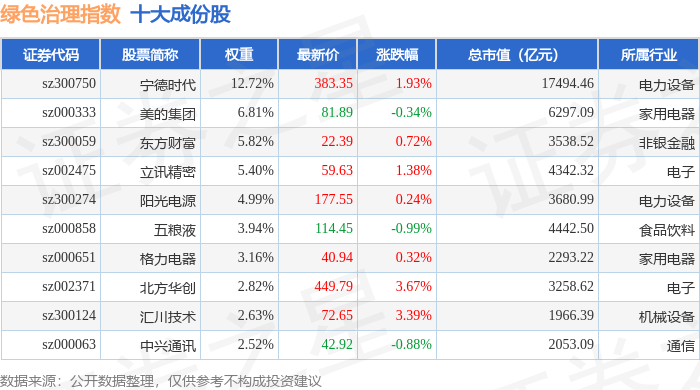
12月4日绿色治理(980058)指数涨0.4%,成份股北方华创(002371)领涨
Sou Hu Cai Jing· 2025-12-04 11:39
Core Points - The Green Governance Index (980058) closed at 1324.41 points, up 0.4%, with a trading volume of 87.561 billion yuan and a turnover rate of 1.14% [1] - Among the index constituents, 39 stocks rose while 58 fell, with Northern Huachuang leading the gainers at 3.67% and Luzhou Laojiao leading the decliners at 3.76% [1] Index Constituents - The top ten constituents of the Green Governance Index include: - Ningde Times (12.72% weight) at 383.35 yuan, up 1.93% [1] - Midea Group (6.81% weight) at 81.89 yuan, down 0.34% [1] - Dongfang Wealth (5.82% weight) at 22.39 yuan, up 0.72% [1] - Luxshare Precision (5.40% weight) at 59.63 yuan, up 1.38% [1] - Sungrow Power Supply (4.99% weight) at 177.55 yuan, up 0.24% [1] - Wuliangye (3.94% weight) at 114.45 yuan, down 0.99% [1] - Gree Electric Appliances (3.16% weight) at 40.94 yuan, up 0.32% [1] - Northern Huachuang (2.82% weight) at 449.79 yuan, up 3.67% [1] - Inovance Technology (2.63% weight) at 72.65 yuan, up 3.39% [1] - ZTE Corporation (2.52% weight) at 42.92 yuan, down 0.88% [1] Capital Flow - The net outflow of main funds from the index constituents totaled 2.808 billion yuan, while retail investors saw a net inflow of 3.06 billion yuan [1] - Detailed capital flow for specific stocks shows: - Ningde Times had a main fund net inflow of 568 million yuan [2] - Inovance Technology had a main fund net inflow of 15 million yuan [2] - Dongfang Wealth experienced a main fund net inflow of 76.89 million yuan [2] Recent Adjustments - The Green Governance Index constituents were adjusted recently, adding 10 new stocks, effective December 15, 2025 [3] - New additions include: - Zhongke Environmental Protection (77.42 billion yuan market cap) [3] - Dongsoft Zhaibo (72.07 billion yuan market cap) [3] - Furan Energy (158.40 billion yuan market cap) [3] - Water Technology (51.67 billion yuan market cap) [3] - Satellite Chemical (567.95 billion yuan market cap) [3] - Jinhe Industry (115.60 billion yuan market cap) [3] - Changbao Co. (70.35 billion yuan market cap) [3] - Shuanghuan Transmission (338.81 billion yuan market cap) [3] - Shield Environment (136.16 billion yuan market cap) [3] - Fu'ao Co. (94.25 billion yuan market cap) [3]