
LZLJ(000568)

Search documents
突发!6000亿芯片巨头筹划资产重组事项


Xin Lang Cai Jing· 2025-08-29 13:57
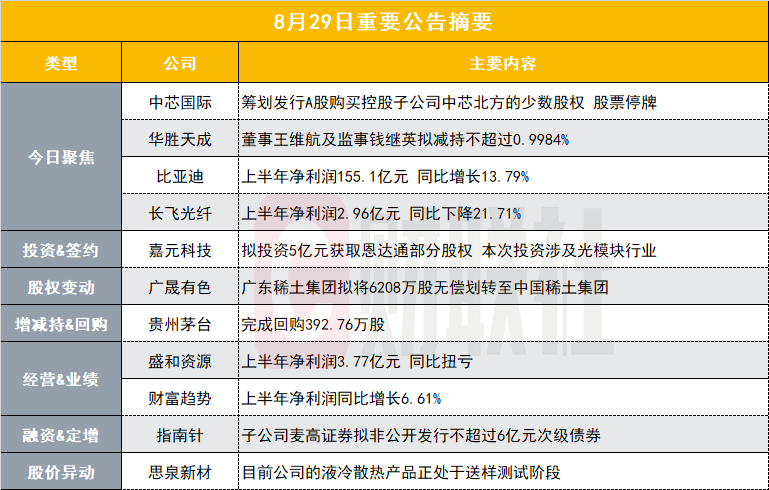
Company Announcements - SMIC plans to issue A-shares to acquire minority stakes in its subsidiary, SMIC North, leading to a temporary suspension of its stock trading for up to 10 trading days [1] - Huasheng Tiancheng's director and supervisor plan to reduce their holdings by up to 0.9984% of the total shares [2] - BYD reported a net profit of 15.51 billion yuan for the first half of the year, a year-on-year increase of 13.79% [2] - Changfei Fiber's net profit for the first half of the year was 296 million yuan, down 21.71% year-on-year [2] - Jia Yuan Technology plans to invest 500 million yuan to acquire part of the equity in Endatong, focusing on the optical module industry [1][17] - Guizhou Moutai completed the repurchase of 3.9276 million shares [1][19] Financial Performance - CEC reported a net profit of 24.641 billion yuan for the first half of the year, a decrease of 12% year-on-year [5] - Longjiang Power achieved a net profit of 13.056 billion yuan, up 14.86% year-on-year [8] - China Rare Earth reported a net profit of 162 million yuan, turning from a loss of 244 million yuan in the previous year [9] - Huayi Brothers' net profit increased by 48.34% to 2.028 billion yuan [6] - Wealth Trend's net profit grew by 6.61% year-on-year [24] Mergers and Acquisitions - Tailin Micro plans to acquire 100% of Panqi Micro's equity through a combination of cash and stock issuance [4] - Aishen Medical announced the acquisition of partial equity in three medical institutions for a total of 105 million yuan [18] Stock Movements - Guizhou Moutai's controlling shareholder plans to increase its stake by 3 to 3.3 billion yuan [15] - Ganfeng Lithium plans to invest 4 billion yuan to build a new lithium-ion battery manufacturing base [16] Market Developments - China National Offshore Oil Corporation won a bid for a project in Qatar worth approximately 4 billion USD [14] - Aishen Medical's acquisition of equity in medical institutions aims to enhance its service coverage and operational efficiency [18]

泸州老窖2025年上半年营收164.54亿元
Ren Min Wang· 2025-08-29 13:52
Group 1 - The core viewpoint of the article is that Luzhou Laojiao has reported strong financial performance for the first half of 2025, with significant revenue and profit figures [1] - In the first half of 2025, Luzhou Laojiao achieved a revenue of 16.454 billion yuan and a net profit attributable to the parent company of 7.663 billion yuan [1] - The company aims to maintain strategic determination to accurately grasp the pulse of consumer iteration and industrial transformation, actively transforming to build differentiated competitive advantages [1] Group 2 - Luzhou Laojiao is focusing on category innovation, channel transformation, and value reconstruction to open up new tracks and promote high-quality development in the liquor industry [1]

明星基金经理二季度调仓路线图:科技医药成共识,消费现分歧
Nan Fang Du Shi Bao· 2025-08-29 13:36
Core Viewpoint - The article highlights the strategic adjustments made by prominent fund managers in response to the market's structural characteristics, focusing on sectors like AI, innovative pharmaceuticals, and consumer goods, while also indicating a clear divergence in the consumer sector's performance [2][3][4]. Group 1: Fund Manager Strategies - Prominent fund managers have collectively increased their positions in high-growth sectors such as AI and innovative pharmaceuticals while making structural adjustments within the consumer sector [2]. - The technology and pharmaceutical sectors have emerged as core allocation directions, with significant investments in companies like BYD (increased by 184.78%) and Alibaba (increased by 161.10%) [2]. - Fund managers are focusing on "hard technology" in the tech sector, with AI computing and robotics becoming key investment areas [4]. Group 2: Consumer Sector Dynamics - The consumer sector has shown significant structural differentiation, with fund managers displaying contrasting attitudes towards traditional liquor and new consumption trends [3]. - Some fund managers have increased their holdings in traditional liquor stocks like Wuliangye and Moutai, while others have reduced their positions in these stocks, indicating a shift towards new consumption opportunities [3][4]. - The performance of consumer companies has influenced fund adjustments, with companies like Yili achieving strong revenue growth while others like Yanghe experienced profit declines [4]. Group 3: Future Outlook - Looking ahead to the third quarter, there is optimism regarding the innovative pharmaceutical sector, driven by global collaborations and anticipated clinical data disclosures [5]. - The consumer healthcare sector is expected to continue benefiting from rising health awareness among residents, with demand for home medical devices projected to grow steadily due to an aging population [5]. - The overall economic environment is seen as favorable for investment, although structural pressures may persist, with policies aimed at reducing excessive competition likely to improve corporate profitability [5].




泸州老窖上半年营收164.54亿元,28度国窖1573适时投入市场
Cai Jing Wang· 2025-08-29 13:27
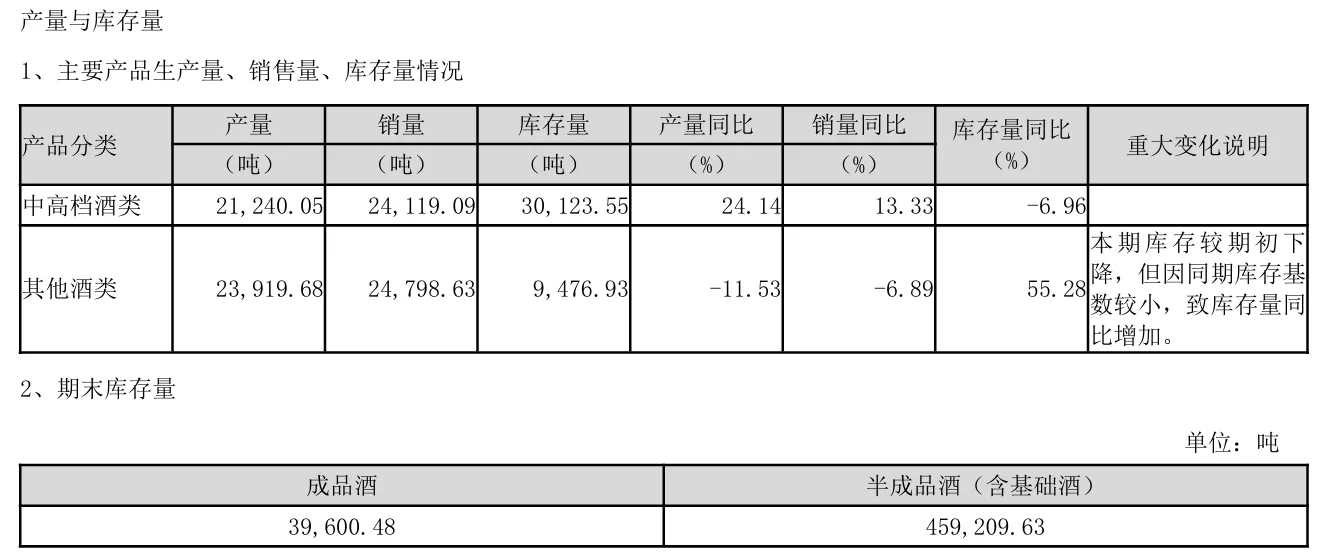
Core Viewpoint - Luzhou Laojiao reported a decline in revenue and net profit for the first half of 2025, indicating challenges in the current market environment [1]. Financial Performance - The company achieved a revenue of 16.454 billion yuan, a year-on-year decrease of 2.67% [1]. - Net profit stood at 7.663 billion yuan, reflecting a year-on-year decline of 4.54% [1]. Product Performance - For mid-to-high-end liquor, production was 21,240.05 tons, with sales of 24,119.09 tons, showing a production increase of 24.14% and sales growth of 13.33% year-on-year [2]. - Other liquor categories saw production of 23,919.68 tons and sales of 24,798.63 tons, with production down by 11.53% and sales down by 6.89% year-on-year [2]. - Inventory levels for mid-to-high-end liquor decreased by 6.96%, while other liquor categories experienced a significant inventory increase of 55.28% [2]. Strategic Initiatives - The company is implementing the "Hundred Cities Plan" and advancing the "East China Strategy 2.0" [2]. - There is a focus on deepening cross-industry collaborations through "Special Channels" and launching a "Terminal Infrastructure" initiative [2]. - The company is enhancing its digital marketing capabilities and has launched a nationwide promotion of its "Five-in-One" product strategy [2]. Future Plans - The company aims to innovate and adapt to current consumer trends towards lower-alcohol, healthier, and diversified products [3]. - Plans include the development and market introduction of a new 28-degree Guojiao 1573 product [3]. - Resources will be allocated towards mainstream mid-to-high-end products and the high-growth "light bottle liquor" segment, with a new Luzhou Laojiao Erqu product set to be launched [3].
华安研究:2025年9月金股组合
Huaan Securities· 2025-08-29 13:23
Group 1: Financial Performance - The projected net profit for 2025 is estimated at 605 million RMB, reflecting a growth rate of 52% compared to 2024[1] - The expected operating revenue for 2025 is 4,157 million RMB, with a growth rate of 4% from 2024[1] - The estimated EPS for 2025 is 0.6, with a PE ratio of 18[1] Group 2: Market Trends and Risks - The valuation for 2025-2027 is projected at 18x, 16x, and 14x, with a PEG ratio of less than 1 for 2026[1] - The company is expected to launch innovative and hard-to-replicate products, including a new drug expected to be approved in 2025[1] - Risks include fluctuations in customer demand and potential delays in product development[1] Group 3: Industry Insights - The pharmaceutical industry is experiencing a gradual recovery, with the raw material drug business stabilizing[1] - The beverage industry is expected to see improved sales during the Mid-Autumn Festival and National Day, with a narrowing decline[1] - The semiconductor equipment sector is projected to achieve significant revenue growth, with a target of 5 billion RMB by 2025[1]


泸州老窖(000568) - 2025年半年度财务报告
2025-08-29 13:19
泸州老窖股份有限公司 2025 年半年度财务报告 【2025 年 8 月】 财务报告 一、审计报告 半年度报告是否经过审计 □是 否 公司半年度财务报告未经审计。 二、财务报表 财务附注中报表的单位为:元 1、合并资产负债表 编制单位:泸州老窖股份有限公司 2025 年 06 月 30 日 单位:元 | 项目 | 期末余额 | 期初余额 | | --- | --- | --- | | 流动资产: | | | | 货币资金 | 35,451,080,327.05 | 33,578,396,831.33 | | 结算备付金 | | | | 拆出资金 | | | | 交易性金融资产 | 1,610,560,917.24 | 1,694,282,295.97 | | 衍生金融资产 | | | | 应收票据 | | | | 应收账款 | 16,077,566.15 | 11,022,302.31 | | 应收款项融资 | 1,411,989,312.86 | 1,801,947,455.78 | | 预付款项 | 228,470,687.43 | 123,870,282.65 | | 应收保费 | | | | 应收分保 ...
泸州老窖(000568) - 半年度非经营性资金占用及其他关联资金往来情况汇总表
2025-08-29 13:19
非经营性资金 占用 资金 占用 方名 称 占用方与 上市公司 的关联关 系 上市公司 核算的会 计科目 2025年期 初占用资 金余额 2025 年上半 年占用累计 发生金额(不 含利息) 2025 年 上半年占 用资金的 利息(如 有) 2025 年上 半年偿还 累计发生 金额 2025 年上 半年期末 占用资金 余额 占用形 成原因 占用性质 控股股东、实 际控制人及其 附属企业 无 小计 前控股股东、 实际控制人及 其附属企业 无 小计 其他关联方及 附属企业 无 小计 合计 泸州老窖股份有限公司 2025 年半年度非经营性资金占用及其他关联资金往来情况汇总表 编制单位:泸州老窖股份有限公司 单位:万元 | | 泸州老窖怀 旧酒类营销 | 子公司 | 其他应 收款 | - | 141,286.97 | | 126,278.16 | 15,008.81 | 销售商 品、资 | 经营性 往来 | | --- | --- | --- | --- | --- | --- | --- | --- | --- | --- | --- | | | 有限公司 | | | | | | | | 金往来 | | | 小计 其 ...
泸州老窖(000568) - 关于2025年上半年募集资金存放与使用情况的专项报告
2025-08-29 13:19
证券代码:000568 证券简称:泸州老窖 公告编号:2025-34 泸州老窖股份有限公司 关于 2025 年上半年募集资金存放与使用情况的专项 报告 本公司及董事会全体成员保证信息披露的内容真实、准确、完整, 没有虚假记载、误导性陈述或重大遗漏。 一、 募集资金基本情况 (一)募集资金金额及到账时间 1.2019 年和 2020 年面向合格投资者公开发行公司债券募集资金 2019 年 7 月 18 日,经中国证监会"证监许可〔2019〕1312 号"文 核准,本公司获准面向合格投资者公开发行面值总额不超过 40 亿元(含 40 亿元)的公司债券(以下简称"本次债券"),分期发行,首期发行 自核准之日起 12 个月内完成,其余各期自核准之日起 24 个月内完成。 本公司于 2019 年 8 月 27 日发行了第一期 2,500.00 万张 5 年期公 司债券,每张面值 100 元,票面利率 3.58%,发行总额 250,000.00 万元, 扣除发行费用 1,000.00 万元后收到实际募集资金金额 249,000.00 万元, 债券简称"19 老窖 01"。本公司于 2020 年 3 月 17 日发行了 2 ...
泸州老窖(000568) - 半年报董事会决议公告
2025-08-29 13:14
证券代码:000568 证券简称:泸州老窖 公告编号:2025-33 泸州老窖股份有限公司 第十一届董事会十四次会议决议公告 本公司及董事会全体成员保证信息披露的内容真实、准确、完整, 没有虚假记载、误导性陈述或重大遗漏。 一、董事会会议召开情况 泸州老窖股份有限公司(以下简称"公司")第十一届董事会十四 次会议于2025年8月28日以通讯表决的方式召开。召开本次会议的通 知已于2025年8月18日以邮件方式发出,截止会议表决时间2025年8 月28日,共收回10名董事的有效表决票10张。本次董事会会议的召开 符合有关法律、行政法规、部门规章、规范性文件和公司《章程》的 规定。 二、董事会会议审议情况 1.审议通过了《2025年半年度报告》。 决定使用不超过 20 亿元人民币的闲置自有资金购买安全性高、 流动性好、短期持有(不超过一年)的理财产品(不得进行股票、期 货、期权、外汇及其衍生品等高风险投资),该额度自公司本次董事 会授权之日起 12 个月内可循环滚动使用,且任意时点进行投资理财 的总金额均在此额度范围内进行筹划。 三、备查文件 1.经与会董事签字并加盖董事会印章的董事会决议; 2.深交所要求的其他 ...
泸州老窖:上半年净利润76.63亿元 同比下降4.54%
Zheng Quan Shi Bao Wang· 2025-08-29 12:49
Core Viewpoint - Luzhou Laojiao (000568) reported a decline in both revenue and net profit for the first half of 2025, indicating potential challenges in the company's financial performance [1] Financial Performance - The company achieved an operating income of 16.454 billion yuan, a year-on-year decrease of 2.67% [1] - The net profit attributable to shareholders was 7.663 billion yuan, down 4.54% compared to the previous year [1] - Basic earnings per share stood at 5.21 yuan [1]