
LZLJ(000568)

Search documents
泸州老窖(000568) - 2025 Q2 - 季度财报
2025-08-29 12:46
泸州老窖股份有限公司 2025 年半年度报告全文 【2025 年 8 月】 1 泸州老窖股份有限公司 2025 年半年度报告全文 泸州老窖股份有限公司 2025 年半年度报告 第一节 重要提示、目录和释义 公司董事会及董事、高级管理人员保证半年度报告内容的真实、准确、 完整,不存在虚假记载、误导性陈述或者重大遗漏,并承担个别和连带的法 律责任。 公司负责人刘淼、主管会计工作负责人谢红及会计机构负责人(会计主管 人员)宋缨声明:保证本半年度报告中财务报告的真实、准确、完整。 所有董事均已出席了审议本次半年报的董事会会议。 受到风险、不明朗因素及假设的影响,本报告中基于对未来政策和经济 情况的主观假定和判断而做出的涉及经营目标、未来计划等前瞻性描述,可 能与实际结果有重大差异。该等陈述不构成公司对投资者的实质承诺,投资 者及相关人士应当对此保持足够的风险认识,并应当理解计划、预测和承诺 之间的差异。 公司已在本报告中披露可能存在的风险因素,敬请投资者注意投资风险。 公司计划不派发现金红利,不送红股,不以公积金转增股本。 2 | P | 1 | | --- | --- | | | | | 第二节 | 公司简介和主要 ...

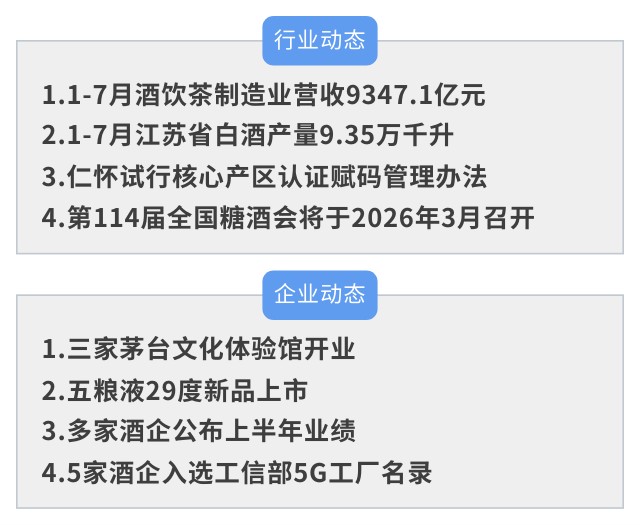
中经酒业周报∣1-7月酒饮茶制造业营收9347.1亿元、仁怀试行核心产区认证赋码管理办法、五粮液29度新品上市
Xin Hua Cai Jing· 2025-08-29 11:15
Industry Dynamics - From January to July, the beverage and refined tea manufacturing industry achieved revenue of 934.71 billion yuan, a year-on-year increase of 1.8% [4] - In Jiangsu Province, the production of liquor from large-scale enterprises was 93,500 kiloliters, a year-on-year decrease of 17.0% [4] - The city of Renhuai has implemented a trial management method for core production area certification and coding for Chinese sauce-flavored liquor [4] Event Announcements - The 114th National Sugar and Wine Fair will be held from March 26 to 28, 2026, in Chengdu, aiming to broaden the range of exhibits and better connect the industry chain [5] Company Developments - Three new Moutai cultural experience centers opened in Urumqi and Zhengzhou, integrating local cultural elements into their design [7] - Wuliangye launched a new low-alcohol product, 29° Wuliangye, targeting younger consumers, with pre-sales available on multiple platforms [7] - Several liquor companies, including Wuliangye and Luzhou Laojiao, are actively developing low-alcohol products as a strategy to attract younger consumers [7] Financial Performance - Wuliangye reported a revenue of 52.771 billion yuan for the first half of 2025, a year-on-year increase of 4.19% [8] - Shanxi Fenjiu achieved a revenue of 23.964 billion yuan, up 5.35% year-on-year [8] - Jinzhongzi Liquor reported a revenue of 0.484 billion yuan, a decline of 27.47% year-on-year [8] - Other companies, including Yingjia Gongjiu and Jinsiyuan, also reported declines in revenue for the first half of 2025 [8][9] Technological Advancements - Five liquor companies were included in the Ministry of Industry and Information Technology's 5G factory list, indicating advancements in smart manufacturing [10]





策略深度报告20250829:9月度金股:重视高低切-20250829
Soochow Securities· 2025-08-29 09:32
Group 1 - The report highlights a shift in the macro narrative affecting the A-share market, driven by internal policies aimed at demand stimulation and external factors such as a weakening dollar [5][6]. - The report identifies a rotation in investment focus from TMT and manufacturing sectors to other areas, suggesting a potential shift in market dynamics [5][6]. - The report emphasizes the importance of high-low switching strategies in the technology sector, recommending stocks like Kunlun Wanwei, Leisai Intelligent, and Jingchen Co. for investment [5][10][14]. Group 2 - Kunlun Wanwei is focusing on AI business development, with significant advancements in AI chip research and application, leading to a positive outlook for its commercialization potential [10][11]. - Leisai Intelligent is expanding its market share in the automation sector, leveraging its strong product matrix and partnerships to capture growth opportunities [14][15]. - Jingchen Co. is experiencing robust growth in its AIoT and WiFi chip segments, with significant sales increases and a strong customer base [19][20]. Group 3 - Conch Cement is positioned to benefit from supply-side reforms and industry policy improvements, which are expected to enhance profitability and market conditions [24][25]. - Luzhou Laojiao is implementing proactive marketing strategies to adapt to market cycles, aiming to capture demand in emerging consumer segments [30][31]. - Jerry Holdings is poised for recovery as it capitalizes on the resurgence of high-end liquor demand and maintains a strong digital marketing framework [34][35]. Group 4 - New Hope Liuhe is leveraging its integrated supply chain advantages in the fine chemical sector, focusing on vitamin and amino acid production to enhance competitiveness [39][40]. - Xinhecheng is expected to benefit from rising prices in the vitamin market and increased demand for its amino acid products, supported by its strong production capabilities [39][41]. - Newnovel is projected to see significant revenue growth driven by its innovative drug pipeline, particularly in the oncology sector [43][44]. Group 5 - The report anticipates that the financial technology sector, represented by companies like Zhinan Zhen, will continue to grow as it transitions into comprehensive financial service providers [48][49]. - Zhinan Zhen's strategic acquisitions and capital operations are expected to enhance its market position and profitability in the coming years [48][50].




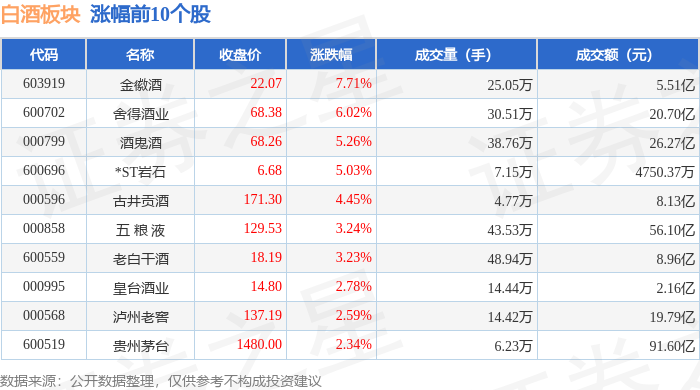
白酒板块8月29日涨2.52%,金徽酒领涨,主力资金净流入18.86亿元
Zheng Xing Xing Ye Ri Bao· 2025-08-29 08:41
Market Performance - The liquor sector rose by 2.52% on August 29, with Jinhuijiu leading the gains [1] - The Shanghai Composite Index closed at 3857.93, up 0.37%, while the Shenzhen Component Index closed at 12696.15, up 0.99% [1] Individual Stock Performance - Jinhuijiu (code: 616809) closed at 22.07, up 7.71% with a trading volume of 250,500 shares and a turnover of 551 million yuan [1] - Shede Liquor (code: 600702) closed at 68.38, up 6.02% with a trading volume of 305,100 shares and a turnover of 2.07 billion yuan [1] - Other notable stocks include Zhi Si Li (code: 000799) up 5.26%, Gujing Gongjiu (code: 000596) up 4.45%, and Wuliangye (code: 000858) up 3.24% [1] Capital Flow Analysis - The liquor sector saw a net inflow of 1.886 billion yuan from main funds, while retail funds experienced a net outflow of 833 million yuan [1] - Main funds showed significant net inflows in stocks like Kweichow Moutai (code: 600519) with 61.3 million yuan and Wuliangye (code: 000858) with 486 million yuan [2] - Retail investors had net outflows in several stocks, including Kweichow Moutai and Wuliangye, indicating a shift in investor sentiment [2]


本周累计"吸金"超7500万元,食品饮料ETF天弘(159736)涨超2%,扩大服务消费的若干政策措施将于下月出台
2 1 Shi Ji Jing Ji Bao Dao· 2025-08-29 02:33
Group 1 - The liquor sector experienced a strong performance on August 29, with the Tianhong Food and Beverage ETF (159736) rising by 2.16% and reaching an intraday high of 2.70%, with a trading volume exceeding 13 million yuan [1] - Key stocks in the sector included Kweichow Moutai, Yili, and Wuliangye, with Kweichow Moutai hitting the daily limit [2] - The Tianhong Food and Beverage ETF has seen a net inflow of over 75 million yuan during the week of August 25 to August 28, indicating strong investor interest [2] Group 2 - Ping An Securities noted that the liquor sector is stabilizing at a fundamental level, with mid-year reports addressing historical inventory issues and dividend yields supporting stock prices [3] - Hualong Securities highlighted that the current mid-year reporting period is seeing concentrated performance pressure in the liquor sector, while new consumer brands are experiencing rapid growth [3] - The upcoming Mid-Autumn Festival and National Day are expected to catalyze consumption in the liquor sector [3]


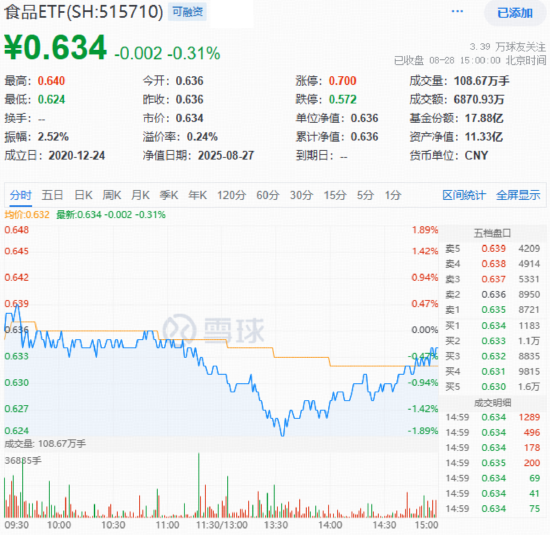
茅台逆势扩张文化版图!吃喝板块回调,食品ETF(515710)盘中跌近2%!布局时机或至?
Xin Lang Ji Jin· 2025-08-28 12:30
Group 1 - The food and beverage sector continues to experience a pullback, with the Food ETF (515710) showing a decline of 0.31% at the close after a drop of nearly 2% during the day [1][3] - Major consumer goods stocks, particularly leading liquor brands, have also performed poorly, with companies like Qianhe Flavor, Miaokelando, and others dropping over 3% [3] - The launch of three Moutai cultural experience centers in Xinjiang and Zhengzhou is seen as a strategic move to deepen market penetration in the northwest and central regions, enhancing consumer engagement and cultural marketing [3] Group 2 - The current valuation of the food and beverage sector is considered low, with the food index's price-to-earnings ratio at 20.8 times, indicating a favorable long-term investment opportunity [4] - Analysts from Ping An Securities suggest that the liquor sector is stabilizing, with expectations for increased consumption during the upcoming Mid-Autumn Festival and National Day [5] - Huashang Securities notes that the liquor demand has been under pressure since the second quarter, but the marginal impact of policies is expected to diminish, setting a foundation for recovery [5] Group 3 - The Food ETF (515710) is recommended for investment, with approximately 60% of its portfolio allocated to leading high-end and mid-range liquor stocks, and nearly 40% in other beverage and dairy segments [5] - The top ten weighted stocks in the ETF include major brands like Moutai, Wuliangye, and Yili, indicating a strong focus on established market leaders [5]
白酒:从周期角度看白酒的布局时点:充分考虑周期的学习效应,当下或是绝对收益起点
Hua Yuan Zheng Quan· 2025-08-28 06:26
Investment Rating - The report rates the white liquor industry as "Positive" (First Time) [1] Core Viewpoints - The current moment is seen as a potential starting point for absolute returns in the white liquor sector, considering the cyclical learning effects [4] - The white liquor industry has returned to cyclical characteristics, with fund holdings dropping to levels seen in 2017, and the food and beverage sector's overweight ratio has decreased significantly from a peak of 11% in 2019 to 3.2% [4][13] - The valuation of the white liquor sector has declined by 72% over the past four years, indicating a slow and steady adjustment process, unlike previous cycles [4][18] - Historical analysis suggests that the bottoming out of the white liquor index occurred after the 2014 Spring Festival, which is anticipated to happen again during the current cycle [5][22] Summary by Sections 1. Decline in White Liquor Holdings and Return to Cyclical Stock Characteristics - Fund holdings in the white liquor sector have decreased to 2017 levels, indicating a shift back to cyclical stock characteristics [10][13] - The overweight ratio of the food and beverage sector has significantly decreased, reflecting a gradual exit of funds focused on long-term value [4][13] 2. Review of Previous Cycle's Bottoming Characteristics - The previous cycle's bottoming process involved several stages, including a decline in dealer profitability, reduced receivables, and a subsequent recovery in real demand [4][18] - The current cycle is expected to show a similar pattern, with the learning effect potentially leading to an earlier inflection point for absolute returns [4][18] 3. Upcoming Investment Timing - The report suggests monitoring for signs of risk clearance in financial statements and early inventory reduction among dealers as indicators for potential investment opportunities [4][6] - Specific companies to watch include Luzhou Laojiao for its high dividend yield and Yingjia Gongjiu for its low valuation and inventory clearance [4][6]

聚焦低估值!白酒终于翻身了!这些白酒主题基金值得关注!
私募排排网· 2025-08-28 03:34
Core Viewpoint - The liquor sector, particularly the baijiu segment, has recently experienced a significant rebound after a prolonged downturn, with notable gains in stock prices and a favorable valuation compared to historical levels [5][7]. Group 1: Market Performance - The baijiu sector has seen an increase of over 8% in the last five trading days, with specific stocks like JiuGuiJiu rising over 30% and major brands like Kweichow Moutai and Wuliangye rebounding nearly 5% [5]. - The current price-to-earnings (P/E) ratio for the baijiu sector stands at 19.04, and the price-to-book (P/B) ratio is at 5.05, indicating that the sector is undervalued compared to historical averages [5]. Group 2: Fund Performance - Over the past year, the average return of 370 baijiu-themed funds reached 24.11%, with 93.51% of these funds showing positive returns [7][8]. - The top-performing fund, Anxin Value Growth A, managed by Nie Shilin, achieved a return of 53.62%, significantly outperforming its benchmark [8][9]. Group 3: Fund Holdings - As of the end of Q2, the top three holdings in Anxin Value Growth A included Kweichow Moutai, Wuliangye, and Shanxi Fenjiu, with respective holding ratios of 9.60%, 5.81%, and 4.21% [9]. - The fund manager expressed optimism about the market's transition towards high-quality development, focusing on consumer and advanced manufacturing sectors [9]. Group 4: Long-term Performance - Over the past three years, the average return of 309 baijiu-themed funds was approximately -7.07%, with only 32.36% of these funds achieving positive returns [11]. - The top three funds over this period were Baoying Quality Selection A, Baoying Brand Consumption A, and Penghua Quality Selection A, with returns of 41.20%, 31.09%, and 26.96% respectively [12][14].

低度白酒之战,早在2022年便拉开了序幕
Xin Hua Wang· 2025-08-28 02:19
Core Viewpoint - The low-alcohol fragrant liquor market is experiencing a resurgence, driven by major companies like Wuliangye, Luzhou Laojiao, and others launching new products, indicating a competitive yet collaborative environment among the "fragrant liquor" sector [1][8]. Industry Developments - The new national standard for fragrant liquor, effective from April 1, 2022, defines low-alcohol liquor as having an alcohol content between 25% and 40% [2][3]. - The introduction of this standard aims to stabilize the quality of low-alcohol fragrant liquor by setting specific physicochemical indicators for products based on their production date [3][7]. Product Launches - Wuliangye announced the launch of its 29-degree product "Wuliangye·A First Glance" in June 2023, followed by Luzhou Laojiao's 28-degree "Guojiao 1573" [9][12]. - Other companies, such as Shede and Gujing Gongjiu, are also entering the low-alcohol market with their respective products, indicating a trend among major players to diversify their offerings [9][12]. Technological Advancements - The production of low-alcohol fragrant liquor requires advanced techniques to ensure quality, including adsorption filtration, cold filtration, and molecular sieving, which help maintain flavor while reducing alcohol content [10][11]. - Companies like Wuliangye and Luzhou Laojiao have developed proprietary technologies to achieve "low but not bland" products, focusing on the balance of aroma and flavor [10][11]. Market Trends - The low-alcohol fragrant liquor segment is seen as a response to changing consumer preferences, with a need for innovation and new market scenarios as traditional high-alcohol products face challenges [7][12]. - The competitive landscape is shifting, with major brands actively promoting low-alcohol options, which may lead to increased market acceptance and sales [12].
食品饮料ETF天弘(159736)连续7日获资金净流入!机构:高切低行情或演绎,建议关注低位布局机会
2 1 Shi Ji Jing Ji Bao Dao· 2025-08-28 02:05
Group 1 - A-shares opened lower on August 28, with the consumer sector experiencing slight adjustments [1] - The Tianhong Food and Beverage ETF (159736) fell by 0.67% as of the report, while stocks like San Yuan and Xin Dairy saw gains exceeding 4% [1] - The Tianhong Food and Beverage ETF has seen a net inflow of over 68 million yuan in the week from August 25 to August 27, marking seven consecutive trading days of inflows [1] Group 2 - The current period is critical for the liquor sector as it seeks a bottom, with policies correcting previous bans and supply adjustments being made by liquor companies [2] - The market is experiencing a high-low rotation, with the restaurant supply chain and processed food sectors showing signs of recovery, particularly in beer due to favorable weather conditions [2] - The liquor sector has been under pressure since the second quarter due to demand constraints, but there are expectations for a gradual narrowing of policy impacts and a foundation for recovery [2]