LZLJ(000568)

Search documents
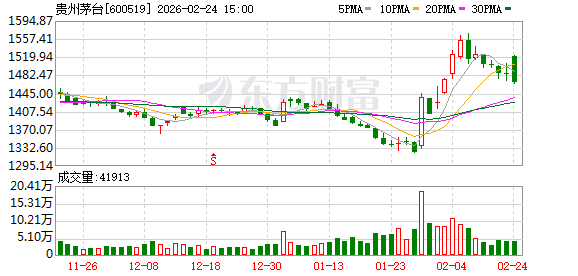
19只白酒股上涨 贵州茅台1491.66元/股收盘
Bei Jing Shang Bao· 2026-02-25 08:19
Group 1 - The core viewpoint of the article highlights the positive performance of the liquor sector, particularly the strong sales of premium brands during the 2026 Spring Festival, indicating a shift in consumer preferences towards well-known brands like Moutai and Wuliangye [1] - The Shanghai Composite Index closed at 4147.23 points, up 0.72%, while the liquor sector index closed at 2250.28 points, up 1.22%, with 19 liquor stocks rising [1] - Specific stock performances include Moutai closing at 1491.66 CNY per share, up 1.69%, Wuliangye at 105.17 CNY per share, up 0.01%, Shanxi Fenjiu at 163.92 CNY per share, up 0.21%, Luzhou Laojiao at 112.92 CNY per share, up 0.37%, and Yanghe at 54.00 CNY per share, up 0.15% [1] Group 2 - Citic Securities' report indicates that the 2026 Spring Festival continues the trend of the past 2-3 years, with a significant increase in brand recognition among consumers, leading to better sales for premium liquor brands compared to lower-tier brands [1] - The report notes that liquor sales are heavily concentrated during the Spring Festival peak season, with a notable release of demand before the festival and stable demand during the festival, particularly for products priced below 300 CNY [1] - A strong Spring Festival is viewed as the foundation for stable sales performance throughout 2026 [1]





动销“三管齐下”,加速去库存
3 6 Ke· 2026-02-25 08:17
Core Viewpoint - The 2026 Spring Festival is expected to be a significant period for the liquor industry, with a nine-day holiday and a focus on consumption recovery, although challenges such as inventory pressure and market differentiation persist [1][8]. Group 1: Spring Festival Impact on Liquor Sales - The Spring Festival is a critical sales period for the liquor industry, serving as a battleground for competition and a reflection of industry health [1]. - Major liquor brands are leveraging the CCTV Spring Festival Gala for brand exposure, with several companies sponsoring the event to enhance visibility [2][3]. - The sales peak for liquor during the Spring Festival is notably shorter in 2026, with a focus on the first half of February, compared to previous years [1][8]. Group 2: Strategies of Liquor Companies - Liquor companies are implementing a "three-pronged" approach to boost sales during the Spring Festival, including promotions, price control, and channel empowerment [5][6]. - High-end liquor brands like Moutai and Wuliangye are focusing on price stability and channel management to maintain brand value [6][7]. - Mid-tier and regional liquor companies are increasing promotional efforts to reduce inventory, with various campaigns launched to stimulate demand [7][8]. Group 3: Inventory Challenges - The liquor industry is still undergoing a prolonged inventory reduction phase, particularly affecting mid-tier and regional brands, which face significant inventory pressure [1][8]. - As of Q3 2025, the total inventory of 20 A-share liquor companies exceeded 170 billion, remaining above reasonable levels despite a 40% reduction from peak levels in 2023 [8]. - The average inventory turnover days are currently around 900 days, indicating a lengthy period required to clear existing stock [8][9]. Group 4: Market Performance and Valuation - The A-share liquor sector has experienced a valuation recovery, with major brands showing strong stock performance amid optimistic sales expectations for the Spring Festival [10][11]. - From early January to early February 2026, the China Securities White Liquor Index rose by 2.54%, with leading brands outperforming the average [11][12]. - Analysts predict a continued divergence in performance, with high-end brands expected to maintain growth while mid-tier and regional brands face ongoing challenges [12]. Group 5: AI Integration in the Liquor Industry - AI technology is increasingly being integrated into various aspects of the liquor industry, enhancing production, quality control, and marketing efforts [13][14]. - Companies like Luzhou Laojiao and Wuliangye are utilizing AI to optimize production processes and improve product quality, demonstrating the potential for increased efficiency and profitability [13][14]. - Despite the promising applications of AI, challenges such as data barriers and limited penetration in marketing and management remain [15][16].
大市“开门红”,白酒逆市调整,春节旺季结束淡季该怎么走?
Nan Fang Du Shi Bao· 2026-02-25 03:04
Core Viewpoint - The white liquor industry is experiencing a market adjustment post-Spring Festival, with a notable decline in stock prices despite a stable overall market performance in A-shares [1][4]. Group 1: Market Performance - On February 24, the white liquor sector opened at 2669.58 points but closed at 2619.94 points, down 0.94% [1]. - From February 6, the white liquor sector has shown a downward trend, with 6 out of 7 trading days in February recording losses [1]. - Major brands like Kweichow Moutai and Wuliangye saw declines, with Moutai closing at 1466.8 yuan per share, down 1.25% [1]. Group 2: Consumer Behavior and Pricing - During the Spring Festival, Kweichow Moutai's Feitian Moutai was in high demand, with significant sales and limited availability reported [2]. - The latest batch price for Feitian Moutai is between 1700 yuan and 1730 yuan per bottle, while retail prices have stabilized above 1800 yuan [2]. - Products priced between 100 yuan and 300 yuan are also experiencing strong sales, driven by consumer gatherings [2]. Group 3: Industry Trends - The white liquor market is exhibiting a "dumbbell-shaped" growth pattern, with strong sales at both the high-end and low-end, but core mid-range products are under pressure [3]. - High-end brands like Moutai and Wuliangye are showing resilience, with some segments experiencing double-digit growth despite overall declines [4]. - Analysts predict that the white liquor sector is at a cyclical bottom, with potential for marginal recovery in 2026, particularly in the second half of the year [5]. Group 4: Future Outlook - The industry is expected to face challenges in the off-season following the Spring Festival, with high inventory levels and a need for strategic adjustments [4][6]. - Many industry players are adopting a cautious stance, emphasizing the need for careful inventory management and maintaining price stability [6].
酒价内参2月25日价格发布,精品茅台逆势上涨7元
Xin Lang Cai Jing· 2026-02-25 02:01
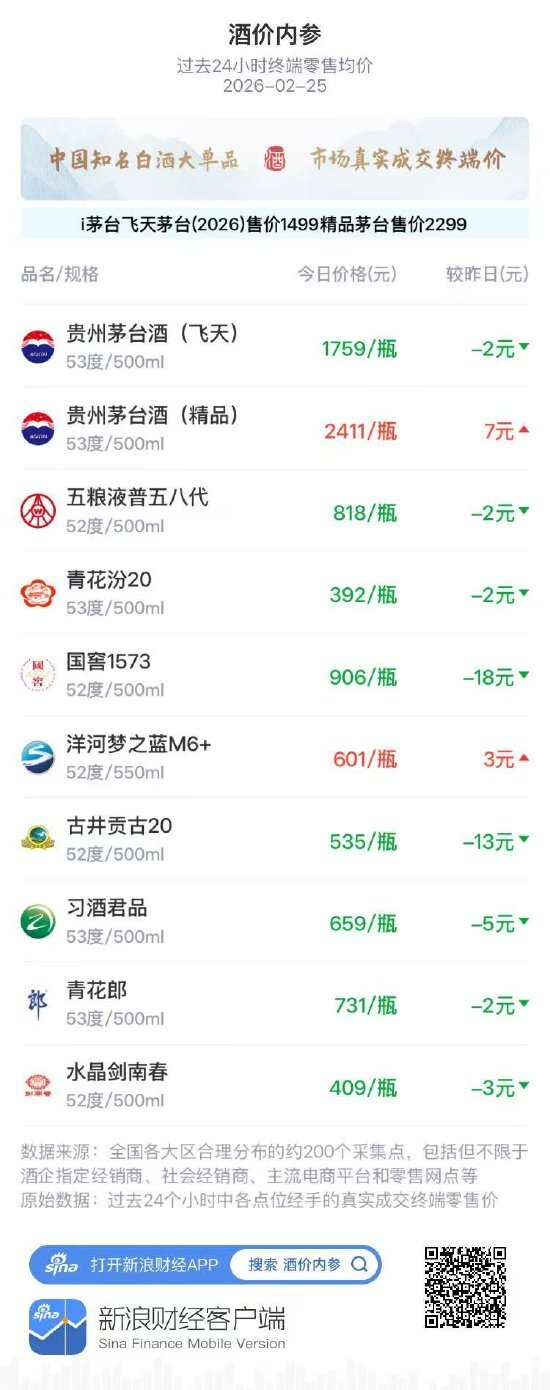
Core Viewpoint - The Chinese white liquor market is experiencing a significant price correction, with the average retail price of the top ten products declining as of February 25, indicating a cautious market sentiment following the post-holiday price surge [1]. Price Trends - The total price for a package of one bottle from each of the top ten products is 9,221 yuan, which represents a decrease of 37 yuan from the previous day, marking a new low for the week [1]. - Out of the top ten products, eight saw price declines while two experienced price increases, reflecting a cautious market atmosphere [1]. Specific Product Performance - Moutai's premium product increased by 7 yuan per bottle, serving as a key support for the market [1]. - Yanghe Dream Blue M6 saw a slight increase of 3 yuan per bottle, continuing its narrow fluctuation trend [1]. - The most significant decline was observed in Guojiao 1573, which dropped by 18 yuan per bottle, following a previous five-day price increase [1]. - Other notable declines included: - Gujing Gong 20 down by 13 yuan - Xijiu Junpin down by 5 yuan - Shuijing Jian'nan Chun down by 3 yuan - Several other products, including Feitian Moutai and Wuliangye, saw minor decreases of 2 yuan each [1][6]. Industry Developments - The Ministry of Industry and Information Technology, the Ministry of Human Resources and Social Security, and the State Administration for Market Regulation jointly issued the "Guidance on Quality Improvement and Upgrading of the Brewing Industry (2026-2030)," marking the beginning of a high-quality development path for the Chinese liquor industry [3]. - The guidance outlines seven key areas for improvement, including enhancing raw material supply, boosting technological innovation, and optimizing industry structure, with 21 specific tasks identified [3].


酒价内参2月25日价格发布 总价明显回落创阶段新低
Xin Lang Cai Jing· 2026-02-25 02:00
Core Viewpoint - The Chinese liquor market is experiencing a significant price correction, particularly among the top ten products, with a notable decline in retail prices following the Spring Festival [1]. Group 1: Market Overview - The average retail price of the top ten liquor products on February 25 has shown a marked decline, with a total price of 9,221 yuan for a bundled sale, down 37 yuan from the previous day, reaching a new low for the week [1]. - Eight of the top ten products saw price decreases, indicating a cautious market sentiment, while only two products experienced price increases [1]. Group 2: Price Changes of Key Products - Moutai's premium product saw a price increase of 7 yuan per bottle, becoming a key support in the market [1]. - The most significant price drop was observed in Guojiao 1573, which decreased by 18 yuan per bottle, following a previous five-day price increase [1]. - Other notable declines included: - Gujing Gong 20 down 13 yuan per bottle - Xijiu Junpin down 5 yuan per bottle - Shuijing Jian'nan Chun down 3 yuan per bottle - Several other products, including Feitian Moutai and Wuliangye, saw minor declines of 2 yuan per bottle [1][3][4].
酒价内参2月25日价格发布,洋河梦之蓝M6+小幅上涨3元
Xin Lang Cai Jing· 2026-02-25 01:42
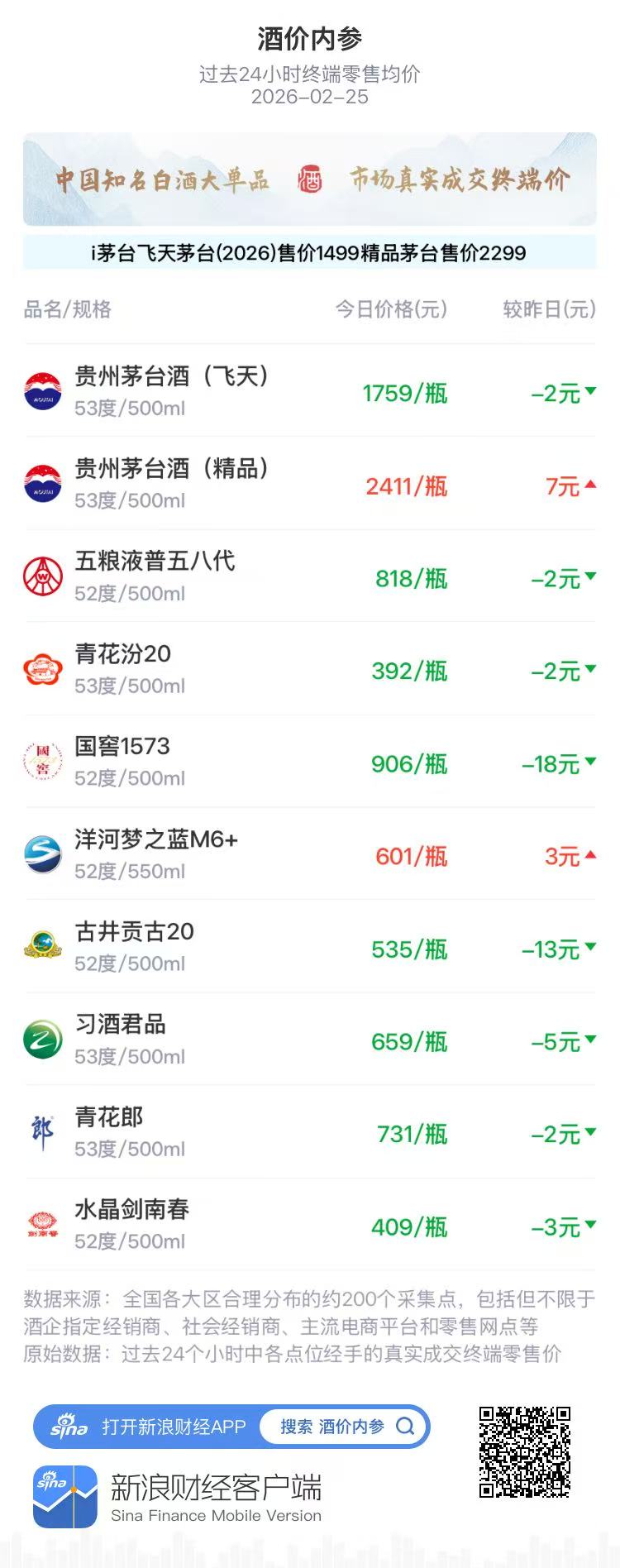
Core Viewpoint - The Chinese white liquor market is experiencing a significant price correction, with the average retail price of the top ten products dropping, indicating market pressure following the holiday price increases [1][6][7]. Price Trends - As of February 25, the total retail price for a package of the top ten liquor products is 9,221 yuan, a decrease of 37 yuan from the previous day, marking a new low for the week [1][6][7]. - Out of the top ten products, eight saw price declines while two experienced price increases, reflecting cautious market sentiment [1][7]. Individual Product Performance - Moutai's premium variant increased by 7 yuan per bottle, serving as a key support for the market [1][7]. - Yanghe Dream Blue M6+ rose by 3 yuan per bottle, continuing its narrow fluctuation trend [1][7]. - The largest decline was observed in Guojiao 1573, which fell by 18 yuan per bottle, indicating a significant downward shift after a previous five-day price increase [1][7]. - Other notable declines included: - Gujing Gong 20 down by 13 yuan - Xijiu Junpin down by 5 yuan - Shuijing Jian'nan Chun down by 3 yuan - Several other brands, including Feitian Moutai and Wuliangye, saw minor decreases of 2 yuan each [1][7][12]. Market Data Collection - The price data is sourced from approximately 200 collection points across various regions, including designated distributors, social distributors, e-commerce platforms, and retail outlets, ensuring a comprehensive and objective representation of the market [2][8]. Industry Developments - A recent report highlighted the release of the "Guidance on Quality Improvement and Upgrading of the Brewing Industry (2026-2030)" by three government departments, marking the beginning of a high-quality development path for the Chinese liquor industry [9]. - The guidance outlines seven key areas for improvement, including enhancing raw material supply, boosting technological innovation, and optimizing industry structure, with 21 specific tasks identified [9].
食品饮料行业2025年信用回顾与2026年展望
新世纪评级· 2026-02-25 01:25
Investment Rating - The food and beverage industry is rated as stable for 2025 and 2026 [1] Core Insights - The food and beverage industry in China includes various sub-industries such as agriculture, food processing, and beverage manufacturing, closely linked to economic development, population structure, and consumer preferences. Despite ongoing economic pressures and weak consumer demand, the industry continues to grow, although revenue growth rates are declining and profitability is weakening [1][6] - The agricultural sector shows a steady increase in grain planting area and production, with major crops like rice, wheat, and corn maintaining a balance between supply and demand. However, some crop prices are under pressure due to supply-demand dynamics and international trade conditions [24][25] - The food manufacturing sector is experiencing stable growth, with overall profitability remaining flat. The industry is characterized by increasing fixed asset investments and a slight increase in total assets [52][53] Summary by Sections 1. Industry Performance - The food and beverage industry has a total asset value of 8.42 trillion yuan at the end of 2024, with a year-on-year growth of 3.59%. The industry’s revenue for 2024 is 9.07 trillion yuan, showing a slight decline of 0.20% year-on-year [7][11] - By the end of September 2025, the industry’s total assets increased to 8.61 trillion yuan, with a revenue of 6.71 trillion yuan, reflecting a year-on-year growth of 1.75% [7][11] 2. Agricultural Sector - The agricultural sector's total output value reached 162,787.5 billion yuan in 2024, with a year-on-year growth of 2.7%. The grain planting area for 2024 and 2025 is projected to be 11,931.9 million hectares and 11,940.9 million hectares, respectively [24][25] - Grain production is expected to increase, with total grain output for 2024 and 2025 estimated at 70.65 million tons and 71.49 million tons, respectively [27] 3. Feed Industry - The feed industry is experiencing growth in production, influenced by the recovery of the livestock sector. The total industrial feed production for 2024 is 31,503.1 million tons, showing a year-on-year decline of 2.1% [45] - The feed prices are expected to remain low due to fluctuations in raw material prices and weak downstream demand [49] 4. Food Manufacturing - The food manufacturing sector continues to grow, with total assets reaching 2.41 trillion yuan by September 2025, reflecting a 4% increase year-on-year. The revenue for the first three quarters of 2025 is 1.63 trillion yuan, with a slight decrease in profit margins [52][53] 5. Livestock Industry - The livestock sector is under pressure, with pork prices gradually declining. The production of beef is increasing, while sheep meat production is decreasing due to weak demand [56][58] - The overall production of meat is expected to grow, with pork production for 2024 and 2025 estimated at 5,706.03 million tons and 5,938 million tons, respectively [58]

中国必需消费品_新年专家电话会议_白酒_茅台、五粮液重回复苏轨道;乳制品定价自律但表现平淡-China Consumer Staples_ LNY expert calls_ Spirits_ Moutai_Wuliangye pivoting to recovery path; Dairy saw disciplined pricing yet unexciting
2026-02-24 14:16
Summary of Key Points from the Conference Call on China Consumer Staples: Spirits and Dairy Industry Overview - The conference call focused on the spirits and dairy sectors in China, particularly in the Hunan province, highlighting the performance of major brands like Moutai, Wuliangye, and Mengniu. Spirits Sector Moutai - Feitian Moutai's retail sales volume increased by over 20% year-on-year during the Chinese New Year (CNY) period, exceeding expectations despite shipment controls on non-standard SKUs [1][9] - Moutai 1935 showed mild growth, outperforming other products in the Moutai series [1][9] - The wholesale price of Feitian Moutai rose to approximately Rmb1,700, with channel inventory remaining stable at around 0.5 months [1][9] - The expert anticipates that Moutai could bottom out around mid-2026 if retail sales momentum remains strong [2][6] Wuliangye - Common Wuliangye experienced mid-single-digit percentage retail volume growth in early February, gaining market share from Guojiao 1573 due to enhanced affordability [1][9] - The effective ex-factory price for Common Wuliangye decreased to around Rmb810, with expectations of further reductions [1][9] - The company achieved a 40% prepayment target by the end of CNY, although this pace is slightly slower than the previous year [1][9] Luzhou Laojiao - Guojiao 1573's retail volume dropped by approximately 30% during the CNY period, facing challenges in maintaining wholesale price stability [1][8] - Luzhou Laojiao is under pressure to stabilize prices amid declining demand [2][6] Other Brands - Brands like Fen Wine, Yanghe, Jiugui, and Shede saw broad-based sales declines of 15-20% [1][14] - Fen Wine's Qinghua series experienced a low-teens percentage decline, while Bofen remained slightly positive [1][14] Dairy Sector - Both Yili and Mengniu reported positive sell-in shipments during January, but holiday sell-through saw a slight decline due to weakening gifting demand [1][12] - Premium products like Satine and Deluxe outperformed basic white milk, indicating a shift in consumer preference [1][12] - Mengniu's sales decline narrowed to low-single digits compared to low-teens last year, aided by a lower comparison base [1][12] - The expert remains cautious about 2026 full-year sell-in targets, suggesting a more realistic outlook of flat to -5% for Yili and +6% for Mengniu [1][12] Beverages Sector - Nongfu's small-pack water and sugar-free tea registered high-single-digit percentage sell-through growth, while large-pack volume doubled due to strong promotions [1][13] - CR Beverages and Wahaha experienced declines in water sales, indicating competitive pressures [1][13] - Eastroc is on track to meet its 20% sales growth target, with energy drinks growing just under 15% [1][16] Inventory and Prepayment Insights - Moutai and Wuliangye maintain low channel inventories of 0.5 to 1 month, while other upper-mid-end brands face over 2.5 months of inventory [1][11] - Prepayment progress for various brands is lagging behind last year, with Wuliangye and Laojiao showing slower prepayment paces [1][14] Conclusion - The spirits sector shows a divergence in performance, with Moutai leading and Wuliangye following, while other brands face significant challenges. The dairy sector is experiencing a shift towards premium products, and the beverage sector is consolidating with strong growth from Nongfu. Overall, cautious optimism is noted for the upcoming periods, with varying recovery timelines across brands.


中国白酒追踪器_2026 年农历新年零售销售略好于预期;茅台、五粮液领衔的超高端品类表现强劲-China Spirits Tracker_ 2026 LNY retail sales slightly better than expected; Resilient super premium with Moutai-Wuliangye
2026-02-24 14:16
Summary of Key Points from the Conference Call Industry Overview - The conference call focuses on the **Chinese spirits industry**, particularly during the **2026 Lunar New Year (LNY)** period, highlighting retail sales trends and brand performances. Key Insights and Arguments 1. **LNY Consumption Sentiment**: - Pax mobility during the LNY holiday increased by approximately **9% year-over-year (yoy)**, with a total of **5.3 billion** trips recorded during the Chunyun window from February 2 to 20 [1] - Strong homecoming flows led to robust on-premise activity, with daily average sales of key retail and catering enterprises rising by **10.6% yoy** over the first two holiday days and **8.6% yoy** in the first four days [1] 2. **Retail Trends**: - Overall spirits retail demand declined by **10-15% yoy**, influenced by a high base from 2025, but the trend stabilized compared to the decline seen during the Mid-Autumn festivals [2] - Super-premium brands like **Moutai** and **Wuliangye** showed resilience, with **Feitian** sell-through up by **10-20%+ yoy** and **Common Wuliangye** recovering to near 2024 LNY volumes [2] 3. **Brand Performance**: - **39-degree Wuliangye** achieved double-digit retail sales growth, while **Fen wine's Bofen** and regional brands like **Yingji's Dongcang 6** performed well due to banquet trends [2] - Mass-market SKUs priced under **RMB 300** per bottle outperformed, particularly those under **RMB 100**, which saw positive retail growth [2] 4. **Pricing Trends**: - Wholesale prices for super-premium brands trended stronger, with **Feitian original case** wholesale price increasing by **RMB 160-195/bottle** year-to-date [2] - Significant pricing pressure was observed for SKUs priced between **RMB 600-800**, with **Junpin Xijiu** wholesale price dropping below **RMB 600** [2] 5. **Post-LNY Factors to Monitor**: - The trajectory of wholesale prices into the Lantern Festival slack period, especially for super-premium SKUs [2] - Retail channel replenishment orders over the next two weeks as holiday sell-through data becomes clearer [2] - Distributor prepayment progress, which is currently slower than the pace seen in 2025 LNY, except for Moutai, which is at **35-40%** [2] Additional Important Insights 1. **Regional Performance**: - Regions like **Sichuan** and **Henan** showed relative resilience, with retail sales down approximately **10%**, driven by super-premium brands amid banquet and gifting demand recovery [7] - **Anhui** mass-market products under **RMB 200** performed solidly due to banquet demand, with a **15% yoy decline**, which was better than pre-LNY expectations [7] 2. **Consumption Scenarios**: - Banquet and family-gathering occasions drove incremental volume, while gifting remained strong only for top-tier brands [8] - Commercial and government-related consumption remained at a structural low, putting sustained pressure on mid-tier brands [8] 3. **Wholesale Price Summary**: - Original case **Feitian Moutai** wholesale price increased by **RMB 10** to **RMB 1,700**, while **Common Wuliangye** and **Guojiao 1573** prices remained stable [9] 4. **Market Dynamics**: - The spirits market is experiencing a **dumbbell trend**, favoring super-premium and mass-market segments while the upper-mid segment remains weak [2] 5. **Valuation and Risks**: - The report outlines various valuation methodologies and key risks for major companies in the spirits sector, including potential regulatory changes and competition dynamics [45] This summary encapsulates the critical insights from the conference call, providing a comprehensive overview of the current state and trends within the Chinese spirits industry during the 2026 Lunar New Year period.
春节后首个交易日 贵州茅台1466.80元/股收盘
Bei Jing Shang Bao· 2026-02-24 08:41
Group 1 - The Shanghai Composite Index closed at 4117.41 points, up 0.87%, while the liquor sector saw a slight increase of 0.27% to 2223.20 points, despite 14 liquor stocks declining [2] - Major liquor stocks such as Kweichow Moutai, Wuliangye, Shanxi Fenjiu, Luzhou Laojiao, and Yanghe all experienced price drops, with Kweichow Moutai closing at 1466.80 CNY per share, down 1.25% [2] Group 2 - Guosheng Securities reported a robust recovery in the 2026 Spring Festival season, highlighting structural repair and significant downward pressure on leading brands, with "Moutai and Wuliangye" sales exceeding expectations and showing year-on-year growth [3] - The demand landscape indicates a recovery in high-end gifting and casual drinking, while business banquets and group purchases remain under pressure; high-end and real estate liquor are the main sales drivers, with mid-range liquor sales slowing [3] - The supply side shows liquor companies exploring diversified business models and innovative marketing strategies for the Spring Festival, increasingly embracing social media and focusing on "ready-to-drink" and "instant" consumption scenarios [3]