GUJING(000596)

Search documents
白酒基金最新持仓披露:加仓“茅五洋”,茅台重回第一重仓!投资者操作现分化
Mei Ri Jing Ji Xin Wen· 2026-01-23 07:39
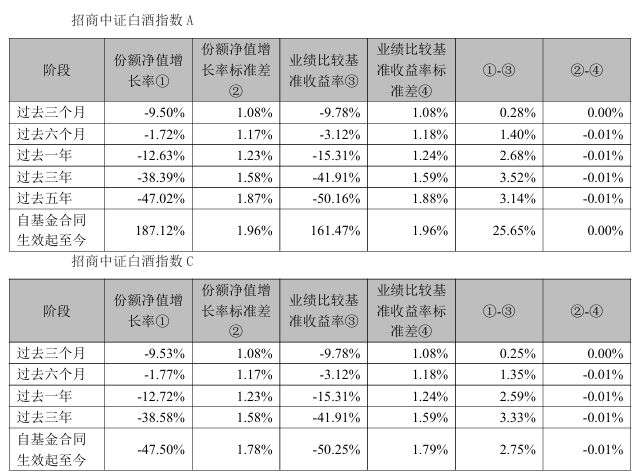
Core Viewpoint - The report highlights the performance of the China Securities White Wine Index Fund, which experienced a decline in net value but outperformed its benchmark during the fourth quarter of 2025, indicating a complex market environment for the white wine industry [1][9]. Fund Performance - The A-class and C-class shares of the white wine fund both saw a net value decrease of approximately 9.5% in Q4 2025, while the benchmark's return was -9.78%, resulting in a slight outperformance of 0.28 and 0.25 percentage points respectively [1][10]. - Over the past year, the A-class and C-class shares recorded net value growth rates of -12.63% and -12.72%, outperforming the benchmark by 2.68 and 2.59 percentage points respectively [1][10]. Fund Holdings - The fund's top holdings include Kweichow Moutai, which regained its position as the largest holding with a 15.38% share, valued at approximately 6.642 billion yuan [3][12]. - The top ten holdings accounted for 84.79% of the fund's net asset value, indicating a significant concentration in leading companies within the white wine sector [3][12]. Market Conditions - The white wine sector faced challenges in Q4 2025 due to slower-than-expected consumer recovery and pressure on terminal sales, leading to an overall downward trend in stock prices [3][11]. - The fund manager noted that the industry is experiencing a phase of adjustment, with head companies exerting pressure on mid-tier firms, complicating the balance of price and volume for wine producers [5][13]. Investor Behavior - There was a notable divergence in investor behavior, with A-class shares experiencing a net redemption of 10.54 billion shares, while C-class shares increased by 15.71 billion shares during the same period [5][16]. - The growth in C-class shares may reflect investor strategies favoring short-term gains, while the redemption of A-class shares suggests a cautious outlook on the industry's recovery [5][16].





酒价内参1月23日价格发布 价格小幅回暖分化格局延续
Xin Lang Cai Jing· 2026-01-23 01:21
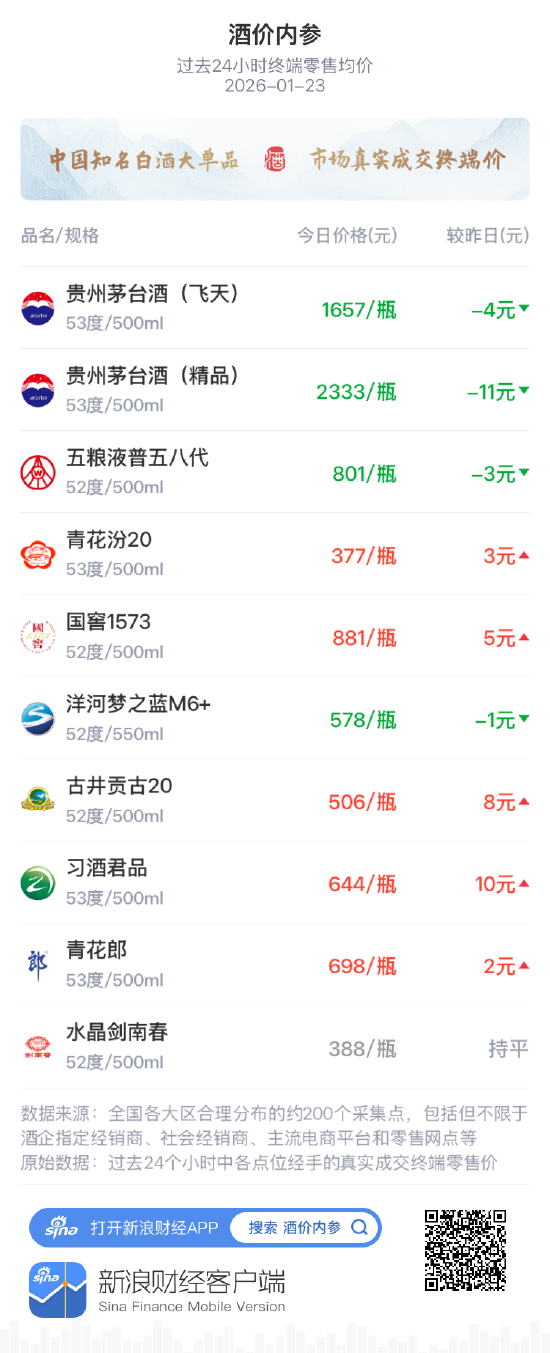
Core Insights - The core viewpoint of the article highlights a slight recovery in the retail prices of China's top ten liquor products, indicating a temporary alleviation of downward pressure in the industry [1][7]. Price Trends - The average retail price of the top ten liquor products reached 8,863 yuan on January 23, an increase of 9 yuan from the previous day [1][7]. - The market displayed a mixed performance with five products increasing in price, four decreasing, and one remaining stable [1][8]. - Notable price increases included Xijiu Junpin and Gujing Gonggu 20, which rose by 10 yuan and 8 yuan per bottle, respectively [1][8]. - Conversely, the premium Moutai led the declines with a drop of 11 yuan per bottle, followed by Feitian Moutai, which fell by 4 yuan [1][8]. Market Analysis - The data for "Wine Price Reference" is sourced from approximately 200 collection points across various regions, aiming to provide an objective and traceable overview of liquor market prices [2][9]. - The introduction of new sales channels for Moutai products has begun to influence market prices significantly [2][9]. - Fund managers are showing a mixed approach towards the liquor sector, with some increasing their holdings in leading brands, indicating a potential recovery phase for the industry [3][9]. - The liquor sector is perceived to be at a historical valuation low, with expectations of demand recovery driven by consumption policies under the "14th Five-Year Plan" [3][9].
公募基金去年如何对待白酒?张坤、刘彦春在减持
Nan Fang Du Shi Bao· 2026-01-22 09:41
Group 1 - Several public funds have reduced their holdings in liquor stocks, particularly in high-end brands like Kweichow Moutai and Shanxi Fenjiu, with reductions of 8.08% and 5.14% respectively [2] - The liquor sector experienced a cumulative decline of 11.5% in Q4 2025, contrasting with the overall bullish market, which has contributed to the decision of funds to decrease their positions [2] - The fundamental performance of the liquor industry is also underwhelming, with many companies issuing profit warnings for 2025 [3] Group 2 - Major liquor companies are forecasting significant declines in net profits, with Shui Jing Fang expected to see a 71% drop and Kuozi Jiao anticipating at least a 50% decrease [3] - The ongoing decline in the liquor sector is attributed to multiple factors, including supply-demand imbalances and changes in consumer behavior, indicating a shift from irrational exuberance to a focus on intrinsic value [3] - The consumer sector remains under pressure, with domestic demand facing challenges compared to export-oriented companies, as highlighted by Zhang Kun's analysis [4]
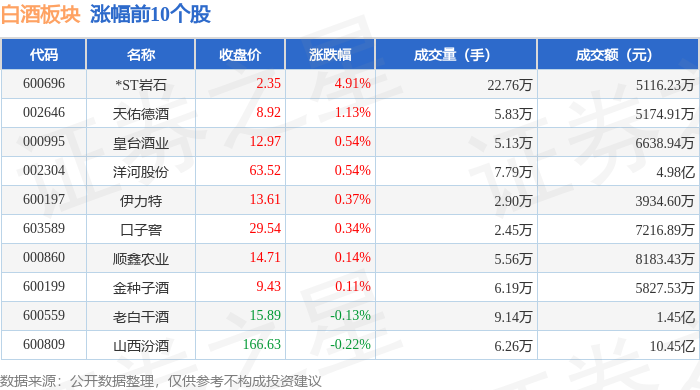
白酒板块1月22日跌0.61%,古井贡酒领跌,主力资金净流出9.04亿元
Zheng Xing Xing Ye Ri Bao· 2026-01-22 09:01
Group 1 - The liquor sector experienced a decline of 0.61% on January 22, with Gujing Gongjiu leading the drop [1] - The Shanghai Composite Index closed at 4122.58, up 0.14%, while the Shenzhen Component Index closed at 14327.05, up 0.5% [1] - Major liquor stocks showed mixed performance, with *ST Yanshi leading with a gain of 4.91% and Gujing Gongjiu declining by 1.22% [2] Group 2 - The liquor sector saw a net outflow of 904 million yuan from institutional investors, while retail investors contributed a net inflow of 172 million yuan [2] - The top stocks by net inflow from retail investors included Shunxin Agriculture and Yili Te, while major outflows were observed in Shanxi Fenjiu and Yanghe Co [3] - Guizhou Moutai had a closing price of 1340.06 yuan, with a decrease of 0.81%, and recorded a transaction volume of 5.90 million shares [2]

张坤等知名基金经理罕见发声!
天天基金网· 2026-01-22 05:20
Group 1 - The core viewpoint of the article highlights the strategic adjustments made by prominent fund managers at E Fund in their investment portfolios for Q4 2025, focusing on sectors like AI, healthcare, consumer goods, and technology [2][4][6][10] Group 2 - Zhang Kun adjusted the structure of investments in the healthcare, consumer, and technology sectors while maintaining a stable position in top holdings, which include Tencent Holdings, Kweichow Moutai, and Alibaba-W [4][5] - Zhang Kun expressed confidence in the improvement of living standards and social security in China over the next decade, suggesting a narrowing gap with developed countries [4] - The AI wave is seen as a significant driver for innovation, with strong domestic demand expected to attract global resources and talent [4][5] Group 3 - Chen Hao focused heavily on AI-related sectors, increasing allocations in power equipment, new energy, non-bank financials, and chemicals, which yielded positive returns [7][8] - Chen Hao anticipates a transition of the AI industry from an acceleration phase in 2025 to a stable growth phase in 2026, emphasizing the importance of structural opportunities and the integration of AI with local applications [7][8] Group 4 - Xiao Nan reduced allocations in high-end and sub-high-end liquor sectors while increasing investments in the livestock industry, anticipating inflation-driven cost increases over the next two years [10] - The top holdings in Xiao Nan's consumer sector fund remained unchanged, including Kweichow Moutai and Midea Group [10]






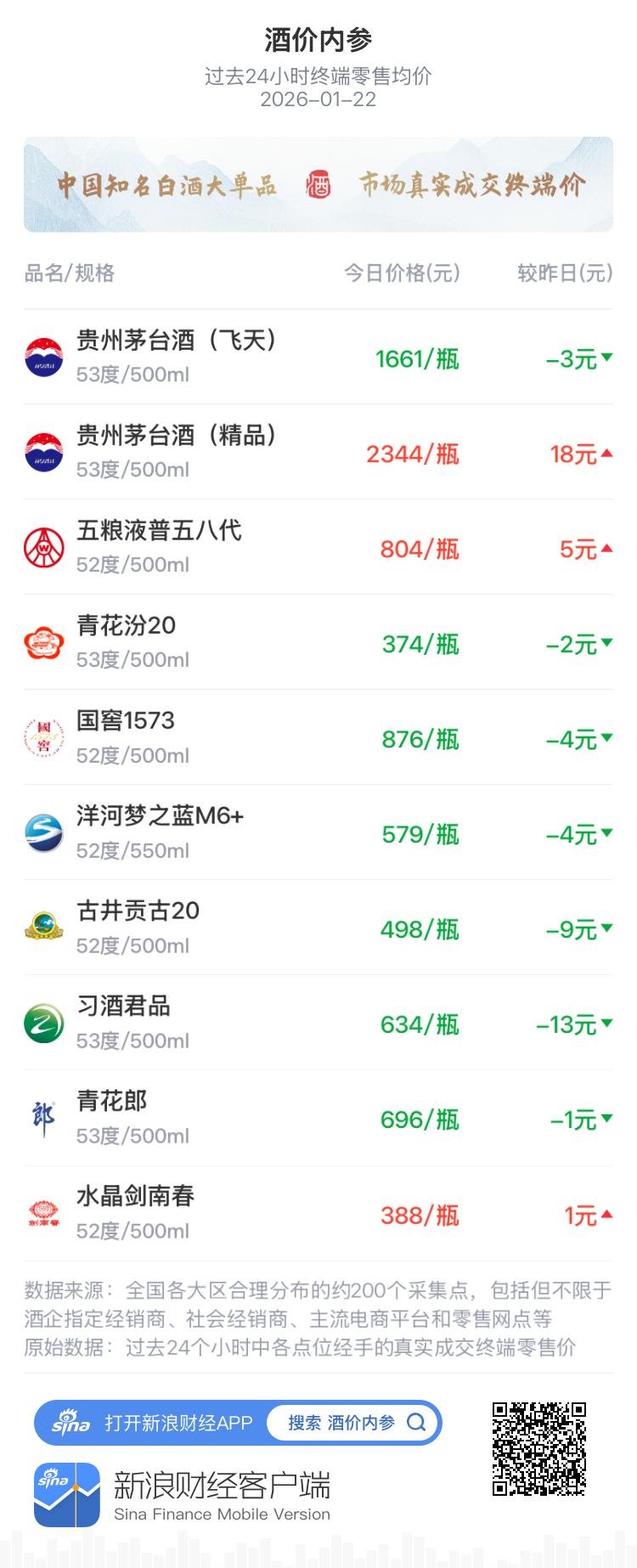
酒价内参1月22日价格发布 习酒君品下跌13元
Xin Lang Cai Jing· 2026-01-22 01:23
Core Insights - The Chinese liquor market is experiencing a general decline in retail prices, with the average price of the top ten products dropping to 8,854 yuan, a decrease of 12 yuan from the previous day, marking the fifth consecutive decline to a two-month low [1][7][8] - The market shows a mixed trend with seven products declining and three increasing in price, indicating a short-term adjustment phase in the industry [1][8] Price Trends - The leading product, Xijiu Junpin, saw the largest drop of 13 yuan per bottle, while Gujing Gonggu followed with a decrease of 9 yuan per bottle [1][8] - Other notable declines include Guojiao 1573 and Yanghe Dream Blue M6+, both down by 4 yuan per bottle, and Feitian Moutai, which decreased by 3 yuan per bottle [1][8] - In contrast, the premium Moutai product increased significantly by 18 yuan per bottle, attributed to tightened supply and replenishment demand [1][8] Data Collection Methodology - The "Liquor Price Reference" collects data from approximately 200 points across various regions, including designated distributors, social distributors, e-commerce platforms, and retail outlets, ensuring a comprehensive and objective representation of market prices [2][9] - The pricing data is weighted based on actual transaction volumes to provide accurate retail price calculations for products like Feitian Moutai and premium Moutai [2][9] Brand Value Insights - Moutai ranks first in the global spirits industry with a brand value of 59.63 billion USD, reflecting a 2.2% year-on-year increase, underscoring its role as a benchmark for Chinese liquor brands [3][9] - The Brand Finance report indicates that while the number of Chinese brands in the top 500 decreased by one, the total brand value increased by 9.7%, with an average brand strength index of 76.4, surpassing the global average [3][9]
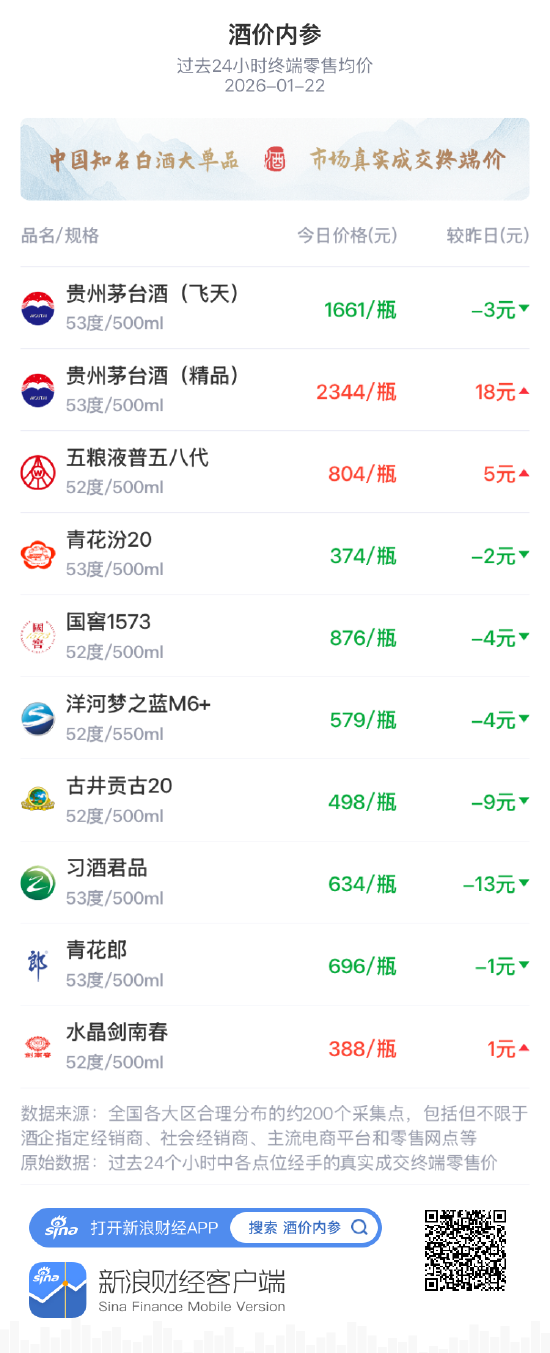
酒价内参1月22日价格发布 市场延续下跌五创两月价格新低
Xin Lang Cai Jing· 2026-01-22 00:59
Core Viewpoint - The Chinese liquor market is experiencing a general decline in retail prices for the top ten products, marking the fifth consecutive drop in two months, with high-end liquor prices continuing to decrease, indicating a short-term adjustment in the industry [1]. Price Trends - The overall retail price for a package of the top ten liquor products is 8,854 yuan, down by 12 yuan from the previous day [1]. - Among the top ten products, seven saw price declines while three experienced price increases, highlighting a clear market downturn [1]. Specific Product Performance - The leading price drop was observed in Xijiu Junpin, which decreased by 13 yuan per bottle; followed by Gujing Gonggu with a drop of 9 yuan; and both Guojiao 1573 and Yanghe Dream Blue M6+ with declines of 4 yuan each [1][3][4]. - The only products that saw price increases were the premium Moutai, which rose by 18 yuan per bottle due to tightened channel supply and replenishment demand, and Wuliangye Pu 58th generation, which increased by 5 yuan [1][3]. Market Dynamics - The market is characterized by a significant divergence in the performance of leading liquor brands, with only a few showing signs of recovery from the price declines [1]. - The continuous supply of lower-priced Moutai is further weakening the support for terminal prices [1].
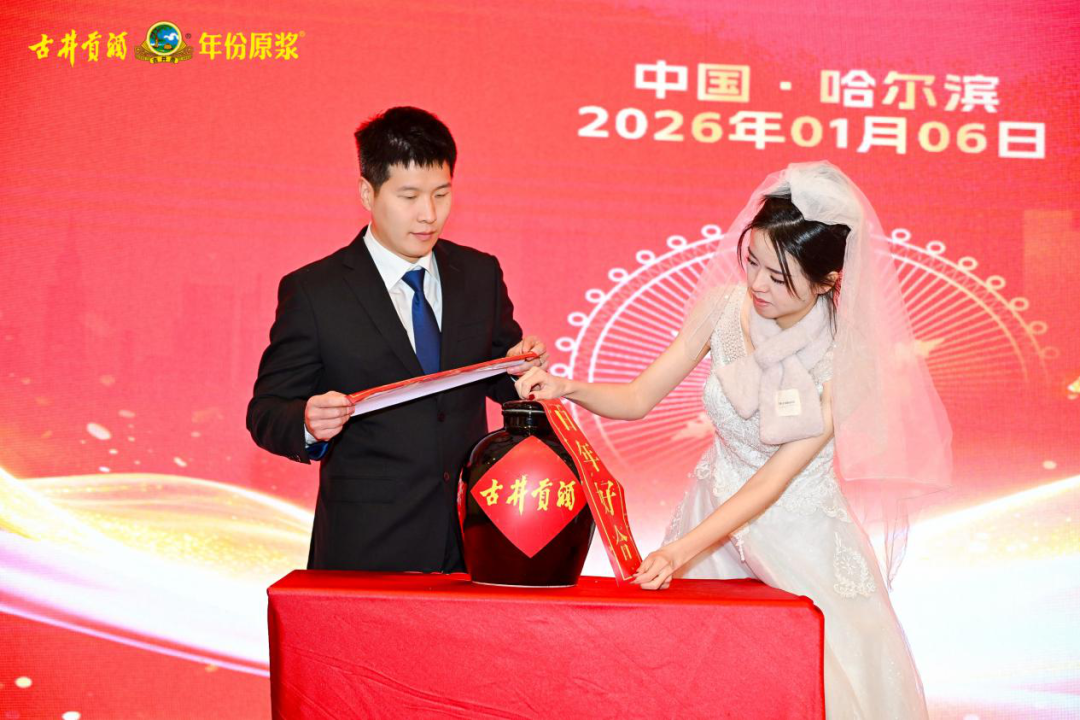
冰雪为盟,佳酿为证!2026最浪漫的哈尔滨,藏着古井贡酒的深情与暖意
Mei Ri Jing Ji Xin Wen· 2026-01-21 11:14
Core Viewpoint - The article highlights the successful collaboration between Gujing Gongjiu and Harbin, showcasing cultural integration through events like the collective wedding and zodiac snow sculptures, enhancing brand visibility and consumer engagement in the context of the upcoming 2026 New Year celebrations [1][3][6]. Group 1: Event Highlights - The 42nd "Siji Muge" public ice and snow collective wedding took place in Harbin, featuring 42 couples who pledged their love amidst a backdrop of ice and snow, attracting significant attention with over 14,510 couples applying and more than 17.01 million votes cast [1]. - Gujing Gongjiu served as the designated beverage for the wedding, enhancing the event's romantic atmosphere with a ceremonial sealing of the wine, symbolizing the couples' commitment [1][3]. Group 2: Cultural Integration - The collaboration between Gujing Gongjiu and Harbin reflects a mutual enhancement of brand culture and city identity, aligning with Harbin's reputation as the "Ice and Snow Culture Capital" and Gujing Gongjiu's values of integrity and social responsibility [3][5]. - The zodiac snow sculpture, inspired by the Year of the Horse, merges Gujing Gongjiu's cultural themes with ice and snow artistry, becoming a new attraction in the Baroque-style district of Harbin [3][5]. Group 3: Consumer Engagement - The events cater to various consumer segments, from newlyweds seeking romantic experiences to tourists interested in cultural symbols, positioning Gujing Gongjiu as a staple for celebrations and gatherings [6]. - The strategic timing of these events during the ice and snow festival maximizes brand exposure and aligns with consumer sentiments around the New Year, reinforcing Gujing Gongjiu's image as a key player in festive celebrations [5][6].
食品饮料行业今日跌1.53%,主力资金净流出24.16亿元
Zheng Quan Shi Bao Wang· 2026-01-21 09:20
Market Overview - The Shanghai Composite Index rose by 0.08% on January 21, with 18 out of the 28 sectors experiencing gains. The top-performing sectors were non-ferrous metals and electronics, with increases of 2.79% and 2.62% respectively [1] - The banking and coal sectors saw the largest declines, with drops of 1.58% and 1.57% respectively [1] Capital Flow Analysis - The net inflow of capital in the two markets was 11.983 billion yuan, with 14 sectors receiving net inflows. The electronics sector led with a net inflow of 16.369 billion yuan, while the non-ferrous metals sector followed with a net inflow of 7.289 billion yuan [1] - Conversely, 17 sectors experienced net outflows, with the power equipment sector seeing the largest outflow of 6.688 billion yuan, followed by the defense and military sector with an outflow of 2.906 billion yuan [1] Food and Beverage Sector Performance - The food and beverage sector declined by 1.53%, with a net outflow of 2.416 billion yuan. Out of 124 stocks in this sector, 23 rose while 97 fell, including one stock that hit the daily limit down [2] - The top three stocks with the highest net inflows in the food and beverage sector were "Hao Xiang Ni" with 61.106 million yuan, "*ST Chun Tian" with 12.8997 million yuan, and "Wei Zhi Xiang" with 12.7381 million yuan [2] - Major stocks with significant net outflows included Kweichow Moutai with 9.52 billion yuan, Wuliangye with 3.66 billion yuan, and Shanxi Fenjiu with 1.33 billion yuan [2][4] Food and Beverage Sector Capital Inflow and Outflow - The capital inflow leaderboard in the food and beverage sector included "Hao Xiang Ni" (+8.11%), "*ST Chun Tian" (+4.85%), and "Wei Zhi Xiang" (+1.43%) [2] - The capital outflow leaderboard featured Kweichow Moutai (-1.64%), Wuliangye (-1.77%), and Shanxi Fenjiu (-2.34%) [4]


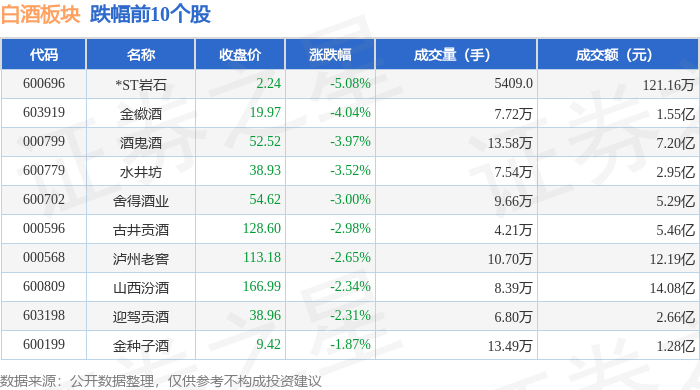
白酒板块1月21日跌1.83%,*ST岩石领跌,主力资金净流出26.42亿元
Zheng Xing Xing Ye Ri Bao· 2026-01-21 08:53
Core Viewpoint - The liquor sector experienced a decline of 1.83% on January 21, with *ST Rock leading the drop, while the overall market indices showed slight increases [1] Group 1: Market Performance - The Shanghai Composite Index closed at 4116.94, up 0.08% [1] - The Shenzhen Component Index closed at 14255.12, up 0.7% [1] - The liquor sector saw a net outflow of 2.642 billion yuan from main funds, while retail investors contributed a net inflow of 858 million yuan [1] Group 2: Individual Stock Performance - *ST Rock closed at 2.24 yuan, down 5.08% with a trading volume of 5409 lots [1] - Other notable declines included Quan Wei Jiu down 4.04%, Zhi Si Li down 3.97%, and Shui Jing Fang down 3.52% [1] - The highest closing price was for Shanxi Fen Jiu at 166.99 yuan, down 2.34% [1] Group 3: Fund Flow Analysis - Main funds showed a significant outflow from several stocks, including Lao Bai Gan Jiu with a net outflow of 18.7589 million yuan [2] - Retail investors had a net inflow in stocks like Jin Shi Zi Jiu, which saw a net inflow of 12.814 million yuan [2] - The overall trend indicates a mixed sentiment among different types of investors within the liquor sector [2]