GUJING(000596)

Search documents
徽酒三国杀,决战社区“最后一公里”
阿尔法工场研究院· 2025-12-22 00:03
Core Viewpoint - The Anhui liquor industry is collectively shifting towards community-focused sales models, with companies like Kuozi Jiao, Gujing Gongjiu, and Yingjia Gongjiu opening local liquor shops to directly engage with consumers [1][10]. Group 1: Market Dynamics - The traditional sales model relied heavily on distributors, but the new "liquor shop" approach requires companies to engage directly with consumers, shifting from brand-centric to retail-centric thinking [1][2]. - The competitive landscape has changed significantly, with Kuozi Jiao's market position declining, Gujing Gongjiu leading in scale and growth, and Yingjia Gongjiu surpassing Kuozi Jiao to become the second-largest player [5][6]. Group 2: Financial Performance - In the first three quarters of 2025, Kuozi Jiao reported a revenue of 3.174 billion yuan and a net profit of 742 million yuan, reflecting year-on-year declines of 27.24% and 43.39% respectively, with a 92.55% drop in net profit for Q3 [8][12]. - Gujing Gongjiu's revenue was 16.425 billion yuan and net profit 3.96 billion yuan, down 13.87% and 16.57% year-on-year [8]. - Yingjia Gongjiu's revenue reached 4.516 billion yuan with a net profit of 1.511 billion yuan, showing declines of 18.09% and 24.67% respectively [9]. Group 3: Consumer Behavior and Market Trends - The demand for liquor has slowed, with a notable decrease in corporate group purchases and business banquets, leading to a reassessment of consumption structures towards community retail and personal consumption [16][17]. - The competition among Anhui liquor brands is shifting from scale expansion to intense competition at the retail level [18]. - The traditional year-end negotiations between liquor companies and distributors are changing, with companies adopting a more cautious approach in setting sales targets [19]. Group 4: Strategic Implications - Kuozi Jiao's move to open community liquor shops symbolizes a strategic shift to regain direct consumer engagement amid market pressures [14][20]. - The industry faces a critical challenge in transitioning from a reliance on wholesale distribution to a focus on direct sales and consumer engagement [21][22].


今日财经要闻TOP10|2025年12月21日
Xin Lang Cai Jing· 2025-12-21 12:14
Group 1 - SpaceX responded to misleading reports regarding the safety of its flights, emphasizing that public safety is always its top priority during flight tests [1][10] - The company stated that all incidents involving spacecraft debris were managed within pre-coordinated control areas established by the U.S. Space Force and the FAA [1][10] - SpaceX criticized the media for relying on anonymous sources and non-scientific analyses, asserting that its safety management tools are well-established and effective [1][10] Group 2 - Longjiang Securities reported that China has become the second country after Germany to approve L3 autonomous driving vehicles for road use, marking a significant step towards mass production [3][12] - The approval of the first batch of L3 vehicles is expected to accelerate the commercialization of autonomous driving technology and benefit the entire industry chain [3][12] - The report suggested investment opportunities in intelligent driving algorithm providers, related hardware suppliers, and Robotaxi operating platforms [3][12][13] Group 3 - Morgan Stanley's Liu Mingdi identified four key themes for investment in 2026, including "anti-involution," AI, overseas expansion, and consumption, with real estate as a potential theme [5][15] - The "anti-involution" theme focuses on sectors with strong growth prospects, such as batteries and photovoltaics, and industries closely tied to the macroeconomy [5][15] - Liu emphasized that AI infrastructure capital expenditure is expected to grow, benefiting Chinese suppliers, and highlighted the importance of energy storage, photovoltaics, and batteries in the AI infrastructure sector [5][15] Group 4 - The Chinese fireworks and firecrackers association supported Shanxi province's decision to shift from a complete ban to a scientific management model for fireworks, allowing for limited use [8][18] - This change reflects a balance between cultural needs and safety governance, aiming to preserve traditional customs while managing safety risks effectively [8][18] Group 5 - RRP Semiconductor in India saw its stock price surge over 55,000% in 20 months, becoming a "meme stock" despite having negative revenue and minimal operational capacity [9][19] - The stock's rise is attributed to network speculation and a growing retail investor base in India, as there are few listed semiconductor companies available for investment [9][19] Group 6 - The Mexican proposal to impose tariffs on Chinese goods has prompted a strong response from China, which is prepared to take various countermeasures if the proposal is enacted [10][20] - China is aware of the complexities behind Mexico's proposal, particularly the pressure from the U.S. to align with its tariff policies [10][20] - The Chinese government maintains that it will protect its rights and interests, indicating a readiness to respond if the tariff proposal proceeds [10][20]






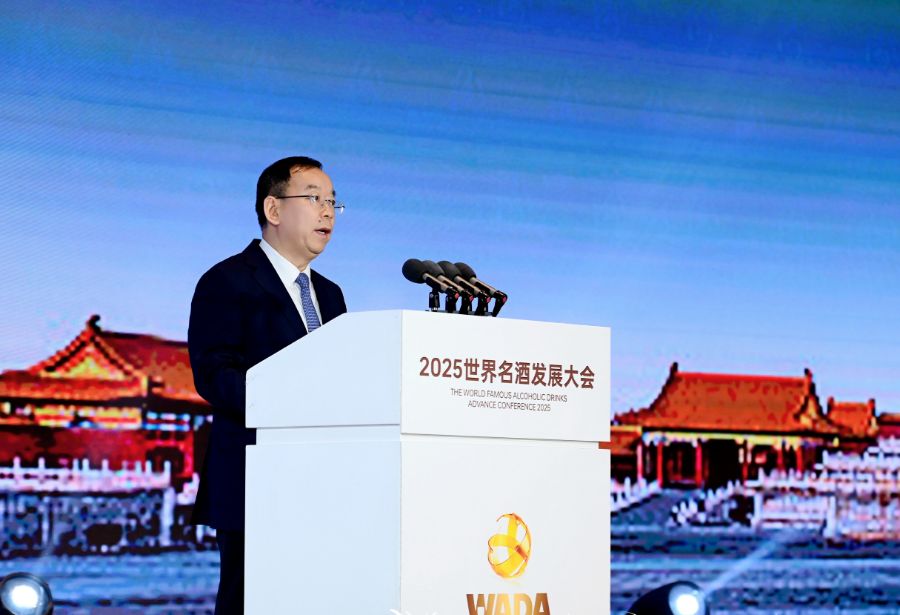
白酒T9齐聚宜宾:政策机遇期到来 求增长转向谋价值
2 1 Shi Ji Jing Ji Bao Dao· 2025-12-20 08:10
Core Viewpoint - The Chinese liquor industry is facing both challenges and opportunities as it enters the "14th Five-Year Plan" period, with a significant policy shift recognizing the liquor industry as a "historical classic industry" [2][3] Industry Policy Changes - The liquor industry has been historically classified as a restricted industry until 2020, when it was "unlocked" [2] - In October, the Ministry of Industry and Information Technology issued guidelines promoting the high-quality development of historical classic industries, further elevating the status of the liquor industry [2] - This policy change is seen as a major boost for the industry, providing a historical opportunity for development [2][3] Current Industry Challenges - The liquor industry is currently undergoing its fifth round of adjustment, with all segments, including leading brands, facing pressure [5] - The ongoing adjustment period is described as more complex and profound, with competition intensifying since 2021 [5] - There is a need for the industry to rethink existing consumption models, business models, product forms, and cultural expressions to innovate and adapt to modern demands [7][10] Shifts in Consumer Demand - The traditional consumption model is declining, with consumers increasingly seeking products that address their needs beyond just drinking [8][15] - The market is transitioning from functional consumption to emotional consumption, where consumers value cultural identity and emotional connections [15][16] - The rise of "self-pleasure" consumption is changing market dynamics, requiring companies to offer diverse product specifications and consumption methods [15][16] Future Directions for the Industry - The industry must balance tradition and innovation, ensuring that cultural values are preserved while adapting to modern consumer needs [16] - There is a call for the industry to leverage technology, cultural resonance, and ecological harmony to drive innovation [12][16] - The focus should be on creating new value propositions that resonate with younger consumers, moving from functional to emotional consumption [15][16] Events and Initiatives - The 2025 China International Famous Liquor Expo was held in Yibin, showcasing the integration of liquor and tourism [18][19] - Yibin has achieved significant milestones in liquor tourism, contributing 30% of revenue and 20% of profits with less than 5% of national production [19] - The expo aims to transform from an industry event to a city festival, promoting deep integration of liquor, culture, and tourism [18][19]
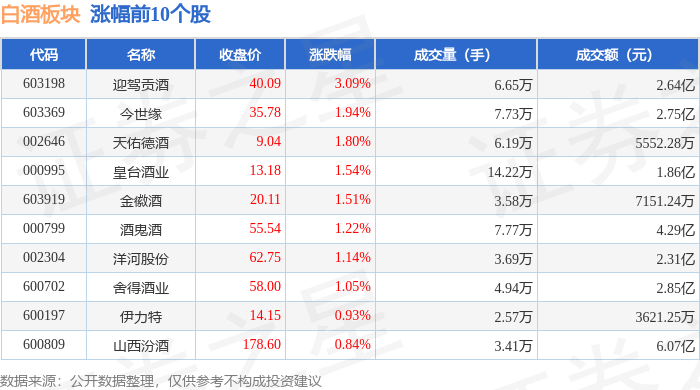
白酒板块12月19日跌0.66%,*ST岩石领跌,主力资金净流出5.64亿元
Zheng Xing Xing Ye Ri Bao· 2025-12-19 09:03
Group 1 - The liquor sector experienced a decline of 0.66% on December 19, with *ST Rock leading the drop [1] - The Shanghai Composite Index closed at 3890.45, up 0.36%, while the Shenzhen Component Index closed at 13140.22, up 0.66% [1] - Key stocks in the liquor sector showed varied performance, with Yingjia Gongjiu rising by 3.09% to a closing price of 40.09, and *ST Rock falling by 4.91% to 3.29 [2] Group 2 - The liquor sector saw a net outflow of 564 million yuan from institutional investors, while retail investors contributed a net inflow of 264 million yuan [2] - Major stocks like Wuliangye and Moutai had minimal price changes, with Wuliangye at 110.53 (up 0.09%) and Moutai at 1410.00 (up 0.21%) [2] - The liquidity dynamics showed that retail investors were more active, with significant inflows into stocks like Yingjia Gongjiu and Yanghe Co., despite overall institutional outflows [3]


酒仙集团董事长郝鸿峰“点赞”名酒:在报表业绩上它们做出了智慧的选择
Xin Lang Cai Jing· 2025-12-19 08:05
Core Viewpoint - The chairman of JiuXian Group, Hao Hongfeng, emphasized the need for the liquor industry to focus on sustainable practices rather than short-term gains, highlighting the importance of maintaining healthy market conditions and protecting distributor interests [3][5]. Group 1: Industry Performance - The financial reports of major liquor companies are declining, indicating a challenging market environment [3][5]. - Despite the downturn, companies like Wuliangye, Yanghe, Gujing, and ShuiJingFang have set positive examples by making wise choices that contribute to market health [3][5]. Group 2: Strategic Recommendations - Companies should avoid sacrificing distributor interests for short-term financial appearances, as this could lead to long-term market damage that may take 5 to 10 years to recover, or potentially never recover [3][5]. - The strategy of "reducing volume, stabilizing prices, and retreating to advance" is recommended to build a solid foundation for future growth [3][5]. - A return to genuine market reflections in financial reports is essential for the industry to gradually move towards a healthier state [3][5].
酒价内参12月19日价格发布 古井贡古20价格下跌4元/瓶
Xin Lang Cai Jing· 2025-12-19 01:41
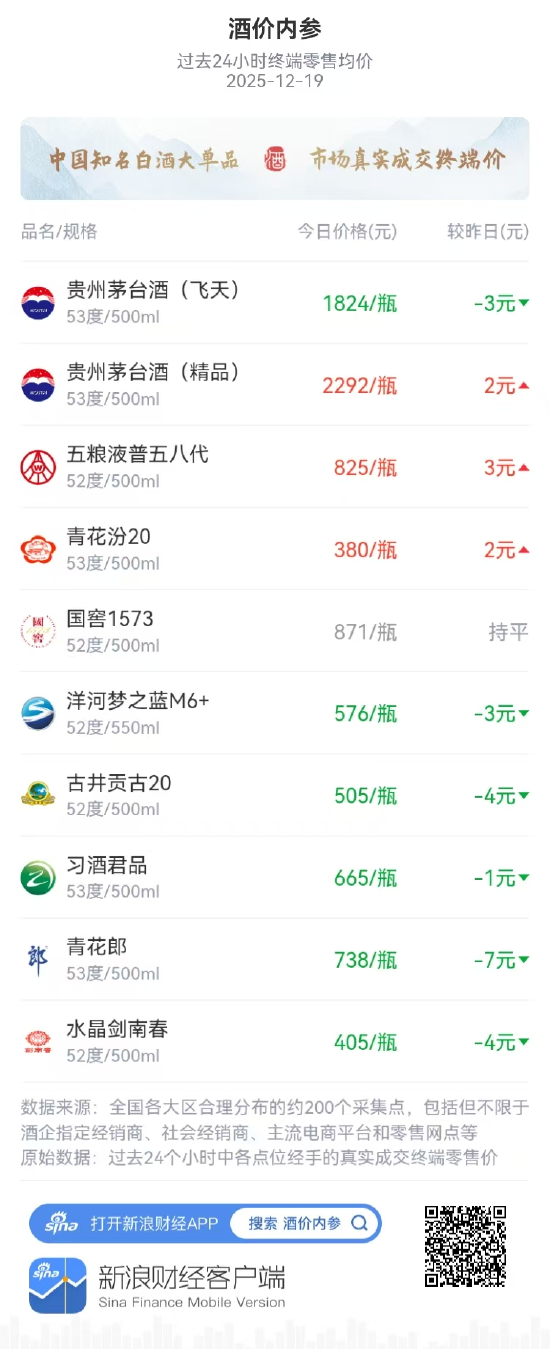
Core Viewpoint - The Chinese liquor market is experiencing a price correction, with the average retail price of the top ten products declining, indicating a potential stabilization in the market after recent fluctuations [1][2]. Price Trends - The overall retail price of the top ten liquor products fell to 9081 yuan, a decrease of 15 yuan from the previous day, marking a new low in five days [1]. - Among the ten products, six saw price declines, with Qinghua Lang dropping by 7 yuan per bottle, the largest decrease [2]. - Other notable price drops include: - Shuijing Jian Nan Chun down 4 yuan - Gu Qing Gong Gu 20 down 4 yuan - Feitian Moutai down 3 yuan - Yanghe Dream Blue M6+ down 3 yuan - Xijiu Junpin down 1 yuan [2]. Product-Specific Strategies - Wuliangye's recent conference revealed strategies focusing on maintaining price balance and optimizing product structure: - The eighth generation of Wuliangye aims to solidify its position in the 1000 yuan price segment - Wuliangye 1618 targets the first banquet brand in the same price range, focusing on key markets like Chengdu and Chongqing - The 39-degree variant aims to strengthen its presence in the 700 yuan segment, targeting regions like the Bohai and Taihu areas - Classic Wuliangye will maintain a dual strategy for classic and new products in the 1500 and 2000 yuan segments respectively - The brand is also focusing on the 300 yuan segment with its small Wuliangye and promoting exclusive products in the cultural liquor market [3]. Market Data - The following are the current prices and changes for notable liquor products: - Feitian Moutai (53 degrees, 500ml): 1824 yuan, down 3 yuan - Boutique Moutai (53 degrees, 500ml): 2292 yuan, up 2 yuan - Wuliangye Pu Wu 58 generation: 825 yuan, down 375 yuan - Qinghua Fen 20 (53 degrees, 500ml): 380 yuan, up 2 yuan - Guojiao 1573 (52 degrees, 500ml): 871 yuan, unchanged - Yanghe Dream Blue M6+: 576 yuan, down 3 yuan - Gu Qing Gong Gu 20: 505 yuan, down 4 yuan - Xijiu Junpin: 665 yuan, down 1 yuan - Qinghua Lang: 738 yuan, down 7 yuan - Shuijing Jian Nan Chun: 405 yuan, down 4 yuan [4][5]. Data Collection Methodology - The data is sourced from approximately 200 collection points across various regions, including designated distributors, social distributors, mainstream e-commerce platforms, and retail outlets, ensuring a comprehensive and accurate representation of the market [1].
酒价内参12月19日价格发布 市场整体下挫多款产品价格回调
Xin Lang Cai Jing· 2025-12-19 01:27
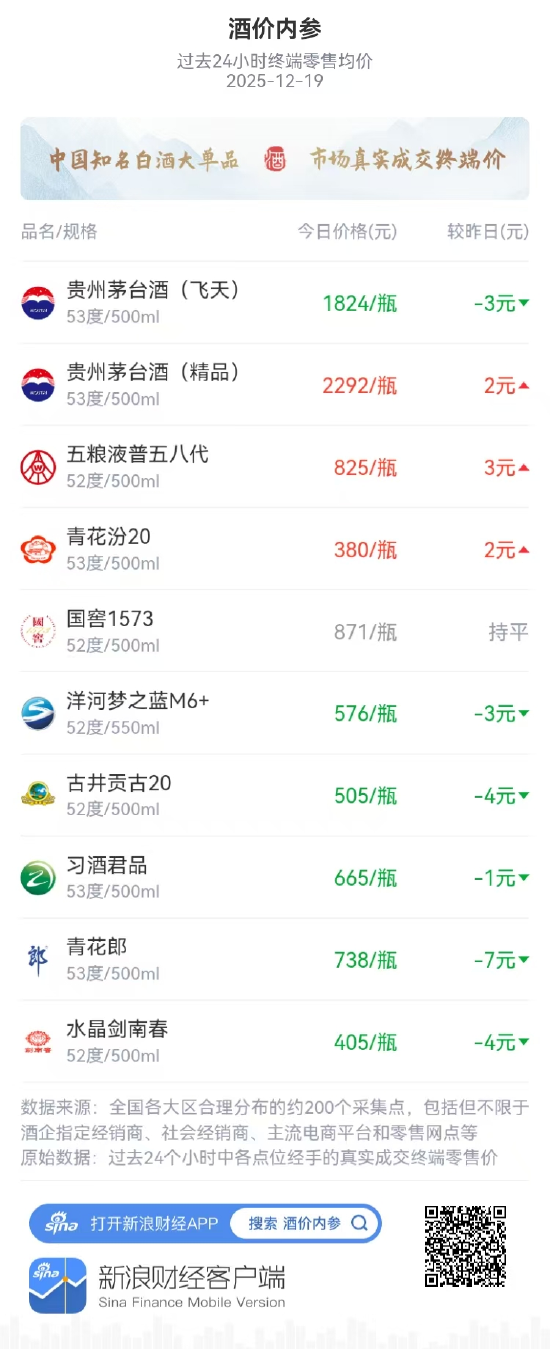
Core Insights - The overall retail price of the top ten Chinese liquor products has decreased, failing to maintain the previous day's rebound, with a total price of 9081 yuan, down 15 yuan from the previous day, marking a five-day low [1][6]. Price Trends - Among the top ten products, six have seen price declines, with Qinghua Lang dropping 7 yuan per bottle, the largest decrease [2][7]. - Other notable price drops include: - Shuijing Jian Nan Chun down 4 yuan per bottle - Gu Qing Gong Gu 20 down 4 yuan per bottle - Feitian Moutai down 3 yuan per bottle - Yanghe Dream Blue M6+ down 3 yuan per bottle - Xi Jiu Jun Pin down 1 yuan per bottle [2][7]. - Conversely, the following products have seen price increases: - Wuliangye Pu Wu 58th generation up 3 yuan per bottle - Boutique Moutai up 2 yuan per bottle - Qinghua Fen 20 up 2 yuan per bottle - Guojiao 1573 remained stable [2][7]. Industry Developments - Wuliangye held its 12.18 dealer conference on December 18, revealing several product strategies aimed at maintaining its market position [2][7]. - Key strategies include: - The eighth generation of Wuliangye focusing on "volume-price balance, structural optimization, and quality service" to solidify its position in the 1000 yuan price segment - Wuliangye 1618 targeting the 1000 yuan banquet brand market in cities like Chengdu and Chongqing - Wuliangye 39-degree aiming to strengthen its presence in the 700 yuan segment, particularly in key markets around the Bohai Sea and Taihu Lake - Classic Wuliangye maintaining a dual strategy for old and new products in the 1500 and 2000 yuan segments respectively - Accelerating marketing efforts for the small Wuliangye in the 300 yuan range and launching exclusive cultural products to enhance market interaction [2][7].
酒价内参12月18日价格发布 市场企稳反弹飞天茅台精品茅台均上涨
Xin Lang Cai Jing· 2025-12-18 01:08
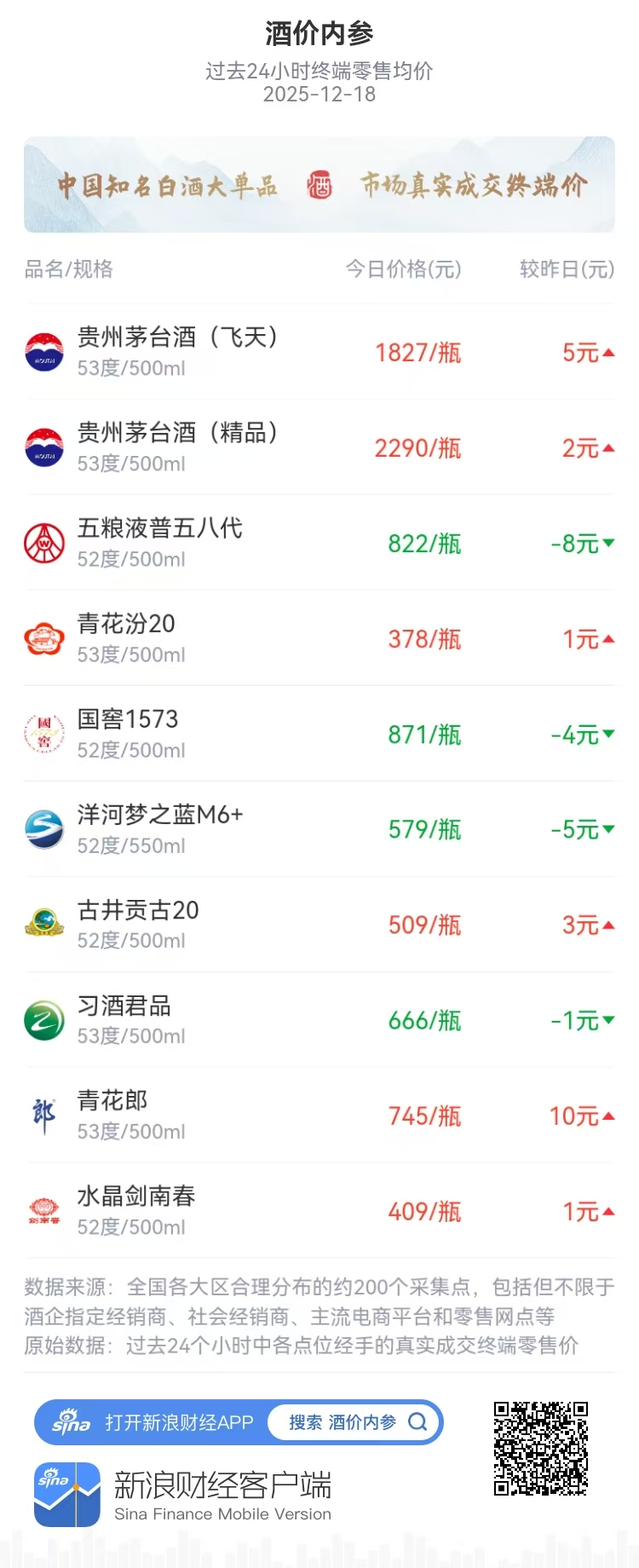
Core Viewpoint - The white liquor market has seen a rebound in the average retail price of the top ten products, ending a previous trend of continuous decline, with a slight overall increase in market sentiment [1]. Price Changes - The overall packaged price of the top ten products is 9096 yuan, which is an increase of 4 yuan from the previous day [1]. - Among the ten products, six experienced price increases while four saw declines [1]. - Notable price increases include: - Qinghua Lang: up 10 yuan per bottle [1][4]. - Guizhou Moutai (Feitian): up 5 yuan per bottle [1][3]. - Gujing Gong (Gong 20): up 3 yuan per bottle [1][4]. - Guizhou Moutai (Jingpin): up 2 yuan per bottle [1][3]. - Qinghua Fen 20 and Shuijing Jian Nan Chun: both up 1 yuan per bottle [1][4]. - Price declines include: - Wuliangye (Pu Wu 8th generation): down 8 yuan per bottle [1][3]. - Guojiao 1573: down 4 yuan per bottle [1][4]. - Yanghe Dream Blue M6+: down 5 yuan per bottle [1][4]. - Xijiu Junpin: down 1 yuan per bottle [1][4]. Market Sentiment - The market has shown signs of stabilization and recovery after a period of decline, with most brands experiencing price increases [1]. - The price increase of Moutai's main products is expected to boost confidence in the industry and market [1].
徽酒三巨头扎堆布局散酒生意 能否破解增长焦虑
Zhong Guo Jing Ying Bao· 2025-12-17 01:14
Core Viewpoint - The leading Anhui liquor companies are embracing the scattered liquor business amid a deep adjustment in the liquor industry, focusing on interactive and experiential marketing to address growth anxiety [2][8]. Group 1: Industry Trends - The liquor industry is shifting towards stock competition, with traditional deep distribution models losing effectiveness, leading to increased growth pressure on Anhui liquor companies [2][8]. - The scattered liquor market is projected to exceed 800 billion yuan in 2024 and 1 trillion yuan in 2025, with a compound annual growth rate of over 15% [5]. Group 2: Company Strategies - Gujing Gongjiu has opened its first direct "liquor shop" in Anhui, focusing on fresh sales and a variety of liquor types, including local specialties [3]. - Kuozi Jiu has launched its first "Kuozi Liquor Workshop," with plans for further expansion, while Yingjia Gongjiu has developed a dedicated scattered liquor division with multiple cooperation models [3][4]. - The product offerings from these companies include a wide range of prices, from 188 yuan per jin to as low as 20 yuan per jin, indicating a diverse product structure [3][4]. Group 3: Market Challenges - Major Anhui liquor companies have reported significant revenue declines in the first three quarters, with Gujing Gongjiu, Yingjia Gongjiu, and Kuozi Jiu experiencing year-on-year revenue drops of 13.87%, 18.09%, and 27.24%, respectively [7]. - The third quarter saw even steeper declines, with revenue falling by 51.65% for Gujing Gongjiu and 92.55% for Kuozi Jiu in net profit [7]. Group 4: Future Outlook - Industry experts suggest that the transition to scattered liquor sales is not a panacea but a necessary adaptation to leverage existing networks and brand recognition in a changing market [9]. - The success of scattered liquor business models may lead to the integration of digital tools and instant retail functions, enhancing the role of scattered liquor shops in the distribution strategy [9].
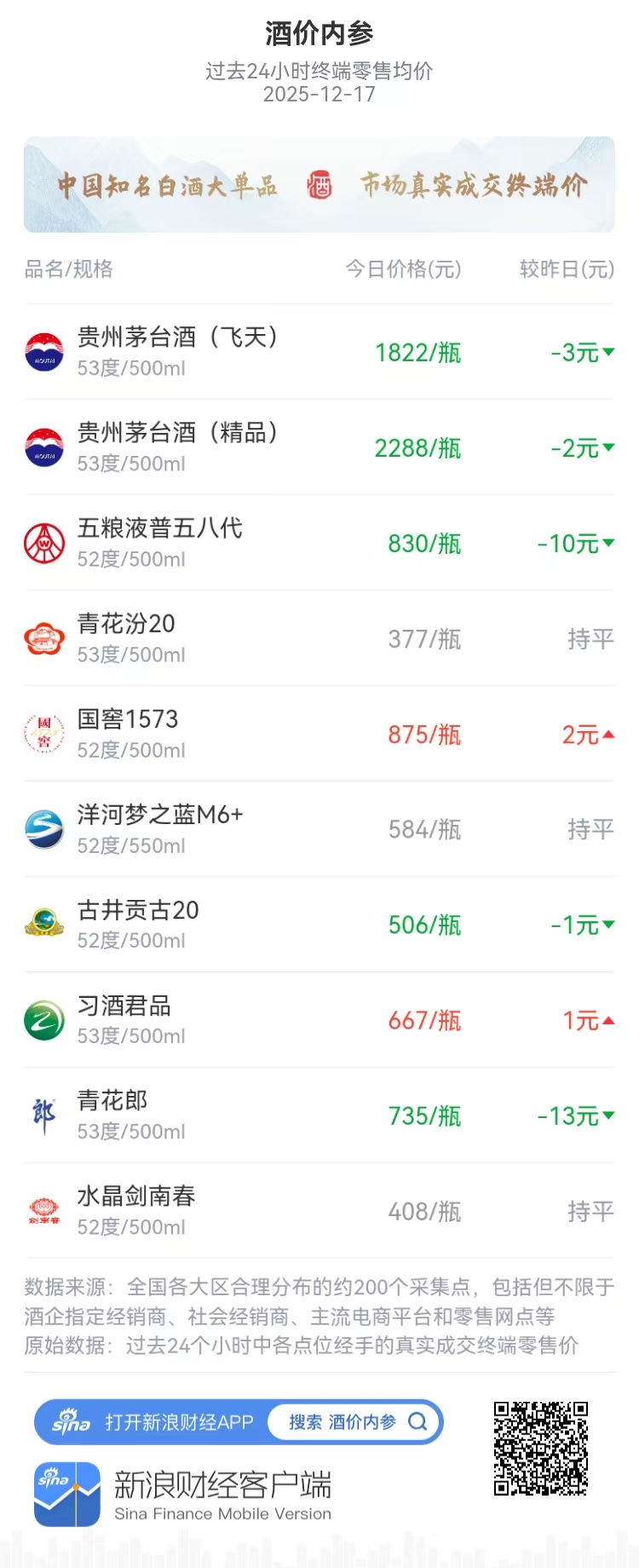
酒价内参12月17日价格发布 市场整体回调青花郎领跌
Xin Lang Cai Jing· 2025-12-17 00:59
Core Viewpoint - The white liquor market has experienced a price correction after a brief rebound, with the average retail price of the top ten products declining slightly, indicating a return to a consolidation phase in the market [1]. Price Trends - The total price for a bundled sale of the top ten products is 9092 yuan, down 26 yuan from the previous day [1]. - The number of products with stable prices has increased significantly, suggesting a market slowdown [1]. - Among the declining products, Qinghua Lang saw the largest drop of 13 yuan per bottle, while Wuliangye Pu 58th generation fell by 10 yuan per bottle [1][3]. - Prices for Feitian Moutai and Jingpin Moutai decreased by 3 yuan and 2 yuan per bottle, respectively [1][3]. - Gujing Gonggu 20 dropped by 1 yuan per bottle, while the prices of Guojiao 1573 and Xijiu Junpin increased slightly by 2 yuan and 1 yuan per bottle, respectively [1][4]. Market Sentiment - Overall transaction volume has weakened, with market participants exhibiting a cautious outlook [1].