CHANGAN AUTOMOBILE-B(000625)

Search documents
政策、技术、全球景气三重叠加,智能汽车板块走强,智能车ETF泰康(159720)冲击4连涨
Xin Lang Cai Jing· 2025-09-16 06:17
Core Viewpoint - The smart vehicle ETF, TaiKang (159720), is experiencing a significant upward trend driven by policy, technology, and global market conditions, indicating a shift from "electrification" to "intelligentization" in the automotive sector [1][5]. Short-term Driving Logic - Policy expectations have been fulfilled with clear guidelines on L3 access trials and energy storage targets, reducing market uncertainty and enhancing sector valuations [2]. - Accelerated technological iterations, such as breakthroughs in solid-state batteries and AI models for vehicles, validate industry growth potential and open long-term opportunities [3]. - Global benchmarks, including Tesla's Robotaxi progress and large orders from Hesai, confirm the commercial viability of smart vehicles and strengthen the global supply chain position [4]. Medium to Long-term Trends - The competitive focus is shifting from battery range to intelligent driving experiences, with software-defined vehicles becoming a core barrier to entry [5]. - The deepening of domestic substitution in critical areas like semiconductors and lidar, along with accelerated overseas expansion (e.g., localized production in Europe), is building global competitiveness [5]. Profit Model Reconstruction - Automotive companies are transitioning from "hardware sales" to "software services" (e.g., subscription-based intelligent driving), with future gross margins expected to continue rising [6]. Related Products - The smart vehicle ETF, TaiKang (159720), employs a full replication investment strategy closely tracking the CSI Smart Electric Vehicle Index, achieving a recent scale of 59.69 million yuan, a six-month high [1][7]. - The ETF's top ten holdings include leading companies in electric and smart vehicle sectors, with a combined weight of 55.33%, indicating strong alignment with the electrification and intelligentization trends [7][8]. - The ETF is positioned to benefit from the positive cycle of "technological breakthroughs - commercial implementation - scale expansion," particularly as Robotaxi operations grow and intelligent driving hardware costs decrease [7][8]. - The CSI Smart Electric Vehicle Index reflects the overall performance of listed companies in the smart electric vehicle industry, with key players like CATL and BYD establishing competitive advantages in battery technology and smart cockpit areas [9].





一天之内17家车企表态:积极落实账款支付倡议!
Zhong Guo Qi Che Bao Wang· 2025-09-16 01:45
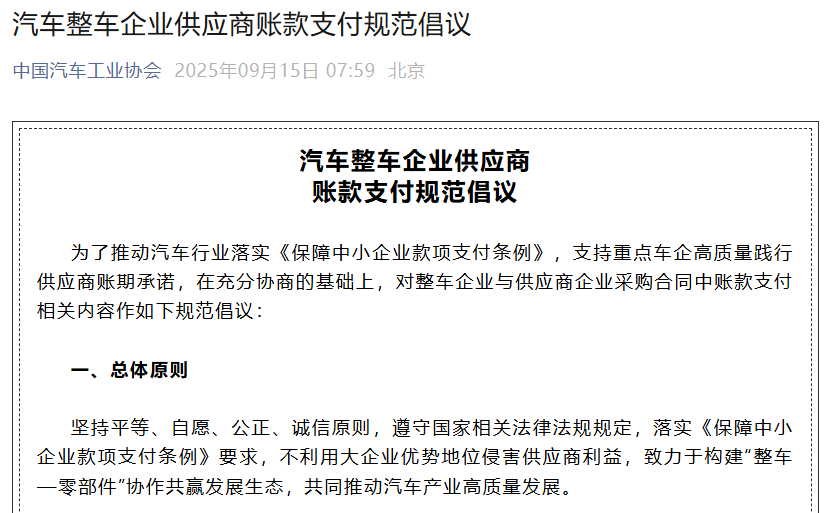
Core Viewpoint - The China Automotive Industry Association released the "Supplier Payment Norms Initiative" on September 15, urging automakers to comply with the "Regulations on Payment to Small and Medium-sized Enterprises" and to avoid exploiting their dominant positions to harm suppliers' interests, aiming to build a collaborative and win-win ecosystem in the automotive industry for high-quality development [1]. Group 1: Industry Response - A total of 17 automakers, including FAW, Dongfeng, Changan, SAIC, GAC, BAIC, Chery, Jiangqi, BYD, Geely, Great Wall, Seres, NIO, Li Auto, Xpeng, Leap Motor, and Xiaomi, have publicly committed to the payment initiative [1]. - The initiative provides clear guidance for building a collaborative ecosystem between complete vehicles and components, promoting high-quality development in the automotive industry [5][8]. Group 2: Specific Company Actions - FAW has unified the payment term for suppliers to within 60 days and optimized internal procurement and financial settlement processes to maintain a healthy market economy [3]. - Dongfeng will implement the initiative's requirements in key areas such as order confirmation, delivery, acceptance, payment, and settlement to protect supplier rights and enhance supply chain resilience [5]. - Changan has also committed to a 60-day payment term and has implemented an innovative payment process to ensure efficient cash flow for suppliers [7]. - SAIC has announced a unified 60-day payment term and will avoid using commercial acceptance bills that increase supplier financial pressure [8]. - GAC has adhered to a payment principle of not exceeding 60 days for 28 years and has established a comprehensive management system for the payment process [10]. - BAIC emphasizes equal, voluntary, fair, and honest principles in supplier relationships and opposes unreasonable payment practices [12]. - Chery has implemented measures to shorten the average payment period for suppliers and alleviate financial pressure on small and medium-sized enterprises [14]. - Jiangqi is enhancing payment efficiency and transparency while ensuring all suppliers receive fair and efficient payment experiences [15]. - BYD is focusing on key areas such as order confirmation and payment to build a collaborative ecosystem with suppliers [17]. - Geely has committed to a 60-day payment term and will not use practices that increase supplier financial pressure [18]. - Great Wall is committed to timely payments and optimizing payment processes to maintain a healthy supplier relationship [21]. - Seres calls for industry self-discipline to enhance supply chain resilience and competitiveness [23]. - NIO aims to establish long-term, mutually beneficial relationships with partners to ensure product quality and user experience [26]. - Li Auto and Xpeng both reaffirm their commitment to a 60-day payment term and efficient payment processes to support their partners [28][30]. - Leap Motor is dedicated to implementing the initiative and ensuring supply chain stability [32]. - Xiaomi emphasizes the importance of timely payments as a fundamental respect for partners and aims to enhance supply chain resilience [35].



财经早报:中美就妥善解决TikTok问题达成基本框架共识
Xin Lang Zheng Quan· 2025-09-15 23:37
Group 1 - The Chinese Ministry of Commerce announced a basic framework consensus with the U.S. to resolve the TikTok issue and promote economic cooperation [2] - Nvidia is under further investigation for violating China's antitrust laws related to its acquisition of Mellanox Technologies [3] - The State Administration of Foreign Exchange released new measures to facilitate foreign investment and improve cross-border financing [4] Group 2 - The National Bureau of Statistics reported that the real estate market is stabilizing, with a narrowing decline in sales and prices over the first eight months of the year [8] - Multiple automotive companies, including Dongfeng and BYD, have committed to a new payment standard to enhance collaboration within the industry [9] - The U.S. is pressuring allies to impose tariffs on China based on its purchase of Russian oil, which China strongly opposes [7] Group 3 - Elon Musk disclosed a $1 billion purchase of Tesla shares, boosting investor confidence and the company's stock price [13] - Recent rumors about the collapse of gold merchants in Shenzhen were found to be exaggerated, with many businesses still operating normally [14] - Several new energy vehicle companies, including Neta and WM Motor, are attempting to revive operations after previous shutdowns [15] Group 4 - The energy storage industry is experiencing significant growth due to favorable policies and increased demand [16] - The semiconductor market is seeing a new wave of price increases, benefiting several related stocks [16] - The A-share market showed mixed performance, with the Shanghai Composite Index closing at 3860.50 points, down 0.26% [16][17]




智驾政策法规有望加速落地,推进有条件批准L3级车型生产准入
Changjiang Securities· 2025-09-15 23:30
Investment Rating - The report maintains a "Positive" investment rating for the automotive and automotive parts industry [7]. Core Insights - The "Automotive Industry Stability Growth Work Plan (2025-2026)" was issued by the Ministry of Industry and Information Technology and seven other departments on September 12, 2025. The plan aims to enhance the quality and reasonable growth of the automotive industry from both supply and demand sides, promote the industrial application of intelligent connected technology, and conditionally approve the production access of L3 level vehicles [2][4]. - The gradual implementation of policies and regulations is expected to accelerate the growth of advanced intelligent driving. The concept of "equal rights for intelligent driving" is likely to reassess the value of complete vehicles, with intelligent driving becoming a new opportunity for reshaping the market following electrification. Strong intelligent driving vehicles are anticipated to capture a larger market share while enhancing their AI capabilities through data accumulation, thus driving investment opportunities in core segments of the industry chain [2][4]. Summary by Sections Policy and Market Outlook - The plan targets achieving approximately 32.3 million vehicle sales in 2025, a year-on-year growth of about 3%, with new energy vehicle sales expected to reach around 15.5 million, reflecting a year-on-year increase of about 20%. The automotive export is also projected to maintain stable growth [4]. Intelligent Driving Development - The report emphasizes the push for the industrial application of intelligent connected technology, with L3 level intelligent driving expected to accelerate. The plan encourages the approval of intelligent connected vehicles and the establishment of pilot programs for road access, alongside improvements in legal frameworks related to traffic safety insurance [4]. Investment Opportunities - The report identifies two main lines of investment opportunities: 1. **Functionality Enhancement**: The continuous exploration of intelligent driving capabilities and the reduction of costs associated with high-level intelligent driving systems are expected to enhance consumer appeal [4]. 2. **Cost Reduction**: Technological advancements are anticipated to lower the costs of intelligent driving systems, with companies like Xiaopeng and BYD leading the charge in making intelligent driving more affordable [4]. Recommended Companies - The report recommends several companies for investment, including: - **Complete Vehicle Manufacturers**: Xiaopeng Motors, Great Wall Motors, Geely, BYD, Xiaomi Group, Leap Motor, Li Auto, SAIC Motor, and Changan Automobile [4]. - **Parts Suppliers**: Top Group, Bertel, and Xingyu Co., with a focus on companies like Desay SV and Coboda [4].


中汽协明确“60天账期”!东风集团、上汽集团、奇瑞等多家车企响应
Bei Jing Shang Bao· 2025-09-15 15:03
Core Viewpoint - The China Automobile Industry Association (CAAM) has released the "Supplier Payment Norms Initiative" to standardize payment practices between automobile manufacturers and suppliers, aiming to protect the rights of suppliers, especially small and medium-sized enterprises, and promote a healthier automotive industry ecosystem [3][9]. Group 1: Initiative Details - The initiative outlines norms for order confirmation, delivery and acceptance, payment and settlement, and contract duration between automobile manufacturers and suppliers [3]. - In the order confirmation section, it specifies that both parties must agree on order details and any changes must be mutually consented [3]. - For delivery and acceptance, manufacturers are required to complete acceptance within three working days and notify suppliers of any discrepancies [6]. Group 2: Payment Terms - The initiative states that payment terms should not exceed 60 calendar days from the date of delivery and acceptance [6][9]. - For continuous supply from non-small and medium-sized enterprises, manufacturers can negotiate concentrated billing periods [6]. - If pricing is not agreed upon, manufacturers should make an initial payment based on the most recent contract price, with adjustments made once a price is established [6]. Group 3: Industry Context - The automotive market has become increasingly competitive, leading to pressure on suppliers through lower procurement prices and extended payment periods, negatively impacting the supply chain [7]. - In the first four months of this year, China's automotive production and sales exceeded 10 million units, but industry profit margins have declined to 4.1% despite increased sales [7]. - The initiative is part of a broader effort to enhance cooperation between manufacturers and suppliers, with 17 major manufacturers committing to the 60-day payment term [9][10].




中汽协发布供应商账款支付倡议 17家车企表态落实
Zhong Guo Xin Wen Wang· 2025-09-15 13:17
Core Viewpoint - The China Automotive Industry Association (CAIA) has released a payment initiative for supplier accounts, which has been supported by 17 major automotive companies, aiming to promote high-quality development in the automotive industry [1][2]. Group 1: Initiative Details - The initiative outlines requirements for goods delivery acceptance, payment terms, reconciliation, and payment processes, specifying that the payment period for automotive companies (the buyer) should not exceed 60 calendar days from the date of delivery and acceptance by the buyer [1]. - The initiative is expected to alleviate financial pressure on suppliers, which is crucial for fostering innovation and building a robust supply chain in the automotive sector [1]. Group 2: Supporting Companies - The 17 automotive companies that have committed to this initiative include major players such as BYD, Xiaomi, Dongfeng Motor Group, and SAIC Motor Corporation, among others [2]. - These companies have previously made public commitments regarding the payment term of not exceeding 60 days [2]. Group 3: Industry Impact - If effectively implemented, the initiative could enhance cash flow efficiency within the industry, leading to improved production efficiency and overall competitiveness of the Chinese automotive sector [1].


中汽协推动“60天账期”承诺落地 17家车企响应
Xin Lang Cai Jing· 2025-09-15 12:26
Core Viewpoint - The China Automotive Industry Association (CAAM) has issued a payment standard initiative for automotive manufacturers, establishing a maximum payment term of 60 days for suppliers, effective from the date of delivery acceptance [1][2]. Group 1: Initiative Details - The initiative specifies that the payment term starts from the date of delivery and acceptance, with a maximum of 60 calendar days [1]. - It outlines requirements for delivery acceptance, payment terms, reconciliation, and payment processes, including a principle that delivery acceptance should not exceed three working days [1]. - The initiative encourages stable cooperation between suppliers and manufacturers, with contracts having a minimum validity of one year [1]. Group 2: Industry Response - Seventeen major automotive companies, including FAW, Dongfeng, Changan, SAIC, and BYD, have committed to implementing the initiative, aiming to foster a collaborative ecosystem between vehicle manufacturers and parts suppliers [1][2]. - In August, these companies collectively sold approximately 2.6 million vehicles, accounting for over 90% of China's total automotive sales for that month, indicating strong industry support for the initiative [2]. Group 3: Market Impact - Following the announcement of the initiative, the A-share automotive sector saw a net inflow of 3.27 billion yuan, with a 1.1% increase in stock prices [2]. - Several listed parts suppliers, such as Wanxiang Qianchao and Zhejiang Shibao, experienced stock price surges, while vehicle manufacturers like Haima and Jinbei also saw significant gains [2]. Group 4: Regulatory Context - The initiative aligns with recent regulatory actions aimed at promoting the healthy development of the automotive industry, including a three-month special campaign to address online irregularities in the sector [2]. - The Ministry of Industry and Information Technology has also released a work plan for stabilizing growth in the automotive industry from 2025 to 2026, focusing on structural optimization and quality improvement [2]. Group 5: Historical Context - Prior to this initiative, CAAM had already advocated for fair competition and healthy industry development, with commitments from major companies to adhere to a 60-day payment term [3]. - Data from Wind indicates that the average payment cycle for major domestic automakers was 183 days in the first half of this year, an increase of about 7 days compared to the same period in 2024 [3].

中汽协明确“60天账期”支付规范,17家车企响应
Bei Ke Cai Jing· 2025-09-15 12:17
Core Viewpoint - The China Automobile Industry Association (CAAM) has launched an initiative to standardize payment terms for automotive suppliers, establishing a maximum payment period of 60 days from the date of delivery and acceptance of goods by the automaker [1][3]. Group 1: Initiative Details - The payment period starts from the date the supplier's goods are delivered and accepted by the automaker, with a maximum of 60 calendar days [1][3]. - Automakers are encouraged to establish long-term cooperative relationships with suppliers, with contracts having a minimum validity of one year [1]. - The initiative outlines key processes including order confirmation, delivery and acceptance, and payment and settlement [3]. Group 2: Industry Response - 17 automakers have publicly committed to implementing the payment initiative, including major companies like Dongfeng Motor, SAIC Group, and BYD [2][6]. - Automakers such as BYD emphasize the importance of adhering to the initiative to ensure supplier rights and stabilize supply chain expectations [6]. Group 3: Specific Policies from Automakers - Chery Group has introduced a four-pronged approach to standardize payment terms and reduce average payment periods for suppliers [7]. - Changan Automobile has implemented a payment scheme that starts counting from the delivery date, successfully fulfilling the 60-day payment commitment [7]. - Great Wall Motors has committed to using bank transfers and bank acceptance bills exclusively for payments, avoiding electronic vouchers [7].

赛力斯、蔚来、东风、长安、上汽齐齐发声,汽车产业链多股暴涨
Mei Ri Jing Ji Xin Wen· 2025-09-15 12:17
Core Viewpoint - The "60-day payment commitment" initiative among 17 automotive companies continues to evolve, with the China Automotive Industry Association releasing the "Payment Norms Initiative for Automotive OEMs and Suppliers" on September 15, which aims to standardize payment terms and enhance supplier rights [1][3]. Group 1: Initiative Details - The initiative specifies that payment terms should not exceed 60 calendar days from the date of delivery and acceptance by the OEM [3]. - It encourages cash payments or bank acceptance bills, especially for small and medium-sized enterprises, to alleviate financial pressure on suppliers [5][6]. - The initiative includes provisions for advance payments based on previous contract prices if pricing agreements are not reached [5]. Group 2: Industry Response - Major automotive companies such as Dongfeng, Changan, and SAIC have committed to implementing the initiative, ensuring supplier rights and stabilizing expectations within the supply chain [6][8]. - The Ministry of Industry and Information Technology emphasized the importance of this initiative for promoting healthy and sustainable development in the automotive industry [8]. Group 3: Market Impact - Following the announcement of the initiative, automotive stocks saw significant gains, with several companies reaching their daily price limits [3]. - In the Hong Kong market, shares of electric vehicle manufacturers like NIO and BYD also experienced notable increases [4]. Group 4: Historical Context and Future Outlook - Since the initial "60-day payment commitment" declaration in June, some companies have already begun to optimize their payment terms, with reports indicating that several firms have successfully implemented the 60-day payment policy [9]. - The Ministry of Industry and Information Technology has previously issued guidelines to regulate payment terms in the automotive sector, highlighting the ongoing challenges in achieving compliance across the industry [9][10].

东风、上汽、比亚迪等,集体声明→
中国基金报· 2025-09-15 11:27
Core Viewpoint - The China Automotive Industry Association has launched the "Supplier Payment Norms Initiative" to promote a collaborative and win-win ecosystem between vehicle manufacturers and suppliers, ensuring the protection of suppliers' interests and fostering high-quality development in the automotive industry [2][5][14]. Group 1: Initiative Details - The initiative aims to prevent large enterprises from exploiting their advantageous positions to harm suppliers and to establish a cooperative development ecosystem between vehicle manufacturers and parts suppliers [2][3]. - Key aspects of the initiative include confirming order details, payment terms, and establishing long-term cooperative relationships with contracts lasting no less than one year [4][5]. Group 2: Industry Response - Major automotive companies such as Dongfeng Motor Group, SAIC Motor Corporation, Chery Automobile, and BYD have publicly committed to implementing the initiative, focusing on key areas like order confirmation, delivery, payment, and contract duration [3][5][14]. - SAIC has standardized supplier payment terms to within 60 days and has committed to not using commercial bills to alleviate supplier financial pressure [6][14]. - Chery has implemented measures to shorten average payment periods for suppliers and has introduced a digital approval process to enhance efficiency [7][14]. Group 3: Long-term Goals - The initiative is part of a broader effort by national ministries to stabilize the supply chain and promote high-quality development in the automotive sector [6][9]. - Companies are encouraged to strengthen self-discipline and work together to enhance the resilience and competitiveness of the automotive industry [9][10].