
CHANGAN AUTOMOBILE-B(000625)

Search documents
长安汽车(000625) - 中信建投证券股份有限公司关于公司向特定对象发行股票之上市保荐书
2026-01-23 13:17
中信建投证券股份有限公司 关于 重庆长安汽车股份有限公司 向特定对象发行股票 之 上市保荐书 保荐人 二〇二六年一月 保荐人出具的上市保荐书 保荐人及保荐代表人声明 中信建投证券股份有限公司及本项目保荐代表人郝智伟、王建已根据《中华 人民共和国公司法》《中华人民共和国证券法》等法律法规和中国证监会及深圳 证券交易所的有关规定,诚实守信,勤勉尽责,严格按照依法制定的业务规则和 行业自律规范出具上市保荐书,并保证所出具文件真实、准确、完整。 3-3-1 | 一、发行人基本情况 4 | | --- | | 二、发行人本次发行情况 9 | | 三、本次证券发行上市的保荐代表人、协办人及项目组其他成员情况、联系地址、 | | 电话和其他通讯方式 11 | | 四、关于保荐人是否存在可能影响公正履行保荐职责情形的说明 14 | | 五、保荐人按照有关规定应当承诺的事项 15 | | 六、保荐人关于发行人是否已就本次证券发行上市履行了《公司法》《证券法》 | | 和中国证监会及深圳证券交易所规定的决策程序的说明 16 | | 七、保荐人关于发行人是否符合国家产业政策所作出的专业判断以及相应理由和 | | 依据,以及保荐人的 ...

长安汽车(000625) - 中信建投证券股份有限公司关于公司向特定对象发行股票之发行保荐书
2026-01-23 13:17
中信建投证券股份有限公司 关于 重庆长安汽车股份有限公司 向特定对象发行股票 之 发行保荐书 保荐人 二〇二六年一月 保荐人出具的证券发行保荐书 保荐人及保荐代表人声明 中信建投证券股份有限公司及本项目保荐代表人郝智伟、王建根据《中华人 民共和国公司法》《中华人民共和国证券法》等有关法律、法规和中国证监会的 有关规定以及深圳证券交易所的有关业务规则,诚实守信,勤勉尽责,严格按照 依法制订的业务规则、行业执业规范和道德准则出具本发行保荐书,并保证发行 保荐书的真实性、准确性和完整性。 3-1-1 | 释 义 | 3 | | --- | --- | | 第一节 | 本次证券发行基本情况 4 | | | 一、本次证券发行具体负责推荐的保荐代表人 4 | | | 二、本次证券发行项目协办人及项目组其他成员 5 | | | 三、发行人基本情况 6 | | | 四、保荐人与发行人关联关系的说明 11 | | 第二节 | 保荐人承诺事项 12 | | 第三节 | 对本次发行的推荐意见 13 | | | 一、发行人关于本次发行的决策程序合法 13 | | | 二、本次发行符合相关法律规定 14 | | | 三、发行人存在的主 ...
长安汽车(000625) - 公司最近一年的财务报告及其审计报告以及最近一期的财务报告
2026-01-23 13:15
重庆长安汽车股份有限公司 审计报告及财务报表 二〇二四年度 信会师报字[2025]第 ZG10913 号 您可使用手机"扫一扫"或处人一定册会计师行业统一监管平台(http://acc.mof.gov.cn) 进行查 报告编码:沪25W21 重庆长安汽车股份有限公司 审计报告及财务报表 (2024年01月01日至2024年12月31日止) | 目求 | 页次 | | --- | --- | | 审计报告 | 1-5 | | 财务报表 | | | 合并资产负债表和母公司资产负债表 | 1-4 | | 合并利润表和母公司利润表 | 5-6 | | 合并现金流量表和母公司现金流量表 | 7-8 | | 合并所有者权益变动表和母公司所有者权益变动表 | 9-12 | | 财务报表附注 | 1-136 | 6-1-2 立信会计师事务所(特殊普通合伙) O CHINA SHU LUN PAN CERTIFIED PUBLIC ACCOUNTANTS 审计报告 信会师报字[2025]第 ZG10913 号 重庆长安汽车股份有限公司全体股东: 一、审计意见 我们审计了重庆长安汽车股份有限公司(以下简称"长安汽车")财务 报表 ...
长安汽车:力争2028年实现人形机器人量产
2 1 Shi Ji Jing Ji Bao Dao· 2026-01-23 10:53
Core Viewpoint - Changan Automobile is implementing a "1+N+X" strategic layout for its robotics business, focusing on humanoid robots and aiming for mass production by 2028 [1] Group 1: Strategic Layout - The "1" in the strategy refers to humanoid robots as the main line, covering full-size (manufacturing), medium-size (stores), and small-size (home) forms [1] - The "N" includes onboard component robots, smart mobility ecosystem robots, and special service robots [1] - The "X" signifies the integration of upstream and downstream industry chain resources [1] Group 2: Commercialization Plan - The company plans to advance commercialization in three phases: near-term, mid-term, and long-term [1] - The goal is to achieve mass production of humanoid robots by 2028 [1]
长安汽车:接受西南证券等投资者调研
Mei Ri Jing Ji Xin Wen· 2026-01-23 10:45
Group 1 - Changan Automobile announced that it will accept investor research on January 23, 2026, with the participation of the company's investor relations director and senior manager [1] - The company is engaging with investors to address their inquiries, indicating a proactive approach to investor relations [1] Group 2 - Local state-owned assets are beginning to "bottom out" by purchasing auctioned properties, acquiring over 60 units in the Nansha District of Guangzhou at prices around 6,000 to 7,000 yuan per unit [1] - The average listing price for second-hand houses in the same community exceeds 20,000 yuan, highlighting a significant price disparity [1]

长安汽车(000625) - 2026年01月23日投资者关系活动记录表
2026-01-23 10:34
Group 1: Sales Targets and Strategic Goals - The company aims to achieve a cumulative sales volume of 40 million vehicles by 2028, with an annual production and sales target of over 5 million vehicles by 2030, where over 60% will be new energy vehicles and over 35% will be from overseas markets [1] - For 2026, the overall sales target is set at 3.3 million vehicles, representing a year-on-year growth of 13.3%. This includes 1.4 million new energy vehicles (up 26.2%) and 750,000 vehicles for overseas markets (up 17.7%) [1] Group 2: Product Development and Innovation - The company plans to launch a total of 43 new models over the next three years, including 13 sedans, 20 SUVs, 1 MPV, 3 pickups, and 6 commercial vehicles, with 35 of these being new energy vehicles [2] - In 2026, the focus will be on enhancing core competitiveness through stronger product assurance and advanced technology empowerment, with a commitment to developing flagship products [1] Group 3: Technological Advancements and R&D - The company will maintain an annual R&D investment of over 5%, aiming to introduce over 160 new technologies in key areas such as AI, software, and next-generation batteries by 2028 [3] - The company is exploring advanced technologies like humanoid robots and flying cars, with plans for mass production of humanoid robots by 2028 and commercial flying cars by 2030 [3] Group 4: Strategic Partnerships - A strategic cooperation agreement was signed with Midea Group to enhance collaboration in digitalization, smart manufacturing, green energy, and logistics, focusing on user experience in the "car-home" interconnected ecosystem [4] Group 5: Robotics Business Strategy - The robotics strategy is centered around a "1+N+X" framework, focusing on humanoid robots while integrating various robotic applications across different scenarios, including manufacturing and home environments [5] - The company aims to leverage its smart driving technology and collaborate with leading tech firms to build robust computational facilities and develop advanced models [5]
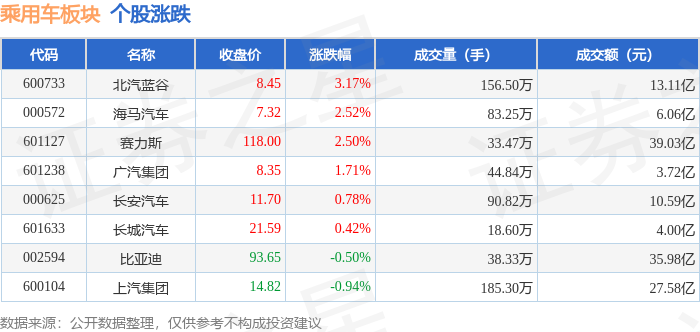
乘用车板块1月23日涨0.49%,北汽蓝谷领涨,主力资金净流出11.47亿元
Zheng Xing Xing Ye Ri Bao· 2026-01-23 09:04
Core Viewpoint - The passenger car sector experienced a slight increase of 0.49% on January 23, with Beijing Blue Valley leading the gains. The Shanghai Composite Index closed at 4136.16, up 0.33%, while the Shenzhen Component Index closed at 14439.66, up 0.79% [1]. Group 1: Market Performance - Beijing Blue Valley (600733) closed at 8.45, up 3.17% with a trading volume of 1.565 million shares and a transaction value of 1.311 billion yuan [1]. - Haima Automobile (000572) closed at 7.32, up 2.52% with a trading volume of 832,500 shares and a transaction value of 606 million yuan [1]. - Seres (601127) closed at 118.00, up 2.50% with a trading volume of 334,700 shares and a transaction value of 3.903 billion yuan [1]. - GAC Group (601238) closed at 8.35, up 1.71% with a trading volume of 448,400 shares and a transaction value of 372 million yuan [1]. - Changan Automobile (000625) closed at 11.70, up 0.78% with a trading volume of 908,200 shares and a transaction value of 1.059 billion yuan [1]. - Great Wall Motors (601633) closed at 21.59, up 0.42% with a trading volume of 186,000 shares and a transaction value of 400 million yuan [1]. - BYD (002594) closed at 93.65, down 0.50% with a trading volume of 383,300 shares and a transaction value of 3.598 billion yuan [1]. - SAIC Motor (600104) closed at 14.82, down 0.94% with a trading volume of 1.853 million shares and a transaction value of 2.758 billion yuan [1]. Group 2: Fund Flow Analysis - The passenger car sector saw a net outflow of 1.147 billion yuan from institutional investors, while retail investors contributed a net inflow of 718 million yuan [1]. - The main fund inflow for Seres (601127) was 118 million yuan, accounting for 3.02% of the total, while retail investors had a net outflow of 11.6 million yuan [2]. - Beijing Blue Valley (600733) had a main fund inflow of 108 million yuan, representing 8.26% of the total, with retail investors contributing a net inflow of 35.217 million yuan [2]. - Changan Automobile (000625) experienced a main fund inflow of 43.554 million yuan, accounting for 4.11%, while retail investors had a net inflow of 19.761 million yuan [2]. - Haima Automobile (000572) saw a main fund inflow of 26.734 million yuan, representing 4.41%, with a retail net outflow of 9.9696 million yuan [2]. - GAC Group (601238) had a main fund inflow of 18.375 million yuan, accounting for 4.94%, while retail investors experienced a net outflow of 26.513 million yuan [2]. - Great Wall Motors (601633) had a main fund inflow of 12.320 million yuan, representing 3.08%, with a retail net outflow of 35.988 million yuan [2]. - BYD (002594) experienced a significant net outflow of 686 million yuan from institutional investors, while retail investors had a net inflow of 51 million yuan [2]. - SAIC Motor (600104) faced a substantial net outflow of 788 million yuan from institutional investors, while retail investors had a net inflow of 34.2 million yuan [2].






内存领衔、涨价潮压顶 汽车行业供应链迎成本与自主升级大考
Zhong Guo Zheng Quan Bao· 2026-01-22 23:22
Core Insights - The automotive industry is facing significant cost pressures due to a shortage of memory chips and rising prices of raw materials, which are impacting supply chain dynamics and competition rules [1][2][3] Group 1: Cost Pressures - The shortage of memory chips has escalated into a systemic issue affecting the entire automotive supply chain, with prices for automotive-grade DDR4 and DDR5 memory increasing by over 150% and 300% respectively since the second half of 2025 [2] - Global storage prices are expected to rise by an additional 40% to 50% in the first quarter of 2026, with a supply gap for general DRAM projected to remain between 15% and 20% [2] - The automotive sector is at a disadvantage in the competition for memory resources, as leading manufacturers prioritize supply to AI and cloud computing sectors, which offer higher profit margins [3] Group 2: Raw Material Price Increases - Prices for essential metals like copper and silver, which are critical for automotive electrical systems and batteries, have also seen significant increases since the second half of 2025 [3] - The competition for these raw materials between the automotive and AI industries has intensified, although current price increases have not yet fully reached end consumer prices [3] Group 3: Supply Chain Strategies - Automotive companies are implementing various strategies to mitigate cost pressures, including technological innovations and supply chain partnerships [5] - Companies like CATL are leveraging scale and technology to manage battery costs, while others are optimizing memory usage through software upgrades [5] - Long-term supply agreements and price locking strategies are being adopted by companies like Changan and Leap Motor to counteract rising costs of critical components [6] Group 4: Industry Dynamics and Competition - The memory crisis is leading to a differentiation in the automotive industry, with larger companies better able to absorb costs compared to smaller firms [7] - The ability to manage supply chains effectively is becoming a critical factor for competitiveness, with larger firms benefiting from established supply chain systems [7] - The crisis may result in a slowdown in the adoption of advanced driving technologies as companies may cut back on non-core storage configurations [7] Group 5: Future Outlook - The automotive industry is encouraged to shift from reactive measures to building autonomous systems, including securing long-term supply agreements and accelerating the validation of domestic storage chips [8] - The ongoing price increases and the transition to electric and intelligent vehicles are expected to concentrate resources among companies with core capabilities, leading to a shift in competition from hardware to integrated software and hardware solutions [8]




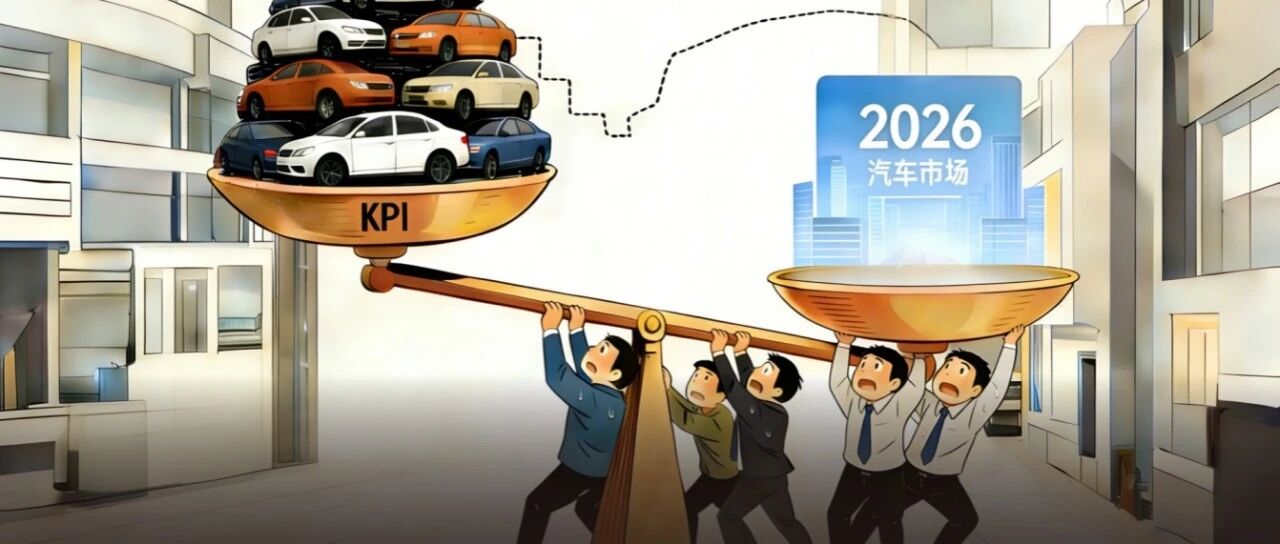
注定悲剧的2026,还有多少车企不信邪?
汽车商业评论· 2026-01-22 23:07
Core Viewpoint - The article discusses the challenges and strategies of the Chinese automotive industry as it faces declining domestic sales and increasing pressure to transition towards higher-value and technology-intensive vehicles. The focus is on the 2026 sales targets set by various automakers amidst a backdrop of changing government policies and market dynamics [3][6][8]. Group 1: Market Overview - In 2025, China's automotive production and sales reached 34.4 million units, a 9.4% increase year-on-year, maintaining its position as the world's largest market for the 17th consecutive year [3]. - Domestic sales, excluding exports, were 27.3 million units, up 6.7%, with passenger vehicles accounting for approximately 24.1 million units, growing by 8.0% [5]. - However, December 2025 saw a significant decline in domestic sales, with only 2.519 million units sold, marking a 6.7% month-on-month drop and a 15.6% year-on-year decrease [5]. Group 2: Industry Challenges - The average profit margin in the Chinese automotive industry has fallen to 4.4%, only slightly above the historical low of 4.3% in 2024, indicating extremely thin profit margins [6]. - The new vehicle replacement subsidy policy, shifting from fixed subsidies to percentage-based subsidies, targets higher-priced vehicles, which may pressure companies that rely heavily on low-cost models [8]. Group 3: Sales Targets and Strategies - Major automakers have set ambitious sales targets for 2026, with a combined goal of approximately 35 to 36 million passenger vehicles, reflecting a year-on-year increase of 12% to 15% [5]. - Traditional automakers are focusing on stability and efficiency improvements, while new entrants are experiencing significant divergence in their growth strategies [10][30]. - For instance, Changan aims for a total sales target of 3.3 million units in 2026, with a strong emphasis on new energy vehicles, projecting 1.43 million units from this segment [12][15]. Group 4: New Energy Vehicle Focus - The article highlights the increasing importance of new energy vehicles (NEVs) in the sales strategies of various automakers, with companies like Dongfeng targeting 1.7 million NEVs in 2026, representing a significant portion of their overall sales goals [15][26]. - Geely plans to launch over ten new models in 2026, focusing on a comprehensive product matrix to drive sales growth [23]. Group 5: Export Market Dynamics - The export market for Chinese vehicles is thriving, with exports reaching 7 million units in 2025, a 21% increase year-on-year, and NEV exports doubling to 2.6 million units [49]. - Automakers are increasingly prioritizing overseas markets, with many setting aggressive export targets that significantly exceed their overall sales growth targets [51][54]. - For example, Changan's overseas sales target for 2026 is set at 750,000 units, accounting for nearly a quarter of its total sales goal [52].


汽车行业供应链迎成本与自主升级大考
Zhong Guo Zheng Quan Bao· 2026-01-22 20:56
Core Viewpoint - The automotive industry is facing significant cost pressures due to a systemic crisis in the supply chain, particularly driven by shortages and price increases in memory chips and raw materials like copper and silver [1][2][3]. Group 1: Cost Pressures and Supply Chain Challenges - The shortage of memory chips has escalated into a critical issue, with prices for automotive-grade DDR4 and DDR5 memory increasing by over 150% and 300% respectively since the second half of 2025 [2]. - Global storage prices are expected to rise by an additional 40% to 50% in the first quarter of 2026, with a supply gap for general DRAM projected to remain between 15% and 20% [2]. - The automotive sector is at a disadvantage in the competition for memory resources, as leading manufacturers prioritize supply to AI and cloud computing sectors, which offer higher profit margins [3]. Group 2: Raw Material Price Increases - Prices for essential raw materials such as copper and silver have also risen significantly since the second half of 2025, impacting the costs of automotive electrical systems and power batteries [3]. - The competition for these materials between the automotive and AI industries has intensified, although current price increases have not yet fully reached end consumers [3]. Group 3: Strategies for Mitigation - Automotive companies are implementing various strategies to combat rising costs, including technological innovations and supply chain partnerships [5]. - Companies like CATL are leveraging scale and technology to manage battery costs, while others are optimizing memory usage through software improvements [5]. - Long-term supply agreements and strategic partnerships are being established to mitigate price volatility in raw materials [6][7]. Group 4: Industry Impact and Future Outlook - The ongoing memory crisis is likely to lead to increased competition and differentiation within the automotive industry, with profit margins under pressure [8]. - Companies with robust supply chain management capabilities are better positioned to withstand these challenges, while smaller firms may struggle [8]. - The crisis may accelerate a shift towards vertical integration and the development of proprietary supply chains, as companies seek to enhance their resilience against future disruptions [9].