
GREE(000651)

Search documents
格力、小米,谁是“空调二哥”
21世纪经济报道· 2025-09-14 00:21
Core Viewpoint - The home appliance industry is experiencing a shift from stable competition among traditional giants to a more dynamic landscape influenced by digital transformation and new entrants like Xiaomi, which is aggressively pursuing market share in the major appliance sector [1][3]. Group 1: Performance of Major Players - Midea Group reported a revenue increase of 15.68% year-on-year, with total revenue reaching 252.3 billion yuan and net profit growing by 26% to 26.7 billion yuan [3][5]. - Haier's revenue grew by 10.22% year-on-year, while Gree Electric Appliances saw a revenue decline of 2.66% [1][3]. - Xiaomi's IOT and lifestyle products segment experienced a remarkable 50.7% growth, driven by increased sales of major appliances [1][5]. Group 2: Market Dynamics and Competition - The home appliance market is entering a phase of stock competition, with Xiaomi's entry disrupting the traditional market structure dominated by Midea, Haier, and Gree [1][3]. - Gree's core business, primarily air conditioning, faced a 5.09% decline, while its industrial products segment grew by 17.13% [6][8]. - The competition for the title of "second in air conditioning" is intensifying between Gree and Xiaomi, with Xiaomi's online air conditioning sales surpassing Gree's in recent months [8][9]. Group 3: Strategic Initiatives - Midea is focusing on R&D, with cumulative investments exceeding 43 billion yuan from 2022 to 2024, and a 14.4% increase in R&D spending in the first half of the year [4][5]. - Xiaomi's strategy emphasizes hardware sales at lower prices to build an ecosystem, contrasting with traditional models that prioritize hardware profit [9]. - Gree is facing challenges in diversifying its business and adapting to market changes, which has affected its performance [6][8]. Group 4: International Expansion - The overseas market is becoming a crucial growth area for home appliance giants, with Midea's overseas revenue growing from 116.78 billion yuan in 2019 to 169.03 billion yuan in 2024, reflecting a compound annual growth rate of 7.68% [11][12]. - Gree's overseas revenue also increased, but its contribution remains below 20% of total revenue, indicating a need for improvement in this area [13]. - Midea's global strategy includes establishing production bases in various countries, enhancing its brand presence and reducing costs [12][13].






全球限流的8张“黑卡”,中国只有2张,马云一张,另一张被女性持有
Sou Hu Cai Jing· 2025-09-14 00:06
Core Insights - The article discusses the existence of eight exclusive "Supreme Black Cards," which symbolize immense power and influence at the pinnacle of global wealth, with two of these cards held by Chinese individuals [1][5][29] - The cards are not commercially available and are managed by a secretive organization called Centurion Circle, which has been operational since 1950 [2][3] - The holders of these cards are not only wealthy, with a minimum net worth of $50 billion, but also possess significant influence in global political, economic, and social spheres [4][10] Group 1: Unique Characteristics of the Supreme Black Cards - There are only eight active Supreme Black Cards globally, which are not available for public sale and have no clear application criteria [2][3] - Unlike the well-known American Express Centurion Card, the Supreme Black Cards do not charge annual fees and are not tied to any commercial entity [3][11] - The cards serve as a key to a global network of resources, allowing holders to mobilize support across various sectors [11][18] Group 2: Chinese Holders and Their Impact - The two Supreme Black Card holders from China are Jack Ma and Dong Mingzhu, both of whom have made significant contributions to their respective industries [6][7][29] - Jack Ma, with a net worth of approximately $38 billion, is recognized for his transformative impact on global e-commerce [6][25] - Dong Mingzhu, as the leader of Gree Electric, has driven significant advancements in China's manufacturing sector, particularly in smart manufacturing [7][24] Group 3: Global Distribution and Influence - The distribution of the eight cards includes three in North America, two in Europe, one in the Middle East, and two in Asia, highlighting a balance of power between Western and non-Western nations [5][26] - The holders are seen as change-makers in their fields, with the ability to influence global dynamics rather than merely possessing wealth [10][28] Group 4: Symbolism and Broader Implications - The presence of two Chinese holders signifies the growing influence of Chinese entrepreneurs on the global stage and reflects China's rising economic power [22][29] - The gender representation among the cardholders, with one male and one female, suggests progress in gender equality within the business landscape [29][30] - The article emphasizes that true success is measured by the ability to create value and influence rather than mere accumulation of wealth [28][30]


超级品牌概念下跌1.00% 10股主力资金净流出超亿元
Zheng Quan Shi Bao Wang· 2025-09-12 13:15
截至9月12日收盘,超级品牌概念下跌1.00%,位居概念板块跌幅榜前列,板块内,百润股份、上汽集 团、金龙鱼等跌幅居前。 今日涨跌幅居前的概念板块 | 概念 | 今日涨跌幅(%) | 概念 | 今日涨跌幅(%) | | --- | --- | --- | --- | | 金属锌 | 3.39 | 足球概念 | -1.33 | | 金属铅 | 3.04 | PEEK材料 | -1.13 | | 存储芯片 | 2.76 | 乳业 | -1.12 | | 培育钻石 | 2.73 | BC电池 | -1.02 | | 黄金概念 | 1.83 | 超级品牌 | -1.00 | | 金属铜 | 1.82 | 互联网保险 | -0.98 | | 金属镍 | 1.78 | 太赫兹 | -0.97 | | 小金属概念 | 1.69 | POE胶膜 | -0.93 | | 特色小镇 | 1.66 | 信托概念 | -0.91 | | 国家大基金持股 | 1.64 | 人造肉 | -0.91 | 资金面上看,今日超级品牌概念板块获主力资金净流出34.55亿元,其中,37股获主力资金净流出,10 股主力资金净流出超亿元,净流出资金居 ...



中国空调品牌东南亚突进 避免重走低价竞争老路
Di Yi Cai Jing· 2025-09-12 11:03
Core Insights - Gree has transitioned from an agency model to brand self-operation in Southeast Asia, marking a significant shift in strategy [1][2] - Chinese home appliance brands are expected to achieve an average growth rate of over 30% in Southeast Asia this year, with market share potentially exceeding 50% in the coming years [1][4] Group 1: Market Dynamics - Gree's revenue from self-owned brands in Southeast Asia has increased from 30% a decade ago to 80% currently [2] - The air conditioning market in Thailand has become a key manufacturing hub, with annual production capacity exceeding 20 million units [3] - The ASEAN market is projected to grow, with a GDP compound growth rate of 4.3% and a population of approximately 680 million [3] Group 2: Competitive Landscape - The market share distribution among Chinese, Japanese, and Korean brands in Southeast Asia is currently 30:40:30, with expectations for Chinese brands to surpass 50% within two years [4] - Major Chinese brands like Haier and Midea are expanding their production capacities in Thailand, with Haier planning to add 4 million units and Hisense targeting 12 million units annually [5] Group 3: Consumer Trends - Southeast Asian consumers exhibit a strong preference for cost-effective products, which benefits Chinese brands due to their cost advantages in the supply chain [5] - The region's young population and low ownership rates of air conditioning units indicate significant growth potential [3][5] Group 4: Challenges and Opportunities - The rise of social e-commerce platforms like TikTok in Southeast Asia presents new sales opportunities for Chinese brands [6] - Despite a recent decline in air conditioning sales due to weather and high previous year bases, the long-term outlook remains positive, with expectations for the market to exceed $5 billion by 2028 [6]
中国空调品牌东南亚突进,避免重走低价竞争老路
Di Yi Cai Jing· 2025-09-12 10:52
Group 1 - Gree has transitioned from an agency model to brand self-operation in Southeast Asia, marking a significant shift in its business strategy [2][3] - The average growth rate of Chinese home appliance brands in Southeast Asia is estimated to exceed 30% this year, with the market share potentially surpassing 50% in the coming years [2][6] - Gree's revenue from self-owned brands in Southeast Asia has increased from 30% a decade ago to 80% currently, indicating a successful shift from OEM to self-branding [4] Group 2 - Thailand has become a major manufacturing hub for air conditioners, with an annual production capacity exceeding 20 million units, and Chinese brands like Haier and Midea contributing significantly to this capacity [5][6] - The ASEAN market, as the fifth largest economy and with a population of approximately 680 million, presents substantial growth opportunities for air conditioning products [5] - The local market in Thailand is characterized by a growing middle class and increasing urbanization, which are driving demand for air conditioning [6][7] Group 3 - Chinese home appliance companies are focusing on localized development, emphasizing "green" and "smart" trends to enhance competitiveness in high-end markets [7] - The Southeast Asian air conditioning market is projected to exceed $5 billion by 2028, with sales expected to surpass 15 million units, driven by high temperatures and low penetration rates [7] - The rise of social e-commerce platforms like TikTok in Southeast Asia is creating new sales opportunities for Chinese brands [7] Group 4 - Despite the growth potential, there are challenges such as price competition leading to a decline in average prices in the Thai air conditioning market [8] - The home air conditioning market in Southeast Asia has seen a decline in sales due to weather factors and high base numbers from previous years, with specific declines reported in Thailand, Vietnam, and Malaysia [8] - Chinese brands are encouraged to shift from price competition to value creation through product innovation tailored to local consumer habits [8]
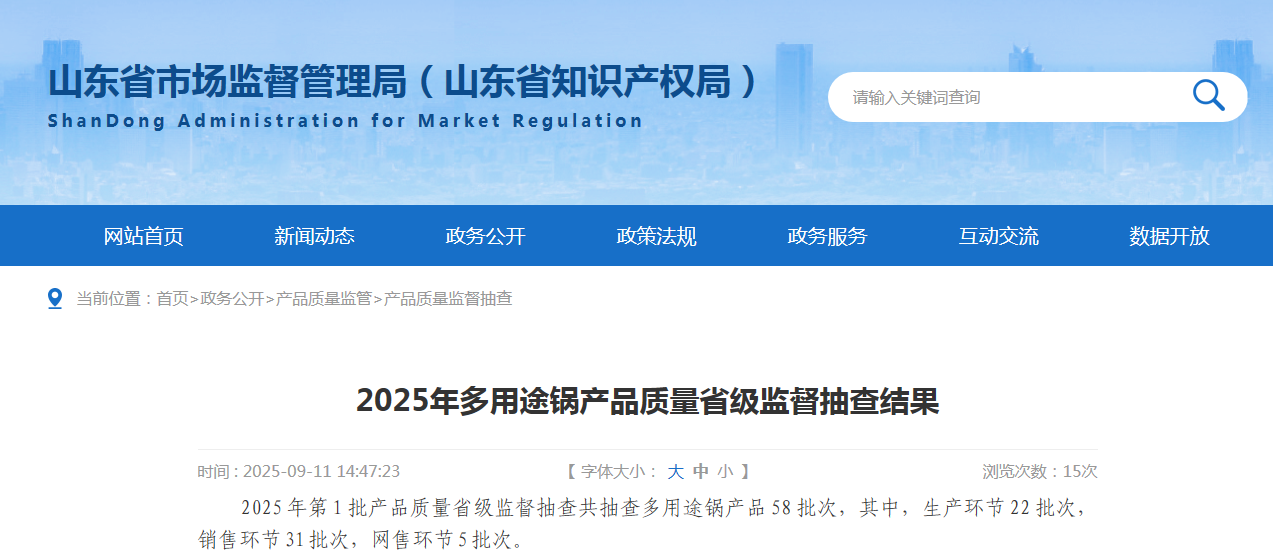
山东省市场监督管理局公布2025年多用途锅产品质量省级监督抽查结果
Zhong Guo Zhi Liang Xin Wen Wang· 2025-09-12 08:30
Group 1 - The Shandong Provincial Market Supervision Administration announced the results of the provincial quality supervision sampling inspection for multi-purpose pots in 2025, with a total of 58 batches inspected [3][4] - The inspection covered production, sales, and online sales, with 22 batches from production, 31 from sales, and 5 from online sales [3] - One batch produced by Binzhou Nanbei Electric Technology Co., Ltd. failed to meet the relevant standards, specifically in mechanical strength [3][4] Group 2 - The inspection was conducted based on national safety standards for household and similar electrical appliances, including GB 4706.1-2005 and GB 4706.19-2008 [3] - The inspection criteria included protection against electric shock, input power and current, heating, leakage current under working temperature, moisture resistance, stability, mechanical hazards, and electrical insulation [3] - The Shandong Provincial Market Supervision Administration has mandated relevant departments to handle the non-compliance results according to the Product Quality Law of the People's Republic of China [4]

家电行业竞争格局生变:美的稳增,小米崛起,格力承压
2 1 Shi Ji Jing Ji Bao Dao· 2025-09-12 07:10
Core Viewpoint - The home appliance industry is experiencing a shift from stable competition among traditional giants like Midea, Haier, and Gree to a more dynamic landscape influenced by digital transformation and the rise of Xiaomi, which is aggressively entering the market with its internet-driven approach [1][2]. Group 1: Company Performance - Midea Group reported a revenue of 252.3 billion yuan, a year-on-year increase of 15.7%, with a net profit of 26.7 billion yuan, up 26% [2][3]. - Xiaomi's IOT and lifestyle products business saw a revenue increase of 50.7% to 71.05 billion yuan, driven by strong sales in major appliances [3][4]. - Gree Electric experienced a revenue decline of 2.46% to 97.33 billion yuan, with a notable drop in its core consumer electronics segment [4][5]. Group 2: Market Dynamics - The home appliance market in China reached a retail total of 453.7 billion yuan in the first half of 2025, reflecting a year-on-year growth of 9.2% [2]. - The air conditioning segment saw a retail value of 126.3 billion yuan, a significant increase of 12.4% [2]. - Xiaomi's market share in online air conditioning sales is increasing, with a notable rise of 3.87% in the first seven months of the year, while Gree's market share remained stagnant [8][9]. Group 3: Strategic Initiatives - Midea is focusing on R&D, with cumulative investments exceeding 43 billion yuan from 2022 to 2024, and a 14.4% increase in R&D spending in the first half of the year [2][3]. - Xiaomi aims to become a top brand in major appliances by 2030, with a specific goal to rank among the top two in the air conditioning market [1][3]. - Gree is facing challenges in diversifying its business, with its multi-business strategy not yielding significant results [5][12]. Group 4: International Expansion - Midea's overseas revenue grew from 116.78 billion yuan in 2019 to 169.03 billion yuan in 2024, with a compound annual growth rate of 7.68% [11][12]. - Gree's overseas revenue increased to 16.33 billion yuan in the first half of the year, but its international business still accounts for less than 20% of total revenue, indicating a need for improvement [12][13].
家电智能重构,电竞沉浸空间升级|世研消费指数品牌榜Vol.68
3 6 Ke· 2025-09-11 15:14
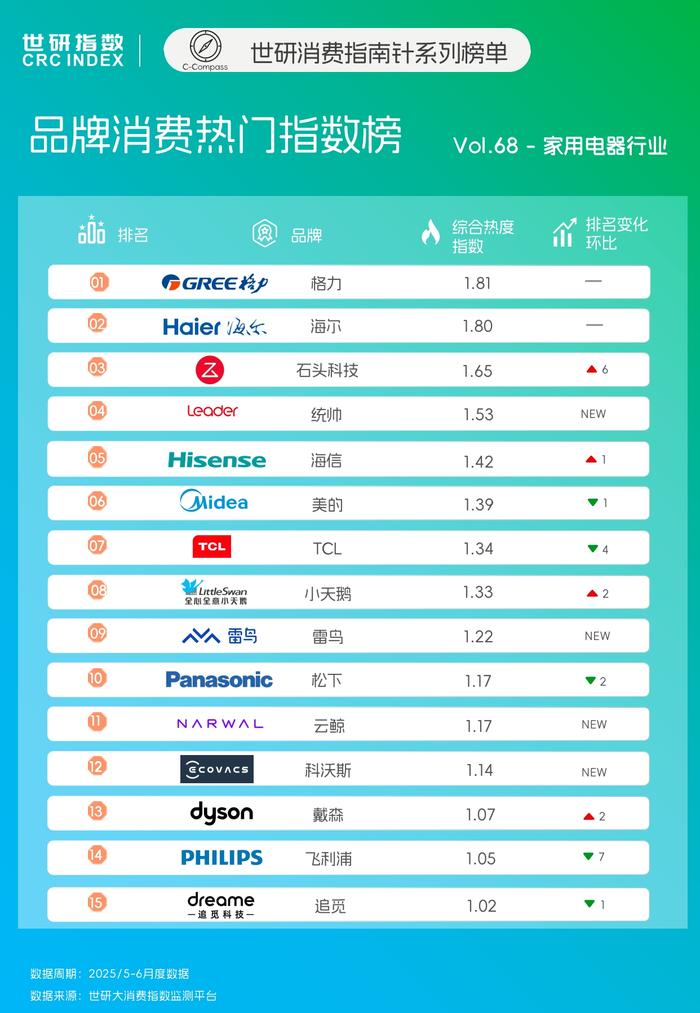
Group 1: Market Rankings - Gree, Haier, and Roborock ranked as the top three brands with comprehensive heat index scores of 1.81, 1.80, and 1.65 respectively [1][2] - The rankings also include brands like Leader, Hisense, and Midea, with scores of 1.53, 1.42, and 1.39 respectively, indicating a competitive landscape in the home appliance sector [2] Group 2: Industry Innovations - The cleaning appliance sector is witnessing a dual-track innovation approach through algorithm iteration and infrastructure design, significantly enhancing household efficiency standards [3] - Roborock's modular design addresses maintenance issues, while Ecovacs' T80 Pro features dual mechanical arms to meet the cleaning needs of pet owners [3] - The introduction of AI-driven products like the Yunzhihai AI water-sweeping robot and the Chasing washing machine is lowering usage barriers and expanding market reach [3] Group 3: Display Technology Advancements - Brands like TCL and Thunderbird are redefining home entertainment through immersive experiences and space adaptation innovations [4] - TCL's high-refresh-rate televisions and Thunderbirds' price reductions for large screens are making advanced display technologies more accessible to consumers [4] - The democratization of technology is shifting the perception of large screens from being exclusive to high-end markets to becoming a core component of family entertainment [4]


格力电器:公司积极推动线下渠道创新升级、持续推进“董明珠健康家”门店升级
Zheng Quan Ri Bao Wang· 2025-09-11 11:15
证券日报网讯格力电器(000651)9月11日在互动平台回答投资者提问时表示,公司积极推动线下渠道 创新升级、持续推进"董明珠健康家"门店升级,为消费者提供全面优质的健康家居生活解决方案。今年 3月,公司在全国范围内启动"董明珠健康家"门店升级计划,目前已完成超800家门店升级,且陆续在各 城市推进旗舰店的建设与筹建。公司通过持续优化销售政策与激励机制、加强培训与资源支持,不断提 升终端活力与服务能力,促进格力产品市场认可度和销售竞争力。 ...
格力电器:公司秉持“人才是第一资源”理念,建立科学的薪酬管理体系
Zheng Quan Ri Bao Wang· 2025-09-11 10:44
Core Viewpoint - Gree Electric Appliances emphasizes the importance of talent as the primary resource and has established a scientific compensation management system while continuously promoting employee stock ownership plans [1] Group 1: Employee Incentives - Since 2021, the company has launched three phases of employee stock ownership plans, incentivizing a total of 12,824 employees, thereby enhancing the profit-sharing and risk-sharing mechanism between shareholders and management [1] - The company continues to advance talent incentive policies, encouraging exemplary employees through awards such as the Technology Progress Award and Management Innovation Award, fostering an environment that values research and respects talent [1] Group 2: Future Plans - The company plans to continuously optimize its talent development mechanisms and improve incentive policies to support the mutual growth of employees and the enterprise [1]