
GREE(000651)

Search documents
厨电巨头们今年钱都花哪了?
3 6 Ke· 2025-10-11 02:41
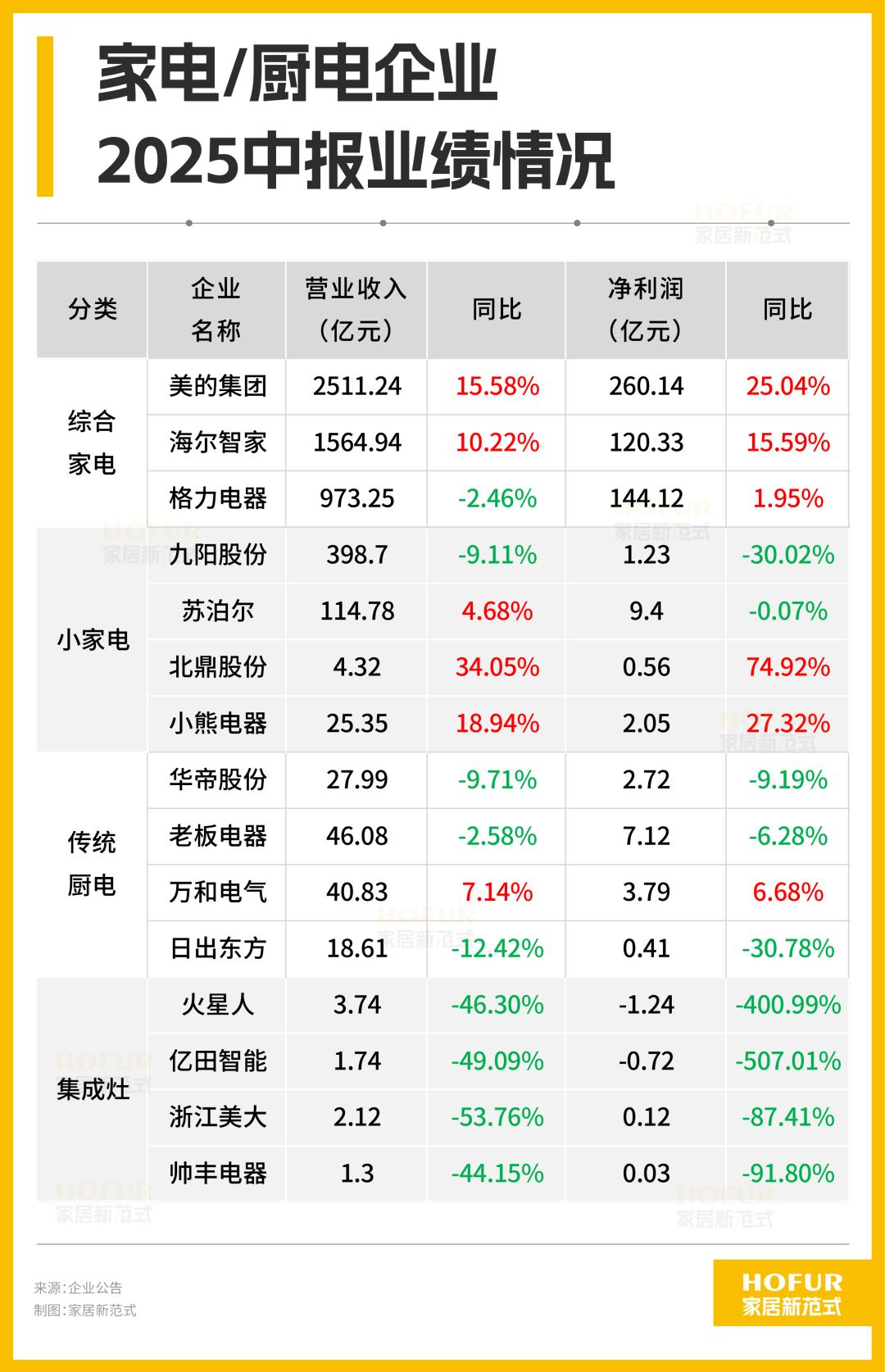
Core Viewpoint - The home appliance industry is experiencing a significant divergence in performance, with comprehensive and small appliance companies thriving, while traditional kitchen appliance and integrated stove companies are struggling with declining revenues and profits [1][4]. Group 1: Performance Overview - Comprehensive appliance giants like Midea and Haier are benefiting from national subsidy policies, overseas market growth, and innovative smart products, achieving revenue growth of 15.58% and 10.22% respectively [2][4]. - In contrast, traditional kitchen appliance companies such as Vatti and Boss Electric are facing revenue declines, with Vatti's revenue down by 9.71% and Boss Electric's by 2.58% [2][4]. - Integrated stove companies, referred to as the "four little dragons," are collectively experiencing significant revenue and profit declines, with companies like Mars and Yitian reporting losses [3][4]. Group 2: Financial Metrics - Midea Group reported a revenue of 251.12 billion and a net profit of 26.01 billion, while Haier's revenue was 156.49 billion with a net profit of 12.03 billion [2]. - The gross profit margin and net profit margin of leading companies like Boss Electric and Vatti are significantly higher than those of emerging brands, indicating a clear tiered differentiation in profitability [5][8]. - Boss Electric leads the industry with a gross profit margin of 50.43% and a net profit margin of 15.26%, showcasing its strong position in the high-end kitchen appliance market [5][8]. Group 3: Strategic Insights - The report highlights a shift in kitchen appliance companies from scale expansion to quality and efficiency, with leading firms maintaining high gross margins through brand and technology barriers [13][34]. - Companies are increasingly focusing on optimizing product structures and diversifying their offerings to mitigate risks, as seen with Boss Electric's entry into cabinet products [30][34]. - New retail, lower-tier markets, and overseas expansion are becoming key channels for growth, with companies like Vatti and Midea actively building new retail channels and expanding their presence in overseas markets [30][32]. Group 4: Cash Flow and Financial Management - The analysis indicates that cash flow is crucial for companies to withstand market fluctuations, with leading firms like Boss Electric and Vatti demonstrating strong cash flow generation capabilities [18][25]. - Most companies are tightening their investment strategies, focusing on cash flow management and reducing leverage to maintain operational stability [21][23]. - The financial management of traditional brands is generally more robust, with lower management expenses and effective cost control compared to emerging brands facing higher operational costs [17][25].







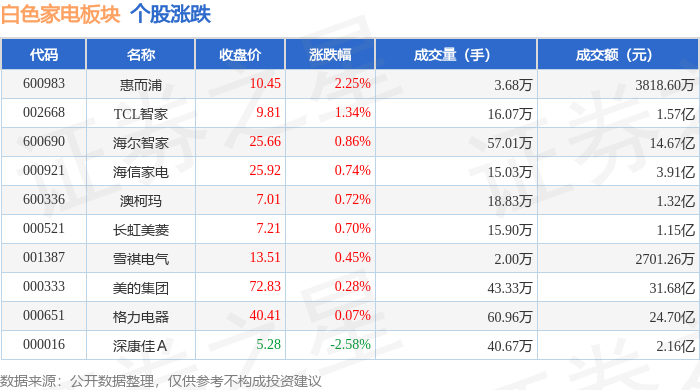
白色家电板块10月10日涨0.35%,惠而浦领涨,主力资金净流入2.38亿元
Zheng Xing Xing Ye Ri Bao· 2025-10-10 08:45
Core Insights - The white goods sector experienced a slight increase of 0.35% on October 10, with Whirlpool leading the gains [1] - The Shanghai Composite Index closed at 3897.03, down 0.94%, while the Shenzhen Component Index closed at 13355.42, down 2.7% [1] Company Performance - Whirlpool (600983) closed at 10.45, up 2.25% with a trading volume of 36,800 lots and a transaction value of 38.186 million yuan [1] - TCL Smart Home (002668) closed at 9.81, up 1.34% with a trading volume of 160,700 lots and a transaction value of 157 million yuan [1] - Haier Smart Home (600690) closed at 25.66, up 0.86% with a trading volume of 570,100 lots and a transaction value of 146.7 million yuan [1] - Hisense Home Appliances (000921) closed at 25.92, up 0.74% with a trading volume of 150,300 lots and a transaction value of 391 million yuan [1] - Midea Group (000333) closed at 72.83, up 0.28% with a trading volume of 433,300 lots and a transaction value of 3.168 billion yuan [1] - Gree Electric Appliances (000651) closed at 40.41, up 0.07% with a trading volume of 609,600 lots and a transaction value of 2.470 billion yuan [1] Capital Flow - The white goods sector saw a net inflow of 238 million yuan from institutional investors, while retail investors experienced a net outflow of 104 million yuan [1] - Midea Group had a net inflow of 191 million yuan from institutional investors, while it faced a net outflow of 89.444 million yuan from retail investors [2] - Hisense Home Appliances recorded a net inflow of 31.2979 million yuan from institutional investors, with a net outflow of 27.4712 million yuan from retail investors [2] - Haier Smart Home had a net inflow of 15.373 million yuan from institutional investors, while retail investors saw a net outflow of 1.29868 million yuan [2]




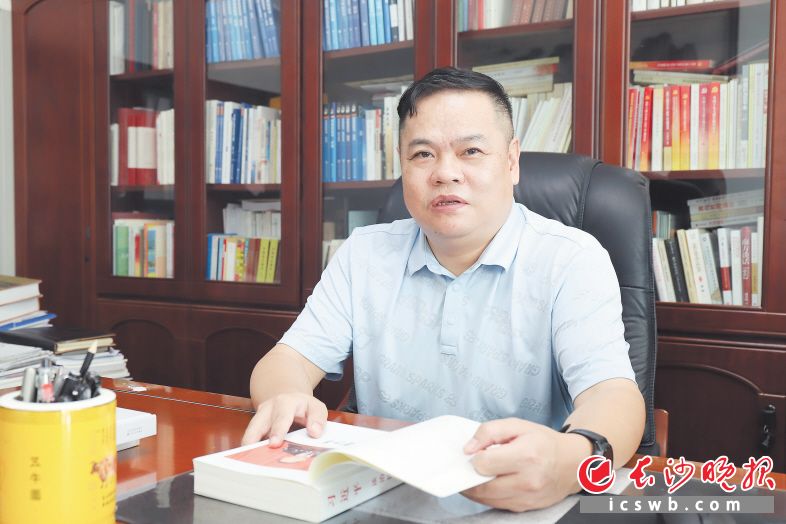
从“华南虎啸星城”看长沙发展生态| 热点面对面
Chang Sha Wan Bao· 2025-10-10 00:32
Core Viewpoint - The gathering of major enterprises in Changsha, such as BYD, Huike, Huawei, Gree, and Guangqi, is a result of the city's enhanced industrial ecosystem and regional competitiveness, reflecting a new trend of "clusterization" and "ecologization" in industrial transfer [7][8]. Group 1: Industrial Ecosystem and Competitiveness - The selection of Changsha by leading companies is driven by the region's complete industrial chain, concentration of innovation resources, and favorable business environment, rather than just cost and policy considerations [7]. - Changsha has accelerated the construction of a modern industrial system, maintaining traditional advantages while advancing into new sectors like artificial intelligence and new energy [7][8]. - The presence of major enterprises has led to a "strong chain and complementary chain" strategy, enhancing the local industrial ecosystem and attracting high-end talent [9][10]. Group 2: Impact of Major Enterprises - The concentration of the "South China Tigers" in Changsha has multi-layered impacts, including the development of supporting enterprises, enhancement of the overall industrial chain, and attraction of high-end talent [9][10]. - Leading companies are establishing collaborative innovation platforms, which facilitate the efficient transformation and application of technological achievements [9][10]. Group 3: Strategic Goals for Changsha - Changsha aims to transition from a factor-driven to an innovation-driven development model, with major enterprises playing a crucial role in forming innovation consortia and enhancing the integration of industry, academia, and research [10]. - The goal of becoming a national advanced manufacturing hub requires a shift from low-end to high-end manufacturing, with leading companies driving the technological advancement of local supporting enterprises [10]. Group 4: Factors Attracting Leading Enterprises - Changsha's advantages include rich talent resources from local universities, a robust transportation network, improved business environment, and comprehensive industrial support [11][12]. - The city has created a talent magnet by offering a favorable living environment and policies that attract young professionals [12]. - Local supply chain integration and high local matching rates for key components enhance the resilience and risk management capabilities of the industrial chain [12][13]. Group 5: Future Development Focus - Future efforts in Changsha should focus on attracting high-end talent, increasing venture capital investment, and optimizing the innovation ecosystem [15]. - Establishing government-led investment funds to support strategic emerging industries like artificial intelligence and new energy is recommended [15]. - Continuous improvement of infrastructure and soft environments, such as intellectual property protection and technology transfer mechanisms, is essential for fostering innovation [15].


2个格力=1个美的,格力电器被“低估”了吗
3 6 Ke· 2025-10-09 12:12
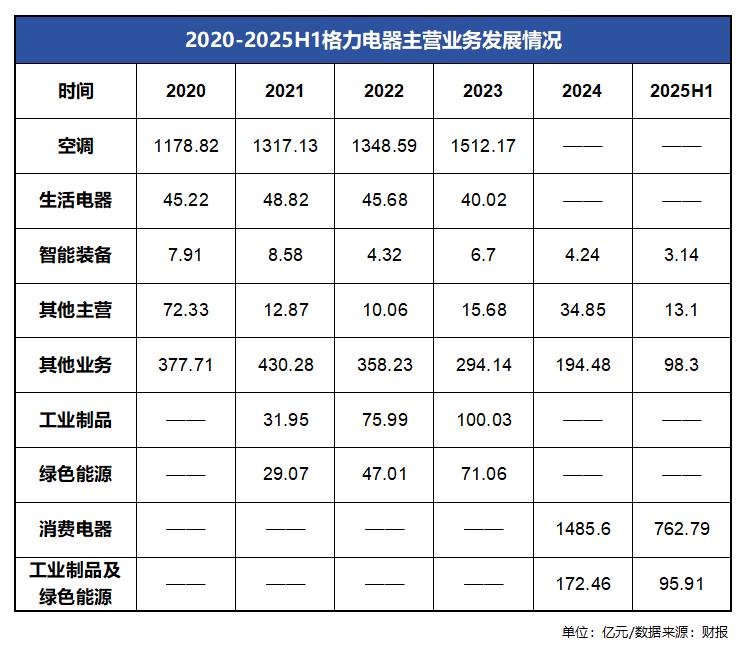
Core Viewpoint - The significant disparity in PE ratios among Gree Electric, Midea Group, and Haier Smart Home indicates a substantial market value gap, with Gree's market capitalization being less than half of Midea's despite being a leading player in the home appliance industry [1][2]. Group 1: Market Performance - During the "9·24" period, the Shenzhen Component Index rose by 67%, while Gree Electric's stock price only increased by 27.15%, highlighting its underperformance relative to the broader market [2]. - Gree Electric's market capitalization stands at 224 billion yuan, significantly lower than Midea Group's 568.53 billion yuan, reflecting a stark valuation difference [2]. Group 2: Business Stability - Gree Electric has maintained a stable business foundation, with its air conditioning and consumer electronics segments generating over 100 billion yuan in revenue, which constitutes its core competitive advantage [3][4]. - The air conditioning business has shown a compound annual growth rate (CAGR) of 8.66% from 2020 to 2023, indicating consistent growth [4]. Group 3: Financial Metrics - Gree Electric's net profit has grown at a CAGR of 9.76% since 2020, outpacing revenue growth, which stands at 2.75%, demonstrating high profitability quality [7]. - The company's asset-liability ratio has remained stable, with a peak of 71.30% in 2022, but has since decreased to 61.55% in 2024, indicating improved financial health [10]. Group 4: R&D and Innovation - Gree Electric has consistently increased its R&D investment, maintaining a spending rate of 3%-4% of revenue, which supports its competitive positioning [11][13]. - The company has launched innovative products, such as those featuring AI dynamic energy-saving technology, which have seen significant sales growth, indicating a strong focus on product development [14]. Group 5: Market Position and Growth Potential - Gree Electric holds a 23.44% market share in online air conditioning sales, slightly below Midea's 24.06%, but has shown strong monthly performance, surpassing Midea in August [5]. - The increasing temperatures and rising disposable incomes are expected to drive further demand for air conditioning, suggesting potential growth opportunities for Gree Electric [16][17]. Group 6: Valuation Discrepancy - Gree Electric's PE ratio is only half that of Midea and Haier, raising questions about the market's perception of its growth potential compared to its competitors [19]. - Despite having a higher return on invested capital (ROIC) than its peers, Gree Electric's market valuation does not reflect its superior profitability, indicating a potential undervaluation [19].
格力回应小凉神空调线上开售:布局2100元以下价位段
Di Yi Cai Jing· 2025-10-09 11:47
Core Insights - Gree Electric's sub-brand "Xiaoliangshen" air conditioners officially launched on JD.com on October 9, with initial pricing set at 1899 yuan and 1999 yuan [1] - The air conditioning market is undergoing structural changes, with products priced below 2100 yuan capturing nearly half of the market share [1] - Gree is strategically positioning itself in the lower price segment through its sub-brand Jinghong, creating a differentiated brand system for online and offline markets [1]
格力的「AB双面」
雷峰网· 2025-10-09 10:40
Core Viewpoint - Gree Electric Appliances is facing a complex situation where its strong brand and cash flow are contrasted by stagnant revenue and a single business focus, particularly in air conditioning, which accounts for nearly 80% of its revenue [2][4][11]. Group 1: Business Performance - Gree's revenue has stagnated since reaching a peak of 198.1 billion yuan in 2019, with a reported revenue of 97.325 billion yuan in the first half of 2025, a year-on-year decline of 2.46% [6][11]. - In contrast, competitors like Midea and Haier have shown strong growth, with Midea's revenue increasing by 15.68% to 252.3 billion yuan and Haier's by 10.2% to 156.494 billion yuan during the same period [6][11]. - Gree's attempts to diversify, such as entering the mobile phone market and investing in new energy, have not yielded significant results, with mobile sales below one million units and losses in the new energy sector reaching 24.2 billion yuan [6][11]. Group 2: Strategic Focus - Gree's focus on air conditioning is seen as both a strength and a limitation, as it holds a high profit margin in this category but risks becoming too narrow in its market approach [7][9]. - The company has invested heavily in technology and quality, with 21.7% of its workforce in R&D, leading to significant advancements in compressor technology and maintaining a brand premium of around 300 yuan over competitors [9][10]. Group 3: Leadership and Governance - The leadership of Chairwoman Dong Mingzhu is a double-edged sword; while her strong governance has driven efficiency, concerns exist about her age and the potential lack of succession planning [12][13]. - Gree is undergoing a transformation in its distribution strategy by establishing joint ventures with local distributors to enhance direct market access, which may be more effectively driven by Dong's leadership [14]. Group 4: Financial Health - Gree's cash flow is robust, with a net cash flow from operating activities increasing by 453.06% to 28.32 billion yuan in the first half of 2025, and cash reserves of 122.371 billion yuan [11][16]. - Despite a recent decision to not distribute cash dividends, Gree's financial position allows for strategic flexibility and potential long-term investments [18][19]. Group 5: Market Perception - Gree's current market valuation is low, with a price-to-earnings ratio of less than 7, compared to Midea's over 10, indicating a potential undervaluation despite strong cash flow capabilities [16][17]. - The company's ability to generate cash flow and maintain a high dividend yield of over 7% positions it as an attractive option for value investors, despite concerns about its growth trajectory [17][19].

白色家电板块10月9日涨0.44%,深康佳A领涨,主力资金净流出4.27亿元
Zheng Xing Xing Ye Ri Bao· 2025-10-09 08:53
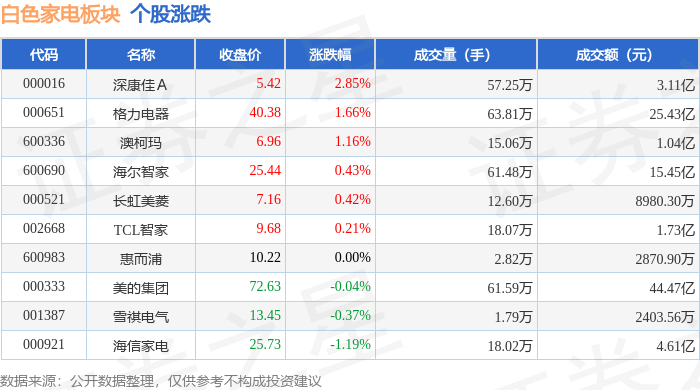
Market Overview - The white goods sector increased by 0.44% on October 9, with Shenzhen Konka A leading the gains [1] - The Shanghai Composite Index closed at 3933.97, up 1.32%, while the Shenzhen Component Index closed at 13725.56, up 1.47% [1] Stock Performance - Shenzhen Konka A (000016) closed at 5.42, up 2.85% with a trading volume of 572,500 shares and a turnover of 311 million yuan [1] - Gree Electric (000651) closed at 40.38, up 1.66%, with a trading volume of 638,100 shares and a turnover of 2.543 billion yuan [1] - Other notable stocks include: - Aucma (600336) at 6.96, up 1.16% - Haier Smart Home (600690) at 25.44, up 0.43% - Midea Group (000333) at 72.63, down 0.04% [1] Capital Flow - The white goods sector experienced a net outflow of 427 million yuan from institutional investors and 165 million yuan from speculative funds, while retail investors saw a net inflow of 592 million yuan [1] - Detailed capital flow for key stocks includes: - Gree Electric: net outflow of 59.31 million yuan from institutional investors [2] - Hisense Home Appliances (000921): net inflow of 17.31 million yuan from institutional investors [2] - Aucma: net inflow of 16.23 million yuan from institutional investors [2] - Midea Group: significant net outflow of 443 million yuan from institutional investors [2]

趋势研判!2025年中国游泳池热泵行业全景速览:作为一种高效、环保的泳池加热设备,正逐渐成为泳池行业的关键组成部分,市场需求持续增长[图]
Chan Ye Xin Xi Wang· 2025-10-09 01:44
Core Viewpoint - The swimming pool heat pump market is experiencing significant growth due to increasing health awareness, economic development, and global carbon reduction policies, making it a key component in the swimming pool industry [1][5]. Group 1: Market Size and Growth - The global swimming pool heat pump market is projected to reach 8.544 billion yuan in 2024, an increase of 870 million yuan from 2023 [3][5]. - The Chinese swimming pool heat pump market is expected to grow to 2.136 billion yuan in 2024, up by 217 million yuan from 2023 [5]. - By 2025, the global market size is anticipated to reach 9.458 billion yuan, while the Chinese market is expected to reach 2.365 billion yuan [1][5]. Group 2: Industry Definition and Classification - Swimming pool heat pumps are energy-efficient heating devices designed to maintain stable water and air temperatures, commonly used in villas, hotels, and sports venues [2]. - They operate based on the reverse Carnot cycle, using minimal electrical energy to heat water up to 50°C-65°C [2]. Group 3: Industry Development Status - The swimming pool heat pump industry is benefiting from global policies promoting renewable energy and subsidies for heat pump installations, leading to increased market demand [3][5]. - The industry is characterized by a shift towards energy-efficient and environmentally friendly heating solutions [3]. Group 4: Industry Chain - The upstream of the swimming pool heat pump industry includes raw materials and components such as compressors, electronic controllers, heat exchangers, and insulation materials [7]. - The downstream applications encompass residential, commercial, and public facilities, including villas, high-end apartments, hotels, fitness centers, and sports venues [7]. Group 5: Competitive Landscape - The global swimming pool heat pump market has a high concentration, with a CR3 of 33.36% in 2024, while the domestic market has a CR3 of 26.17% [8]. - China is the largest producer and exporter of swimming pool heat pumps, holding a significant share of the global market [8]. Group 6: Industry Development Trends - The industry is expected to see increased policy support for green and energy-efficient technologies, driving innovation towards more efficient, intelligent, and integrated products [9]. - The application areas for swimming pool heat pumps are expanding, with a growing demand for customized solutions [9].

中国家电龙头企业加码东南亚投资布局
Di Yi Cai Jing· 2025-10-09 01:29
Core Insights - Chinese home appliance giants are increasing investments in Thailand to navigate complex trade environments and enhance global supply chains [1][2][4] Group 1: Company Investments - Haier's smart air conditioning factory in Thailand commenced operations on September 23, 2023, covering an area of approximately 324,000 square meters with an annual production capacity of 6 million units [1][2] - Hisense's HHA smart manufacturing industrial park in Thailand is set to become the largest overseas industrial park for the company, with an initial investment of 4.7 billion Thai Baht (over 1 billion RMB) [1][3] - Midea Group is deepening its supply chain layout in Thailand, having invested significantly since 2016 and currently operating eight factories with over 10,000 employees [6] Group 2: Market Dynamics - Thailand is the second-largest air conditioning manufacturing base globally, benefiting from favorable trade agreements and a strong relationship with China [2][4] - The Thai market provides access to nearly 700 million people in Southeast Asia, facilitating rapid responses to regional demands [2] - The production capacity in Thailand is projected to reach 8.655 million units by mid-2025, with Haier's new factory adding 6 million units to meet both Southeast Asian and global demands [3] Group 3: Industry Trends - The trend towards "green" and "smart" manufacturing is evident, with companies adopting eco-friendly refrigerants and advanced technologies like AI and automation to enhance efficiency and reduce carbon emissions [3][4] - The need to improve the local supply chain in Thailand is critical to mitigate foreign tariff barriers and reduce production costs [4][5] - Midea's procurement event aimed to integrate local suppliers into the global supply chain, highlighting the importance of local component sourcing [5][6]

长沙晚报长理轩文章:涵养“群虎啸星城”的新生态
Chang Sha Wan Bao· 2025-10-08 23:16
Core Viewpoint - The article highlights the rapid industrial transformation and economic development in Changsha, driven by major companies from South China, referred to as the "Five Tigers," which include BYD, Gree, Huawei, and others, establishing a strong presence in the region [1][2]. Group 1: Industrial Development - BYD established its first electric vehicle base in Changsha in 2009, evolving from a barren land to a collaborative industrial hub within 16 years [1]. - Gree's investment in Ningxiang has exceeded 10 billion yuan, creating a diverse industrial cluster covering seven major projects, showcasing a leap from single-category production to a full industrial chain [1]. - The "Five Tigers" have collectively contributed to Changsha's growth in strategic emerging industries such as new energy vehicles, electronic information, and intelligent equipment [4]. Group 2: Business Environment - Changsha's appeal to major corporations is attributed to its continuously optimized business environment, which has been recognized as superior to that of Shenzhen [1]. - The city has been awarded the title of "International Benchmark City for Business Environment Construction," reflecting its commitment to improving the business climate [1]. Group 3: Political Ecology - A healthy political ecology is essential for a favorable business environment, characterized by orderly power operations and harmonious government-business relations [3]. - Changsha has implemented reforms to enhance administrative efficiency, with processes like "one map" approvals and "one-stop" services becoming standard [3]. Group 4: Industrial Ecosystem - A robust industrial ecosystem is crucial for attracting production factors, with the "Five Tigers" fostering a collaborative environment through shared technology and supply chain integration [4]. - The city is focused on enhancing its industrial chain and promoting investment to create a more attractive environment for businesses [4]. Group 5: Innovation Ecosystem - Innovation is identified as a key driver of development, supported by a strong innovation ecosystem that reduces risks and costs associated with new ventures [5][6]. - Changsha aims to integrate talent, innovation, and industry to foster a collaborative environment for various stakeholders, including enterprises and educational institutions [6]. Group 6: Open Ecosystem - An internationalized business environment is being developed in Changsha, emphasizing alignment with global standards and enhancing the city's openness [7]. - The city plans to improve its international trade capabilities and attract foreign investment through efficient governance and a transparent legal framework [7].