GREE(000651)

Search documents
长沙晚报长理轩文章:涵养“群虎啸星城”的新生态
Chang Sha Wan Bao· 2025-10-08 23:16
Core Viewpoint - The article highlights the rapid industrial transformation and economic development in Changsha, driven by major companies from South China, referred to as the "Five Tigers," which include BYD, Gree, Huawei, and others, establishing a strong presence in the region [1][2]. Group 1: Industrial Development - BYD established its first electric vehicle base in Changsha in 2009, evolving from a barren land to a collaborative industrial hub within 16 years [1]. - Gree's investment in Ningxiang has exceeded 10 billion yuan, creating a diverse industrial cluster covering seven major projects, showcasing a leap from single-category production to a full industrial chain [1]. - The "Five Tigers" have collectively contributed to Changsha's growth in strategic emerging industries such as new energy vehicles, electronic information, and intelligent equipment [4]. Group 2: Business Environment - Changsha's appeal to major corporations is attributed to its continuously optimized business environment, which has been recognized as superior to that of Shenzhen [1]. - The city has been awarded the title of "International Benchmark City for Business Environment Construction," reflecting its commitment to improving the business climate [1]. Group 3: Political Ecology - A healthy political ecology is essential for a favorable business environment, characterized by orderly power operations and harmonious government-business relations [3]. - Changsha has implemented reforms to enhance administrative efficiency, with processes like "one map" approvals and "one-stop" services becoming standard [3]. Group 4: Industrial Ecosystem - A robust industrial ecosystem is crucial for attracting production factors, with the "Five Tigers" fostering a collaborative environment through shared technology and supply chain integration [4]. - The city is focused on enhancing its industrial chain and promoting investment to create a more attractive environment for businesses [4]. Group 5: Innovation Ecosystem - Innovation is identified as a key driver of development, supported by a strong innovation ecosystem that reduces risks and costs associated with new ventures [5][6]. - Changsha aims to integrate talent, innovation, and industry to foster a collaborative environment for various stakeholders, including enterprises and educational institutions [6]. Group 6: Open Ecosystem - An internationalized business environment is being developed in Changsha, emphasizing alignment with global standards and enhancing the city's openness [7]. - The city plans to improve its international trade capabilities and attract foreign investment through efficient governance and a transparent legal framework [7].



2025年中国家电维修行业发展历程、产业链、市场规模、重点企业及发展趋势研判:人们生活水平提高和家电产品更新换代,家电维修行业前景广阔[图]
Chan Ye Xin Xi Wang· 2025-10-08 00:36
Core Insights - The home appliance repair industry is becoming an essential service area due to the increasing demand for maintenance and reliability of various appliances, driven by rising consumer expectations and income levels [1][12] - The market size of China's home appliance repair industry is projected to grow from 235.1 billion yuan in 2016 to 399 billion yuan in 2024, with a compound annual growth rate (CAGR) of 6.8% [1][12] - The industry is expected to benefit from advancements in smart home technology and the Internet of Things (IoT), creating more opportunities for growth [1][12] Industry Overview - Home appliance repair involves the detection, adjustment, repair, and component replacement of household appliances, aiming to restore functionality and extend lifespan [3][11] - The industry is categorized into large appliance repair (e.g., refrigerators, air conditioners) and small appliance repair (e.g., vacuum cleaners, coffee machines) [3] Market Dynamics - The home appliance repair industry has evolved through three stages: the initial phase in the 1980s, the standardization and professionalization phase in the 1990s to early 2000s, and the platform integration phase from the 21st century onwards [7][11] - The increasing production of home appliances, such as refrigerators and washing machines, is driving the demand for repair services, with significant growth in production volumes projected from 2017 to 2024 [10] Industry Structure - The market comprises various players, including brand after-sales service providers, chain repair platforms, independent repair shops, and community service points [12] - Major companies like Midea, Haier, Gree, and Xiaomi have established comprehensive after-sales service systems, leveraging brand strength and original parts [12] Key Trends - Preventive maintenance services are gaining traction, utilizing IoT and sensor technology for real-time monitoring and predictive maintenance [15] - Modular design in appliances is becoming a trend, allowing for easier and quicker repairs, thus reducing waste and enhancing resource efficiency [16] - The emergence of repair technology sharing platforms is transforming the dissemination of repair knowledge and service delivery, promoting digitalization and collaboration within the industry [16]







“华南五虎”,为何偏爱长沙?
Chang Sha Wan Bao· 2025-10-07 23:29
Core Insights - The article highlights the growing investment interest of major companies in Changsha, Hunan, particularly in the fields of new energy vehicles, electronics, and smart equipment, driven by favorable business conditions and government support [1][10]. Group 1: Investment and Business Environment - Major companies such as BYD, Huike, Huawei, Gree, and GAC Aion are establishing significant operations in Changsha, indicating a strategic shift towards the city [1][2]. - The efficient government services and streamlined approval processes have been pivotal in attracting these investments, with companies praising the administrative efficiency [2][11]. - Changsha has received multiple accolades for its business environment, including being named a top city for entrepreneurs' happiness and investment potential [3]. Group 2: Innovation and Talent Resources - Changsha aims to become a global research and development center, with a 3.3% investment intensity in R&D leading to numerous innovative achievements [5]. - The city is home to several prestigious universities, providing a steady supply of skilled talent, and actively promotes industry-education integration to meet workforce needs [6]. - The city's high quality of life, including education and healthcare, contributes to its attractiveness for talent retention [7][8]. Group 3: Industrial Development and Collaboration - The establishment of the Harmony Ecosystem Innovation Center in collaboration with Huawei marks a significant step in enhancing local technological capabilities and fostering a digital economy [9]. - Changsha is focused on building a robust industrial ecosystem, with initiatives to strengthen supply chains and support various manufacturing sectors [12]. - The city is committed to continuous improvement of its business environment and infrastructure to facilitate further investment and growth [11].
破局与重构:2025 空调行业趋势与消费需求白皮书
艾瑞咨询· 2025-10-04 00:06
Core Insights - The air conditioning industry is undergoing a critical phase of "breaking through and restructuring," driven by policies promoting low-carbon transformation and rising consumer demand due to extreme heat and subsidy policies [1] - The report aims to provide a comprehensive overview of industry trends, consumer market dynamics, and user needs, while analyzing benchmark cases of comfortable and healthy air conditioners [1] Policy and Technology - The dual drivers of policy guidance and technological innovation are reshaping the air conditioning market, promoting energy-efficient products and sustainable development [2] - National and local policies, such as the "Accelerating Energy Conservation and Carbon Reduction in the Building Sector," support energy-saving renovations, providing strategic guidance for the market [2] Market Dynamics - The air conditioning market is stabilizing, with online sales accounting for 60% of total sales, highlighting the dominance of traditional e-commerce as a core traffic entry point [5] - Price differentiation is evident, with low-priced (below 1599) and high-priced (above 3000) 1.5P wall-mounted units both seeing increased market share [5] Consumer Demand - Social media discussions reflect the evolving consumer demands for air conditioning, with energy efficiency, comfort, cooling performance, aesthetics, and health being the top topics for 2025 [9] - The shift from basic temperature regulation to a focus on comfort, health, and aesthetics indicates a deeper consumer need for high-quality living environments [11] High-End Market Trends - The high-end air conditioning segment is evolving towards a comprehensive experience that integrates extreme comfort, health purification, aesthetic design, and smart connectivity [13] - The transition from "selling products" to "selling lifestyles" emphasizes the importance of understanding specific consumer scenarios and emotional needs [15] Consumer Segmentation - The main consumer groups for air conditioning are shifting, with post-00s and post-90s families becoming the primary buyers, particularly in first-tier cities [19] - The motivations for purchasing air conditioning are evolving from basic needs to a desire for enhanced quality of life and better home environment compatibility [21] Purchase Channels and Influences - JD.com has established itself as the leading information channel and purchasing platform for air conditioning, with social media and short video platforms playing a significant role in consumer decision-making [24] - Performance and quality are the primary considerations for consumers, with a growing emphasis on comprehensive experience rather than just price sensitivity [28] Product Features and Consumer Feedback - High satisfaction rates (over 99%) for features like "no-wind" and "quiet operation" indicate strong consumer preference for comfort and health functionalities [56] - The integration of health features, such as air purification and self-cleaning technologies, enhances the overall value proposition of air conditioning products [55] Collaborative Innovations - JD.com collaborates with major brands like Gree, Haier, and TCL to promote air conditioning products that emphasize comfort and health, responding to the trend of upgrading consumer experiences [59][61][63][67][69]



家电龙头加码泰国投资布局,中国与东盟已形成产业链协作
Di Yi Cai Jing· 2025-10-03 06:21
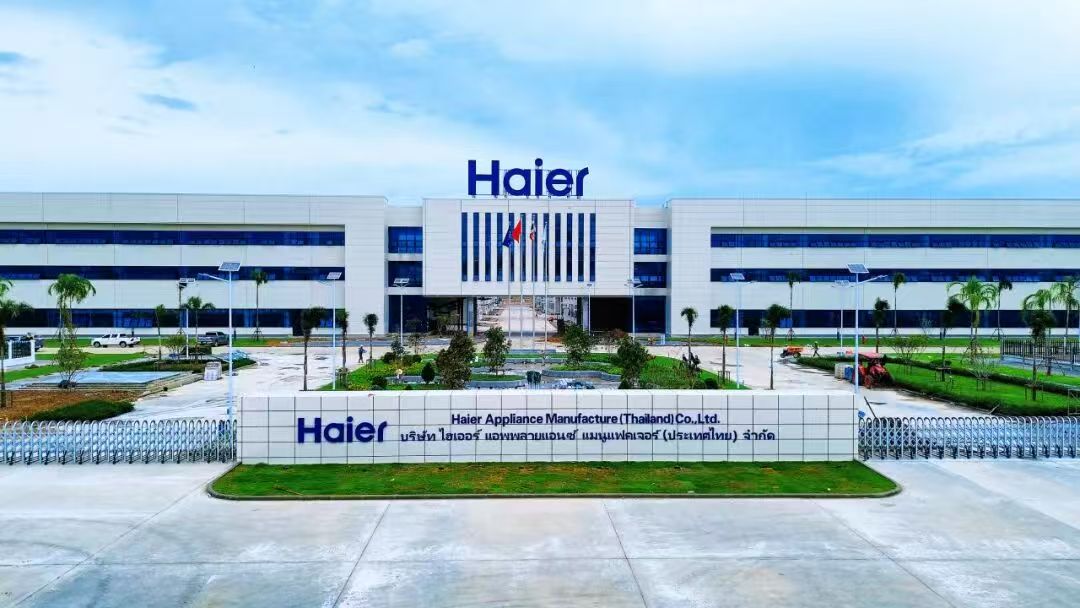
Core Viewpoint - Chinese home appliance leaders are increasing investments in Thailand and Southeast Asia to navigate the complex and changing trade environment by deepening their global presence [1][3][5] Group 1: Investment and Expansion - Haier Group has launched its smart air conditioning factory in Thailand, which began construction a year ago and commenced operations on September 23 this year [3] - Hisense has initiated the construction of its largest overseas industrial park in Thailand, with an initial investment of 4.7 billion Thai Baht (over 1 billion RMB) [3][6] - Midea Group is also enhancing its supply chain layout in Thailand this year, while Gree Electric's subsidiary is focused on producing and selling refrigeration components in Thailand [3][5] Group 2: Strategic Considerations - Thailand is the second-largest air conditioning manufacturing base globally, benefiting from good Sino-Thai relations and multiple free trade agreements, which facilitate exports to the EU and the US [5][8] - The establishment of local production bases in Thailand allows Chinese companies to respond quickly to Southeast Asian market demands and mitigate tariff barriers [5][8] Group 3: Production Capacity and Technology - Haier's Thai factory covers approximately 324,000 square meters with a planned annual production capacity of 6 million units, serving both Southeast Asian and global markets [5][6] - Hisense's HHA smart manufacturing park aims for an annual production capacity of 12 million units by 2030, with an estimated annual output value of 100 billion Thai Baht (approximately 21.97 billion RMB) [6] - The trend towards "green" and "smart" manufacturing is evident, with companies adopting eco-friendly refrigerants and advanced technologies to enhance efficiency and reduce carbon emissions [6][8] Group 4: Local Supply Chain Development - There is a need to improve the local supply chain in Thailand to meet the origin requirements for exports and to keep production costs competitive [8][9] - Midea has been actively engaging with local suppliers to enhance the procurement of components, aiming to generate over 1.5 billion Thai Baht in parts sales [9] - Gree Electric is transitioning from an agency model to independent operations in Thailand, focusing on establishing a comprehensive overseas manufacturing and sales network [9][10]

数读白色家电半年报 | 深康佳近三年半累亏超88亿 澳柯玛经营性现金流由正转负
Xin Lang Zheng Quan· 2025-09-30 09:37
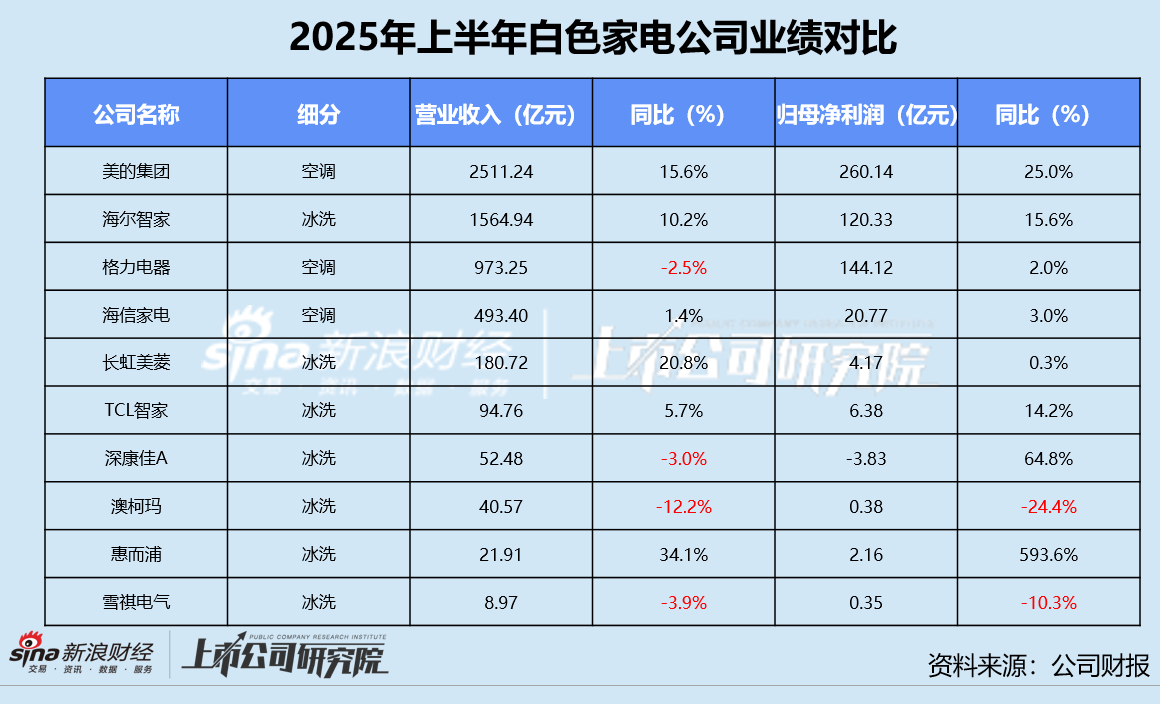
Core Insights - The domestic home appliance market in China showed resilience in growth during the first half of 2025, with a retail market size of 453.7 billion yuan, a year-on-year increase of 9.2% [1] - The top 10 listed white goods companies in A-shares reported a total revenue of 594.22 billion yuan, up 10.5% from the same period in 2024, with a total net profit of 55.50 billion yuan, compared to 47.38 billion yuan in 2024 [1] Revenue Performance - Midea Group led the revenue rankings with 251.12 billion yuan, 1.6 times that of Haier Smart Home, and accounted for 42.3% of the total revenue of the 10 companies [3] - Whirlpool experienced a revenue growth rate of 34.1%, driven by strong overseas demand for washing machines, refrigerators, and dishwashers [3] - Aokema and Xueqi Electric reported declines in both revenue and net profit, with Aokema's core product sales dropping significantly [3] Cost Management - The operating costs of white goods companies generally increased, with about half of the companies experiencing a growth rate in costs that exceeded revenue growth [3] - Gree Electric's revenue slightly decreased by 2.5%, but its operating costs remained stable compared to 2024 [3] - Whirlpool's operating costs rose by 29.4% due to overseas business expansion, while Aokema's costs were the lowest at 78.6 million yuan [3] Profitability - Midea Group achieved a net profit of 26.01 billion yuan, a year-on-year increase of 25.0%, leading the profitability rankings [10] - Gree Electric and Haier Smart Home followed with net profits of 14.41 billion yuan and 12.03 billion yuan, respectively [10] - Deep Kangjia was the only company to report a net loss of 383 million yuan, continuing a trend of losses over the past three and a half years [10] Cash Flow and Efficiency - Midea Group reported a net cash flow of 37.28 billion yuan, an increase of 11.3% year-on-year, while Gree Electric's cash flow surged to 28.33 billion yuan [12] - Deep Kangjia experienced a cash outflow of 16.59 million yuan due to delayed government procurement payments [12] - Whirlpool's accounts receivable turnover days were high at 140 days, while Haier Smart Home and Changhong Meiling had much shorter cycles of less than 30 days [14] Research and Development - The R&D expense ratio for white goods companies remained around 3%, with Gree Electric and Xueqi Electric both reaching 4.0% [8] - Midea Group and Haier Smart Home had significant R&D expenditures of 8.77 billion yuan and 5.79 billion yuan, respectively, with year-on-year growth rates of 14.4% and 13.8% [8] - Whirlpool reduced its R&D expenses by 17.5%, significantly cutting design and certification costs [8]


格力壶口瀑布直播展现净水机实力 全国门店设立公益饮水点
Jing Ji Wang· 2025-09-30 08:21
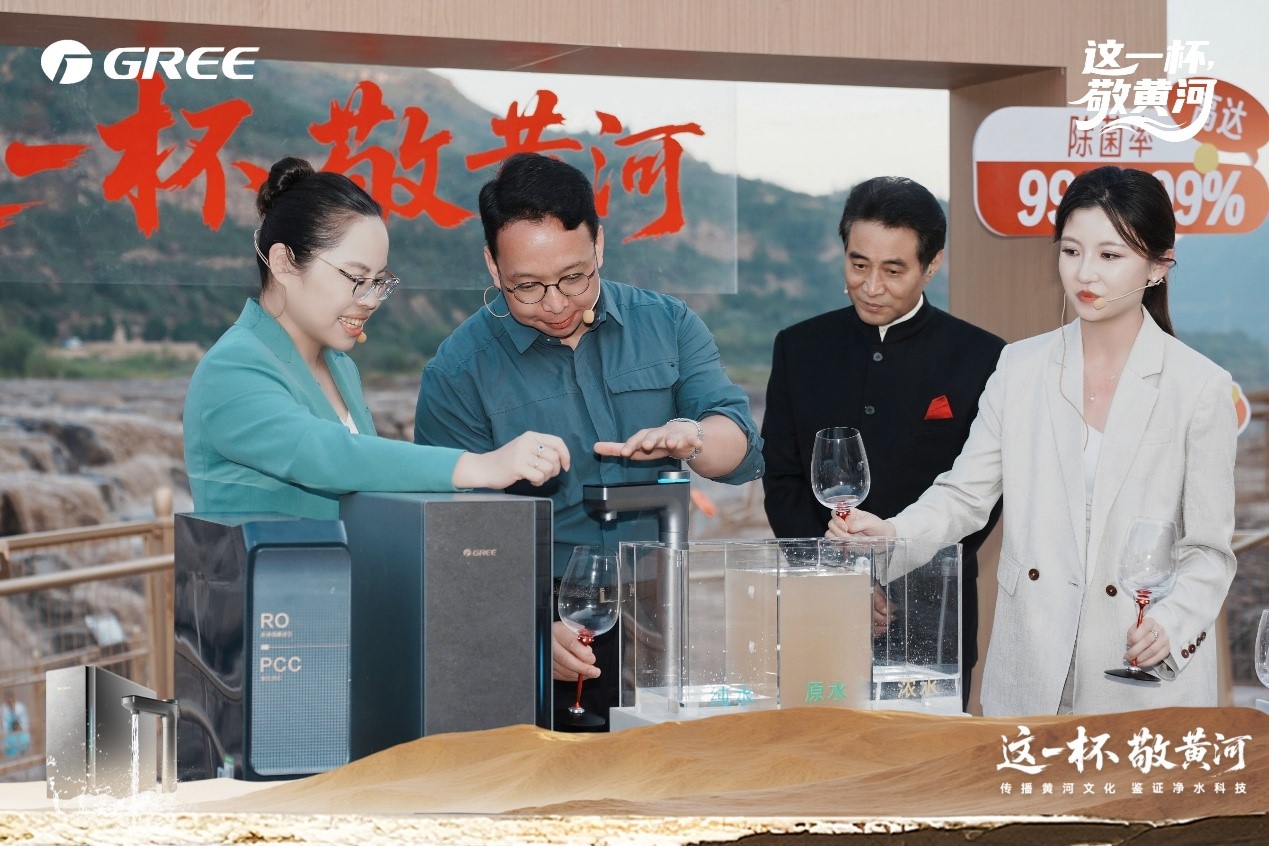
Core Viewpoint - Gree Electric Appliances launched a unique live streaming event titled "A Cup to Toast the Yellow River" to demonstrate its water purification technology and announce the nationwide "Dong Mingzhu Healthy Home" public drinking water point initiative, aimed at providing free healthy drinking water to outdoor workers [1][5][7] Group 1: Event Highlights - The live streaming event featured an 8-hour demonstration by Gree's marketing director, Zhu Lei, showcasing the purification of Yellow River water using Gree's water purifier, which includes a five-stage filtration technology [2][3] - The event included various interactive segments such as cultural discussions about the Yellow River, product experiences, and sales challenges, effectively illustrating the product's capabilities under extreme water quality conditions [2][3] Group 2: Public Drinking Water Initiative - Starting from September 25, Gree Electric announced the establishment of public drinking water points in all "Dong Mingzhu Healthy Home" stores across the country, providing free filtered drinking water to outdoor workers and citizens in need [5][6] - The initiative aims to address the immediate drinking water needs of outdoor workers, creating "warm stations" in urban areas, and reflects the company's commitment to social responsibility [5][6] Group 3: Brand and Social Responsibility - Industry observers noted that Gree's innovative combination of product demonstration and public welfare projects enhances brand trust and translates technological advantages into social value, embodying the philosophy of "technology for good, love for the brand" [7] - The public drinking water point plan not only meets the practical needs of outdoor workers but also fosters consumer trust through frequent, close interactions with Gree products, achieving a win-win for social and brand benefits [7]
广东民企百强:入围门槛123亿 去年4家营收超4000亿 12家超千亿
Nan Fang Du Shi Bao· 2025-09-29 23:15
Core Points - The 2025 World Cantonese Business Conference was held in Guangzhou, aiming to unite global Cantonese business forces and promote high-quality development in the Greater Bay Area [8][10] - Three lists were released: "Top 100 Private Enterprises in Guangdong 2025," "Top 100 Private Manufacturing Enterprises in Guangdong 2025," and "Top 50 Private Service Enterprises in Guangdong 2025" [9] - The threshold for entering the "Top 100 Private Enterprises in Guangdong" list was set at 12.332 billion yuan, with 4 companies exceeding 400 billion yuan in revenue and 12 exceeding 100 billion yuan [9] Summary of Lists - The top companies in the "Top 100 Private Enterprises in Guangdong" include Huawei Investment Holding Co., Ltd. with revenue of 862.072 billion yuan, BYD Co., Ltd. with 777.102 billion yuan, and Tencent Holdings Ltd. with 660.257 billion yuan [7] - In the "Top 100 Private Manufacturing Enterprises," Huawei, BYD, and Midea Group Co., Ltd. lead the list, with revenues of 862.072 billion yuan, 777.102 billion yuan, and 409.084 billion yuan respectively [7] - The "Top 50 Private Service Enterprises" is led by Tencent Holdings Ltd. with 660.257 billion yuan, followed by SF Holding Co., Ltd. with 284.420 billion yuan [7] Investment and Economic Impact - The conference attracted nearly a thousand representatives from global Cantonese businesses, resulting in 24 signed projects worth 44.458 billion yuan, covering sectors like artificial intelligence and semiconductors [10] - The Guangdong Provincial Federation of Industry and Commerce initiated a survey to rank large-scale private enterprises based on their 2024 revenue [9] Global Cantonese Business Initiative - The "Global Cantonese Business Cooperation Initiative" was launched, calling for collaboration among global Cantonese businesses to enhance competitiveness and innovation [11][12][13] - The initiative emphasizes the importance of integrating into the Greater Bay Area's development and contributing to high-quality growth in Guangdong [14][15] Notable Statements - TCL's chairman highlighted the company's investment of 82.5 billion yuan in Guangdong over the past five years and its focus on global business expansion [16] - The chairman of the Hong Kong Chinese General Chamber of Commerce noted that the total import and export volume between Guangdong and Hong Kong reached 566.85 billion yuan, reflecting a 7.9% increase [18]



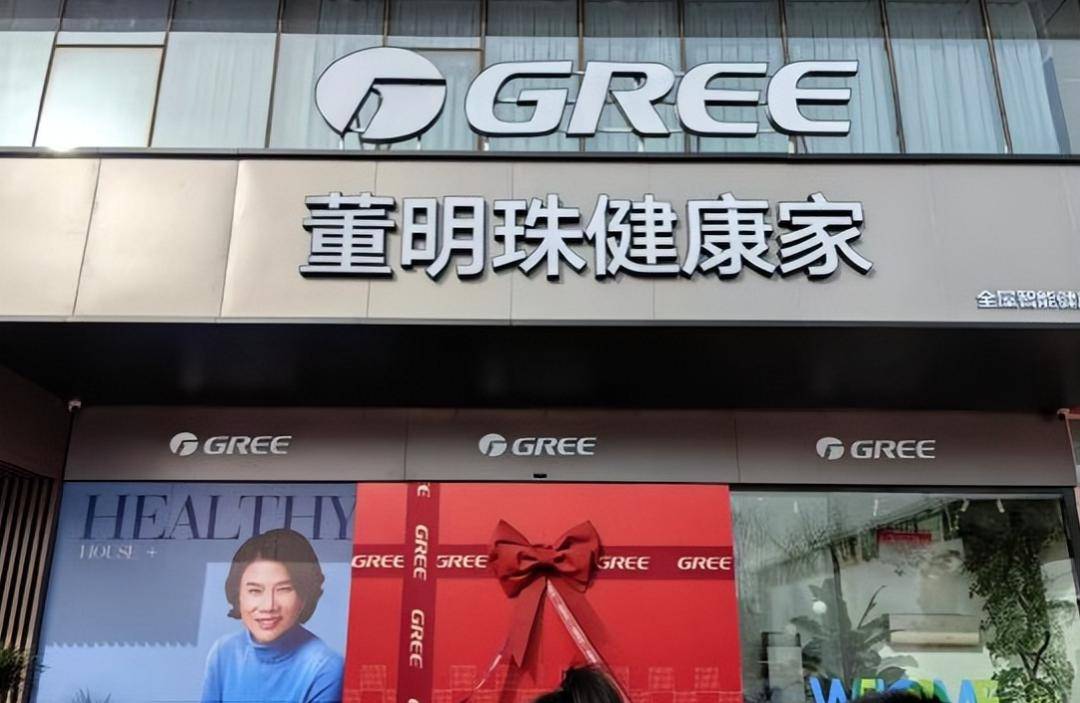
半年狂飙近千家,备受争议的“董明珠健康家”搞咋样了?
Sou Hu Cai Jing· 2025-09-29 14:33
Core Insights - Gree Electric Appliances is rapidly expanding its "Dong Mingzhu Healthy Home" initiative, with over 970 stores established nationwide within six months of its launch in Beijing [4][6][7] - The company aims to reshape consumer perceptions that associate Gree solely with air conditioning, offering a comprehensive home appliance solution through innovative store designs [2][19] - Despite the growth in store numbers, Gree faces challenges with declining revenue in its core air conditioning segment, which saw a 5.09% decrease in revenue during the first half of the year [18][19] Expansion and Strategy - The "Dong Mingzhu Healthy Home" stores are part of Gree's diversification strategy, leveraging the personal brand of its leader, Dong Mingzhu, to attract consumer attention and drive sales [3][14] - Gree plans to continue expanding the "Dong Mingzhu Healthy Home" concept, with a target of 3,000 stores by the end of the year, focusing on a "mature one, open one" approach [7][22] - The initiative has already shown positive results, with significant sales increases in non-air conditioning categories, such as a 40% rise in water purification products [7][8] Financial Performance - Gree's total revenue for the first half of the year was 976.19 billion, reflecting a 2.66% decline year-on-year, while net profit increased by 1.95% to 144.12 billion [18][19] - The company's core consumer electronics segment, primarily air conditioning, accounted for 78.38% of total revenue but faced a 5.09% decline [19][20] - Gree's industrial products and green energy segments showed promising growth, with revenues increasing by 17.13% and 20.9% respectively, although their overall contribution remains limited [24][25] Market Challenges - Gree is experiencing pressure from a changing market environment, with a notable shift towards lower-priced air conditioning units, which poses a challenge to its high-end positioning [20][22] - The perception of Gree as solely an air conditioning brand is a significant barrier to the company's efforts to diversify its product offerings [22] - The company must navigate competitive pressures, particularly from rivals like Xiaomi, as it seeks to maintain its market share in the air conditioning sector [22]
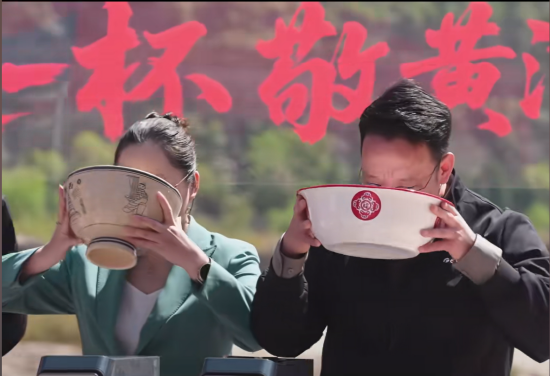
拼了!格力高管直播带货:用“黄河水”煮咖啡,卖一台喝一杯
Xin Lang Cai Jing· 2025-09-29 01:05
Core Viewpoint - The live demonstration by Gree Electric showcased the effectiveness of its water purification technology using Yellow River water, emphasizing the company's commitment to providing safe drinking water through advanced technology [2][5][10]. Group 1: Product Performance - Gree Electric's market director demonstrated the purification of Yellow River water, which was previously considered unsafe for direct consumption, by using the company's "6 nine" water purifier [2][10]. - The "6 nine" purifier claims to remove 99.9999% of total coliform bacteria, ensuring that the filtered water is safe for drinking [12][14]. - The purification process involves a multi-stage filtration system, including PP cotton, activated carbon, and RO reverse osmosis membrane, which effectively removes harmful substances from the water [14]. Group 2: Water Quality Improvement - The Yellow River's water quality has improved significantly due to ongoing environmental efforts, achieving a stable "Class II" water quality status for three consecutive years [6]. - Despite the improvement, "Class II" water is still not safe for direct consumption without purification due to high TDS levels and potential contaminants [6][10]. Group 3: Corporate Social Responsibility - Gree Electric launched a campaign titled "A Cup of Healthy Water, Warming a City," providing free purified water to outdoor workers and citizens at its stores starting September 25 [15][16]. - This initiative aims to address immediate drinking water needs and reflects the company's commitment to social responsibility and community support [17].