Yanjing Brewery(000729)

Search documents
增利难增收?5家头部啤酒企业掌门人揭秘破局关键
Mei Ri Jing Ji Xin Wen· 2025-11-17 14:37
Core Insights - The beer industry is experiencing a slowdown in overall growth, with companies facing challenges in increasing profits while revenues remain stagnant [2][8] - The recent "Double 11" shopping festival saw significant online sales for major beer brands, but the competitive landscape is shifting towards high-end products and diverse consumption scenarios [2][6] Group 1: Market Trends - Major beer brands like Tsingtao, Budweiser, and Yanjing dominated online sales during "Double 11," with Tsingtao's exclusive 211ml small white beer seeing a nearly 4-fold increase in sales [2] - The beer market is transitioning from a speed competition to a focus on high-end products and diverse consumption scenarios, indicating a need for innovation and adaptation [2][8] Group 2: Product Innovation - Companies are focusing on product innovation to meet changing consumer demands, with new categories like non-alcoholic and low-calorie beers gaining traction [3][9] - Carlsberg China emphasizes the importance of high-end products and fine management, while Budweiser Asia Pacific highlights the need for technological advancements in brewing processes [4][5] Group 3: Consumption Scenarios - The traditional consumption scenarios for beer are weakening, prompting companies to explore new experiences such as outdoor activities and urban street culture [6][7] - Tsingtao Beer is creating experiential venues like museums and beer gardens to enhance consumer engagement, while Carlsberg is aligning its brands with specific dining experiences [6][7] Group 4: Industry Outlook - Despite the current challenges, the long-term growth potential of the Chinese beer market remains strong, with a focus on quality and innovation [8][9] - Industry leaders stress the importance of collaboration and shared efforts to drive innovation and quality improvements across the sector [9]




食品饮料行业周报:CPI催化预期,底部价值凸显-20251117



Haitong Securities International· 2025-11-17 07:10
Investment Rating - Investment advice indicates a sector recovery catalyzed by recent CPI data, focusing on growth and supply-demand inflection points [5][16]. Core Views - The report emphasizes the importance of consumer goods growth, particularly in beverages, snacks, and food ingredients, while also highlighting structural opportunities in the baijiu sector [5][16]. - CPI data shows a positive trend with October CPI year-on-year at +0.2% and core CPI at +1.2%, indicating a recovery in domestic demand [6][16]. - The baijiu industry is undergoing accelerated clearing, with expectations for improved sales and inventory adjustments leading into 2026 [7][16]. - Consumer goods are expected to benefit from stabilization and recovery, with a focus on low valuation and high dividend stocks [8][16]. Summary by Sections Investment Recommendations - Recommended baijiu stocks include Shanxi Xinghuacun Fen Wine Factory, Gujing Distillery, and stable targets like Kweichow Moutai and Wuliangye [5][16]. - Beverage growth is highlighted with recommendations for Eastroc Beverage and Nongfu Spring, alongside low valuation stocks like China Foods and Tingyi [5][16]. - Snack and food ingredient stocks recommended include Bailong Chuangyuan, Yankershop Food, and Three Squirrels [5][16]. - Beer recommendations include Yanjing Brewery and Tsingtao Brewery, while condiment stocks like Haitian Flavoring & Food are also suggested [5][16]. Baijiu Sector Insights - The baijiu sector is experiencing a significant adjustment, with industry destocking still in progress and a focus on promotional sales for 2026 [7][16]. - Recent sales data from JD.com shows a +18% year-on-year increase in liquor sales during the Double 11 shopping festival, indicating a positive market response [7][16]. Consumer Goods Outlook - Consumer goods are expected to see growth as the mainline, with structural differentiation evident in beverages, snacks, and health products [8][16]. - The report notes that companies with product innovation and channel expansion will have growth advantages, particularly in the context of recent service and non-food price recoveries [8][16].
燕京啤酒跌2.05%,成交额1.90亿元,主力资金净流出1564.18万元
Xin Lang Cai Jing· 2025-11-17 06:31
Core Viewpoint - Yanjing Beer experienced a stock price decline of 2.05% on November 17, trading at 12.40 CNY per share with a total market capitalization of 34.95 billion CNY [1] Financial Performance - For the period from January to September 2025, Yanjing Beer reported a revenue of 13.433 billion CNY, reflecting a year-on-year growth of 4.57%, and a net profit attributable to shareholders of 1.770 billion CNY, which is a 37.45% increase compared to the previous year [2] - The company has distributed a total of 4.509 billion CNY in dividends since its A-share listing, with 1.043 billion CNY distributed over the last three years [2] Shareholder Information - As of November 10, 2025, the number of shareholders for Yanjing Beer decreased by 7.96% to 52,100, while the average circulating shares per person increased by 8.65% to 48,206 shares [2] - The second-largest circulating shareholder is Hong Kong Central Clearing Limited, holding 74.5763 million shares, a decrease of 21.0157 million shares from the previous period [2] Stock Market Activity - On November 17, the main funds saw a net outflow of 15.6418 million CNY, with large orders buying 17.256 million CNY and selling 17.3769 million CNY [1] - Yanjing Beer's stock has increased by 4.64% year-to-date, with a 2.73% rise over the last five trading days, a 0.72% decline over the last 20 days, and a 1.56% increase over the last 60 days [1] Company Overview - Yanjing Beer, established on July 8, 1997, and listed on July 16, 1997, is primarily engaged in the manufacturing and sales of beer (92.26% of revenue), water, beer raw materials, tea beverages, yeast, and feed [1] - The company is categorized under the food and beverage industry, specifically in the non-liquor beer segment, and is associated with concepts such as beer, Beijing state-owned assets, state-owned enterprise reform, mid-cap stocks, and margin trading [1]
食品饮料月月谈电话会
2025-11-16 15:36
Summary of Conference Call on Dairy and Beverage Industry Industry Overview - The dairy industry is experiencing a continuous capacity reduction, with expectations for supply-demand balance improvement by mid to late 2026, leading to potential stabilization in milk prices. As of October, milk prices remained stable at 2.94 yuan per kilogram, with a production loss of approximately 0.2 yuan per kilogram and a loss rate of about 5% [2][2][2]. Key Points on Dairy Companies New Dairy Industry - New Dairy reported a strong performance in October, continuing the trend from Q3, with double-digit growth in low-temperature fresh milk and yogurt. The company is expanding into new channels, achieving significant revenue from collaborations, and is expected to meet its profit margin targets ahead of schedule by 2026 [4][4][4]. Mengniu Dairy - Mengniu's Q3 results met expectations, with stable market share following price reductions on its flagship product. The company anticipates stable revenue and profit margin growth through 2026, with a relatively low valuation providing investment flexibility [5][5][5]. Yili Group - Despite weak overall demand, Yili's low-temperature milk and other segments showed positive growth, with low-temperature white milk exceeding 20% growth. The company is expected to stabilize its liquid milk business by 2026, benefiting from diversified product offerings and channels [6][7][6][7]. Miao Ke Lan Duo and Youran Dairy - Miao Ke Lan Duo is experiencing rapid growth in the B-end market, with significant C-end product launches. The company is expanding its deep processing of dairy products, which is expected to improve profitability. Youran Dairy is increasing fresh milk supply with stable prices, supporting profits, and is projected to enhance profitability further with a reduction in livestock numbers [8][8][8]. Beverage Industry Insights Master Kong - Master Kong's beverage business saw a slight decline in Q3, but the drop has narrowed in October. The company expects to stabilize its beverage business next year, with a focus on promotional activities and potential price adjustments for its one-liter products [9][10][9][10]. Nongfu Spring - Nongfu Spring's water business experienced double-digit growth in October, with its sugar-free tea brand capturing nearly 80% market share. The company is expected to maintain steady revenue and profit growth, making it a strong long-term investment choice [10][10][10]. Dongpeng Beverage - Dongpeng Beverage reported a nearly 30% growth rate, with ambitious annual targets. The company shows significant growth potential from a valuation perspective [10][10][10]. Investment Recommendations - The dairy sector is recommended for investment due to expected improvements in profitability and market conditions by 2026. Companies like Mengniu, Yili, and New Dairy are highlighted for their growth potential and stable valuations [5][7][4][4]. - In the beverage sector, Master Kong and Nongfu Spring are noted for their resilience and growth prospects, making them attractive investment options [9][10][10].




食品饮料行业点评:近期更新反馈:固本强基,趋时驭势
GOLDEN SUN SECURITIES· 2025-11-16 09:39
Investment Rating - The report maintains an "Accumulate" rating for the food and beverage industry, indicating a positive outlook for investment opportunities in this sector [5]. Core Insights - The food and beverage industry is experiencing a transformation driven by health-conscious consumer trends, product innovation, and channel expansion, with companies actively enhancing their product offerings and exploring overseas markets [1][9]. - In the liquor segment, the supply side is undergoing continuous changes to seek growth, while the demand side is gradually recovering, highlighting the absolute investment value in the industry [2][3]. - The beverage sector is focusing on product innovation and network expansion to uncover growth potential, with a strong emphasis on health upgrades and premiumization [4][7]. Summary by Relevant Sections Liquor Industry - **Water Well**: The company is optimizing its product matrix and plans to launch a new high-end product in 2025, focusing on brand collaboration and expanding its terminal network [2]. - **Jiu Gui Jiu**: The brand is implementing a strategic focus on brand depth and product line simplification, with expectations for improved sales performance [3]. - **She De Jiu Ye**: The company is maintaining its core strategy while expanding its product offerings, particularly in e-commerce, to drive growth [3]. Beverage Industry - **Kang Shi Fu**: The company is committed to innovation and quality, focusing on expanding its product range to meet diverse consumer needs [4]. - **Unified Enterprises**: The company is experiencing stable performance with a focus on product innovation and market expansion, particularly in the instant noodle and beverage segments [7]. - **Hua Run Beverage**: Short-term performance is under pressure due to competition, but long-term growth prospects remain strong due to the essential nature of its products [7]. Health and Wellness Trends - **Anqi Yeast**: The company is targeting over 10% revenue growth, with a focus on expanding its overseas market presence and maintaining cost advantages [9]. - **Xian Le Health**: The company is advancing its global strategy and product innovation to capture new consumer trends, with a focus on high-margin products [9]. - **Jian Yi Health**: The company is enhancing its probiotic offerings and expanding its product lines to meet evolving consumer demands [10]. Overall Market Trends - The food and beverage industry is witnessing a shift towards healthier products and innovative marketing strategies, with companies adapting to changing consumer preferences and exploring new growth avenues [1][4].


北京市顺义区市场监督管理局关于2025年食品安全监督抽检信息的公告 (2025年第8期)
Zhong Guo Zhi Liang Xin Wen Wang· 2025-11-12 08:46
Overall Situation - The announcement from the Shunyi District Market Supervision Administration indicates that all 279 samples from 15 categories of food products tested were compliant with national food safety standards [2]. Food Categories - Starch and starch products: 1 batch, all compliant [2] - Soy products: 3 batches, all compliant [2] - Convenience foods: 1 batch, all compliant [2] - Pastries: 41 batches, all compliant [2] - Alcoholic beverages: 38 batches, all compliant [2] - Frozen drinks: 9 batches, all compliant [2] - Grain processing products: 28 batches, all compliant [2] - Other foods: 36 batches, all compliant [2] - Meat products: 26 batches, all compliant [2] - Dairy products: 10 batches, all compliant [2] - Food additives: 11 batches, all compliant [2] - Sugar: 1 batch, all compliant [2] - Frozen foods: 19 batches, all compliant [2] - Seasonings: 41 batches, all compliant [2] - Beverages: 14 batches, all compliant [2]


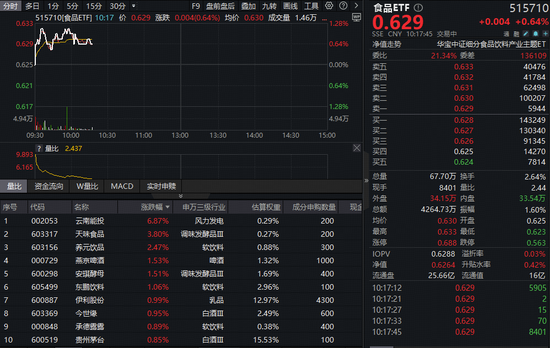
贵州白酒政策引爆行情!白酒、大众品携手上攻,食品ETF(515710)盘中上探1.28%!
Xin Lang Ji Jin· 2025-11-12 02:29
Group 1 - The food and beverage sector continues to rise, with the Food ETF (515710) showing a maximum intraday increase of 1.28% and currently up 0.64% [1] - Major consumer goods stocks are leading the gains, with notable performances from liquor brands such as Tianwei Food up over 3% and Yangyuan Beverage up over 2% [1] - Guizhou's government has introduced multiple consumption expansion measures related to liquor, aiming to boost production and consumption during peak holiday seasons [2][3] Group 2 - Analysts highlight that Guizhou's consumption expansion policy aims to deeply integrate liquor consumption with industrial upgrades and cultural promotion, rather than just short-term sales boosts [3] - The food and beverage sector is currently at a historical low valuation, with the Food ETF's underlying index PE ratio at 21.21 times, indicating a favorable long-term investment opportunity [3] - Future projections suggest that the liquor industry may see improvements in financial reports by 2026, with a gradual recovery in demand expected as policy impacts diminish [4] Group 3 - The Food ETF (515710) tracks the CSI segmented food and beverage industry index, with approximately 60% of its holdings in high-end liquor stocks and nearly 40% in other beverage and food segments [5] - Investors can also access core assets in the food and beverage sector through the Food ETF linked funds [5]


燕京啤酒涨2.01%,成交额4458.02万元,主力资金净流入328.53万元
Xin Lang Zheng Quan· 2025-11-12 01:45
Core Viewpoint - Yanjing Beer has shown a positive stock performance with a 2.01% increase on November 12, 2023, and a year-to-date stock price increase of 7.09% [1] Financial Performance - For the period from January to September 2025, Yanjing Beer reported a revenue of 13.433 billion yuan, representing a year-on-year growth of 4.57%, and a net profit attributable to shareholders of 1.770 billion yuan, which is a 37.45% increase compared to the previous year [2] Shareholder Information - As of November 10, 2023, the number of shareholders for Yanjing Beer decreased by 7.96% to 52,100, while the average circulating shares per person increased by 8.65% to 48,206 shares [2] Dividend Distribution - Yanjing Beer has cumulatively distributed 4.509 billion yuan in dividends since its A-share listing, with 1.043 billion yuan distributed over the past three years [2] Institutional Holdings - As of September 30, 2025, the second-largest circulating shareholder is Hong Kong Central Clearing Limited, holding 74.5763 million shares, a decrease of 21.0157 million shares from the previous period [2]
燕京啤酒:截至2025年11月10日公司股东总户数为52060户
Zheng Quan Ri Bao Wang· 2025-11-11 10:12
Core Viewpoint - Yanjing Beer (000729) reported that as of November 10, 2025, the total number of shareholders is 52,060 [1] Summary by Category - **Company Information** - Yanjing Beer has a total of 52,060 shareholders as of the specified date [1]
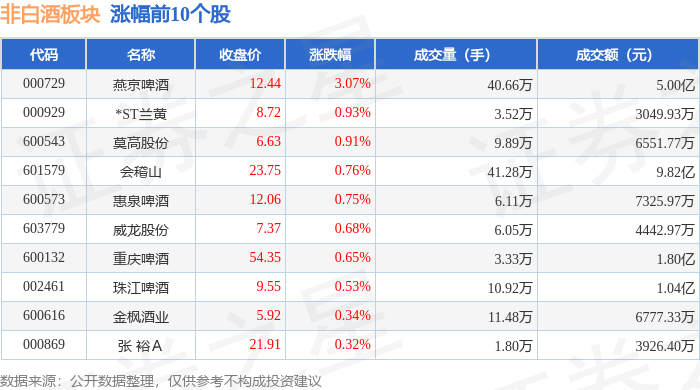
非白酒板块11月11日涨0.56%,燕京啤酒领涨,主力资金净流出2.82亿元
Zheng Xing Xing Ye Ri Bao· 2025-11-11 08:37
证券之星消息,11月11日非白酒板块较上一交易日上涨0.56%,燕京啤酒领涨。当日上证指数报收于 4002.76,下跌0.39%。深证成指报收于13289.0,下跌1.03%。非白酒板块个股涨跌见下表: | 代码 | 名称 | 收盘价 | 涨跌幅 | 成交量(手) | 成交额(元) | | --- | --- | --- | --- | --- | --- | | 000729 | 菲克啤酒 | 12.44 | 3.07% | 40.66万 | 5.00亿 | | 000929 | *ST兰黄 | 8.72 | 0.93% | 3.52万 | 3049.93万 | | 600543 | 莫高股份 | 6.63 | 0.91% | 9.89万 | 6551.77万 | | 601579 | 会稽山 | 23.75 | 0.76% | 41.28万 | 9.82亿 | | 600573 | 惠泉啤酒 | 12.06 | 0.75% | 6.11万 | 7325.97万 | | 603779 | 威龙股份 | 7.37 | 0.68% | 6.05万 | 4442.97万 | | 600132 | 重庆啤酒 | 5 ...