Yanjing Brewery(000729)

Search documents
食品饮料行业周报:白酒动销渐起-20260126
CMS· 2026-01-26 04:52
Investment Rating - The report maintains a positive outlook on the liquor industry, indicating a bottoming out and potential for a rebound during the Spring Festival, with a focus on key stocks such as Guizhou Moutai, Wuliangye, and Shanxi Fenjiu [5][16]. Core Insights - The report highlights that the safety margin for liquor companies is derived more from brand strength, market share, and sales momentum rather than just dividend yields, which are expected to be adjusted downwards for the years 2025-2026 [1][16]. - Recent sales tracking shows that Moutai's sales and pricing are better than market expectations, with a slight increase in overall channel sales volume and stable pricing [1][16]. - The report emphasizes the importance of cash flow and dividend planning, with companies like Yanghe planning to maintain dividends at no less than 100% of their net profit for 2025-2027 [2][11]. Summary by Relevant Sections Core Company Tracking - Yanghe's net profit for 2025 is projected to be between 2.12 billion and 2.52 billion yuan, a decline of 62.2%-68.3% year-on-year, with a focus on inventory reduction and price stabilization [2][11]. - Yanjing Beer expects a net profit of 1.58 billion to 1.74 billion yuan for 2025, reflecting a year-on-year increase of 50.0%-65.0%, with plans to launch a high-end product in 2026 [3][12]. - Yihai International anticipates low single-digit growth in H2 2025, driven by improved gross margins and a return of key personnel, which is expected to enhance business performance [4][13]. - IFBH is expected to face pressure in H2 2025, but with potential recovery in 2026 as supply issues are resolved [4][14]. Investment Recommendations - The report suggests a bottom-up approach to investing in liquor stocks, with a focus on key players and potential rebounds in sales, particularly in the context of the upcoming Spring Festival [5][16]. - It identifies four main lines for consumer goods: restaurant chains, dairy products, valuation-matched companies, and bottom-up recovery plays [5][17]. Industry Overview - The report notes that the food and beverage industry has a total market capitalization of 4,560.2 billion yuan, with 142 listed companies [5]. - The industry index shows a 1-month performance of 0.6%, a 6-month performance of 4.4%, and a 12-month performance of 17.7% [7].





食品饮料周报(26年第4周):各品类春节备货有序进行,预制菜国标将征求意见-20260126
Guoxin Securities· 2026-01-26 02:59
Investment Rating - The report maintains an "Outperform the Market" rating for the food and beverage sector [4][5][11]. Core Views - The food and beverage sector is expected to perform well in 2026, driven by cost advantages, efficiency improvements, innovation, and potential recovery opportunities in the liquor segment [3][11][15]. - The report highlights a diversified performance across sub-sectors, with beverages outperforming food and liquor categories [2][11]. Summary by Relevant Sections 1. Sector Overview - The food and beverage sector saw a cumulative decline of 1.37% this week, with A-shares down 1.57% and H-shares up 1.21% [1]. - Key performers included companies like Hao Xiang Ni and Wei Zhi Xiang, with significant weekly gains [1]. 2. Sub-sector Insights - **Liquor**: - Moutai's price remains stable with an upward trend, and the focus is on sales momentum during the Spring Festival. Recommendations include Moutai, Shanxi Fenjiu, and Luzhou Laojiao [2][11]. - **Beverages**: - The dairy segment is seeing orderly preparations for the Spring Festival, with a focus on leading companies like Yili. Recommendations include Nongfu Spring and Dongpeng Beverage [2][15]. - **Snacks**: - The report emphasizes strong alpha stocks in the snack sector, particularly in konjac products, with companies like Weidong and Yanjinpuzi showing strong innovation [2][13]. - **Catering Supply Chain**: - The sector is entering a peak season for inventory and sales, with new standards for prepared dishes being solicited for public opinion [2][14]. 3. Investment Recommendations - The report suggests a focus on four main lines for investment: cost advantages, efficiency improvements, innovation-driven companies, and potential recovery in the liquor sector [3][11]. - Recommended stocks include Baba Foods, Dongpeng Beverage, Weidong, and Shanxi Fenjiu, which have shown resilience and growth potential [17][19]. 4. Earnings Forecasts - Key companies are projected to maintain strong earnings growth, with Moutai expected to achieve a stable performance and Yili showing significant recovery potential [4][15][19]. - The report provides detailed earnings forecasts for several companies, indicating a positive outlook for the food and beverage sector [4][19].




湖北和广东调研反馈、周观点:啤酒推新蓄力,烘焙旺季稳健-20260125
GOLDEN SUN SECURITIES· 2026-01-25 11:22
Investment Rating - The report maintains an "Accumulate" rating for the food and beverage industry [5] Core Insights - The upcoming Spring Festival is expected to boost sales in the liquor sector, with Moutai leading the industry towards an unexpected improvement. Short-term focus should be on the demand for the Spring Festival, while medium-term investments should target leading brands across various price segments [1] - In the beer segment, new product launches are being prepared, with a focus on high-growth channels and consumer trends towards personalized and diversified consumption [2] - The baking sector is showing stable performance, with companies like Lihigh Foods preparing for the sales peak and benefiting from favorable policies regarding cream products [3] Summary by Relevant Sections Liquor Sector - The Spring Festival is driving demand, with Moutai expected to lead the market. Key short-term stocks include Guizhou Moutai, Guo Jiu Gong Jiu, and others, while medium-term focus should be on Wuliangye and Shanxi Fenjiu [1] Beer Sector - Current beer sales are in a low season, but new product launches and high growth in instant retail channels are promising. Companies like Chongqing Beer are launching new 1L cans to meet consumer preferences [2] Food Sector - Lihigh Foods is preparing for the sales peak with a focus on quality over quantity, while Anqi Yeast is benefiting from declining sugarcane prices, enhancing profit margins [3] - Yizhi Konjac is experiencing rapid demand growth, with a stable supply chain and product innovation driving its market position [4]



燕京啤酒预计2025年利润大增,U8核心大单品成业绩增长核心引擎
Xi Niu Cai Jing· 2026-01-23 10:52
Core Viewpoint - Yanjing Beer (000729.SZ) forecasts a net profit of 1.584 billion to 1.742 billion yuan for 2025, representing a year-on-year growth of 50.00% to 65.00% [2] Group 1: Financial Performance - The company expects a net profit excluding non-recurring gains and losses to be between 1.457 billion and 1.561 billion yuan, with a year-on-year increase of 40.00% to 50.00% [2] - The growth in net profit is attributed to the implementation of a big product strategy centered around Yanjing U8, along with continuous product innovation and promotion [2] Group 2: Product Strategy - The product matrix includes mid-to-high-end products like Yanjing V10, Lion King Craft Beer, and Lijiang 1998, alongside various regional specialty products to meet diverse consumer needs [2] - The company is focusing on enhancing product strength, brand power, and channel strength while exploring innovative paths and deepening management systems [2] Group 3: Channel Strategy - Yanjing Beer employs a "full-channel integration + regional deep cultivation" strategy to activate market growth potential and optimize regional strategies [3] - The company has introduced a "Hundred Cities Project" to complement its existing "Hundred Counties Project," creating a tiered market development strategy [3] - The shift towards self-consumption and scenario-based consumption has led to the expansion of new markets and channels, achieving national layout and sales breakthroughs [3] Group 4: Operational Efficiency - The company is focused on transforming key business areas such as production, marketing, and supply chain to enhance operational efficiency and growth potential [3] - Strategic initiatives are being implemented to improve management quality and operational effectiveness [3] Group 5: Future Outlook - In 2026, Yanjing Beer plans to leverage opportunities by advancing digitalization, expanding new retail channels, and strengthening brand marketing [4] - The company aims to create a resilient and superior long-term value system to support high-quality development in the industry [4]


食饮吾见 | 一周消费大事件(1.19-1.23)
Cai Jing Wang· 2026-01-23 09:19
Group 1: iMoutai Packaging Correction and After-Sales Solutions - iMoutai has corrected the packaging of the classic version of Guizhou Moutai liquor (53% vol 500ml) and announced two after-sales solutions [1] - The first solution allows consumers to exchange the original product for the corrected version at Moutai self-operated stores until December 31, 2026 [1] - The second solution involves a "pen tool" for consumers to correct the packaging themselves, with further details to be announced [1] Group 2: Jinsha Liquor's Organizational Restructuring - Jinsha Liquor has shifted its strategy from "pan-nationalization" to "regional market gradient cultivation" to pursue high-quality development [2] - The company has restructured its organization into a "functional department + regional district" model to enhance market responsiveness and decision-making efficiency [2] - Marketing strategies will focus on content and scenario marketing, with a strong emphasis on digital capabilities for cost control and data analysis [2] Group 3: Xijiu's Sales Growth on JD.com - Xijiu's sales on JD.com have surpassed 1.4 billion yuan in 2025, marking a significant milestone in their partnership with the platform [3] Group 4: Yanjing Beer Profit Forecast - Yanjing Beer expects a net profit of 1.583 billion to 1.742 billion yuan for the previous year, representing a year-on-year growth of 50% to 65% [4] - The company is focusing on a big product strategy and enhancing brand management to drive growth [4][5] Group 5: ST Juewei's Revenue and Loss Forecast - ST Juewei anticipates a revenue of 5.3 billion to 5.5 billion yuan for 2025, a decline of 12.09% to 15.29% year-on-year, with a projected net loss of 160 million to 220 million yuan [10] - The company cites underutilized production capacity and increased non-operating expenses as factors affecting performance [10] Group 6: Liangpinpuzi's Expected Losses - Liangpinpuzi forecasts a net loss of 120 million to 160 million yuan for 2025, primarily due to store optimization and product adjustments [11] - The company is focusing on improving management efficiency and reducing costs, but revenue and gross margin declines have impacted profitability [11] Group 7: Yijia Yue's Profit Growth Projection - Yijia Yue expects a net profit increase of 50.06% to 72.79% for 2025, driven by enhanced customer orientation and store upgrades [18] - The company is optimizing its product offerings and improving operational efficiency to boost profitability [18] Group 8: Yonghui Supermarket's Stake Sale - Yonghui Supermarket plans to sell a 28.095% stake in YunJin Technology for 80 million yuan to focus on its core business [16][17]


【企韵风华】15.84亿起!燕京啤酒发布这份业绩预告!
Sou Hu Cai Jing· 2026-01-23 08:26
Core Viewpoint - Yanjing Beer is expected to achieve a net profit of approximately 1.584 billion to 1.742 billion yuan in 2025, marking a year-on-year growth of 50% to 65%, continuing its trend of over 50% annual net profit growth for four consecutive years [1] Group 1: Financial Performance - For the first three quarters of 2025, Yanjing Beer reported a revenue of 13.433 billion yuan, a year-on-year increase of 4.57%, and a net profit of 1.77 billion yuan, a significant year-on-year growth of 37.45% [4] - From 2022 to 2024, the company's revenue grew from 13.202 billion yuan to 14.667 billion yuan, with a compound annual growth rate (CAGR) of 5.4%, while net profit surged from 352 million yuan to 1.056 billion yuan, with a CAGR of 73.4% [4] - The company's operating costs increased by only 0.57%, significantly lower than the revenue growth of 4.57%, indicating a notable improvement in gross margin [5] Group 2: Strategic Transformation - Yanjing Beer is focusing on quality growth through a systematic transformation, shifting from quantity to quality and emphasizing growth quality and profitability [3] - The company is implementing nine major strategic reforms to build long-term competitive advantages, enhancing management efficiency and brand strength [4] - Yanjing Beer is diversifying its product offerings with a three-tier product structure of "mid-to-high-end + mid-range + regional specialties," which has led to a 9.32% year-on-year increase in revenue from mid-to-high-end products [7] Group 3: Market Position and Competitive Advantage - Despite a general decline in the beer industry, Yanjing Beer has positioned itself as a "dark horse" in the market, successfully navigating through economic cycles by focusing on consumer demand [4] - The company has achieved a market share exceeding 75% in North and South China, driven by its high-end product strategy and innovative marketing approaches [8] - Yanjing Beer is also expanding into the beverage sector with the launch of Best Jia soda, aiming to complement its beer offerings and enhance its market presence [8] Group 4: Shareholder Returns - Yanjing Beer has been increasing its cash dividends, with a distribution of 0.19 yuan per share for the 2024 fiscal year and a mid-year dividend of 1.00 yuan per 10 shares for the first three quarters of 2025 [8]

非白酒板块1月22日涨0.72%,威龙股份领涨,主力资金净流出1821.8万元
Zheng Xing Xing Ye Ri Bao· 2026-01-22 09:02
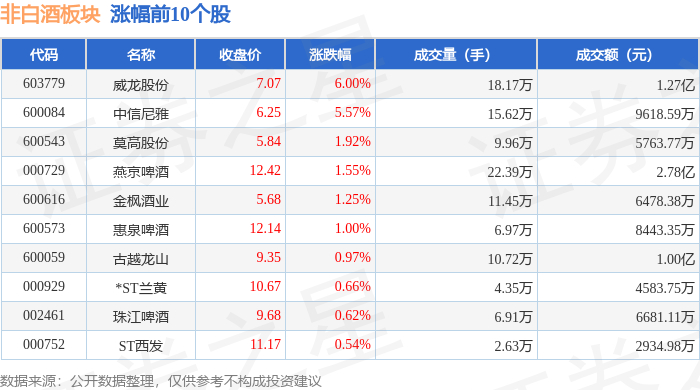
Core Viewpoint - The non-baijiu sector experienced a 0.72% increase on January 22, with Weilong Co., Ltd. leading the gains, while the Shanghai Composite Index rose by 0.14% and the Shenzhen Component Index increased by 0.5% [1] Group 1: Market Performance - The closing price of Weilong Co., Ltd. was 7.07, with a rise of 6.00% and a trading volume of 181,700 shares, amounting to a transaction value of 127 million yuan [1] - Other notable performers included CITIC Neya with a closing price of 6.25, up 5.57%, and Mogaoguan Co. at 5.84, up 1.92% [1] - The overall trading volume in the non-baijiu sector showed varied performance, with some stocks like Feike Beer and Jinfeng Wine also recording positive gains [1] Group 2: Capital Flow - The non-baijiu sector saw a net outflow of 18.218 million yuan from institutional investors and 35.8685 million yuan from retail investors, while there was a net inflow of 54.0864 million yuan from individual investors [2] - The capital flow data indicates that while institutional and speculative funds withdrew, retail investors were actively buying into the sector [2] Group 3: Individual Stock Analysis - Chongqing Beer experienced a net outflow of 16.9419 million yuan from institutional investors, while retail investors contributed a net inflow of 1.2597 million yuan [3] - Weilong Co., Ltd. had a net inflow of 14.4287 million yuan from institutional investors, but faced a net outflow of 1.19562 million yuan from retail investors [3] - Qingdao Beer saw a net inflow of 11.5279 million yuan from institutional investors, indicating strong institutional interest despite retail outflows [3]




燕京啤酒:预计2025年净利润同比增长50.00%至65.00%
Jing Ji Guan Cha Wang· 2026-01-22 02:55
Core Viewpoint - Yanjing Beer (000729) is expected to report a net profit of 1.584 billion to 1.742 billion yuan for the year 2025, representing a year-on-year growth of 50.00% to 65.00% [1] Financial Performance - The net profit excluding non-recurring gains and losses is projected to be between 1.457 billion and 1.561 billion yuan, indicating a year-on-year increase of 40.00% to 50.00% [1]
燕京啤酒8元啤酒助力净利增逾50% 年投近16亿推进品牌“三化”建设
Chang Jiang Shang Bao· 2026-01-22 00:05
Core Viewpoint - Yanjing Beer is experiencing rapid growth in its operating performance, with a projected net profit of 1.584 billion to 1.742 billion yuan for 2025, representing a year-on-year increase of 50% to 65% [1][6]. Group 1: Financial Performance - The net profit for 2025 is expected to mark the fifth consecutive year of growth since 2021, with a significant increase in profitability [2][8]. - The company anticipates a non-recurring net profit of approximately 1.457 billion to 1.561 billion yuan for 2025, reflecting a year-on-year growth of 40% to 50% [6]. - Historical revenue figures show consistent growth from 11.961 billion yuan in 2021 to 14.667 billion yuan in 2024, with net profits increasing from 228 million yuan to 1.056 billion yuan during the same period [7]. Group 2: Strategic Initiatives - Yanjing Beer is committed to a big product strategy, focusing on the Yanjing U8, which is priced at 8 yuan, and is experiencing steady growth [3][9]. - The company is optimizing its product matrix, which includes a three-tier structure of "mid-to-high-end + mid-range + regional specialties" [4]. - Yanjing Beer is actively pursuing brand modernization through a strategy of "youthfulness, fashion, and premiumization," alongside a gradient market development strategy [11][12]. Group 3: Market Trends - The beer industry is witnessing a shift, with the 8 yuan price range becoming increasingly profitable, as it replaces traditional low-priced products [10]. - Yanjing Beer is benefiting from this trend by focusing on the most lucrative price segment, which has contributed to its substantial profits [10]. - The company is also expanding its market presence and sales channels, adapting to changing consumer preferences towards personalized and scenario-based consumption [12]. Group 4: Cost Management - Sales expenses for Yanjing Beer have remained stable at around 1.6 billion yuan over recent years, indicating effective cost management [5][13]. - The company has maintained a consistent advertising budget of approximately 500 million yuan annually from 2021 to 2024 [12]. Group 5: Diversification - Yanjing Beer is diversifying its product offerings beyond beer, incorporating beverages into its marketing strategy to create a multi-dimensional market presence [13].
【燕京啤酒(000729.SZ)】改革红利持续释放,土地收储款进一步增厚利润——2025年度业绩预告点评(陈彦彤/汪航宇/聂博雅)
光大证券研究· 2026-01-21 23:07
Core Viewpoint - The company expects a significant increase in net profit for 2025, driven by both operational improvements and additional income from land reserve payments [4][5]. Group 1: Financial Performance - The company forecasts a net profit attributable to shareholders of 1.584 to 1.742 billion yuan for 2025, representing a year-on-year growth of 50% to 65% [4]. - The expected net profit excluding non-recurring items is projected to be between 1.457 to 1.561 billion yuan, indicating a growth of 40% to 50% [4]. - For Q4 2025, the company anticipates a net loss attributable to shareholders ranging from 29 million to 187 million yuan [4]. Group 2: Operational Improvements - The rapid growth in net profit is attributed to enhancements in the main business operations and the recognition of land reserve payments, which contribute approximately 132 million yuan to net profit [5]. - The company has maintained a net profit growth rate exceeding 50% for four consecutive years, significantly outperforming the industry average [5]. - The net profit margin for the first three quarters of 2025 is reported at 15.32%, which is still below the industry average, but improvements are expected as reforms progress [5]. Group 3: Product and Channel Strategy - In response to a slowing beer production growth rate, the company is optimizing its product structure and sales channels, focusing on high-end and youth-oriented strategies [6]. - The flagship product, Yanjing U8, continues to see rapid sales growth, becoming a key driver of revenue [6]. - The company is implementing a three-tier product architecture that includes high-end, mid-range, and regional specialty products, alongside differentiated offerings like non-alcoholic beer and beverage combinations [6]. - The channel strategy emphasizes "full-channel integration and regional deep cultivation," with initiatives like the "Hundred Cities Project" to tap into strong market potential and accelerate expansion into emerging markets [6].