
Yanjing Brewery(000729)

Search documents
中金:2025年线下渠道表现整体承压 零食、饮料健康化趋势显著
Zhi Tong Cai Jing· 2026-01-14 07:41
Core Insights - The overall sales performance of offline channels in the food and beverage sector is under pressure for the period of January to December 2025, with notable differentiation in the soft drink industry across various segments [1] - Functional beverages and ready-to-drink juices are maintaining high single-digit growth, while the snack food category shows strong growth in konjac products and healthy snacks [1] Beverage Sector - Beer sales are under pressure with a year-on-year decline of 6.7% in sales for January to December 2025, although average prices continue to rise [2] - Ready-to-drink cocktails have seen a cumulative year-on-year sales decline of 9.9%, while the market share of the brand Rio remains stable [2] - The soft drink industry shows varied performance across segments, with functional beverages experiencing a year-on-year sales increase of 9.3% and ready-to-drink juices seeing an average price increase of 7.8% [2] Dairy Products - The demand for dairy products continues to face pressure, although there is a quarter-on-quarter improvement in Q4 2025 [2] - Leading dairy companies are performing relatively well in the low-temperature yogurt segment, which is positively impacting overall yogurt performance compared to the broader dairy market [2] Condiments and Snacks - Basic condiments prioritize price, with leading brands continuing to capture market share [3] - The performance of spicy snack foods shows significant differentiation, with konjac products and certain specialty items providing crucial support [3] - Healthy snacks are experiencing notable growth, while the nut and dried fruit category is under pressure due to the timing of the Spring Festival affecting December sales [3] - Sweet snacks are generally underperforming, with widespread year-on-year declines [3] Frozen Foods - Hot pot ingredients are showing a trend of volume growth with stable prices, while competition remains fierce in the frozen dumpling and tangyuan markets [3] - By December 2025, the frozen food sector enters a peak stocking phase, with hot pot ingredients, frozen prepared foods, and frozen snacks achieving year-on-year growth, while frozen dumplings and tangyuan continue to face pressure [3] Recommendations - Recommended stocks in the A-share market include Anjuke Food, Yanjinpuzi, New Dairy, Ximai Food, Yanjing Beer, Dongpeng Beverage, Yili Group, Qianhe Flavor, and Haitian Flavor [4] - Recommended stocks in the H-share market include Weilong, Gu Ming, Master Kong, Uni-President China, Nongfu Spring, China Resources Beer, Mengniu Dairy, and Qingdao Beer [4]





顺义聚焦文旅+工业,拓展燕京啤酒、理想汽车加入工业游
Xin Jing Bao· 2026-01-13 10:08
截至2025年三季度,顺义区旅游接待1190万人次,旅游收入132.1亿元,同比增长4.4%和10.3%。 顺义区是制造业大区,有很多大家耳熟能详的工业品牌,2025年,顺义区已经成功将牛栏山二锅头酒文 化苑、"爱慕"时尚工厂以及北汽越野智能工厂,这三个点作为北京市工业旅游示范项目。今年,顺义区 将在工业旅游项目上发力,深化"文旅+工业",开发兼具观光与互动的工业时尚旅游项目。 此外,依托新国展展会资源,聚焦"会、展、食、宿、娱、游、购"全链条服务,顺义区将紧抓车展等热 门大展,升级推出"会展票根"多元化叠加举措,联动周边景点、酒店、旅游新业态等,推出"观展+游 玩"套餐,进一步提升游客消费体验,实现会展人流向文旅消费高效转化,利用会展经济与文旅的双向 赋能。 顺义区委宣传部分管日常工作的副部长、区文化和旅游局党组书记、局长卢海珀透露,2026年,顺义区 还将拓展公共文化空间,持续打造一批"类博物馆"、演艺新空间、"城市会客厅"等新型公共文化场所, 同时营造多元开放创作环境,计划全年引进精品演出不少于45场,开展群众文化活动3000场以上,带动 优质资源集聚荟萃。 新京报讯(记者耿子叶)1月13日,记者从顺义 ...
食品饮料行业周报:食品价格继续改善,消费潜力不断释放-20260113
Donghai Securities· 2026-01-13 09:17
Investment Rating - The report assigns an "Overweight" rating for the food and beverage industry, indicating a positive outlook for the sector relative to the broader market [1]. Core Insights - The report highlights that the Consumer Price Index (CPI) in December 2025 reached its highest year-on-year increase since March 2023, with food prices continuing to improve. This is attributed to policies aimed at boosting domestic demand and increased consumer spending during the New Year period [5][48]. - The food and beverage sector saw a 2.12% increase in the market last week, underperforming the CSI 300 index by 0.66 percentage points, ranking 26th among 31 sectors [10]. - Key companies such as Sam's Club and Alibaba are expanding aggressively, with Sam's Club projected to exceed 140 billion yuan in sales for 2025, marking a 40% increase from 2024 [48]. Summary by Sections 1. Market Performance - The food and beverage sector's performance was highlighted, with a 2.12% increase last week, while the pre-processed food sub-sector performed particularly well with a 6.72% increase [10][13]. - The top five performing stocks included Qianwei Yangchun, Anji Food, and Yangyuan Beverage, with respective increases of 22.52%, 18.34%, and 14.78% [10][15]. 2. Price Trends - The report notes that food prices have shown significant increases, particularly in fresh vegetables and fruits, which rose by 18.2% and 4.4% year-on-year, respectively [5]. - The price of milk was reported at 12.17 yuan per liter, with a slight year-on-year decrease of 0.16% [26]. 3. Industry Dynamics - The report discusses the expansion of membership supermarkets and instant retail, with notable growth in companies like Sam's Club and Alibaba's Taobao Flash Sale [48][49]. - The government is implementing a comprehensive policy to stimulate domestic demand, focusing on enhancing consumer spending and supporting private investment [49]. 4. Core Company Updates - New Dairy announced a cash dividend of 0.70 yuan per share, while Fuling Pickled Vegetables and Luzhou Laojiao also declared significant cash dividends [51].



啤酒行业专题报告:渠道变革,精酿崛起
GUOTAI HAITONG SECURITIES· 2026-01-13 05:15
Investment Rating - The report rates the beer industry as "Buy" [1] Core Insights - The beer industry is entering a new normal characterized by stock competition, with structural opportunities arising from category and channel changes. The demand for beer in China has been gradually declining in 2023, and it is expected to follow a long-term downward trend similar to overseas experiences. The average selling price (ASP) of leading companies is projected to increase by only 0.4% in 2024 due to weaker-than-expected demand recovery and inflation decline [4][7] - The rise of craft beer represents a significant opportunity for the industry, with leading companies likely to benefit from this trend. The penetration rate of craft beer in China is estimated to be around 3%, which is still significantly lower than the 5-15% levels seen in developed countries [4][20] - New retail channels are rapidly growing, driven by consumer demands for convenience, rationality, and differentiation. The estimated sales of beer through new retail channels are around 30 billion yuan, with a penetration rate of approximately 6% and an annual growth rate of about 20% [4][61] Summary by Sections 1. Industry New Phase: Stock Era, Channel Change, Craft Beer Rise - The beer industry in China is experiencing a new normal with both volume and price entering a downward trend. The production volume is expected to decline by 0.4% in 2023 and 1.0% in 2024 [7][4] - The concentration of leading companies is expected to decrease slightly, with the CR5 ratio projected to drop by 3.5 percentage points to around 74.8% in 2024 [14][4] 2. Category Change: Demand Shift Creates Opportunities, Large Companies to Benefit - The demand for beer in China is at a turning point, with potential for big single product opportunities. The younger generation is becoming the main consumer group, leading to a shift in drinking culture towards personal preference [23][24] - The craft beer market is expected to grow significantly, with an estimated annual growth rate in sales exceeding double digits. The penetration rate of craft beer is projected to reach around 3% by 2025 [29][30] 3. Channel Change: Demand Stock Competition, Impact on Structure Manageable - The structure of beer distribution channels is changing, with a decline in traditional on-premise sales and an increase in new retail channels. The new retail channel is expected to account for about 6% of total beer sales, with significant growth in instant retail and membership warehouse stores [56][61] - The rapid growth of new retail channels is driven by improved logistics efficiency and changing consumer preferences for convenience and differentiated products [57][61]



燕京啤酒:截至2026年1月9日股东总户数为45767户
Zheng Quan Ri Bao Wang· 2026-01-12 12:45
证券日报网讯1月12日,燕京啤酒(000729)在互动平台回答投资者提问时表示,截至2026年1月9日, 公司股东总户数为45767户。 ...
187家公司公布最新股东户数
Zheng Quan Shi Bao Wang· 2026-01-12 09:58
187只股公布截至1月10日最新股东户数,相比上期股东户数下降的有81只,降幅居前的是亚翔集成、燕 京啤酒、浙江华远等。 其次是燕京啤酒,截至1月10日最新股东户数为45767户,较12月31日下降16.65%,筹码集中以来该股 累计上涨7.48%,累计换手率为8.37%,其间主力资金净流出8696.71万元。 市场表现方面,最新一期筹码集中股1月1日以来平均上涨3.93%,涨幅居前的有亚翔集成、联发股份、 图南股份等,分别上涨30.46%、25.91%、13.28%。所属行业来看,筹码集中股中汽车、机械设备、电 子等行业最为集中,分别有10只、9只、6只个股上榜。 最新筹码集中股业绩 投资者除了在定期报告中获得股东信息数据外,还可以在交易所互动平台上通过提问方式了解部分公司 更及时(每月10日、20日、月末)的股东户数信息。以往3期分别有878家、1052家、1032家公司在互动 平台透露了股东户数,截至发稿,共有187家公司公布了截至1月10日股东户数。 上期筹码集中股回测:42%跑赢沪指 证券时报·数据宝对上一期(12月31日)筹码集中股监测显示,这些股12月21日以来平均上涨7.76%,走势 强于同期 ...

燕京啤酒涨2.00%,成交额2.30亿元,主力资金净流出661.48万元
Xin Lang Cai Jing· 2026-01-07 05:35
Core Viewpoint - Yanjing Beer has shown a positive stock performance with an 8.99% increase year-to-date and a 2.00% increase on January 7, 2025, indicating strong market interest and potential growth in the beverage sector [1]. Group 1: Stock Performance - As of January 7, 2025, Yanjing Beer shares rose by 2.00% to 12.24 CNY per share, with a trading volume of 2.30 billion CNY and a market capitalization of 34.499 billion CNY [1]. - The stock has increased by 8.99% since the beginning of the year, with a 5-day increase of 8.70%, a 20-day decrease of 0.81%, and a 60-day increase of 1.58% [1]. Group 2: Financial Performance - For the period from January to September 2025, Yanjing Beer reported a revenue of 13.433 billion CNY, reflecting a year-on-year growth of 4.57%, and a net profit attributable to shareholders of 1.770 billion CNY, which is a 37.45% increase compared to the previous year [2]. - The company has distributed a total of 4.791 billion CNY in dividends since its A-share listing, with 1.325 billion CNY distributed over the last three years [3]. Group 3: Shareholder Structure - As of December 31, 2025, Yanjing Beer had 54,900 shareholders, an increase of 23.76% from the previous period, with an average of 45,705 circulating shares per shareholder, a decrease of 19.20% [2]. - The second-largest shareholder, Hong Kong Central Clearing Limited, holds 74.576 million shares, a decrease of 21.016 million shares from the previous period [3].
年度投资策略报告:底部向阳,寻找结构性亮点-20260105
Tai Ping Yang Zheng Quan· 2026-01-05 14:15
Overall Industry Review - The food and beverage sector significantly underperformed the market, with a year-to-date decline of -0.62%, lagging behind the Shanghai Composite Index by 15.0 percentage points [7][11] - The snack sector showed strong performance with a year-to-date increase of 28.88%, driven by channel expansion and a total revenue growth of 30.97% in the first three quarters of 2025 [11] - The beverage sector, particularly soft drinks, benefited from travel demand and low-price, high-frequency consumption, achieving a revenue and profit growth in double digits [11][14] Alcoholic Beverages - The liquor sector exhibited weak performance, with a decline in sales and prices, particularly for white liquor, which saw a year-on-year revenue drop of -5.83% and a net profit decline of -6.93% in the first three quarters of 2025 [11][44] - The overall white liquor sector's revenue decreased by -5.8% and net profit by -6.9% in the first three quarters of 2025, with a significant drop in Q3, where total revenue fell by -18.4% [44] - The report indicates that the white liquor industry is in a prolonged adjustment phase, with the current downturn lasting 57 months, marking the longest adjustment period in history [35][40] Future Outlook - The central economic work conference emphasized the importance of boosting domestic demand in 2026, with expectations for policy support to stimulate recovery [3] - The report suggests focusing on sectors with low bases for recovery, such as frozen foods and beverages, which are expected to benefit from demand recovery and new product opportunities [3][4] - The report highlights the potential for structural opportunities in the food and beverage sector, particularly in overseas markets and cost improvements, recommending companies like Anqi Yeast and Mijiu Group for their overseas expansion strategies [4][34] Investment Strategies - The report identifies four key investment themes for 2026: opportunities in overseas markets, cost benefits, new product launches, and value-for-money consumption [4] - Companies with strong platform capabilities and innovative products, such as Dongpeng Beverage and Wancheng Group, are recommended for their potential in the beverage sector [4] - The report also emphasizes the importance of identifying companies that can adapt to a low-inflation, low-confidence environment by offering high-value products [14]




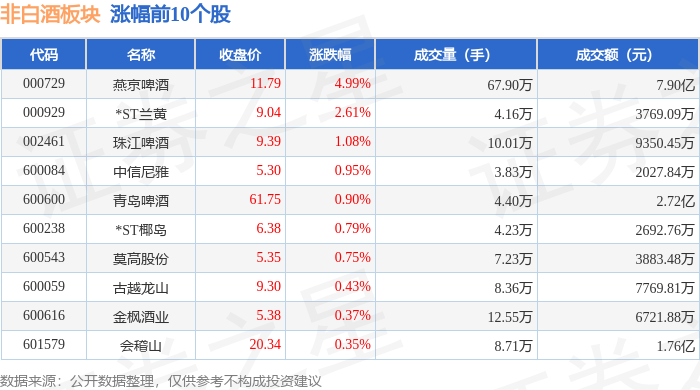
非白酒板块1月5日涨1.26%,燕京啤酒领涨,主力资金净流出5761.27万元
Zheng Xing Xing Ye Ri Bao· 2026-01-05 08:59
Market Overview - The non-liquor sector increased by 1.26% on January 5, with Yanjing Beer leading the gains [1] - The Shanghai Composite Index closed at 4023.42, up 1.38%, while the Shenzhen Component Index closed at 13828.63, up 2.24% [1] Stock Performance - Wujing Beer (000729) closed at 11.79, up 4.99% with a trading volume of 679,000 shares and a transaction value of 790 million yuan [1] - ST Lanhua (000929) closed at 9.04, up 2.61% with a trading volume of 41,600 shares and a transaction value of 37.69 million yuan [1] - Zhujiang Beer (002461) closed at 9.39, up 1.08% with a trading volume of 100,100 shares and a transaction value of 93.50 million yuan [1] - Other notable stocks include Chongqing Beer (600132) at 52.39, up 0.29%, and Huichuan Beer (600573) at 11.92, down 0.08% [2] Capital Flow - The non-liquor sector experienced a net outflow of 57.61 million yuan from institutional investors, while retail investors saw a net inflow of 86.47 million yuan [2] - The main capital inflow and outflow for specific stocks include: - Huichuan Beer had a net inflow of 14.29 million yuan from institutional investors [3] - Kuaijishan (601579) saw a net outflow of 22.50 million yuan from speculative funds but a net inflow of 17.31 million yuan from retail investors [3] - Zhujiang Beer had a net inflow of 4.08 million yuan from institutional investors [3]


国泰海通晨报-20260105
国泰海通· 2026-01-05 05:41
Macro Research - The recovery momentum in consumption is strong, but investment and production still require further policy support [2] - The A-share market is expected to welcome a "spring opening red" as policy expectations, liquidity, and fundamentals resonate positively [2] - The price signals indicate that industrial prosperity is beginning to emerge and continue [2] Strategy Research - The A-share market closed 2025 at 3968.84 points, with an annual increase of 18.41%, confirming the strategic judgment made by Guotai Junan [3] - The market is anticipated to stabilize and appreciate due to the upcoming announcement of the new Federal Reserve chairman and expectations of U.S. interest rate cuts in 2026 [3][24] - The decision-makers have emphasized the need to "promote investment stabilization," indicating a potential increase in policy support for growth [3][24] Food and Beverage Research - Yanjing Beer shows strong reform momentum, with significant potential for national expansion of its U8 product line, expected to exceed 1.5 million tons in the future [3][8] - The company is expected to enhance its product structure and profitability through the expansion of high-priced products above 10 yuan [8][9] - The beer industry is stabilizing, with leading companies like Yanjing benefiting from structural upgrades and improved profit margins [8][9] Industry Comparison - The report highlights a favorable outlook for technology, non-bank financials, and consumer sectors, driven by the industrialization of emerging markets and the AI trend [6][27] - The technology sector is expected to benefit from global chip technology breakthroughs and rising storage prices, with domestic infrastructure shortages accelerating the pace of domestic production [6][27] - Non-bank financials are poised to gain from increased wealth management demand and capital market reforms, while cyclical stocks are seen as bottoming out and benefiting from domestic demand expansion [6][27]