Yanjing Brewery(000729)

Search documents
食品饮料周报(25年第44周):基本面左侧寻底,关注下游消费场景恢复-20251201
Guoxin Securities· 2025-12-01 09:11
Investment Rating - The report maintains an "Outperform the Market" rating for the food and beverage sector [4][5][15]. Core Views - The food and beverage sector is expected to see a recovery in consumer demand as the year-end approaches, with a positive outlook for 2026 [3][10]. - The report highlights a differentiation in the performance of various sub-sectors, with beverages outperforming food and alcoholic beverages [2][10]. - Key investment opportunities are identified in leading companies within the sector, particularly those with strong growth potential and market positioning [3][10][15]. Summary by Relevant Sections 1. Sector Overview - The food and beverage sector has shown a slight increase of 0.03% this week, with A-shares remaining flat and H-shares up by 0.47% [1]. - The top performers in the sector include Hai Xin Food, Jia Long Co., and Yan Tang Dairy, with significant weekly gains [1]. 2. Sub-sector Analysis - **Alcoholic Beverages**: The report indicates that the liquor sector is in a bottoming phase, with premium brands like Moutai and Luzhou Laojiao expected to gain market share [2][10]. - **Beverages**: The beverage sector is experiencing stable demand recovery, with leading companies like Nongfu Spring and Dongpeng Beverage recommended for investment [2][14]. - **Food**: The snack segment is highlighted for its growth potential, particularly in konjac products, with companies like Wei Long and Yan Jin Pu Zi recommended [2][11]. 3. Investment Recommendations - The recommended investment portfolio includes Moutai, Baba Foods, Dongpeng Beverage, Wei Long, and Luzhou Laojiao, reflecting a diverse range of opportunities across the sector [3][15]. - The report emphasizes the importance of focusing on companies with strong fundamentals and growth trajectories, particularly in the context of changing consumer preferences and market dynamics [2][10][15]. 4. Earnings Forecasts - Earnings forecasts for key companies indicate a positive growth trajectory, with Moutai expected to achieve revenues of approximately 183.5 billion yuan by 2027, reflecting a compound annual growth rate [4][15]. - Other companies like Dongpeng Beverage and Baba Foods are also projected to see significant revenue growth, driven by market expansion and product innovation [15][17].






国投证券:食品饮料行业迎来基本面与估值双重复苏机遇
智通财经网· 2025-11-26 09:13
Core Viewpoint - The report from Guotou Securities emphasizes the importance of consumption in economic growth, predicting a stabilization in the consumption fundamentals in 2026, which presents a significant opportunity for investment in the food and beverage industry [1] Group 1: Alcohol Industry - The liquor sector is at a cyclical bottom, with low expectations, low holdings, and low valuations, suggesting potential for left-side layout opportunities [2] - The rapid clearing of financial reports in the past two quarters indicates a resolution of supply-demand conflicts, with a gradual recovery in household consumption expected [2] - The white liquor business model remains strong, and with a potential economic recovery, valuations are likely to rebound quickly [2] Group 2: Beer Industry - The beer sector is expected to maintain a structural market in 2026, with investment opportunities in companies with strong single-product growth logic and those benefiting from competitor adjustments [3] - Overall profitability in the beer sector is on an upward trend, driven by the expansion of products priced between 8-10 yuan and improved efficiency from lean management [3] Group 3: Dairy Industry - The dairy sector is positioned for a turnaround in the raw milk cycle in 2026, with a focus on the profitability elasticity of the dairy supply chain [4] - Demand for dairy products has shown differentiation, with low-temperature fresh milk and cheese experiencing healthy growth, while room temperature liquid milk has been a drag [4] - The average milk price in major production areas is expected to recover above the average cost of production in 2026, making it an opportune time to invest in the dairy supply chain [4] Group 4: Soft Drink Industry - The soft drink sector has seen significant performance differentiation, with companies in strong growth categories leading the industry [5] - In 2026, there is a focus on functional beverages and the competitive landscape of packaged water, with an emphasis on companies introducing new products [5] - The demand for low-sugar functional beverages is anticipated to grow, particularly among white-collar workers seeking fatigue-relief options [5] Group 5: Snack Industry - The snack sector is benefiting from strong new channel drivers, with expectations of improved gross and net profit margins due to scale effects [6] - The konjac product category is maintaining high market interest, with significant growth potential in China [6] - Investment recommendations include focusing on companies with strong performance during the adjustment period and those with leading products in the snack sector [6]




食品饮料行业双周报:CPI同比转正,食饮板块预期修复-20251124
Guoyuan Securities· 2025-11-24 02:43
Investment Rating - The report maintains a "Recommended" investment rating for the food and beverage industry [4] Core Insights - The food and beverage sector in A-shares has shown a 1.34% increase over the past two weeks, outperforming major indices such as the Shanghai Composite Index by 5.41 percentage points [12] - The Consumer Price Index (CPI) turned positive in October, with a year-on-year increase of 0.2%, indicating a potential recovery in consumer sentiment [3][62] - The report highlights a structural shift in dairy imports towards high-value products, driven by changing consumer preferences for low-fat, high-protein, and organic options [7][62] Summary by Sections 1. Market Review - A-shares in the food and beverage industry rose by 1.34% from November 10 to November 21, outperforming the Shanghai Composite Index by 5.41 percentage points [12] - Within the sector, dairy (+6.67%), processed foods (+2.60%), and liquor (+2.52%) saw the highest gains, while soft drinks (-4.27%), health products (-2.25%), and snacks (-1.02%) experienced declines [12] 2. Key Data Tracking - The average price of fresh milk in major production areas is 3.03 yuan/kg, down 2.9% year-on-year [39] - The national market price for pork is 23.13 yuan/kg, reflecting a year-on-year decrease of 19.7% [44] - The price of PET (water bottle grade) is 6,100 yuan/ton, down 3.9% year-on-year [44] 3. Key Events Tracking - The October CPI data showed a year-on-year increase of 0.2%, with food prices decreasing by 2.9% [3][62] - Retail sales in October grew by 2.9% year-on-year, with significant increases in the sales of grain, oil, and beverages [3][62] - Dairy imports have returned to positive growth, driven by strong demand for high-end products [7][62] 4. Important Company Announcements - Yili Group plans to maintain a cash dividend payout ratio of no less than 75% over the next three years [63] - Huangtai Liquor's major shareholder intends to increase their stake in the company through market purchases [63] 5. Investment Recommendations - For liquor, focus on high-end brands with strong market positions such as Kweichow Moutai and Wuliangye [8][65] - In the consumer goods sector, consider companies in the snack and energy drink markets, as well as those benefiting from the recovery of the dairy and restaurant supply chains [8][65]

燕京啤酒最新股东户数环比下降16.15% 筹码趋向集中
Zheng Quan Shi Bao Wang· 2025-11-21 12:21
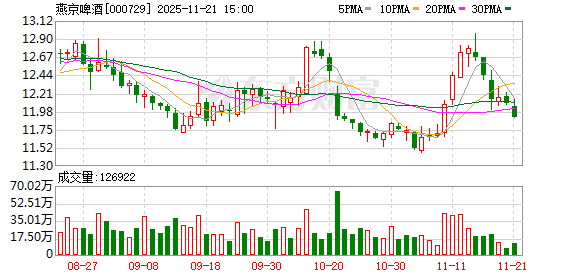
Core Viewpoint - Yanjing Beer has reported a significant decrease in the number of shareholders, indicating potential concerns regarding investor confidence and stock performance [2] Shareholder Information - As of November 20, the number of shareholders for Yanjing Beer was 43,651, a decrease of 8,409 from the previous period (November 10), representing a decline of 16.15% [2] - This marks the second consecutive period of decline in the number of shareholders [2] Stock Performance - The closing price of Yanjing Beer on November 20 was 11.91 yuan, down 1.41%, with an overall decline of 1.33% since the concentration of shares began [2] - The stock experienced 4 days of increases and 5 days of decreases during this period [2] Financing and Margin Data - As of November 20, the margin trading balance for Yanjing Beer was 171 million yuan, with a financing balance of 166 million yuan [2] - The financing balance has decreased by 49.07 million yuan, reflecting a decline of 22.83% since the concentration of shares began [2] Financial Performance - In the first three quarters, Yanjing Beer achieved a revenue of 13.433 billion yuan, representing a year-on-year growth of 4.57% [2] - The net profit for the same period was 1.770 billion yuan, showing a year-on-year increase of 37.45% [2] - The basic earnings per share were 0.6281 yuan, with a weighted average return on equity of 11.62% [2] Institutional Ratings - Over the past month, Yanjing Beer has received buy ratings from 21 institutions [2] - The highest target price set by Huatai Securities is 16.75 yuan, as reported on October 21 [2]

燕京啤酒:截至2025年11月20日,公司股东总户数为43651户
Zheng Quan Ri Bao Wang· 2025-11-21 09:43
Core Viewpoint - Yanjing Beer (000729) reported on November 21 that as of November 20, 2025, the total number of shareholders is 43,651 [1] Summary by Category - Company Information - Yanjing Beer has a total of 43,651 shareholders as of the specified date [1]
加速出清行业寻底,预期先行板块启动
East Money Securities· 2025-11-19 06:56
Investment Highlights - The report indicates a clear turning point for the food and beverage industry following accelerated clearance, with expectations for leading sectors to initiate recovery [2][7] - The overall revenue for the food and beverage sector showed a slight increase of 0.2% year-on-year, while net profit decreased by 4.6% in the first three quarters of 2025 [18][20] - In Q3 2025, the sector experienced a significant decline, with revenues and net profits dropping by 4.9% and 14.6% respectively [18][20] Sector Review 1. Overall Review - The food and beverage sector faced continuous pressure and adjustments, with traditional consumption accelerating clearance while new consumption trends continued to grow [18][20] - The white liquor segment saw a revenue decline of 18.4% and a net profit decline of 22.2% in Q3 2025, indicating significant pressure on the sector [20][22] - In contrast, sectors like snacks and beverages maintained double-digit growth due to product and channel innovations [20][21] 2. White Liquor - The white liquor industry is undergoing accelerated clearance, with varying rhythms among companies. The demand has weakened, leading to noticeable declines in revenue and net profit for most companies [22][25] - High-end liquor maintained some growth, with Moutai achieving a revenue increase of 0.3% in Q3 2025, while other brands like Wuliangye saw declines exceeding 50% [23][25] - The report emphasizes the importance of supply-demand balance and pricing as key indicators for the industry's recovery [22][23] 3. Low-Alcohol Beverages and Drinks - The beer segment showed stable performance with a revenue increase of 2.0% and a net profit increase of 11.8% in the first three quarters of 2025 [21][22] - The report highlights the potential for recovery in demand for low-alcohol beverages and drinks, driven by health trends and product innovation [22][23] 4. Consumer Goods - The dairy sector is gradually stabilizing, with upstream supply clearing and downstream processing demand increasing, leading to a potential balance in the raw milk cycle [31][33] - The snack sector, particularly the konjac and oat categories, is expected to maintain high growth rates, supported by the expansion of new retail channels [31][36] - The report notes that the overall demand for dining remains weak, but specific segments like Western-style condiments and frozen baking show structural opportunities [31][33] Investment Recommendations - The report suggests focusing on companies that are early in their clearance processes and have strong brand momentum, such as Gujing Gongjiu and Luzhou Laojiao [11][12] - For low-alcohol beverages, attention is drawn to leading companies like Kweichow Moutai and Tsingtao Brewery, which are expected to benefit from demand recovery [11][12] - In the consumer goods sector, companies with strong performance and cost advantages, such as Yili and Modern Dairy, are recommended for investment [11][12]



2025年1-9月中国啤酒产量为3095.2万千升 累计增长3.7%
Chan Ye Xin Xi Wang· 2025-11-19 03:56
Core Viewpoint - The report highlights the growth of China's beer production, indicating a positive trend in the industry with a year-on-year increase in production volume. Industry Summary - As of September 2025, China's beer production reached 3.04 million kiloliters, reflecting a year-on-year growth of 3.1% [1] - From January to September 2025, the cumulative beer production in China was 30.952 million kiloliters, showing a cumulative growth of 3.7% [1] Company Summary - Listed companies in the beer industry include Zhujiang Beer (002461), Chongqing Beer (600132), Yanjing Beer (000729), Lanzhou Yellow River (000929), and Huichuan Beer (600573) [1] - The report by Zhiyan Consulting provides insights into the non-alcoholic beer market dynamics and competitive strategies from 2025 to 2031 [1]


非白酒板块11月18日跌0.95%,燕京啤酒领跌,主力资金净流出1.09亿元
Zheng Xing Xing Ye Ri Bao· 2025-11-18 08:04
Market Overview - The non-liquor sector experienced a decline of 0.95% on November 18, with Yanjing Beer leading the drop [1] - The Shanghai Composite Index closed at 3939.81, down 0.81%, while the Shenzhen Component Index closed at 13080.49, down 0.92% [1] Stock Performance - Key stocks in the non-liquor sector showed varied performance, with ST Xifa closing at 12.32, up 0.49%, while other notable declines included Caijing Beer down 2.41% to 12.14 and Huichuan Beer down 2.41% to 12.15 [2] - The trading volume and turnover for selected stocks indicated significant activity, with Chongqing Beer recording a turnover of 1.33 billion and ST Xifa at 47.48 million [1][2] Capital Flow - The non-liquor sector saw a net outflow of 109 million from major funds, while retail investors contributed a net inflow of 115 million [2] - Detailed capital flow data showed that ST Xifa had a net inflow of 671,900 from major funds, while other stocks like ST Yedao experienced significant outflows [3]


从“量大”到“质强” 中国啤酒行业如何实现破局?
Jing Ji Ri Bao· 2025-11-18 05:38
Core Insights - The Chinese beer industry has evolved significantly over the past century, transitioning from traditional brewing to industrial production, and has been the world's largest producer and consumer of beer since 2002 [1][2][3] - The industry is now facing a period of stock competition, with a need for innovation and quality improvement to maintain international competitiveness [1][4] Historical Development - The first Chinese brewery was established in Harbin in 1900, followed by others in major cities, leading to the emergence of local brands [2] - The beer industry saw rapid growth post-1949, with significant expansion in production and variety, particularly after the implementation of the "beer special project" in 1985 [2][3] - By 1993, China surpassed Germany in beer production, and by 2002, it became the world's largest beer producer with a total output of 24.03 million tons [2][3] Market Dynamics - The industry has entered a phase of stock competition since 2013, with a decline in traditional beer demand due to demographic shifts and changing consumer preferences towards healthier options [3][4] - The proportion of consumers aged 60 and above has increased, while the main consumer group (ages 20-40) has decreased, leading to a natural decline in beer production [3] Competitive Landscape - The market is highly concentrated, with major brands like China Resources, Tsingtao, and Yanjing holding over 70% of the market share [4] - Companies are shifting focus from expansion to high-quality development, adapting to new consumer trends and demands [4][5] Consumer Trends - There is a noticeable shift in consumer preferences towards high-end, refined, and diversified beer products, prompting companies to innovate in flavors and marketing strategies [5][6][9] - The rise of craft beer reflects a growing consumer desire for unique flavors and experiences, with many new entrants in the market [12][13] Pricing and Revenue - The average selling price of beer has become a key driver for revenue growth, with companies targeting the premium market segment [8] - Major brands have reported significant growth in mid-to-high-end product sales, indicating a successful transition towards premiumization [8] Sustainability and Innovation - The industry is increasingly focusing on sustainability, with initiatives aimed at reducing carbon emissions and improving water efficiency [21][22][23] - Companies are investing in advanced technologies and practices to enhance production efficiency and environmental responsibility [25][26] Supply Chain Challenges - The beer industry faces challenges related to raw material supply, particularly barley and hops, which are heavily imported [30][35][36] - Efforts are being made to improve domestic production and quality of these essential ingredients to ensure supply chain security [35][36] Future Outlook - The industry is expected to continue evolving with a focus on innovation, quality, and sustainability, aiming to enhance its global competitiveness [37][38] - There is a strong emphasis on cultural branding and international market penetration to elevate the global presence of Chinese beer brands [38]

啤酒业破局
Jing Ji Ri Bao· 2025-11-17 22:10
Core Viewpoint - The Chinese beer industry is transitioning from a phase of rapid growth to one of quality improvement and brand building, driven by changing consumer preferences and market dynamics [3][5][6]. Industry Development - The Chinese beer industry has evolved significantly over the past century, becoming the world's largest producer and consumer of beer since 2002, with a peak production of 50.62 million tons in 2013 [2][4]. - The industry has seen a shift from traditional brewing to industrial production, with major policy support since the 1980s leading to a rapid increase in production capacity and the emergence of numerous regional brands [4][5]. Market Dynamics - The beer market is now characterized by intense competition and a focus on quality over quantity, as traditional beer consumption declines and health-conscious trends rise among consumers [5][6]. - By 2023, the proportion of the population aged 60 and above reached 21.1%, while the main consumer demographic (ages 20-40) decreased from 35% to 28%, indicating a shift in market dynamics [5]. Consumer Trends - There is a growing demand for high-end, diverse, and premium beer products, with companies focusing on innovation and brand differentiation to meet these evolving consumer preferences [10][11][12]. - The rise of craft beer reflects a broader trend towards product differentiation and unique consumer experiences, with major brands entering the craft beer space [14][15]. Strategic Initiatives - Major beer companies are implementing high-end strategies, with products priced above 10 yuan gaining traction, and some brands even entering the ultra-premium market [10]. - Companies are also focusing on product diversification to cater to different consumer segments, with a notable increase in the variety of beer offerings [11][12]. Technological Advancements - The industry is leveraging digital and smart manufacturing technologies to enhance production efficiency and reduce carbon emissions, with companies like Qingdao Beer leading the way in smart factory initiatives [30][31]. - The adoption of instant retail models is reshaping sales channels, allowing for rapid delivery and increased consumer engagement [16][17]. Sustainability Efforts - The beer industry is increasingly focused on achieving carbon neutrality and sustainable practices, with initiatives aimed at reducing water and energy consumption throughout the production process [21][22][23]. - Companies are collaborating with upstream and downstream partners to promote green practices across the entire value chain, including the use of low-carbon packaging and transportation methods [26]. Challenges and Opportunities - The industry faces challenges related to raw material dependency, particularly for barley and hops, which are largely imported, impacting supply chain security [34][35]. - There is a need for innovation in product development to create globally recognized Chinese beer brands, emphasizing the importance of cultural elements in marketing strategies [36][37][38].