Yanjing Brewery(000729)

Search documents
燕京啤酒:截至2025年8月29日公司股东总户数为53481户
Zheng Quan Ri Bao Wang· 2025-09-02 13:14
Group 1 - The company Yanjing Beer (000729) responded to investor inquiries on September 2, indicating that as of August 29, 2025, the total number of shareholders is 53,481 [1]

啤酒旺季平稳,饮料龙头势强
GOLDEN SUN SECURITIES· 2025-09-02 03:26
Investment Rating - The report maintains an "Increase" rating for the food and beverage industry [3][5] Core Insights - The beer sector shows stable performance during peak season, with slight revenue decline but consistent cost benefits contributing to profits [1][9] - The soft drink sector faces intensified competition, yet leading companies continue to demonstrate strong performance [2][17] Summary by Sections Beer Sector - The beer industry achieved total revenue of 879.3 billion CNY in 25H1, a year-on-year decrease of 0.5%, while net profit rose by 5.9% to 152.3 billion CNY [9] - The gross margin improved to 48.1%, up 1.3 percentage points year-on-year, and net margin increased to 18.7%, up 1.2 percentage points [9][15] - The revenue decline is attributed to weak overall demand and diversified consumer preferences, while profit performance remains strong due to cost reductions and structural upgrades [9][10] - Key players like Yanjing and Zhujiang outperformed in revenue and profit growth, while Budweiser Asia faced challenges due to weak channel performance [9][10] Soft Drink Sector - The soft drink industry reported total revenue of 226.4 billion CNY in 25H1, reflecting a year-on-year growth of 7.5%, with net profit increasing by 1.7% to 39.5 billion CNY [17] - The gross margin for the sector was 41.8%, up 0.6 percentage points, while net margin decreased to 17.5%, down 1.0 percentage points [17][22] - Despite fierce competition, leading companies like Dongpeng Beverage and Quanyuan maintained strong growth, while other companies experienced varying degrees of decline [17][18] - In 25Q2, the soft drink sector saw revenue rise to 107.1 billion CNY, a 14.7% increase year-on-year, but profit margins were pressured due to increased competition and spending [18][20] Key Investment Recommendations - The report suggests focusing on companies with strong single products and distribution channels, highlighting high-growth leaders and stable dividend or undervalued stocks [5][6]



和君王明夫:世界酒业王者是怎样炼成的?
Sou Hu Cai Jing· 2025-09-01 10:19
Core Insights - The article emphasizes the potential for individual wine enterprises to rise above current industry challenges through self-initiated efforts and strategic innovation, suggesting that the time has come for China to produce a global wine leader [2][3]. Industry Overview - The global wine industry is characterized by significant competition and evolving market dynamics, with a focus on strategic growth paths for companies transitioning from local to global players [2][3]. - The top ten global wine companies are dominated by beer giants, with Anheuser-Busch InBev leading at $593.8 billion in revenue, followed by Heineken at $402.1 billion and Diageo at $247.4 billion [7][14]. - In contrast, the Chinese wine industry shows a strong dominance of baijiu companies, with seven out of the top ten companies being baijiu producers, highlighting a stark difference from the global trend [14][17]. Company Performance - The top Chinese wine company, Kweichow Moutai, reported revenues of $212.1 billion, making it the second-largest wine company globally by market capitalization [11][17]. - The combined revenue of the top ten Chinese wine companies is approximately $620 billion, which is about 30% of the total revenue of the top ten global wine companies [17]. - The market capitalization of Kweichow Moutai and Wuliangye significantly exceeds that of their global counterparts, indicating a higher valuation in the capital markets [17][18]. Strategic Insights - The article discusses the importance of management consulting, goal decomposition, and process management as critical components for success in the wine industry [2][18]. - The narrative of Anheuser-Busch InBev's rise illustrates the effectiveness of strategic acquisitions and operational efficiencies in building a global brand [19][27]. - Diageo's growth is attributed to a series of strategic acquisitions and a focus on high-end products, showcasing the importance of brand management and market responsiveness [39][50]. Market Trends - The article notes a lack of significant presence for wine companies in the global top rankings, suggesting challenges in scaling production and market share within the wine sector [18]. - The Chinese wine market is characterized by a lack of internationalization, with Moutai's overseas revenue accounting for only 4% of its total, indicating potential growth opportunities in global markets [14][17].





25H1业绩综述:饮料旺销,餐饮链承压
HTSC· 2025-09-01 07:53
Investment Rating - The report maintains an "Overweight" rating for the food and beverage industry [8]. Core Insights - The beverage sector is experiencing strong seasonal sales, with cost benefits offsetting competitive pressures, leading to stable profitability [14][20]. - The dairy sector shows flat demand in the first half of 2025, with expectations for improved performance during the upcoming holiday seasons [27][33]. - The beer sector faced demand pressure in Q2 due to policy factors, but cost benefits have become prominent [3][32]. - The snack food sector is experiencing a slowdown in revenue during the off-season, with leading companies focusing on channel adjustments [4][32]. - The condiment sector shows muted demand, with a focus on adjustments and cost improvements [5][32]. - The frozen food sector continues to face operational pressures, with industry price competition affecting profitability [6][32]. Beverage Sector Summary - The soft drink segment achieved Q2 revenue growth of 22.8% year-on-year, driven by strong travel demand and new product launches [14][25]. - Major raw material prices are declining, contributing to stable profitability despite competitive pressures [20][24]. - Key companies such as Nongfu Spring and Uni-President China are recommended for their robust revenue and profit growth [14][20]. Dairy Sector Summary - The dairy sector reported a revenue increase of 3.5% in Q2, with expectations for demand recovery during the Mid-Autumn and National Day holidays [27][28]. - Leading companies like Yili and Mengniu are highlighted for their improved profitability due to lower raw milk costs [27][33]. - The sector's gross margin improved by 0.9 percentage points year-on-year, indicating a positive trend in profitability [32][33]. Beer Sector Summary - The beer sector's Q2 revenue grew by 1.8%, with profitability supported by cost reductions [3][32]. - Companies like Yanjing Beer and Qingdao Beer are recommended for their strong performance in the premium segment [3][32]. Snack Food Sector Summary - The snack food sector experienced a revenue decline of 0.3% in Q2, with leading companies focusing on inventory management and channel strategies [4][32]. - Companies such as Weidong and Yanjinpuzi are recommended for their potential benefits from category and channel advantages [4][32]. Condiment Sector Summary - The condiment sector saw a revenue increase of 4.5% in Q2, with a focus on channel replenishment and cost improvements [5][32]. - Companies like Haitian Flavoring and Angel Yeast are highlighted for their strong market positions [5][32]. Frozen Food Sector Summary - The frozen food sector reported a revenue increase of 2.6% in Q2, but profitability is under pressure due to intense competition [6][32]. - Companies such as Anjijia and Lihai Foods are recommended for their potential recovery in the upcoming seasons [6][32].



非白酒板块8月27日跌1.7%,*ST兰黄领跌,主力资金净流出2.83亿元
Zheng Xing Xing Ye Ri Bao· 2025-08-27 08:43
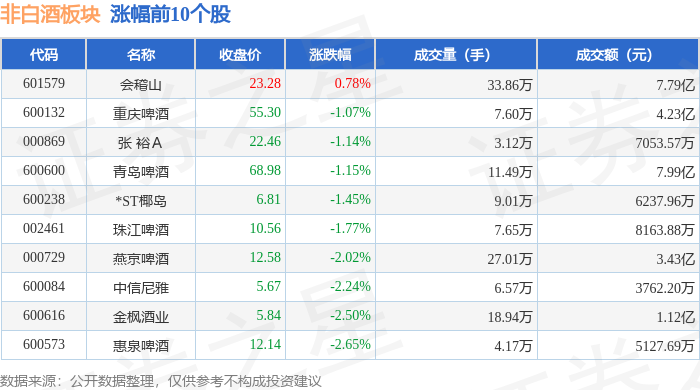
Market Overview - On August 27, the non-liquor sector declined by 1.7% compared to the previous trading day, with *ST Lanhuang leading the decline [1] - The Shanghai Composite Index closed at 3800.35, down 1.76%, while the Shenzhen Component Index closed at 12295.07, down 1.43% [1] Stock Performance - Key stocks in the non-liquor sector showed varied performance, with 会稽山 (Kuaijishan) increasing by 0.78% to close at 23.28, while *ST Lanhuang (Lanhuang) fell by 4.47% to close at 8.34 [1][2] - Other notable declines included 重庆啤酒 (Chongqing Beer) down 1.07%, 张裕A (Zhangyu A) down 1.14%, and *ST 椰岛 (Yedao) down 1.45% [1][2] Trading Volume and Capital Flow - The non-liquor sector experienced a net outflow of 283 million yuan from institutional investors, while retail investors saw a net inflow of 298 million yuan [2] - The trading volume for 会稽山 was 338,600 hands with a transaction value of 779 million yuan, while *ST 兰黄 had a trading volume of 57,300 hands and a transaction value of 48.47 million yuan [1][2] Capital Inflow Analysis - In terms of capital inflow, 张裕A had a net inflow of 5.04 million yuan from institutional investors, while *ST 兰黄 saw a significant net outflow of 10.63 million yuan [3] - The data indicates that retail investors were more active in the market, with notable inflows into stocks like *ST 椰岛 and 珠江啤酒 (Zhujiang Beer) [3]


燕京啤酒跌2.02%,成交额2.72亿元,主力资金净流出3709.81万元
Xin Lang Cai Jing· 2025-08-27 06:56
Core Viewpoint - Yanjing Beer has experienced a decline in stock price and significant net outflow of funds, despite a year-to-date increase in stock price and positive revenue and profit growth in the first half of 2025 [1][2]. Financial Performance - For the first half of 2025, Yanjing Beer achieved a revenue of 8.558 billion yuan, representing a year-on-year growth of 6.37% [2]. - The net profit attributable to shareholders reached 1.103 billion yuan, showing a substantial year-on-year increase of 45.45% [2]. Stock Market Activity - As of August 27, Yanjing Beer’s stock price was 12.58 yuan per share, with a market capitalization of 35.457 billion yuan [1]. - The stock has seen a year-to-date increase of 6.16%, but has declined by 1.02% over the last five trading days and 11.22% over the last 60 days [1]. Shareholder Information - As of August 20, the number of shareholders increased to 56,500, a rise of 24.85%, while the average circulating shares per person decreased by 19.91% to 44,439 shares [2]. - The top ten circulating shareholders include significant institutional investors, with Hong Kong Central Clearing Limited being the second-largest shareholder, increasing its holdings by 7.5728 million shares [3]. Dividend Distribution - Yanjing Beer has distributed a total of 4.509 billion yuan in dividends since its A-share listing, with 1.043 billion yuan distributed in the last three years [3].
啤酒企业探索 “啤酒+饮品”战略布局
Zheng Quan Ri Bao· 2025-08-27 00:46
Core Viewpoint - The beer industry is facing intensified competition, prompting companies to explore diversification strategies, particularly the integration of "beer + beverages" as a key focus for growth [1][3]. Group 1: Industry Overview - As of August 19, 2025, seven beer companies listed in A-shares have reported their semi-annual results, with many citing increased competition as a common challenge [1]. - The beer industry is undergoing structural adjustments and transformation, with a reported production volume of 19.044 million kiloliters in the first half of 2025, reflecting a year-on-year decline of 0.3% [3]. Group 2: Company Strategies - Chongqing Beer has accelerated its entry into non-beer categories, launching a fruit-flavored soda, "Tianshan Fresh Fruit Garden," in pilot markets [2]. - Yanjing Beer has introduced its first national beverage product, "Beisite" soda in various flavors, marking its strategic shift towards a dual-driven model of "beer + beverages" [3]. Group 3: Market Insights - Industry experts suggest that beer companies entering the beverage market is a strategic response to changing market conditions, emphasizing the need for new growth avenues [4][5]. - The integration into the beverage sector is seen as a potential source of new revenue, but companies must navigate the complexities of market penetration and differentiation [6][7].
2024年上市公司独董观察:燕京啤酒、*ST椰岛独董郭晓川合计薪酬16.69万元 现任上海大学管理学院教授、博导
Xin Lang Cai Jing· 2025-08-26 07:09
Core Insights - The independent director system is a crucial component of the capital market's foundational structure, aimed at enhancing corporate governance, promoting transparency in information disclosure, and protecting the interests of minority investors [1]. Group 1: Independent Director Activities - Guo Xiaochuan served as an independent director for Yanjing Beer and *ST Yedao, receiving total compensation of 166,900 yuan during 2024 [1]. - During his tenure in 2024, Yanjing Beer held 8 board meetings, 1 shareholders' meeting, and 5 special meetings for independent directors, with Guo participating in all [1]. - Guo voted in favor of all proposals presented at the board meetings of Yanjing Beer without raising any objections [1]. Group 2: *ST Yedao Activities - In 2024, *ST Yedao convened 10 board meetings and 3 shareholders' meetings, with Guo attending all required board meetings and one shareholders' meeting [1]. - Similar to Yanjing Beer, Guo voted in favor of all proposals at *ST Yedao's board meetings without any dissenting votes [1]. Group 3: Guo Xiaochuan's Background - Guo Xiaochuan, born in 1966, has held various independent director positions in multiple listed companies and is a professor at Shanghai University [2]. - He is also a doctoral supervisor and has held teaching positions at Fudan University and Dalian Nationalities University [2].
非白酒板块8月25日涨1.52%,会稽山领涨,主力资金净流入1.81亿元
Zheng Xing Xing Ye Ri Bao· 2025-08-25 08:47
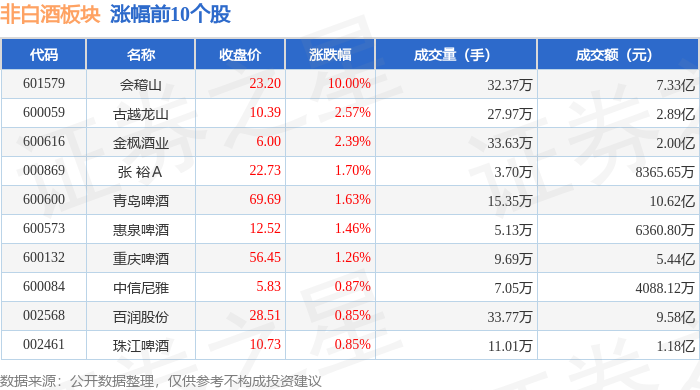
Market Performance - The non-baijiu sector increased by 1.52% on August 25, with Kuaijishan leading the gains [1] - The Shanghai Composite Index closed at 3883.56, up 1.51%, while the Shenzhen Component Index closed at 12441.07, up 2.26% [1] Stock Highlights - Kuaijishan (601579) closed at 23.20, up 10.00% with a trading volume of 323,700 shares and a turnover of 733 million yuan [1] - Guyue Longshan (600059) closed at 10.39, up 2.57% with a trading volume of 279,700 shares and a turnover of 289 million yuan [1] - Jinfeng Wine Industry (600616) closed at 6.00, up 2.39% with a trading volume of 336,300 shares and a turnover of 200 million yuan [1] Capital Flow - The non-baijiu sector saw a net inflow of 181 million yuan from institutional investors, while retail investors experienced a net outflow of 85.13 million yuan [2] - The main stocks with significant capital inflow included Kuaijishan with a net inflow of 127 million yuan, accounting for 17.39% of its trading volume [3] Individual Stock Capital Flow - Kuaijishan had a net inflow of 127 million yuan from main funds, while retail investors saw a net outflow of 72.16 million yuan [3] - Zhirun Co. (002568) experienced a net inflow of 35.89 million yuan from main funds, but a net outflow of 5.45 million yuan from retail investors [3] - Chongqing Beer (600132) had a net inflow of 29.53 million yuan from main funds, with a net outflow of 42.03 million yuan from retail investors [3]


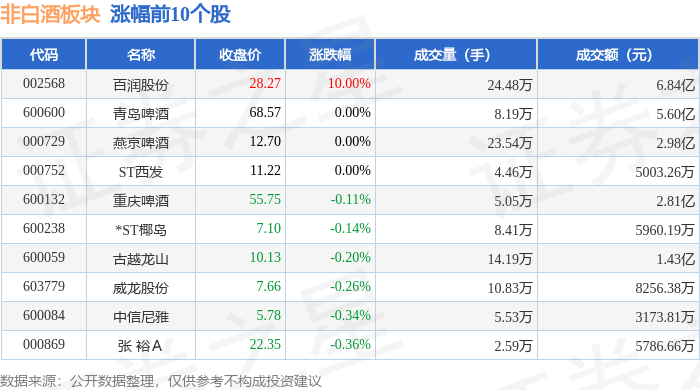
非白酒板块8月22日涨0.42%,百润股份领涨,主力资金净流出4044.01万元
Zheng Xing Xing Ye Ri Bao· 2025-08-22 08:39
Market Overview - On August 22, the non-liquor sector rose by 0.42% compared to the previous trading day, with BaiRun Co., Ltd. leading the gains [1] - The Shanghai Composite Index closed at 3825.76, up 1.45%, while the Shenzhen Component Index closed at 12166.06, up 2.07% [1] Stock Performance - BaiRun Co., Ltd. (002568) closed at 28.27, with a significant increase of 10.00% and a trading volume of 244,800 shares, amounting to a transaction value of 684 million [1] - Other notable stocks included: - GuanFengMingJia (600600) remained unchanged at 68.57 with a trading volume of 81,900 shares [1] - XianJing Beer (000729) also remained unchanged at 12.70 with a trading volume of 235,400 shares [1] - ST XiFa (000752) closed at 11.22, unchanged with a trading volume of 44,600 shares [1] - Chongqing Beer (600132) slightly decreased by 0.11% to 55.75 with a trading volume of 50,500 shares [1] Capital Flow - The non-liquor sector experienced a net outflow of 40.44 million from institutional investors and 74.53 million from retail investors, while there was a net inflow of 115 million from individual investors [2] - The capital flow for specific stocks showed: - BaiRun Co., Ltd. had a net inflow of 164 million from institutional investors, but a net outflow of 81.47 million from retail investors [3] - Zhongxin Niya (600084) had a net inflow of 1.94 million from institutional investors, with a slight outflow from retail investors [3] - ST XiFa (000752) saw a net outflow of 3.26 million from institutional investors, but a net inflow of 472.60 thousand from retail investors [3]