WLY(000858)

Search documents
酒价内参1月22日价格发布 五粮液普五八代上涨5元
Xin Lang Cai Jing· 2026-01-22 01:44
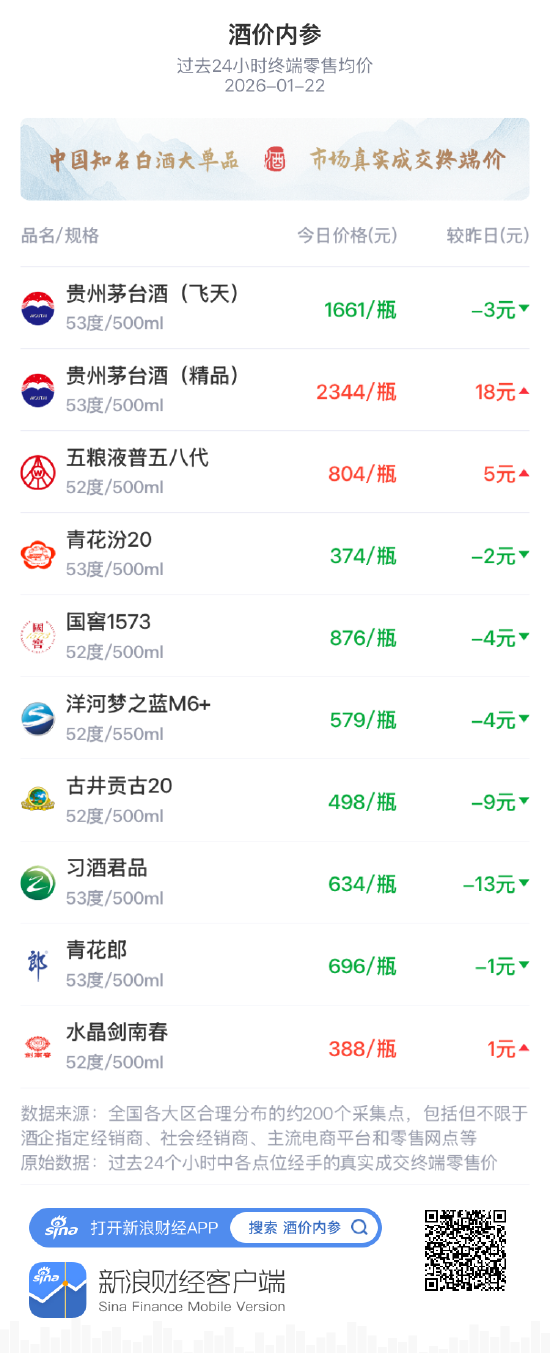
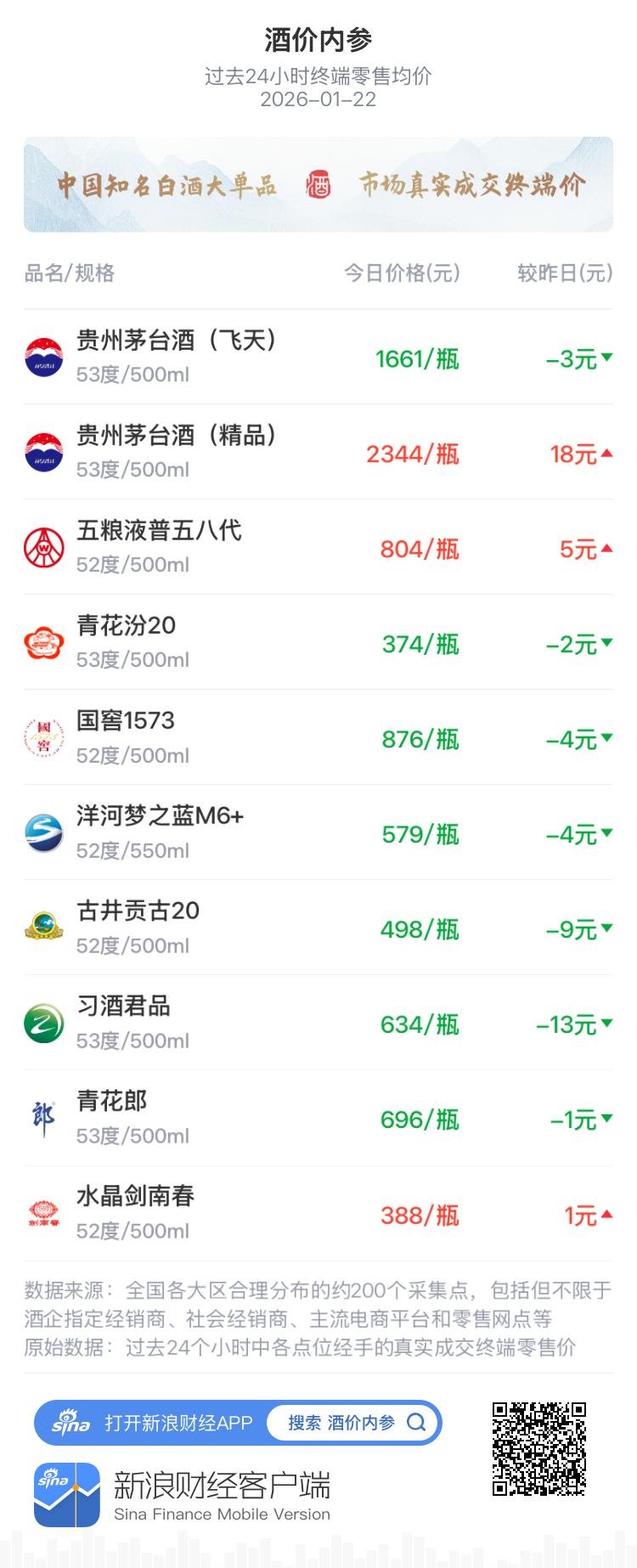
Group 1 - The core viewpoint of the article indicates that the retail prices of the top ten Chinese liquor products have generally declined, marking the fifth consecutive drop and reaching a new low in two months, with high-end liquor prices continuing to decrease [1] - The overall retail price for a package of the top ten products is 8,854 yuan, down by 12 yuan from the previous day, reflecting a short-term adjustment trend in the industry [1] - Among the ten products, seven experienced price drops while three saw increases, highlighting a divergence in the performance of leading liquor brands [1] Group 2 - The leading product, Xijiu Junpin, saw the largest decline, dropping 13 yuan per bottle, while Gujing Gonggu 20 followed with a decrease of 9 yuan per bottle [1] - Other notable declines include Guojiao 1573 and Yanghe Dream Blue M6+, both down by 4 yuan per bottle, and Feitian Moutai, which fell by 3 yuan per bottle [1] - Conversely, the premium Moutai product experienced a significant increase of 18 yuan per bottle, attributed to tightened channel supply and released terminal replenishment demand [1] Group 3 - The data for liquor prices is sourced from approximately 200 collection points across various regions, including designated distributors, social distributors, e-commerce platforms, and retail outlets, aiming to provide an objective and traceable overview of the market [2] - The recent introduction of official sales channels for Feitian Moutai and premium Moutai has begun to show a magnetic influence on their market retail prices [2] Group 4 - Moutai ranks first in the global spirits industry with a brand value of 59.63 billion USD, reflecting a year-on-year growth of 2.2%, and serves as a benchmark for Chinese liquor brands on the international stage [3] - The total number of Chinese brands in the Brand Finance 2026 Global Brand Value 500 list decreased by one compared to last year, but the total brand value increased by 9.7%, indicating an overall improvement in brand strength [3] - Moutai's performance underscores the development potential of high-quality Chinese liquor brands in the global market [3]



酒价内参1月22日价格发布 习酒君品下跌13元
Xin Lang Cai Jing· 2026-01-22 01:23
Core Insights - The Chinese liquor market is experiencing a general decline in retail prices, with the average price of the top ten products dropping to 8,854 yuan, a decrease of 12 yuan from the previous day, marking the fifth consecutive decline to a two-month low [1][7][8] - The market shows a mixed trend with seven products declining and three increasing in price, indicating a short-term adjustment phase in the industry [1][8] Price Trends - The leading product, Xijiu Junpin, saw the largest drop of 13 yuan per bottle, while Gujing Gonggu followed with a decrease of 9 yuan per bottle [1][8] - Other notable declines include Guojiao 1573 and Yanghe Dream Blue M6+, both down by 4 yuan per bottle, and Feitian Moutai, which decreased by 3 yuan per bottle [1][8] - In contrast, the premium Moutai product increased significantly by 18 yuan per bottle, attributed to tightened supply and replenishment demand [1][8] Data Collection Methodology - The "Liquor Price Reference" collects data from approximately 200 points across various regions, including designated distributors, social distributors, e-commerce platforms, and retail outlets, ensuring a comprehensive and objective representation of market prices [2][9] - The pricing data is weighted based on actual transaction volumes to provide accurate retail price calculations for products like Feitian Moutai and premium Moutai [2][9] Brand Value Insights - Moutai ranks first in the global spirits industry with a brand value of 59.63 billion USD, reflecting a 2.2% year-on-year increase, underscoring its role as a benchmark for Chinese liquor brands [3][9] - The Brand Finance report indicates that while the number of Chinese brands in the top 500 decreased by one, the total brand value increased by 9.7%, with an average brand strength index of 76.4, surpassing the global average [3][9]




酒价内参1月22日价格发布 市场延续下跌五创两月价格新低
Xin Lang Cai Jing· 2026-01-22 00:59
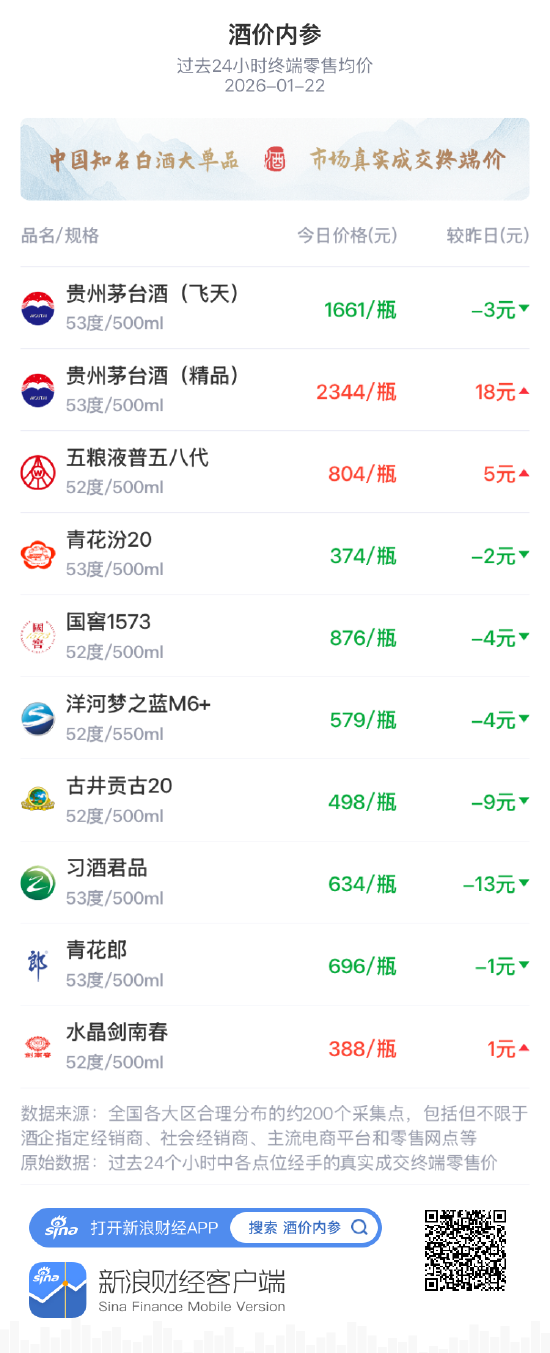
Core Viewpoint - The Chinese liquor market is experiencing a general decline in retail prices for the top ten products, marking the fifth consecutive drop in two months, with high-end liquor prices continuing to decrease, indicating a short-term adjustment in the industry [1]. Price Trends - The overall retail price for a package of the top ten liquor products is 8,854 yuan, down by 12 yuan from the previous day [1]. - Among the top ten products, seven saw price declines while three experienced price increases, highlighting a clear market downturn [1]. Specific Product Performance - The leading price drop was observed in Xijiu Junpin, which decreased by 13 yuan per bottle; followed by Gujing Gonggu with a drop of 9 yuan; and both Guojiao 1573 and Yanghe Dream Blue M6+ with declines of 4 yuan each [1][3][4]. - The only products that saw price increases were the premium Moutai, which rose by 18 yuan per bottle due to tightened channel supply and replenishment demand, and Wuliangye Pu 58th generation, which increased by 5 yuan [1][3]. Market Dynamics - The market is characterized by a significant divergence in the performance of leading liquor brands, with only a few showing signs of recovery from the price declines [1]. - The continuous supply of lower-priced Moutai is further weakening the support for terminal prices [1].
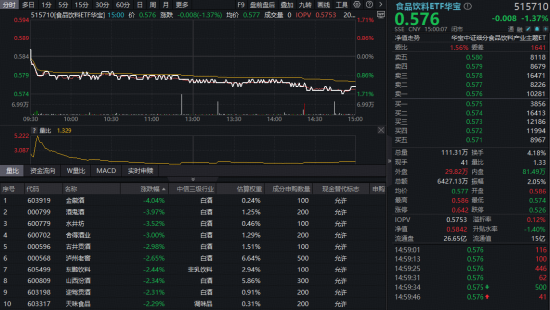
吃喝板块突遭寒流,白酒股领跌!食品饮料ETF华宝(515710)重挫1.71%,机构激辩:布局时刻到了吗?
Xin Lang Cai Jing· 2026-01-21 11:23
Core Viewpoint - The food and beverage sector continues to experience a downturn, with the Huabao Food and Beverage ETF (515710) showing a significant decline, particularly in the liquor stocks, which have collectively dropped, impacting the overall sector performance [1][10]. Group 1: Market Performance - On January 21, the Huabao Food and Beverage ETF (515710) experienced a maximum intraday decline of 1.71%, closing down 1.37% [1][10]. - Major liquor stocks such as Jinhui Liquor fell by 4.04%, while others like Guizhou Moutai and Wuliangye also saw significant declines, contributing to the sector's downturn [1][10]. Group 2: Company Insights - Guizhou Moutai, the largest holding in the Huabao Food and Beverage ETF, had a holding ratio of 14.89% as of the third quarter of 2025 [3][12]. - The brand value of Guizhou Moutai increased by 2.2% to reach $59.63 billion, ranking first in the global liquor industry according to the Brand Finance report [1][12]. Group 3: Valuation and Investment Strategy - The current valuation of the food and beverage sector is at a historical low, with the price-to-earnings ratio of the ETF's underlying index at 19.83, placing it in the bottom 3.33% of the last decade [4][12]. - Analysts suggest that the food and beverage sector may present a good opportunity for left-side positioning due to its low valuation and strong cash dividend capabilities [4][14]. Group 4: Future Outlook - The market is expected to show a "growth first, liquor accumulation" characteristic as the Spring Festival approaches, with increasing demand for liquor as inventory levels decrease [14][15]. - The food and beverage ETF is positioned to capture core assets in the sector, with approximately 60% of its holdings in high-end and mid-range liquor stocks, and 40% in other beverage and dairy segments [15][16].

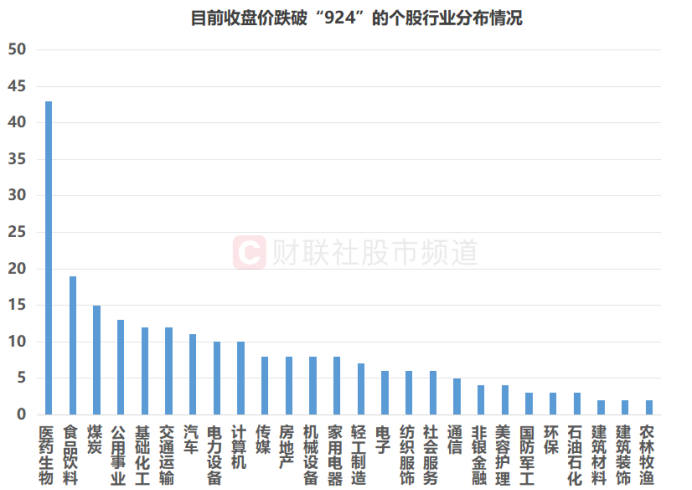
超200股已跌破“924”!千亿市值权重占一成,这些板块临近行情起点
Xin Lang Cai Jing· 2026-01-21 09:28
Core Viewpoint - The A-share market has shown overall stability, but nearly 230 stocks have seen their closing prices fall below the level recorded on September 24, 2024, accounting for approximately 4.3% of the total market [1]. Industry Analysis - The pharmaceutical sector has the highest number of stocks below the September 24 closing price, making up 18.7% of the total. Other sectors with significant representation include food and beverage, coal, public utilities, basic chemicals, and transportation, each exceeding 10% [2]. - Among the sub-sectors, stocks in the liquor, traditional Chinese medicine, thermal coal, coking coal, and residential development categories are the most affected, with a notable presence of chemical preparations, in vitro diagnostics, and medical consumables [2]. Market Capitalization Insights - The average total market capitalization of the over 200 stocks currently below the September 24 closing price is approximately 43.6 billion, with a median market capitalization of 10.8 billion. Stocks with a market capitalization below 5 billion account for nearly 30%, while those above 100 billion represent close to 10% [5]. - Notably, China Mobile, the only stock with a market capitalization exceeding 1 trillion, has seen a decline of about 3.7% from its September 24 closing price, currently fluctuating around 96 yuan [5]. Performance of Major Stocks - Key large-cap stocks that have fallen below the September 24 closing price include China Petroleum, Yangtze Power, China Telecom, Wuliangye, and others. Six stocks, including Pizaihuang and Daqin Railway, have experienced declines exceeding 10% [7]. - The performance of the dividend index has lagged behind the broader market, with a cumulative increase of only 5.9% since September 24, while other indices have shown more substantial gains [8]. Index Performance Overview - As of January 21, all 31 first-level industry indices are above their September 24 levels, with an average increase of approximately 58.12% and a median increase of 53.42%. The communication, non-ferrous metals, electronics, and comprehensive sectors have seen increases exceeding 130% [10]. - Conversely, sectors such as coal, food and beverage, public utilities, banking, and transportation have shown relatively lower growth, with the coal sector only increasing by 0.6% [10].





食品饮料行业今日跌1.53%,主力资金净流出24.16亿元
Zheng Quan Shi Bao Wang· 2026-01-21 09:20
Market Overview - The Shanghai Composite Index rose by 0.08% on January 21, with 18 out of the 28 sectors experiencing gains. The top-performing sectors were non-ferrous metals and electronics, with increases of 2.79% and 2.62% respectively [1] - The banking and coal sectors saw the largest declines, with drops of 1.58% and 1.57% respectively [1] Capital Flow Analysis - The net inflow of capital in the two markets was 11.983 billion yuan, with 14 sectors receiving net inflows. The electronics sector led with a net inflow of 16.369 billion yuan, while the non-ferrous metals sector followed with a net inflow of 7.289 billion yuan [1] - Conversely, 17 sectors experienced net outflows, with the power equipment sector seeing the largest outflow of 6.688 billion yuan, followed by the defense and military sector with an outflow of 2.906 billion yuan [1] Food and Beverage Sector Performance - The food and beverage sector declined by 1.53%, with a net outflow of 2.416 billion yuan. Out of 124 stocks in this sector, 23 rose while 97 fell, including one stock that hit the daily limit down [2] - The top three stocks with the highest net inflows in the food and beverage sector were "Hao Xiang Ni" with 61.106 million yuan, "*ST Chun Tian" with 12.8997 million yuan, and "Wei Zhi Xiang" with 12.7381 million yuan [2] - Major stocks with significant net outflows included Kweichow Moutai with 9.52 billion yuan, Wuliangye with 3.66 billion yuan, and Shanxi Fenjiu with 1.33 billion yuan [2][4] Food and Beverage Sector Capital Inflow and Outflow - The capital inflow leaderboard in the food and beverage sector included "Hao Xiang Ni" (+8.11%), "*ST Chun Tian" (+4.85%), and "Wei Zhi Xiang" (+1.43%) [2] - The capital outflow leaderboard featured Kweichow Moutai (-1.64%), Wuliangye (-1.77%), and Shanxi Fenjiu (-2.34%) [4]


“顶流”调仓!傅鹏博、李晓星,加仓这些股票
Zhong Guo Zheng Quan Bao· 2026-01-21 08:51
Group 1: Fund Manager Insights - Fund manager Fu Pengbo reduced holdings in companies with weak fundamentals and increased investments in data center liquid cooling, storage, and computing-related companies [1][2] - Fu noted that the annual reports of listed companies for 2025 will be pre-disclosed by the end of January 2026, with high-growth sectors like AI, non-ferrous metals, and lithium battery materials expected to show significant growth [1][3] - Li Xiaoxing increased positions in Hong Kong internet and consumer stocks while reducing holdings in some Hong Kong financial stocks, believing that overall opportunities in the equity market for 2026 outweigh risks [1][4] Group 2: Fund Performance and Adjustments - Fu's fund saw minor changes in its top ten holdings, with Maiwei Co. replacing China Mobile, and increased positions in Han's Laser while reducing stakes in companies like Ningde Times and Tencent [2][3] - Li's fund reported a stock position of 88.55% at the end of Q4 2025, a decrease of 4.54 percentage points from Q3 2025, with new entries in the top ten holdings including Tencent, Alibaba, and Meituan [4][5] Group 3: Market Outlook - Fu and Zhu believe that the stock market's activity is increasing, with a "spring excitement" arriving early, and expect high growth in sectors like AI and semiconductor manufacturing [3][6] - Li highlighted that AI remains the main line of global technological innovation, with significant capital expenditure growth in the AI sector, and domestic internet companies expected to maintain stable growth [6][7] - The consumer sector's performance needs dynamic observation, with many quality consumer stocks showing favorable dividend yields [6][7] Group 4: Sector-Specific Insights - The pharmaceutical sector experienced fluctuations in Q4 2025 due to previously high market expectations and capital flowing to other popular sectors, but long-term prospects for domestic innovative drugs remain positive [7] - The CRO and CDMO segments are showing clear signs of recovery in domestic and international demand, indicating an industry turning point [7]






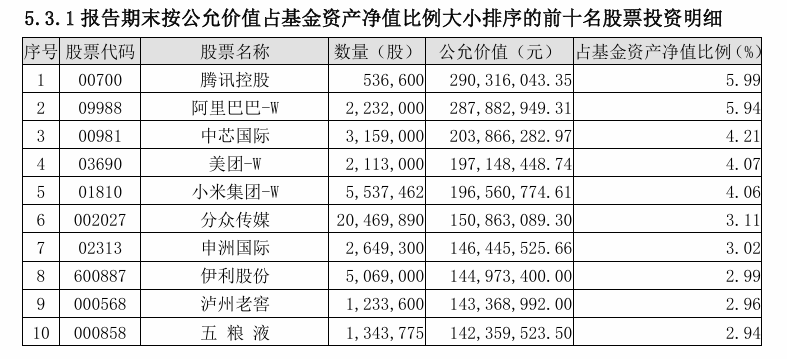
银华基金李晓星Q4加仓港股互联网和消费股,包括腾讯、阿里等
Zhong Guo Zheng Quan Bao· 2026-01-21 05:21
Group 1 - The core viewpoint of the report indicates that the overall opportunities in the equity market for 2026 outweigh the risks, with AI remaining the main theme of global technological innovation [1] - As of the end of Q4 2025, the stock position of the Silver Hua Xinyi fund was 88.55%, a decrease of 4.54 percentage points compared to the end of Q3 2025 [1] - The top ten holdings of the fund as of Q4 2025 include Tencent Holdings, Alibaba-W, SMIC, Meituan-W, Xiaomi Group-W, Focus Media, Shenzhou International, Yili Group, Luzhou Laojiao, and Wuliangye [1] Group 2 - The AI industry is experiencing explosive growth in capital expenditure globally, with domestic internet companies also showing rapid growth in capital spending [2] - The consumer sector is expected to lag in 2025, with consumers remaining cautious and price-sensitive, although there are opportunities in high-quality consumer stocks with attractive dividend yields [2] - The pharmaceutical sector experienced fluctuations in Q4, attributed to previously high market expectations and capital flowing to other popular sectors, but there is a long-term positive outlook for domestic innovative drugs and the CRO/CDMO segments [2]


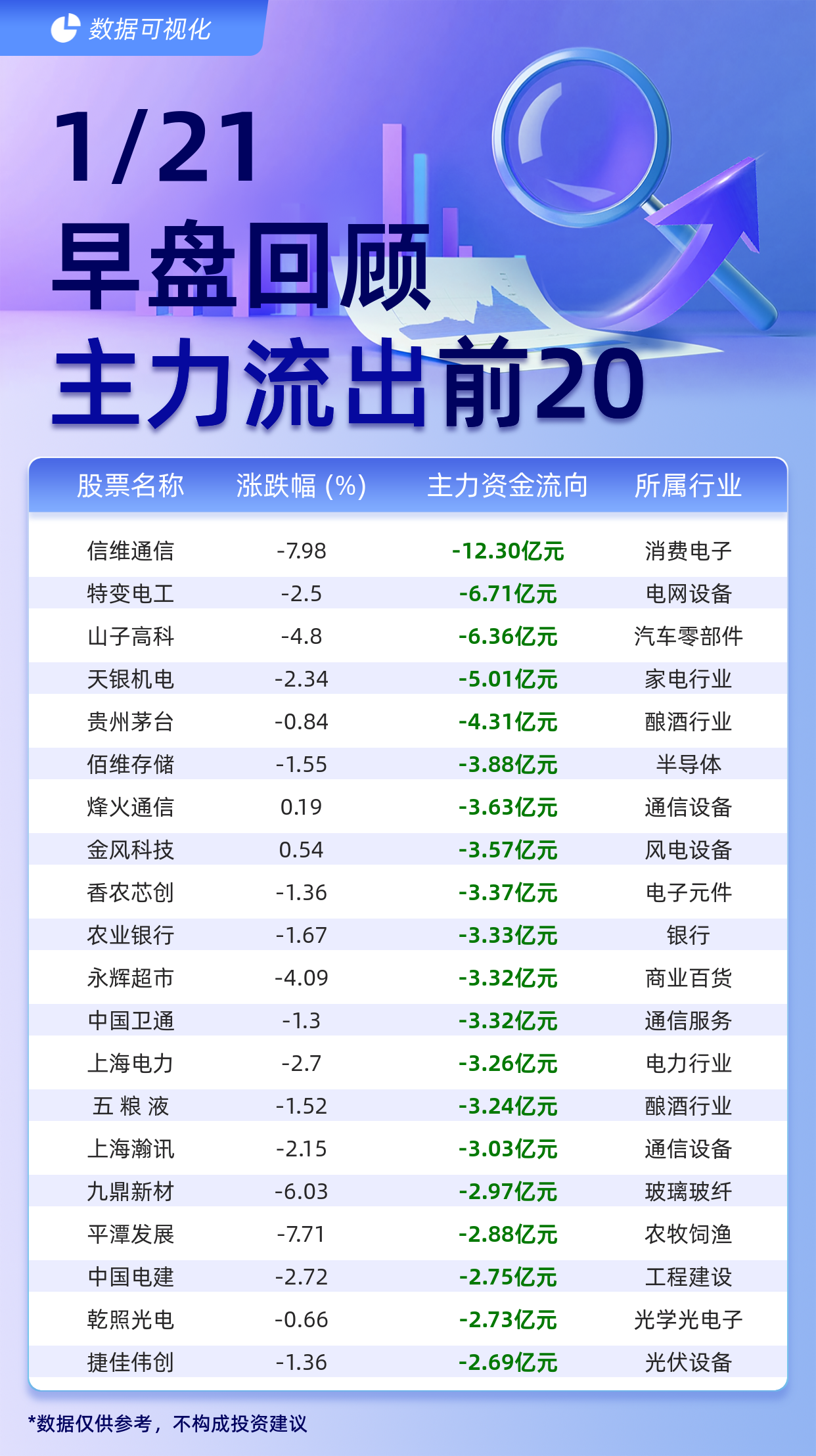
主力个股资金流出前20:信维通信流出12.30亿元、特变电工流出6.71亿元
Jin Rong Jie· 2026-01-21 04:04
Core Viewpoint - The data indicates significant outflows of capital from various stocks, with notable declines in share prices across multiple sectors, suggesting a bearish sentiment in the market. Group 1: Major Stocks with Capital Outflows - Xinyi Communication experienced a capital outflow of 1.23 billion, with a price drop of 7.98% [1][2] - Tebian Electric witnessed a capital outflow of 671 million, with a price decline of 2.5% [1][2] - Shanzi Gaoke had a capital outflow of 636 million, with a decrease of 4.8% [1][2] - Tianyin Electromechanical saw an outflow of 501 million, with a drop of 2.34% [1][2] - Kweichow Moutai experienced a capital outflow of 431 million, with a decline of 0.84% [1][2] Group 2: Additional Stocks with Notable Outflows - Baiwei Storage had a capital outflow of 388 million, with a price drop of 1.55% [1][2] - Fenghuo Communication saw an outflow of 363 million, with a slight increase of 0.19% [1][2] - Goldwind Technology experienced a capital outflow of 357 million, with a price increase of 0.54% [1][2] - Shannon Chip Creation had an outflow of 337 million, with a decline of 1.36% [1][2] - Agricultural Bank saw a capital outflow of 333 million, with a drop of 1.67% [1][2] Group 3: Further Stocks with Capital Outflows - China Satellite Communications experienced a capital outflow of 332 million, with a decline of 1.3% [3] - Shanghai Electric saw an outflow of 326 million, with a price drop of 2.7% [3] - Wuliangye experienced a capital outflow of 324 million, with a decline of 1.52% [3] - Shanghai Hanxun had an outflow of 303 million, with a drop of 2.15% [3] - Jiuding New Materials saw a capital outflow of 297 million, with a significant decline of 6.03% [3]


酒价内参1月21日价格发布 青花郎下跌11元
Xin Lang Cai Jing· 2026-01-21 01:31
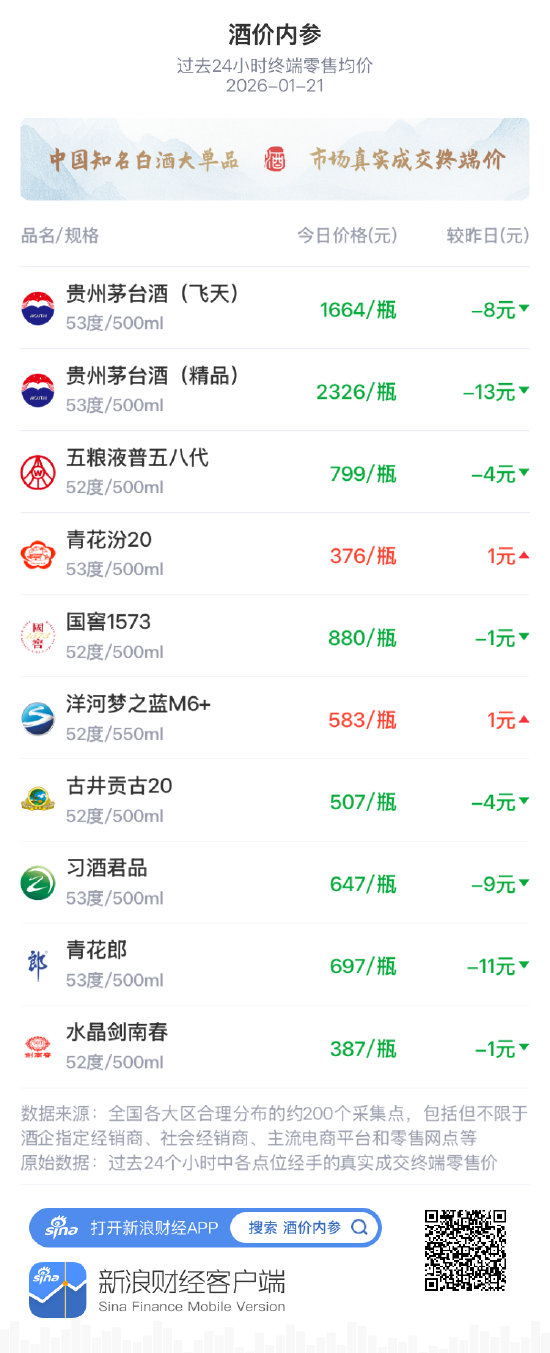
Core Insights - The Chinese white liquor market has experienced a general decline in retail prices for its top ten products as of January 21, with an overall price drop of 49 yuan, bringing the total price to 8866 yuan, marking the fourth consecutive decline in two months [1][4]. Price Trends - The market shows a downward trend with eight products declining and only two increasing in price, indicating significant short-term adjustment pressure in the industry [1]. - The leading product in price decline is the premium Moutai, which fell by 13 yuan per bottle due to increased supply and dealer discounts [1]. - Other notable declines include Qinghua Lang and Xijiu Junpin, which decreased by 11 yuan and 9 yuan per bottle, respectively [1]. - The price of Feitian Moutai dropped by 8 yuan per bottle, influenced by the entry of lower-priced products on the "i Moutai" platform [1]. - Other products like Gujing Gonggu 20 and Wuliangye Pu 58 also saw a decrease of 4 yuan per bottle, while Guojiao 1573 and Shuijing Jian Nan Chun experienced minor declines of 1 yuan [1][5]. Price Increases - The only products that saw price increases were Yanghe Dream Blue M6+ and Qinghua Fen 20, both rising by 1 yuan per bottle [1][5]. Data Collection Methodology - The price data is sourced from approximately 200 collection points across various regions, including designated distributors, social distributors, e-commerce platforms, and retail outlets, ensuring a comprehensive and objective representation of the market [2]. - The data reflects real transaction prices from the past 24 hours, aiming to provide accurate insights into the market dynamics [2]. Consumer Concerns - Recently, Jian Nan Chun issued a notice regarding counterfeit authorization letters found in e-commerce platforms, urging consumers to verify the authenticity of products before purchase [3]. - The company aims to maintain its sales channels and pricing order amidst concerns over low-priced online sales potentially disrupting brand pricing structures [3].