SHUNXIN AGRICULTURE(000860)

Search documents
猪肉概念19日主力净流入482.43万元,牧原股份、海大集团居前
Sou Hu Cai Jing· 2025-08-19 07:51
序号代码名称最新价涨跌幅主力净流入主力净占比1002714牧原股份46.710.821.22亿元6.8%2002311海大 集团59.881.911.15亿元22.34%3000876新 希 望9.830.924099.52万元9.4%4000860顺鑫农业 16.131.131780.33万元4.42%5600073光明肉业7.721.311383.10万元8.3%6605296神农集团32.340.811340.91 万元9.47%7603477巨星农牧20.870.341180.37万元4.14%8000735罗 牛 山6.370.0760.46万元4.53%9002982 湘佳股份16.18-0.25441.11万元4.47%10002726龙大美食5.45-0.18280.21万元2.76% 来源:金融界 8月19日,猪肉概念上涨0.22%,今日主力资金流入482.43万元,概念股19只上涨,10只下跌。 主力资金净流入居前的分别为牧原股份(1.22亿元)、海大集团(1.15亿元)、新希望(4099.52万 元)、顺鑫农业(1780.33万元)、光明肉业(1383.1万元)。 ...





白酒板块8月13日跌0.65%,*ST岩石领跌,主力资金净流出17.58亿元
Zheng Xing Xing Ye Ri Bao· 2025-08-13 08:31
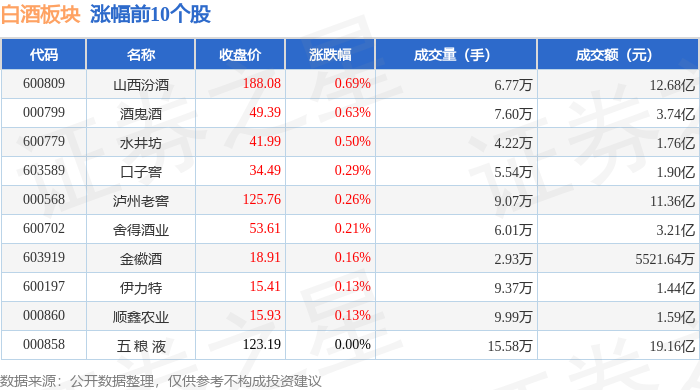
Market Overview - The liquor sector experienced a decline of 0.65% on August 13, with *ST Rock leading the drop [1] - The Shanghai Composite Index closed at 3683.46, up 0.48%, while the Shenzhen Component Index closed at 11551.36, up 1.76% [1] Liquor Sector Performance - Key liquor stocks showed mixed performance, with Shanxi Fenjiu closing at 188.08, up 0.69%, and Wuliangye remaining unchanged at 123.19 [1][2] - The trading volume and turnover for major stocks included Shanxi Fenjiu with 67,700 shares traded and a turnover of 1.268 billion yuan, and Wuliangye with 155,800 shares and a turnover of 1.916 billion yuan [1][2] Capital Flow Analysis - The liquor sector saw a net outflow of 1.758 billion yuan from institutional investors, while retail investors contributed a net inflow of 286 million yuan [2][3] - Notable individual stock capital flows included *ST Rock with a net outflow of 11.2673 million yuan from institutional investors, and a net inflow of 799.42 million yuan from retail investors [3]




股市必读:顺鑫农业(000860)8月8日董秘有最新回复
Sou Hu Cai Jing· 2025-08-10 22:37
Core Viewpoint - The company, Shunxin Agriculture, is experiencing a decline in stock price and has no plans for share repurchase, indicating potential concerns about market performance and investor confidence [1][2]. Group 1: Stock Performance - As of August 8, 2025, Shunxin Agriculture's stock closed at 15.8 yuan, down 0.32%, with a turnover rate of 0.73% and a trading volume of 54,100 shares, amounting to a total transaction value of 85.51 million yuan [1]. - On the same day, there was a net outflow of 7.68 million yuan from main funds, accounting for 8.98% of the total transaction value [7][8]. Group 2: Company Operations - The company has no plans for share buybacks, as confirmed by the company secretary in response to investor inquiries [2]. - The company experiences losses in the second to fourth quarters primarily due to the impact of other business operations, while the first quarter benefits from seasonal demand during traditional holidays [3]. - Shunxin Agriculture does not export alcoholic products, indicating a focus on domestic markets [4]. - The company is actively working on the construction of a national modern agricultural industrial park in Shunyi District, with plans for production to commence within the year [5][6].
白酒指数弱反弹,重组预期公司股价异动:*ST岩石本周大涨,*ST椰岛却跌了丨酒市周报
Mei Ri Jing Ji Xin Wen· 2025-08-10 08:15
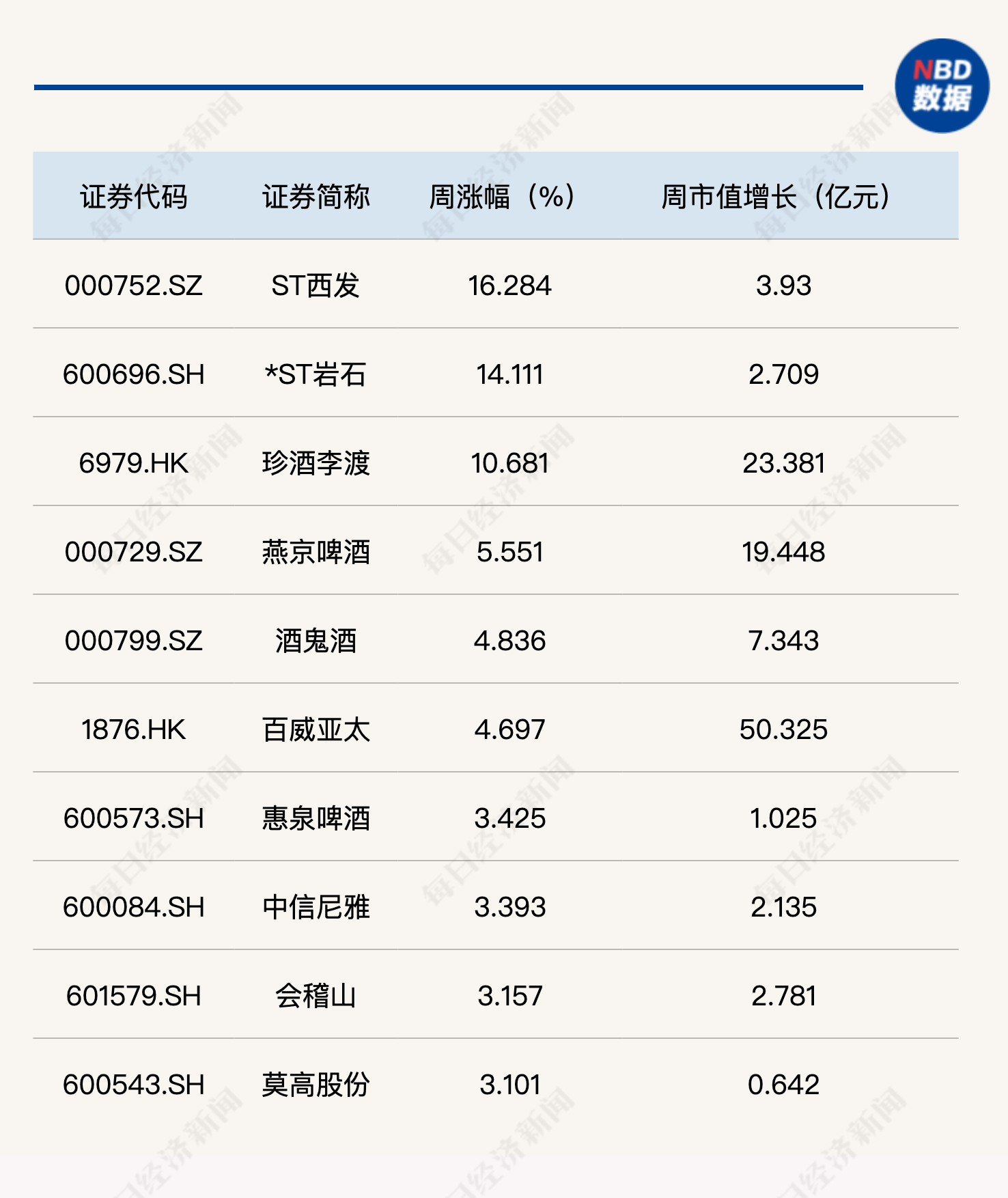
Core Viewpoint - The white liquor sector continues to show weak rebound momentum due to persistent demand-side issues, with the Wind white liquor index rising only 0.78% this week, significantly lower than the Shanghai and Shenzhen indices [1] Industry Summary - The white liquor sector is transitioning from a volume-price logic to a share logic, leading to weakened growth potential for most stocks in the sector. White liquor may no longer be considered a cyclical growth stock, with a few stocks becoming "quasi-debt assets" due to competitive advantages, making stable ROE increasingly important for pricing [1][5] - Despite a slight increase in the white liquor index this week, several companies, including Jinshiyuan, Shunxin Agriculture, Jinzongzi Liquor, Shede Liquor, and Huangtai Liquor, saw their stock prices decline. Jinshiyuan reported significant operational difficulties, indicating that the industry is unlikely to see a turnaround in the short term [4][5] Company-Specific Summary - *ST Yanshi and *ST Yedao have experienced significant stock price fluctuations due to restructuring expectations, with market speculation evident [3] - *ST Yanshi's actual controller is under criminal investigation, which may lead to a change in company control if the judicial disposition of his shares occurs. *ST Yedao is backed by state-owned assets in Haikou, with the CSRC supporting state-led restructuring of troubled companies [4] - Jinshiyuan has reported a decline in terminal sales growth in June and July compared to April and May, primarily due to policy factors and seasonal influences. The company anticipates a substantial industry recovery may not occur until the second half of 2026 [5]


白酒不行了?不,是市场太急了
Sou Hu Cai Jing· 2025-07-29 12:15
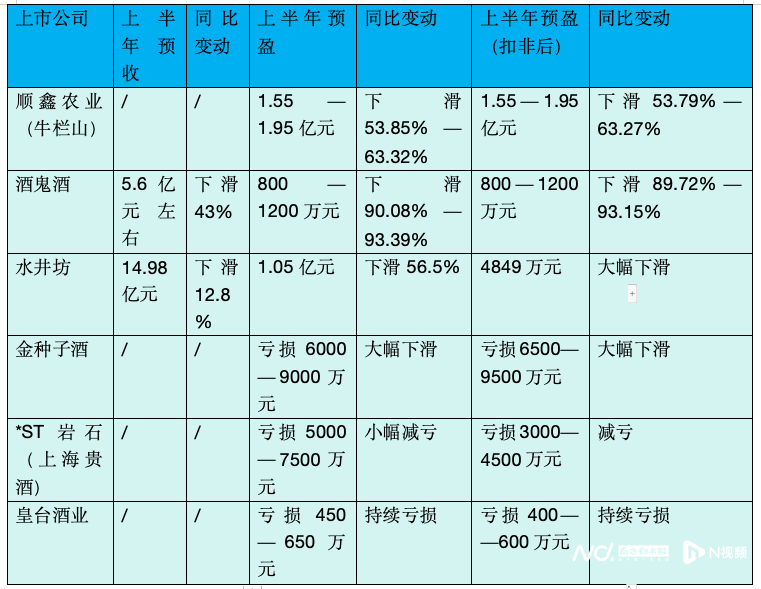
Core Viewpoint - The Chinese liquor industry is currently undergoing a deep adjustment period, with overall market performance being sluggish and many companies reporting significant declines in revenue and profit [1][3][4]. Industry Overview - The liquor industry is experiencing a noticeable slowdown in growth, with many companies reporting declines in both revenue and net profit, and some even turning from profit to loss [1][3]. - The adjustment in the industry is characterized by a systemic pressure affecting all companies, rather than isolated operational issues [3][4]. Company Performance - Jiu Gui Jiu's net profit for the first half of the year is expected to be between 8 million and 12 million yuan, a decline of 90.08% to 93.39% compared to 121 million yuan in the same period last year, with revenue expected to drop by approximately 43% to around 560 million yuan [1]. - Shui Jing Fang anticipates a net profit of 105 million yuan for the first half of the year, down 56.52% year-on-year, with revenue expected to decrease by 12.84% to 1.498 billion yuan, despite a 14.54% increase in sales volume [1]. - Shunxin Agriculture expects a net profit of 155 million to 195 million yuan, a decline of 53.85% to 63.32% year-on-year, due to decreased sales volume impacting overall revenue and profit levels [3]. - Jinzhongzi forecasts a net loss of 60 million to 90 million yuan for the first half of the year, attributing this to the industry's deep adjustment and ongoing decline in production [3]. Market Dynamics - The industry faces multiple challenges, including shrinking consumption scenarios, soft market demand, and a shift in consumer preferences towards fruit wines and low-alcohol beverages [4]. - High inventory levels and serious price inversion issues are exacerbating industry pressures, with over 58% of distributors reporting increased inventory and more than half facing price inversion problems [4]. - The average inventory turnover days have reached 900 days, an increase of 10% year-on-year, indicating significant supply chain inefficiencies [4]. Future Outlook - Despite the current challenges, leading companies like Kweichow Moutai and Wuliangye are still achieving relatively stable growth, with Moutai reporting a 9% year-on-year revenue increase [7]. - The low-alcohol beverage market is emerging as a new growth point, with companies exploring new product lines and sales channels [7]. - Industry experts predict a full recovery by 2027, with new development opportunities arising in 2028, suggesting that patience and understanding are needed for the industry's transformation [8][9].




越卖越亏?酒鬼酒等业绩暴跌!白酒基金经理如何调仓?
Sou Hu Cai Jing· 2025-07-28 10:32
Core Viewpoint - The Chinese liquor industry is experiencing a significant downturn, with over 15 companies reporting substantial declines in profits or expected losses, indicating a deep adjustment period for the sector [1][5]. Company Performance - Shunxin Agriculture (Niulanshan) expects a net profit of 155 to 195 million yuan for the first half of 2025, a decrease of 53.85% to 63.32% compared to over 400 million yuan in the same period last year [2][3]. - Jiu Gui Jiu anticipates a revenue of approximately 560 million yuan, down about 43%, with a net profit drop of 90.08% to 93.39%, projecting earnings of 8 to 12 million yuan [2][3]. - Shui Jing Fang forecasts a net profit of 105 million yuan, a decrease of about 137 million yuan or 56.52% year-on-year, with expected revenue of 1.498 billion yuan, down 12.84% [2][3]. - Jin Zhong Zi Jiu, *ST Yan Shi, and Huang Tai Jiu Ye are expected to report losses, with Jin Zhong Zi Jiu projecting a loss of 60 to 90 million yuan [4][5]. Industry Trends - The liquor industry is undergoing a deep adjustment, with many companies citing declining sales volumes as a key factor affecting revenue and profit levels [5][6]. - Despite an increase in sales volume, Shui Jing Fang's profits have significantly declined due to rising sales expense ratios and the need for promotional support for new products [5][6]. - Fund managers are actively adjusting their portfolios, reducing positions in companies like Gu Jing Gong Jiu and Jin Si Yuan, reflecting a cautious outlook on the sector [7][12]. Strategic Responses - Companies are focusing on terminal sales and channel penetration, with some investing in store coverage and single-store productivity to adapt to the changing market [1][14]. - Jiu Gui Jiu plans to enhance consumer purchasing intent through events and expand sales channels, while Shui Jing Fang aims to increase store coverage and improve single-store sales [13][14]. - Major liquor brands are introducing lower-alcohol products to attract younger consumers, with several companies developing new low-alcohol offerings [14].
量价齐跌、利润腰斩,白酒如何走出阵痛期?| 白酒半年特辑②
Sou Hu Cai Jing· 2025-07-28 00:44
Core Viewpoint - The Chinese liquor industry is facing severe challenges in 2025 due to a combination of policy adjustments, consumption structure transformation, and deep competition, leading to declining production, prices, and profits [2][6]. Group 1: Industry Performance - Major liquor companies such as Shunxin Agriculture, Shui Jing Fang, and Jiu Gui Jiu have reported significant declines in net profits, with some experiencing drops of over 90% [2][3]. - The overall industry is experiencing a "volume and price decline," with production volume down 7.6% year-on-year in the first five months of 2025, and a cumulative decline of 69.5% from 2016 to 2024 [5][6]. - The first quarter of 2025 saw a slight increase in revenue of 0.38% for large-scale liquor enterprises, but total profits decreased by 0.73%, indicating a clear downward trend [5][6]. Group 2: Market Dynamics - The industry is facing "three heavy cold currents": persistent price fluctuations, high inventory levels, and a collapse in consumption scenarios [8][10][11]. - Price declines are evident, with liquor prices dropping by 2.0% year-on-year in the first half of 2025, and over 60% of companies experiencing price inversions [8][9]. - Inventory pressure is significant, with an average inventory turnover period of 900 days, and over 58% of distributors reporting increased stock levels [10][11]. Group 3: Consumer Behavior and Trends - Consumer demand is shifting towards more rational spending, with a notable decrease in high-end liquor purchases and a preference for lower-priced products [12][13]. - The traditional consumption scenarios, such as business banquets and gift-giving, are shrinking, leading to a decline in sales during peak seasons [11][12]. - The rise of low-alcohol and foreign liquor preferences among younger consumers is further diluting the market for traditional liquor [11][12]. Group 4: Strategic Responses - Liquor companies are urged to adapt by targeting the mass market with affordable and quality products, as the market for low-cost liquor is expected to grow significantly [14]. - Product innovation is essential, with a focus on lower alcohol content to meet the health-conscious preferences of younger consumers [14]. - Companies are exploring new sales channels, including online platforms and instant retail, to enhance market reach and efficiency [14][15].

顺鑫农业业绩急转直下:2025上半年亏损,百亿目标渐行渐远
Sou Hu Cai Jing· 2025-07-21 20:46
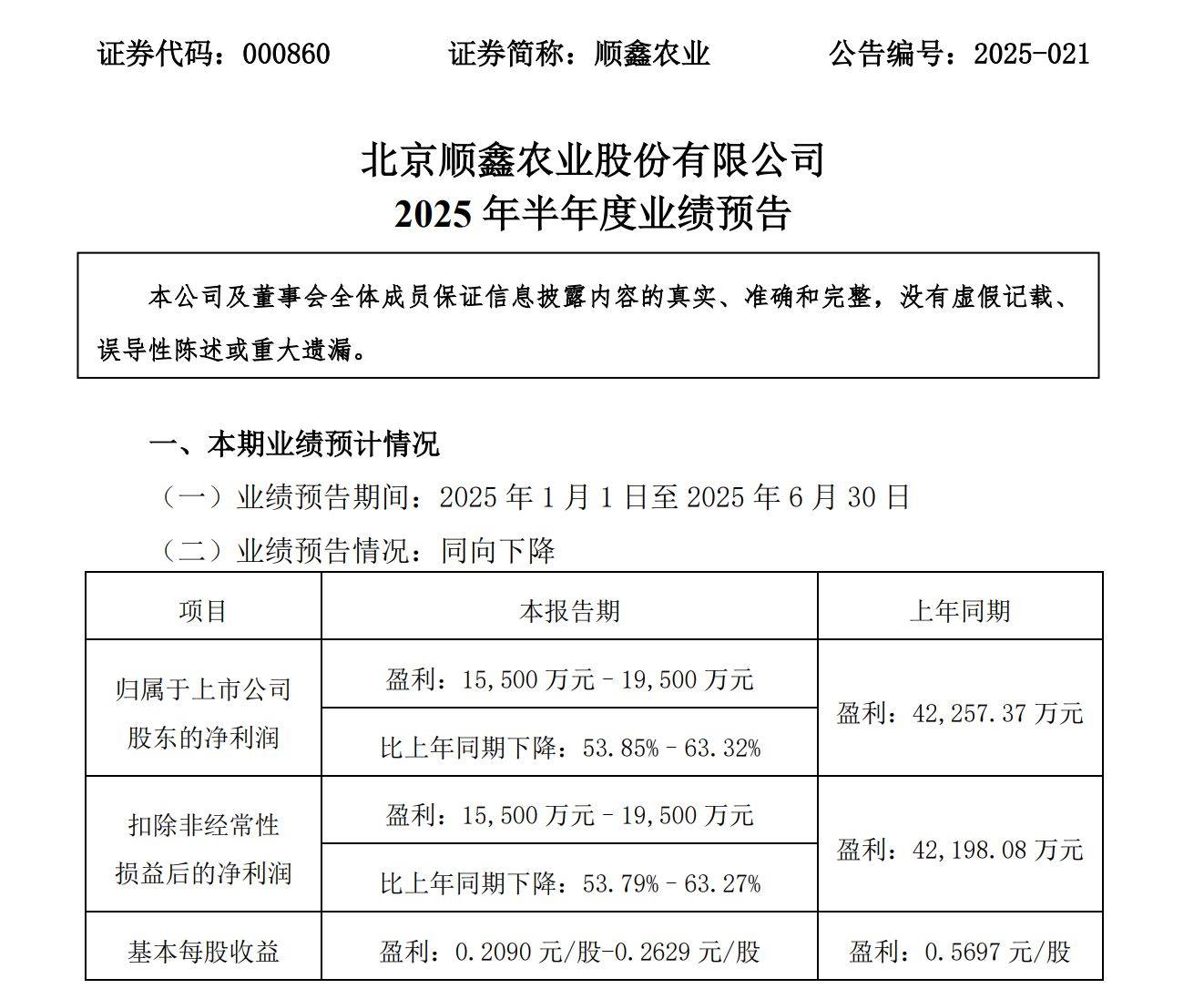
Core Viewpoint - Shunxin Agriculture has announced a forecast for a net loss in the first half of 2025, following a brief recovery in 2024, primarily due to a significant decline in the liquor industry and reduced sales volume [1][3]. Financial Performance - The company expects a net profit attributable to shareholders in the range of 155 million to 195 million yuan, representing a year-on-year decline of 53.85% to 63.32% [1][3]. - The expected non-recurring net profit is also projected to decline by 53.79% to 63.27%, with similar figures for both net profit and non-recurring net profit [1][3]. - In the first quarter of 2025, Shunxin's revenue was approximately 3.258 billion yuan, a decrease of about 19.69% compared to the previous year [5][4]. Sales and Revenue Trends - Shunxin Agriculture's revenue has been declining for four consecutive years, with figures of 14.869 billion yuan in 2021, 11.678 billion yuan in 2022, 10.593 billion yuan in 2023, and 9.126 billion yuan in 2024 [5][11]. - The first quarter of 2025 saw a net profit of approximately 282 million yuan, down 37.34% year-on-year, indicating further deterioration in the second quarter [5][6]. Market Position and Strategy - The company is attempting to focus on the light bottle liquor market to address its challenges, but market expectations for its full-year performance in 2025 remain cautious [5][10]. - Shunxin's liquor business is heavily reliant on low-end products, which accounted for 70.64% of its liquor sales in 2024, leading to limited profitability [7][9]. - The gross margin for low-end liquor is significantly lower at 39.44%, compared to 70.83% for high-end and 47.26% for mid-range products, highlighting the risks associated with its product mix [8][9]. Competitive Landscape - The company faces increasing competition from regional brands and mid-to-high-end liquor companies that are encroaching on its market share through various promotional strategies [9][10]. - The shift in consumer preferences towards mid-to-high-end liquor products further exacerbates Shunxin's challenges due to its heavy reliance on low-end offerings [9][10]. Future Outlook - The ability of Shunxin Agriculture to successfully pivot towards the light bottle liquor market and reverse its financial decline remains to be seen, with market observations needed in the latter half of 2025 [10][18].
酒业半年大考:八仙过海寻出路,三大趋势定格局
Sou Hu Cai Jing· 2025-07-21 07:29
Industry Overview - In 2024, the production of large-scale liquor enterprises is expected to reach 4.145 million kiloliters, a year-on-year decrease of 1.8%, while sales revenue is projected to increase to 796.38 billion yuan, a year-on-year increase of 5.3%, indicating a unique trend of "declining volume but increasing profit" [2] - By the first half of 2025, 59.7% of liquor companies reported a decline in operating profit, and 50.9% experienced a contraction in revenue, with an average inventory turnover period of 900 days, up 10% year-on-year, highlighting significant challenges in the industry [2] Key Trends - The industry is witnessing a simultaneous trend of "contraction and concentration," with smaller companies exiting the market and leading firms shifting focus from "high-speed growth" to "steady development" [3] - A "channel revolution" is underway, with major companies moving towards direct consumer engagement through new sales channels like online platforms and instant retail, indicating a shift in power from distributors to brands [4] - Consumer demand is evolving, driven by younger consumers, leading to product upgrades towards lower alcohol content and diverse flavors, with major brands launching new products to cater to these trends [5] Company Performance - **Kweichow Moutai**: Aims for a 9% revenue growth by 2025, with a first-quarter revenue of 51.443 billion yuan, up 11.07%, and a net profit of 26.847 billion yuan, up 11.56%, demonstrating strong execution of its strategic goals [6][7] - **Wuliangye**: Targets revenue growth in line with macroeconomic conditions, reporting a first-quarter revenue of 36.940 billion yuan, up 6.05%, and a net profit of 14.860 billion yuan, up 5.80%, with ongoing channel reforms [6][8] - **Luzhou Laojiao**: Focuses on low-alcohol products, with a first-quarter revenue of 9.352 billion yuan, up 1.78%, and a net profit of 4.593 billion yuan, up 0.41%, indicating a strong market position in lower alcohol segments [6][9] - **Shanxi Fenjiu**: Reports a first-quarter revenue of 16.523 billion yuan, up 7.72%, and a net profit of 6.648 billion yuan, up 6.15%, with ongoing efforts in national expansion and product innovation [6][10] - **Guojiao**: Achieves a first-quarter revenue of 5.099 billion yuan, up 9.17%, and a net profit of 1.644 billion yuan, up 7.27%, driven by a focus on the wedding market [6][12] Strategic Shifts - The industry is transitioning from "incremental expansion" to "stock optimization," with companies focusing on refining existing markets rather than pursuing aggressive growth [17] - A shift from "channel-driven" to "consumer-driven" strategies is evident, with companies prioritizing direct consumer engagement and enhancing consumer experiences [18] - The trend is moving from "high alcohol content" to "low and diverse products," with major brands launching lower alcohol options to attract younger consumers [20] - Companies are increasingly emphasizing "long-term value" over short-term performance, with a focus on cultural branding and sustainable growth strategies [21] - The shift from "national expansion" to "regional deepening" is becoming a survival strategy for many companies, focusing on local market penetration and brand recognition [22][23]
食饮行业周报(2025年7月第3期):龙头白马持续反弹,大众品Q2业绩表现分化-20250720
ZHESHANG SECURITIES· 2025-07-20 11:52
Investment Rating - The industry rating is maintained as "Positive" [4] Core Views - The rotation between old and new consumption sectors continues, with leading brands in liquor and dairy products rebounding. The performance of mass-market products in Q2 shows divergence, with new consumption-related stocks experiencing rapid growth despite previous adjustments in performance expectations. Traditional channel reforms have impacted some stocks, leading to ongoing adjustments in performance [1][3][33] - The liquor sector is expected to have limited downside potential for leading companies, with high ROE, dividends, and cautious profit assumptions indicating a valuation floor. Recommended stocks include Guizhou Moutai, Shanxi Fenjiu, and Luzhou Laojiao [2][12] - New consumption trends are anticipated to continue, with potential for recovery in the second half of the year. Focus on low-priced or undervalued stocks with future catalysts, including Wei Long, Yili, and Wancheng Group [1][3][33] Summary by Sections Liquor Sector - The liquor sector remains at a low point, with a focus on potential policy catalysts and rebound opportunities. Leading brands with strong market positions are prioritized for investment. Recommended stocks include Guizhou Moutai, Wuliangye, and Shanxi Fenjiu [2][12] - Recent performance shows a positive trend, with Luzhou Laojiao, Yanghe, and Jiu Gui Jiu leading in gains, while Jinzhidao and Huangtai Jiuye faced declines [5][39] Mass-Market Products - The new consumption paradigm is reshaping the food and beverage investment landscape. Despite a recent pullback, the long-term trend remains positive, with clear opportunities for continued investment. Focus on stocks that align with new consumption trends, such as Wei Long, Yili, and Wancheng Group [3][33] - The mass-market sector has seen significant fluctuations, with stocks like Huangshi Group and Guoquan showing strong gains, while stocks like Ganyuan and Gu Ming faced notable declines [39][42] Performance Metrics - From July 14 to July 18, the Shanghai Composite Index rose by 1.09%, with non-dairy beverages and liquor sectors showing gains of 2.16% and 1.30%, respectively. Conversely, frozen foods and snacks experienced declines of 2.26% and 1.10% [39][40] - The valuation levels for the food and beverage industry have adjusted, with the liquor sector showing the highest valuation increase this week [43]