
NEW HOPE(000876)

Search documents
新希望集团董事长刘永好:稳定就业要“稳、扩、活”
Zhong Guo Xin Wen Wang· 2025-12-16 09:20
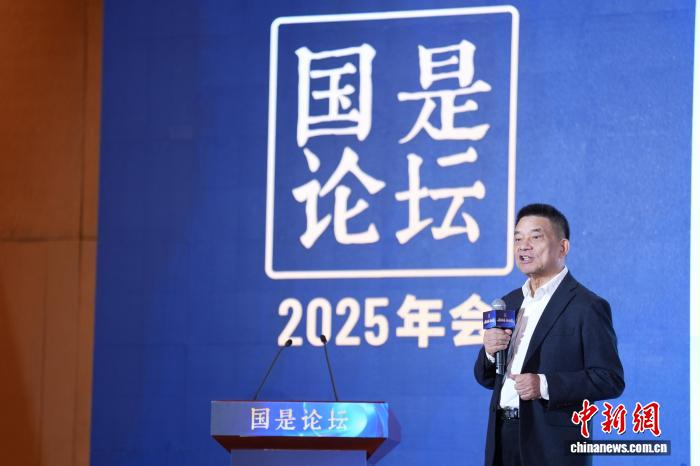
在中国新闻社16日举办的"国是论坛:2025年会"上,十四届全国政协委员、新希望集团董事长刘永好发 表主旨演讲。 中新社记者 蒋启明 摄 刘永好表示,传统就业要稳,传统制造业仍然是解决就业最重要的领域。新质就业要扩,科技型企业成 长很快,要延长科技产业链,在上下游增加就业机会。灵活就业要活,建议出台适度宽松政策支持灵活 就业,同时建立相应社会保障体系。 新希望集团董事长刘永好:稳定就业要"稳、扩、活" 中新网北京12月16日电 (段修健)在中国新闻社16日举办的"国是论坛:2025年会"上,十四届全国政协委 员、新希望集团董事长刘永好在发表主旨演讲时指出,稳定就业可以有三种形态:传统就业要稳,新质 就业要扩,灵活就业要活。 《中共中央关于制定国民经济和社会发展第十五个五年规划的建议》提出,促进高质量充分就业。深入 实施就业优先战略,健全就业促进机制,构建就业友好型发展方式。 广告等商务合作,请点击这里 本文为转载内容,授权事宜请联系原著作权人 他对比集团发展40多年来生产条件的变化,讲述以实业带动就业的做法,认为民营企业做大做强,不仅 是规模和产值做大,担当的社会责任也在变大。 中新经纬版权所有,未经书面授权 ...

新 希 望(000876) - 关于控股股东非公开发行2023年可交换公司债券(第一期)完成办理解除部分持有股份担保及信托登记的公告
2025-12-16 09:01
本公司控股股东新希望集团有限公司保证向本公司提供的信息内容真实、准 确、完整,没有虚假记载、误导性陈述或重大遗漏。 本公司及董事会全体成员保证信息披露的内容与信息披露义务人提供的信 息一致。 新希望六和股份有限公司(以下简称"公司"、"新希望")近日 接到控股股东新希望集团有限公司(以下简称"新希望集团")的通 知,根据《新希望集团有限公司 2023 年面向专业投资者非公开发行 可交换公司债券(第一期)募集说明书》约定的维持担保比例和解除 担保机制,新希望集团已于 2025 年 12 月 15 日在中国证券登记结算 有限责任公司深圳分公司办理完成标的股票的解除担保及信托登记, 40,900,000 股(占总股本的 0.91%)新希望股票划出"新希望-德邦 证券-23 希望 E1 担保及信托财产专户",专户受托管理人为德邦证券 股份有限公司(以下简称"德邦证券"),股票信托登记期限为本期可 交换债券存续期。在上述可交换公司债券存续期间,新希望集团委托 德邦证券作为受托管理人,按照新希望集团的意愿代为行使表决权, 但不得损害本期可交换债券持有人的利益。 1 本次解除部分担保及信托登记完成后,新希望集团直接持有公司 ...
21股获推荐,泽璟制药、佐力药业目标价涨幅超30%
Xin Lang Cai Jing· 2025-12-16 03:38
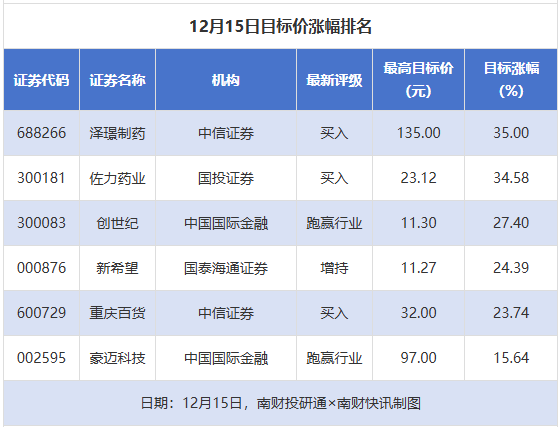
Group 1 - The core viewpoint of the article highlights the target price increases for several listed companies as of December 15, with notable gains in the pharmaceutical and automation sectors [1][5]. - The companies with the highest target price increases include Zejing Pharmaceutical at 35.00%, Zoli Pharmaceutical at 34.58%, and Genesis at 27.40%, indicating strong bullish sentiment in the chemical pharmaceutical, traditional Chinese medicine, and automation equipment industries respectively [1][5]. - A total of 21 listed companies received broker recommendations on December 15, with Zoli Pharmaceutical receiving the most recommendations at 5, while companies like Tiandi Technology and Changbao Co. received 1 recommendation each [6]. Group 2 - On December 15, brokers initiated coverage on 7 companies, with Changbao Co. receiving an "Accumulate" rating from China Merchants Securities, Genesis receiving a "Outperform" rating from China International Capital Corporation, and SAIC Motor receiving a "Buy" rating from Aijian Securities [3][7]. - The newly covered companies include Changbao Co. in the special steel industry, Genesis in the automation equipment sector, and SAIC Motor in the passenger vehicle market, indicating a diverse range of industries being targeted for investment [4][8].


21股获推荐 泽璟制药、佐力药业目标价涨幅超30%丨券商评级观察
2 1 Shi Ji Jing Ji Bao Dao· 2025-12-16 02:31
Core Insights - On December 15, 2023, brokerage firms provided target prices for listed companies, with notable increases for Zejing Pharmaceutical, Zoli Pharmaceutical, and Genesis, showing target price increases of 35.00%, 34.58%, and 27.40% respectively, across the chemical pharmaceuticals, traditional Chinese medicine, and automation equipment industries [1][2]. Group 1: Target Price Increases - Zejing Pharmaceutical received a target price increase of 35.00%, with a latest closing price of 135.00 yuan [2]. - Zoli Pharmaceutical's target price increased by 34.58%, with a closing price of 17.18 yuan [2]. - Genesis saw a target price increase of 27.40%, with a closing price of 11.30 yuan [2]. Group 2: Brokerage Recommendations - A total of 21 listed companies received brokerage recommendations on December 15, with Zoli Pharmaceutical receiving the highest number of recommendations at 5 [3]. - Other companies like Tiandi Technology and Changbao Co. received 1 recommendation each [3]. Group 3: First Coverage Ratings - On December 15, 7 companies received initial coverage from brokerages, including Changbao Co. with an "Accumulate" rating from China Merchants Securities [4]. - Genesis received a "Outperform Industry" rating from China International Capital Corporation [4]. - SAIC Motor was rated "Buy" by Aijian Securities [4].



养殖业板块12月15日涨0.87%,罗牛山领涨,主力资金净流入1124.65万元
Zheng Xing Xing Ye Ri Bao· 2025-12-15 09:01
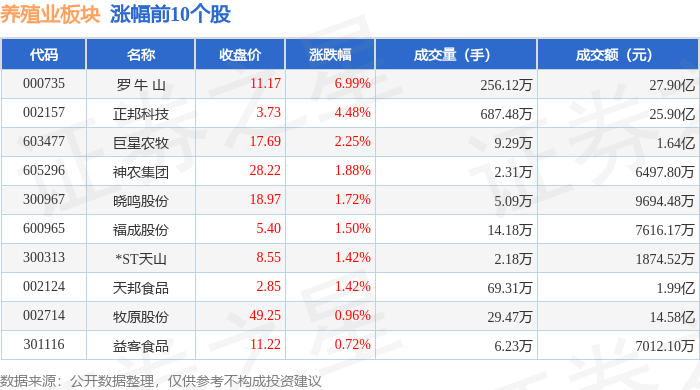
Group 1: Market Performance - The aquaculture sector increased by 0.87% on December 15, with Luo Niushan leading the gains [1] - The Shanghai Composite Index closed at 3867.92, down 0.55%, while the Shenzhen Component Index closed at 13112.09, down 1.1% [1] Group 2: Individual Stock Performance - Luo Niushan (000735) closed at 11.17, up 6.99%, with a trading volume of 2.5612 million shares and a transaction value of 2.79 billion [1] - Zhengbang Technology (002157) closed at 3.73, up 4.48%, with a trading volume of 6.8748 million shares and a transaction value of 2.59 billion [1] - Other notable stocks include Juxing Agriculture (603477) at 17.69, up 2.25%, and Shennong Group (605296) at 28.22, up 1.88% [1] Group 3: Capital Flow Analysis - The aquaculture sector saw a net inflow of 11.2465 million from institutional investors, while retail investors experienced a net outflow of 13.7316 million [2] - Main stocks with significant net inflows include Luo Niushan with 42.7010 million and Wen's Shares (300498) with 21.6029 million [3] - Retail investors showed a negative trend in several stocks, including Juxing Agriculture and New Hope, indicating a shift in investor sentiment [3]



新希望(000876):2025 年 11 月出栏月报点评:养殖成本改善,饲料持续成长-20251215
GUOTAI HAITONG SECURITIES· 2025-12-15 08:26
Investment Rating - The report maintains a "Buy" rating for the company [8] Core Views - The company is experiencing continuous improvement in breeding costs, with stable growth in both domestic and international feed businesses [1] - The target price has been adjusted to 11.27 CNY due to a decline in pig prices expected after October 2025, leading to a downward revision of earnings per share (EPS) forecasts for 2025 and 2026 [8] - The company’s breeding cost per kilogram has decreased to 12.5 CNY, with further potential for reduction [8] - The feed segment is expected to continue its robust growth, with a 16% increase in overseas sales volume in the first three quarters of 2025 [8] Financial Summary - Total revenue for 2023 is projected at 141,703 million CNY, with a slight increase of 0.1% [2] - Net profit attributable to the parent company is expected to rise significantly from 249 million CNY in 2023 to 1,077 million CNY in 2026, reflecting a growth of 117.1% in 2023 [2] - Earnings per share (EPS) is forecasted to be 0.06 CNY in 2023, increasing to 0.24 CNY by 2026 [2] - The company’s return on equity (ROE) is projected to improve from 1.0% in 2023 to 4.0% in 2026 [2] Market Data - The company's stock price has fluctuated between 8.35 CNY and 11.04 CNY over the past 52 weeks [3] - The total market capitalization is approximately 40,883 million CNY [3] Balance Sheet Summary - Shareholder equity stands at 25,762 million CNY, with a book value per share of 5.72 CNY [4] - The company has a net debt ratio of 136.65% [4] Sales and Production Insights - In November 2025, the company sold 156.75 thousand pigs, with a revenue of 1.812 billion CNY [8] - The cumulative sales from January to November 2025 reached 1,573.65 thousand pigs [8] - The average selling price of commodity pigs was 11.54 CNY per kilogram [8]
2025年生猪市场回顾与2026年展望:生猪:冬藏未尽,春芽尚伏
Fang Zheng Zhong Qi Qi Huo· 2025-12-15 06:35
Group 1: Report's Core View - In 2025, the overall commodity market showed a high - opening and low - closing trend. Agricultural products were less affected by macro - liquidity but pressured by cyclical factors. The downstream of the breeding industry chain led the decline, and pig prices hit a new low in Q3 2025. The industry focused on cost - reduction and efficiency - improvement, with no significant increase in absolute production capacity, but the production efficiency of sows improved [2]. - Looking ahead to H1 2026, it's difficult for feed costs to continue to decline. As the de - stocking of pig production capacity deepens, pig prices are expected to rise. It is recommended to buy contracts after 2607 below the breeding cost or go long on market volatility in Q2 [3]. Group 2: Industry Investment Rating - There is no information about the industry investment rating in the report. Group 3: Summary by Directory Part 1: Review of 2025 Pig Futures and Spot Prices 1. Review of Pig Futures and Spot Price Quotes - In 2025, domestic policies increased liquidity, but the economy still faced pressure. Commodity prices were polarized, and agricultural products generally fell. The downstream of the feed - breeding industry chain was under pressure due to over - capacity and weak demand [11]. 2. Summary of Characteristics of Typical Pig Cycle Bottoms in the Past - Different pig cycles had different bottom characteristics in terms of time, pig and piglet prices, sow inventory, and reasons for the bottom, such as diseases, trade issues, and policy impacts [47]. 3. Pig Futures Trading Volume and Open Interest - There is no specific content about pig futures trading volume and open interest in the given text. Part 2: Supply - Demand Fundamentals of Pigs 1. Supply Side - The industry's absolute production capacity did not increase significantly, but the average PSY of sows increased from 24 to over 26, with some leading enterprises approaching 29. The growth of sow inventory was limited [2]. 2. Demand Side - In 2025, consumer confidence was low, and food consumption was at a low level. The slaughter volume of large - scale pig slaughtering enterprises increased year - on - year, but the profit and capacity utilization rate of slaughtering enterprises were relatively low [78]. 3. Pork Supply - Demand Balance Sheet and Related Meat Production - From 2010 to 2025E, the pork supply - demand balance sheet showed changes in production, imports, supply, and demand. In 2025E, production was 5230000 tons, imports were 80000 tons, and the supply - demand difference was 168000 tons [95]. 4. Pig Breeding Profit and Cost - The average breeding cost of group enterprises decreased. The profit of pig breeding showed seasonal and annual fluctuations, with significant differences between self - breeding and self - raising and purchasing piglets for fattening [101][108][109]. 5. Seasonal Characteristics of Pig Prices - Pig prices showed certain seasonal patterns, with different monthly price changes in different years [112]. Part 3: Technical Analysis of Pig Futures and Option Strategies 1. Technical Analysis of Pig Futures - There is no specific content about the technical analysis of pig futures in the given text. 2. Pig Options - There is no specific content about pig options in the given text. Part 4: Outlook for the 2026 Pig Market - In 2026, it's difficult for feed costs to decline further. As the de - stocking of production capacity deepens, pig prices are expected to gradually recover from the bottom [3]. Appendix: Performance of Stock Prices of Related Listed Pig Companies - As of certain dates, different listed pig companies had different stock price performances and annual cumulative price change rates [124].


国家队为何匆匆离场?中信入股新希望核心资产,不足9个月便全部退出
Da Zhong Ri Bao· 2025-12-15 01:47
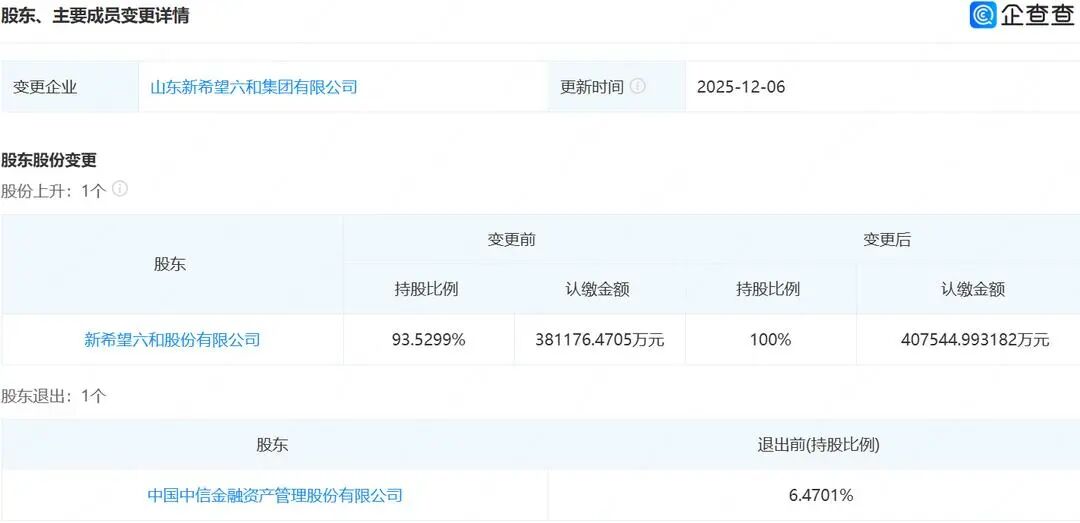
Core Viewpoint - Recently, there has been a change in the shareholders and key members of Shandong New Hope Liuhe Group Co., Ltd. (referred to as "Shandong Liuhe"), with CITIC Financial Assets exiting its stake in the company [1][2]. Shareholder Changes - CITIC Financial Assets has exited Shandong Liuhe, having previously contributed a subscribed capital of 264 million yuan, representing a 6.47% shareholding [2][3]. - New Hope (000876.SZ) has taken over all shares previously held by CITIC Financial Assets, increasing its total subscribed capital in Shandong Liuhe to 4.075 billion yuan, now holding a 100% stake [2][4]. Management Changes - The management of Shandong Liuhe has also undergone changes, with Zhang Fang replacing Ran Jiaxuan as a director. The company has transitioned from being classified as "other limited liability company" to "limited liability company, wholly owned by a legal entity that is not a natural person" [4]. Company Background - Shandong Liuhe, established in 1995 and headquartered in Qingdao, is a leading player in Shandong's livestock industry, with core businesses including feed production, food processing, breeding, import-export trade, and livestock insurance. The company has direct investments in 74 enterprises and indirect investments in 332 enterprises [5]. Recent Strategic Moves - Shandong Liuhe has been actively adjusting its asset portfolio. Notably, it exited from several subsidiaries related to livestock breeding and machinery manufacturing, while simultaneously expanding into the biotechnology sector by establishing a wholly-owned subsidiary, Sheyang New Hope Biotechnology Co., Ltd., with a subscribed capital of 20 million yuan [6].
开源晨会-20251214




KAIYUAN SECURITIES· 2025-12-14 14:42
Group 1 - The report highlights the recent performance of various industries, with notable gains in sectors such as non-ferrous metals, electronics, and power equipment, while retail and real estate sectors faced declines [1][1][1] - The central economic work conference emphasized the importance of technological breakthroughs and supply-demand optimization, indicating a shift towards quality improvement in economic growth [11][12][19] - The commercial aerospace sector is experiencing significant growth, with the establishment of a dedicated regulatory body and a notable increase in the commercial aerospace index, which has risen by 46.52% since April 7 [47][48] Group 2 - The report indicates a seasonal recovery in social financing, with November seeing an increase of 24,885 billion yuan, driven primarily by government bond issuance [4][7] - The credit environment is showing signs of marginal improvement, particularly in corporate loans, which increased by 6,100 billion yuan in November, reflecting a recovery in demand [5][6] - The report notes that the retail sector is undergoing a transformation, with a focus on quality, as highlighted by the Ministry of Commerce's emphasis on retail quality upgrades [1][1][1] Group 3 - The report discusses the rising interest in inquiry transfers, which have seen a significant increase in both project numbers and transfer scale, indicating a growing trend in the market [51][52] - The technology sector is expected to remain a key focus, with upcoming events such as the Volcano Engine FORCE conference anticipated to showcase advancements in AI and cloud services [56]
养殖业“内外兼修”锻造穿越周期新引擎
Zheng Quan Ri Bao· 2025-12-12 16:30
本报记者 肖艳青 养殖场内,智能饲喂系统实现猪群的精准投喂,巡检机器人自主巡检,集控大屏闪烁着各项生产数据——曾经手持铲勺的 饲养员,如今正紧盯着屏幕,化身掌控全局的"数据监管员"。这不仅是生产场景的转换,更是我国养殖业在阵痛中开启深层变 革的直观呈现。 当前,养殖业正在经历洗牌,行业竞争逻辑也加速改变:从一味追求规模扩张,转向对质量效益与全球资源整合能力的比 拼。在此背景下,头部企业以智能化革新练内功、以全球化布局谋外拓,"内外兼修"加速锻造穿越周期、决胜未来的新引擎。 产能调控成共识 今年以来,我国生猪价格处于下跌趋势。中国养猪网数据显示,12月12日,生猪(外三元)价格为11.45元/千克,同比下 降27.85%,环比下降3.94%。生猪价格的持续下探,使得多家企业宣布中止或延期生猪养殖项目。 "这两年,我们公司接到的焊接猪栅栏的订单明显减少了。"某焊接设备制造企业负责人向《证券日报》记者表示,这类产 品主要用于新建规模化养猪场的配套建设,订单下滑反映出生猪养殖行业新增产能放缓的情况。 面对挑战,产能调控与行业自律成为推动行业走出困局的关键路径。 今年以来,农业农村部等有关部门多次召开生猪产能调控座谈会 ...