
NEW HOPE(000876)

Search documents
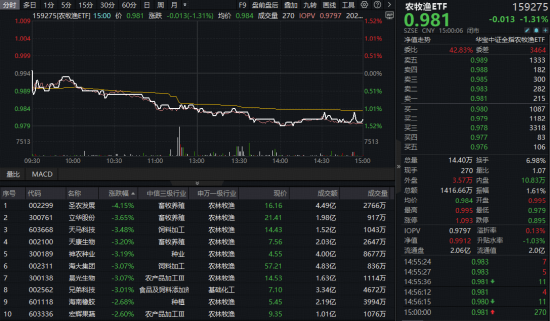
政策限产+市场出清,猪价支撑转强!全市场唯一农牧渔ETF(159275)收跌1.31%,底部区域显现?
Xin Lang Ji Jin· 2025-10-22 12:05
Core Viewpoint - The agricultural, animal husbandry, and fishery sector is experiencing a downturn, with the first agricultural ETF (159275) declining by 1.31% as of market close on October 22, 2023 [1] Industry Analysis - The pig farming industry is facing significant capacity pressure, leading to widespread losses. Current prices for fat and piglets have dropped to yearly lows, suggesting a potential further decline in prices. Historical trends indicate that when both prices are low, the industry may initiate market-driven capacity reduction, which could support long-term price increases for pigs [3] - Despite the current challenges, there is an expectation of increased pig supply in the fourth quarter due to rising slaughter volumes and accelerated weight gain as temperatures drop. This has led to a stronger demand for meat, with pig prices stabilizing at psychological levels, easing the pressure on the breeding sector [3] - The valuation of the agricultural sector remains relatively low, presenting a favorable investment opportunity. As of October 22, 2023, the agricultural ETF's index price-to-book ratio stands at 2.57, placing it in the 29.3 percentile over the past decade, highlighting its mid- to long-term investment value [3] Investment Direction - Analysts are optimistic about the pig farming sector due to policy and market forces driving capacity reduction, which is expected to enhance long-term performance [4] - The agricultural sector plays a crucial role in food security, economic development, ecological balance, and social welfare. The traditional farming industry is undergoing significant supply-side reforms, which are likely to benefit large-scale farming enterprises. The domestic market concentration is increasing, and companies that have expanded into overseas markets are expected to gain a competitive edge [5] - The current upward trend in grain prices and favorable conditions in the planting and seed sectors indicate significant investment opportunities in these areas [6] ETF Overview - The agricultural ETF (159275) tracks the CSI Agricultural Index, with major holdings including leading companies in livestock, feed, and planting sectors. The top ten holdings account for over 90% of the index, focusing on agricultural breeding, feed, and planting industries [6]





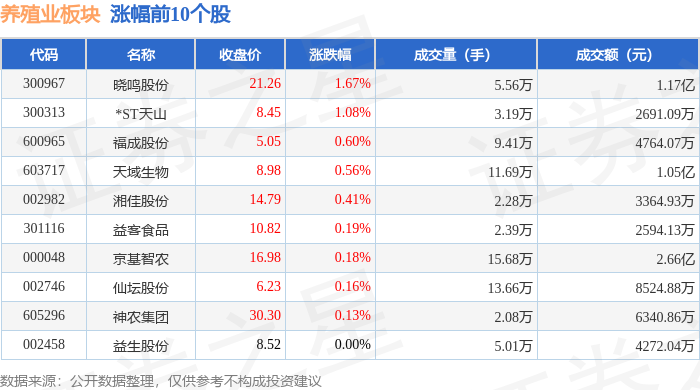
养殖业板块10月22日跌1.22%,圣农发展领跌,主力资金净流出3.88亿元
Zheng Xing Xing Ye Ri Bao· 2025-10-22 08:19
Core Insights - The aquaculture sector experienced a decline of 1.22% on October 22, with Shengnong Development leading the drop [1][2] - The Shanghai Composite Index closed at 3913.76, down 0.07%, while the Shenzhen Component Index closed at 12996.61, down 0.62% [1] Aquaculture Sector Performance - The following companies showed notable performance: - Pangming Co., Ltd. (300967) closed at 21.26, up 1.67% with a trading volume of 55,600 shares and a transaction value of 117 million [1] - Shengnong Development (002299) closed at 16.16, down 4.15% with a trading volume of 276,600 shares and a transaction value of 449 million [2] - Wens Foodstuff Group (300498) closed at 18.09, down 1.15% with a trading volume of 410,500 shares and a transaction value of 750 million [2] Capital Flow Analysis - The aquaculture sector saw a net outflow of 388 million from institutional investors, while retail investors contributed a net inflow of 211 million [2] - Notable capital flows included: - Pangming Co., Ltd. had a net inflow of 6.53 million from institutional investors, while retail investors had a net outflow of 7.21 million [3] - Wens Foodstuff Group experienced a net outflow of 2.93 million from institutional investors, with a significant net inflow of 20.58 million from retail investors [3]




生猪行业动态跟踪报告(月度):9月上市猪企出栏量同比增加环比下降,售价环比走低-20251022
Western Securities· 2025-10-22 05:18
Investment Rating - The industry investment rating is "Overweight" [5] Core Insights - In September 2025, the total number of pigs slaughtered by listed companies reached 15.2934 million, representing a year-on-year increase of 27.11% but a month-on-month decrease of 5.92% [10][11] - The significant year-on-year growth in slaughter volume is attributed to the release of new production capacity in 2024, while the month-on-month decline is due to leading companies like Muyuan and others responding to policy calls by slaughtering heavier pigs earlier [10][11] - The average selling price of pigs in September 2025 decreased by 5.42% month-on-month and 30.18% year-on-year, with the current prices being the lowest for the peak season since 2022 [19][20] - The cumulative revenue for the first three quarters of 2025 for listed pig companies was 222.871 billion, reflecting a year-on-year increase of 7.15% despite the decline in average selling prices [11][12] Summary by Sections Slaughter Volume - In September 2025, listed pig companies reported a slaughter volume of 15.2934 million pigs, with leading companies like Muyuan, Wens, and New Hope slaughtering 5.573 million, 3.3253 million, and 1.3942 million pigs respectively [10][11] - The cumulative slaughter volume for the first three quarters of 2025 was 139 million pigs, showing a year-on-year increase of 20.39% [10][11] Revenue and Pricing - The revenue for September 2025 was 21.647 billion, down 18.74% year-on-year and 10.77% month-on-month, primarily due to lower selling prices [11][12] - The average selling price for pigs in September was 13.26 yuan per kilogram, which is significantly lower than the previous year [19][20] Weight and Performance - The average weight of pigs slaughtered in September was 106.74 kg, showing a slight year-on-year increase of 0.44% but a month-on-month decrease of 0.39% [20] - Leading companies reported average weights of 126.30 kg, 113.51 kg, and 97.16 kg for Muyuan, Wens, and New Hope respectively [20]
新希望乳业股份有限公司关于控股股东减持计划期限届满暨实施情况的公告
Shang Hai Zheng Quan Bao· 2025-10-21 18:46
Core Viewpoint - The controlling shareholder of New Hope Dairy, Universal Dairy Limited (UDL), did not execute its planned share reduction within the specified timeframe, maintaining its shareholding status in the company [2][4]. Shareholder Reduction Situation - UDL had announced a plan to reduce its holdings by up to 25,820,305 shares, representing 3% of the total share capital, from July 21, 2025, to October 20, 2025 [1]. - As of October 20, 2025, UDL did not reduce any shares, and its shareholding remained unchanged [2]. Compliance with Regulations - The reduction plan adhered to relevant laws and regulations, including the Securities Law of the People's Republic of China and the Shenzhen Stock Exchange's rules [3]. - UDL has complied with its commitments made during the initial public offering, indicating a preference to continue holding shares unless specific financial needs arise [4]. Additional Notes - UDL has not violated any commitments regarding share reduction and has not triggered any conditions that would require an extension of the lock-up period or necessitate an increase in shareholding [5].

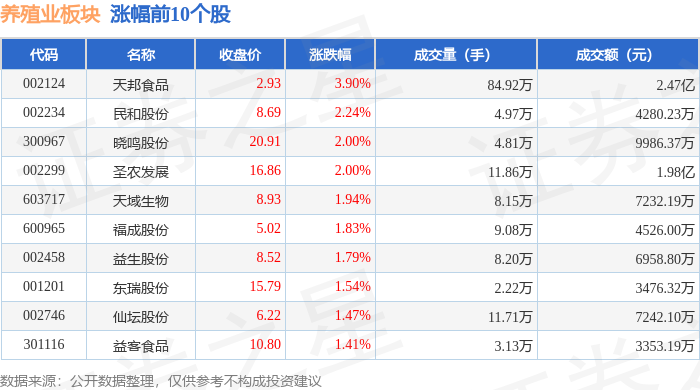
养殖业板块10月21日涨0.28%,天邦食品领涨,主力资金净流出4444.89万元
Zheng Xing Xing Ye Ri Bao· 2025-10-21 08:22
Market Overview - The aquaculture sector increased by 0.28% on October 21, with Tianbang Food leading the gains [1] - The Shanghai Composite Index closed at 3916.33, up 1.36%, while the Shenzhen Component Index closed at 13077.32, up 2.06% [1] Stock Performance - Tianbang Food (002124) closed at 2.93, up 3.90% with a trading volume of 849,200 shares and a transaction value of 247 million [1] - Minhe Livestock (002234) closed at 69.8, up 2.24% with a trading volume of 49,700 shares and a transaction value of 42.8 million [1] - Xiaoming Co. (300967) closed at 20.91, up 2.00% with a trading volume of 48,100 shares and a transaction value of 99.9 million [1] - Shengnong Development (002299) closed at 16.86, up 2.00% with a trading volume of 118,600 shares and a transaction value of 28.67 million [1] - Tianyu Bio (603717) closed at 8.93, up 1.94% with a trading volume of 81,500 shares and a transaction value of 72.32 million [1] Capital Flow - The aquaculture sector experienced a net outflow of 44.44 million from institutional investors and 35.77 million from retail investors, while retail investors saw a net inflow of 80.22 million [2] - The capital flow for individual stocks shows Shengnong Development (002299) with a net inflow of 22.98 million from institutional investors [3] - Institutional investors also showed a net inflow of 18.73 million for Zhengbang Technology (002157) [3] - Tianbang Food (002124) had a net inflow of 16.94 million from institutional investors [3]


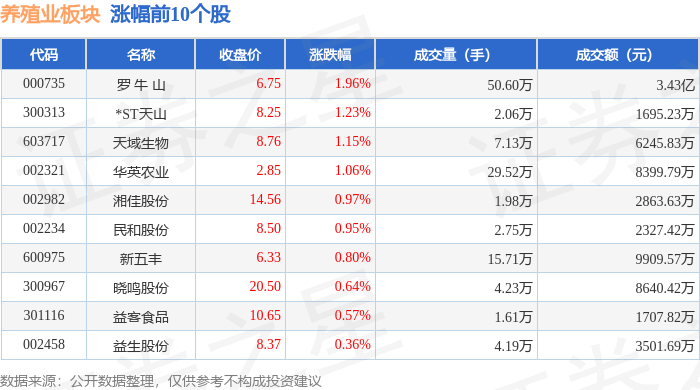
养殖业板块10月20日跌1.22%,巨星农牧领跌,主力资金净流出2.43亿元
Zheng Xing Xing Ye Ri Bao· 2025-10-20 08:21
Core Viewpoint - The livestock sector experienced a decline of 1.22% on October 20, with Juxing Agriculture leading the drop, while the Shanghai Composite Index rose by 0.63% and the Shenzhen Component Index increased by 0.98% [1][2]. Livestock Sector Performance - Juxing Agriculture's stock closed at 18.47, down 4.15%, with a trading volume of 189,500 shares and a transaction value of 350 million yuan [2]. - Other notable declines included Muyuan Foods, down 2.25% to 49.48, and Shengnong Development, down 1.31% to 16.53 [2]. - In contrast, stocks like Luoniushan and *ST Tianshan saw slight increases of 1.96% and 1.23%, respectively [1]. Capital Flow Analysis - The livestock sector saw a net outflow of 243 million yuan from main funds, while retail investors contributed a net inflow of 209 million yuan [2][3]. - Notable net inflows from retail investors were observed in stocks like Zhengbang Technology and Huaying Agriculture, while main funds showed outflows in several stocks including Shengnong Development and *ST Tianshan [3].


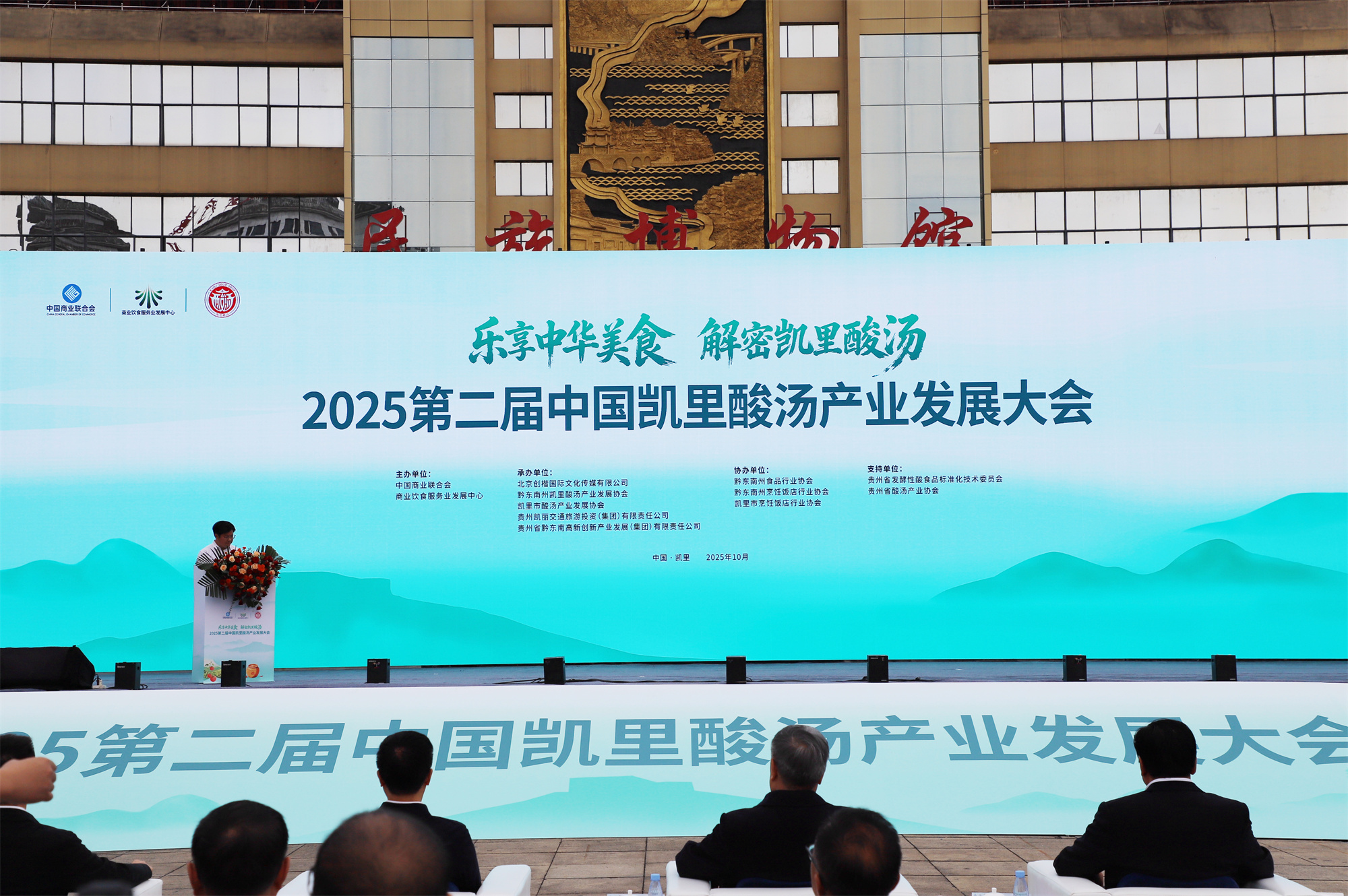
新希望味业受邀出席第二届中国凯里酸汤产业发展大会 以匠心与创新共促酸汤产业高质量发展
Zhong Guo Shi Pin Wang· 2025-10-20 07:15
Core Insights - The second China Kaili Sour Soup Industry Development Conference was held in Kaili, Guizhou, focusing on promoting Kaili sour soup as a cultural heritage and marketable product [1] - New Hope Wiyu, a key player in the condiment industry, is committed to the development of this intangible cultural heritage food [1][19] - The brand "You Yan You Wei" launched a new product, red sour soup hot pot base, which received positive feedback at the conference [3][17] Group 1: Product Development and Innovation - New Hope Wiyu's technical director shared insights on the inheritance and innovation of Kaili red sour soup, emphasizing the brand's dedication to this culinary heritage [1] - The "You Yan You Wei" brand is focused on sourcing ingredients directly from the origin and respecting traditional fermentation processes, ensuring authentic flavor [14][17] - The red sour soup undergoes a meticulous fermentation process lasting up to 365 days, highlighting the importance of time in flavor development [12][14] Group 2: Cultural Significance and Sourcing - Kaili sour soup is recognized as a national intangible cultural heritage and geographical indication product, reflecting its unique flavor derived from local resources [6] - The sourcing of key ingredients like wood ginger and Mao La fruit is crucial, with local farmers ensuring high-quality production through careful cultivation practices [7][9] - The brand's commitment to understanding and respecting the cultural background of Kaili red sour soup is essential for product authenticity [12][14] Group 3: Strategic Partnerships and Market Expansion - New Hope Wiyu has established a strategic partnership with the Kaili municipal government to promote the sour soup industry, focusing on quality development [19][22] - The collaboration aims to enhance the standardization of raw material cultivation and protect traditional production methods, benefiting local agriculture [22] - This partnership model fosters a win-win situation for the company, local farmers, and the economy, driving the growth of the sour soup industry [22]
进入投后管理,消费产业投资的挑战才真正开始|系列报道③
Sou Hu Cai Jing· 2025-10-20 04:29
Core Insights - The article discusses the evolution of the consumer industry investment landscape in China, emphasizing the shift from financial investments to strategic industrial investments as companies face slow revenue growth and profit declines due to intense competition [2][5] - It highlights the importance of post-investment management in creating value, moving beyond merely identifying opportunities to actively managing and integrating acquired companies [5][6] Group 1: Investment Strategy and Management - The article outlines how the company, New Hope Group, began its industrial investment strategy earlier than many competitors, focusing on mergers and acquisitions to find new growth drivers [2][5] - It emphasizes the need for a robust post-investment management system, which has become increasingly critical in the current investment climate, contrasting it with traditional financial investment practices [5][6] - The company has established a strategic direction of "four parts investment and six parts management," focusing on controlling risks and managing strategy, organization, and incentives [7][9] Group 2: Tools and Methodologies - The Grass Green Post Investment System (GPS) has been developed to standardize post-investment management, allowing teams to identify operational pain points and needs effectively [9][10] - Specific tools like the PD tool and PSP cycle are utilized to set clear strategic goals and create a feedback loop for continuous improvement in operations [10][13] - The company has successfully implemented these tools in various projects, leading to significant revenue growth and product innovation [10][11] Group 3: Growth Opportunities and Market Trends - The article discusses how the company has identified new growth opportunities in the consumer market, particularly in the context of changing consumer preferences and market dynamics [14][16] - It highlights the successful integration of new retail channels and the importance of collaboration with partners to enhance product offerings and market reach [18][20] - The company has adapted its strategies to focus on unique product offerings and deep collaboration with retail partners, leading to recognition as a top supplier in the market [20][22] Group 4: Ecosystem and Collaborative Management - The article describes the establishment of a multi-dimensional collaborative ecosystem that goes beyond financial investment, focusing on channel, technology, and talent collaboration [22][28] - The company has created a technology research institute to address core technical challenges and facilitate innovation across its portfolio [28][30] - Talent management is emphasized as a critical component, with a structured approach to talent selection, training, and motivation to ensure alignment with strategic goals [33][35] Group 5: Future Directions - The article concludes that the future of consumer industry investment will require a more complex approach that emphasizes collaboration and co-creation, moving beyond simple investment and management dichotomies [37]

两大畜牧展会开幕!农牧渔ETF(159275)微跌0.5%!机构:产能去化加速或促行业拐点
Xin Lang Ji Jin· 2025-10-20 01:51
Core Insights - The agricultural and livestock ETF (159275) showed weak performance with a price drop of 0.5% and a trading volume of 997,400 yuan, while the fund's latest scale is 207 million yuan [1] - Notable performers among constituent stocks include Hainan Rubber, Ronniu Mountain, and Zhongxing Mushroom Industry, with increases of 3.7%, 3.63%, and 3.0% respectively [1] - Conversely, Haida Group, Juxing Agriculture, and Tianma Technology experienced declines of 3.34%, 2.91%, and 2.61% respectively [1] - The Northeast Animal Husbandry Expo has been officially renamed and focuses on industry innovation and resource integration, while the 14th World Pig Industry Expo opened on October 18 in Changsha, covering 100,000 square meters and attracting over 800 global enterprises [1] - Dongguan Securities reported that pig prices have fallen to 11.17 yuan/kg, leading to continuous losses in breeding profits, with an average loss of 244.7 yuan per self-breeding pig [1] - The number of breeding sows remains high at 40.38 million, indicating significant future capacity reduction potential [1] - In poultry farming, the average price of white feather chickens is 6.87 yuan/kg, showing a slight decline, but breeding profits have marginally improved to -2.03 yuan per bird [1] - The industry valuation is at a PB of 2.85 times, which is at the historical 63.8% percentile, maintaining an "overweight" rating [1] Industry Analysis - The pig farming industry is experiencing supply pressure release, with prices continuing to decline; self-breeding and purchased piglet farming are both operating at losses of 244.70 yuan and 375.29 yuan per head respectively [2] - Under policy guidance, capacity reduction may accelerate, with a slight decrease in the number of breeding sows in September [2] - In poultry farming, the outbreak of avian influenza overseas creates uncertainty in the breeding of grandparent chickens, which is beneficial for the white feather chicken industry chain prices [2] - The demand in the animal health industry is expected to bottom out, with year-on-year changes in vaccine approvals for roundworms and pseudorabies at -17% and -11% respectively [2] - The seed industry is focusing on the progress of biological breeding expansion, the promotion of genetically modified corn, and industry mergers and acquisitions [2] - Pet food exports are minimally affected by tariff disturbances, while domestic sales continue to grow rapidly, with a 3% increase in e-commerce platform sales in September [2] - The agricultural and livestock ETF (159275) and its linked funds passively track the agricultural and livestock index, with the top ten weighted stocks including Muyuan Foods, Wens Foodstuff Group, Haida Group, New Hope Liuhe, Meihua Holdings, Dabeinong Technology, Shennong Development, Bio-Stock, Beidahuang, and Longping High-Tech [2]

农林牧渔行业周报:首份宠物双十一战报公布,板块或迎催化-20251019
GOLDEN SUN SECURITIES· 2025-10-19 08:34
Investment Rating - Maintain "Add" rating for the agricultural sector [5] Core Views - The first pet Double Eleven sales report has been released, indicating potential catalysts for the sector [1][12] - The trend of domestic substitution and premiumization in the pet food market remains strong, with most top brands being domestic [2][13] - The current valuation of pig farming is relatively low, with opportunities in low-cost pig farming companies [3][15] - The poultry market shows mixed signals, with white feather chicken prices declining while yellow feather chicken prices are increasing [15][30] - The commercialization of genetically modified varieties is expected to enhance growth potential in the agricultural sector [15] Summary by Sections Pet Industry - The top ten brands in the pet food sector are predominantly domestic, with high-end brands like Xianlang and Fregate leading the sales [2][13] - The Double Eleven event is ongoing, with expectations for new product launches and sales data to be closely monitored [14] Pig Farming - The national price for lean pigs is 10.98 yuan/kg, down 3.6% from last week [3][16] - The average wholesale price of pork is 18.03 yuan/kg, down 2.4% [16][24] - Self-breeding pig farming shows a loss of 244.7 yuan per head, indicating a decrease in profitability [20][21] Poultry Farming - The price of white feather chickens is 6.87 yuan/kg, down 0.1%, while chicken product prices average 8.6 yuan/kg, down 0.6% [15][34] - The price of meat chicken chicks has increased by 2.2% to 3.29 yuan each [15][30] - Yellow feather chicken prices have shown a 1.9% increase, suggesting seasonal price elasticity opportunities [15][40] Agricultural Products - The approval of genetically modified varieties is set to enter commercial sales, with potential for growth in the sector [15] - The fluctuation in agricultural product prices is expected to continue, with leading feed companies likely to replace smaller competitors [15][49] Commodity Prices - Domestic corn prices have decreased by 2.0% to 2263.14 yuan/ton [50] - Soybean meal prices have dropped by 0.7% to 2993.43 yuan/ton [68] - The price of imported fish meal has decreased by 3.7% to 13067.39 yuan/ton [80]

