
SANHUA(002050)

Search documents
三花智控(002050.SZ):已累计回购150.68万股
Ge Long Hui A P P· 2025-09-03 12:59
Core Viewpoint - Sanhua Intelligent Control (002050.SZ) announced a share buyback program, indicating a strategic move to enhance shareholder value through repurchasing shares in the market [1] Summary by Categories Company Actions - The company repurchased a total of 1.5068 million shares, which represents 0.0358% of its total share capital [1] - The buyback was conducted through a dedicated securities account via centralized bidding [1] Financial Details - The highest transaction price during the buyback was 31.00 yuan per share, while the lowest was 22.69 yuan per share [1] - The total amount spent on the buyback was 35.9715 million yuan, excluding transaction fees [1]

三花智控(002050) - 关于回购公司股份的进展公告
2025-09-03 12:47
证券代码:002050 证券简称:三花智控 公告编号:2025-085 浙江三花智能控制股份有限公司 关于回购公司股份的进展公告 本公司及董事会全体成员保证信息披露内容的真实、准确和完整,没有虚假 记载、误导性陈述或重大遗漏。 浙江三花智能控制股份有限公司(以下简称"公司")于 2024 年 12 月 30 日 召开的第七届董事会第三十次临时会议,审议通过了《关于回购公司股份方案的 议案》。2025 年 1 月 8 日,公司披露了《回购股份报告书》(公告编号:2025-002)。 具体关于回购股份的信息详见在巨潮资讯网(http://www.cninfo.com.cn)和《证 券时报》《上海证券报》披露的相关公告。 公司使用自有资金及股票回购专项贷款资金以集中竞价交易方式回购公司 股份,回购的价格不超过人民币 36.00 元/股(因实施 2024 年度权益分派,回购 价格上限相应调整,实际的回购价格上限将不超过 35.75 元/股),回购的资金总 额为不低于人民币 30,000 万元且不超过人民币 60,000 万元,具体回购股份的数 量及占总股本的比例以回购期满时实际回购数量为准。本次回购股份的实施期限 为 ...
三花智控(002050) - H股公告-截至2025年8月31日止之股份发行人的证券变动月报表
2025-09-03 12:45
致:香港交易及結算所有限公司 股份發行人及根據《上市規則》第十九B章上市的香港預託證券發行人的證券變動月報表 截至月份: 2025年8月31日 狀態: 新提交 | 1. 股份分類 | 普通股 | 股份類別 | H | | 於香港聯交所上市 (註1) | | 是 | | | --- | --- | --- | --- | --- | --- | --- | --- | --- | | 證券代號 (如上市) | 02050 | 說明 | H股 | | | | | | | | | 法定/註冊股份數目 | | | 面值 | | 法定/註冊股本 | | | 上月底結存 | | | 476,536,400 | RMB | | 1 RMB | | 476,536,400 | | 增加 / 減少 (-) | | | 0 | | | RMB | | 0 | | 本月底結存 | | | 476,536,400 | RMB | | 1 RMB | | 476,536,400 | | 2. 股份分類 | 普通股 | 股份類別 | A | | 於香港聯交所上市 (註1) | | 否 | | | --- | --- | --- | -- ...
“A+H”股热潮持续!上半年六家A股上市仪器仪表公司披露赴港IPO
Sou Hu Cai Jing· 2025-09-03 10:20
Group 1: Overview of Companies Planning to List in Hong Kong - A-share companies are increasingly planning to list in Hong Kong, with six companies including Junsheng Electronics, Naxin Micro, Estun, Puyuan Precision, Sanhua Intelligent Control, and Changguang Chenchip disclosing plans for IPOs in the first half of 2025 [1] - Junsheng Electronics has initiated its A+H share listing plan, with over 70% of its revenue coming from overseas markets, indicating a strong global presence [2] - Naxin Micro has approved plans to issue H shares and list on the Hong Kong Stock Exchange to enhance its competitiveness and international strategy [3] - Estun aims to issue H shares to accelerate its global strategy and improve its international brand image, with a focus on expanding its overseas business [4][5] - Puyuan Precision plans to issue H shares to enhance its competitiveness and utilize international capital markets for diversified financing [6][7] - Sanhua Intelligent Control has passed the listing hearing for its IPO on the Hong Kong Stock Exchange, aiming to issue up to 477 million shares [8] - Changguang Chenchip has submitted its IPO application to the Hong Kong Stock Exchange, with plans to use the funds for R&D and expanding its international business [9] Group 2: Regulatory and Market Context - The China Securities Regulatory Commission has introduced measures to support domestic companies in listing overseas, enhancing their global market capabilities [10] - The People's Bank of China and the State Administration of Foreign Exchange have issued guidelines to improve cross-border financing for domestic companies seeking to list abroad [10] - The Hong Kong Stock Exchange has launched initiatives to facilitate listings for technology and biotech companies, enhancing its attractiveness as a listing destination [10]





三花智控股价跌5.15%,华宝基金旗下1只基金重仓,持有9.99万股浮亏损失16.99万元
Xin Lang Cai Jing· 2025-09-03 05:47
Company Overview - Sanhua Intelligent Control Co., Ltd. is primarily engaged in the manufacturing of refrigeration and air conditioning electrical components and automotive components, with a revenue composition of 63.88% from refrigeration and air conditioning parts and 36.12% from automotive parts [1] - The company operates through two main divisions: refrigeration and air conditioning electrical components, and automotive components, focusing on HVAC systems and automotive thermal management [1] Stock Performance - On September 3, Sanhua Intelligent Control's stock fell by 5.15%, closing at 31.30 CNY per share, with a trading volume of 4.106 billion CNY and a turnover rate of 3.49%, resulting in a total market capitalization of 131.739 billion CNY [1] Fund Holdings - Huabao Smart Electric Vehicle ETF (516380) holds a position in Sanhua Intelligent Control, having reduced its holdings by 3,500 shares in the second quarter, now holding 99,900 shares, which constitutes 2.85% of the fund's net value [2] - The fund has reported a floating loss of approximately 169,900 CNY as of the latest update [2] Fund Manager Information - The fund manager of Huabao Smart Electric Vehicle ETF is Chen Jianhua, who has been in the position for 12 years and 259 days, with the fund's total asset size at 15.533 billion CNY [3] - During his tenure, the best fund return achieved was 153.99%, while the worst return was -49.65% [3]
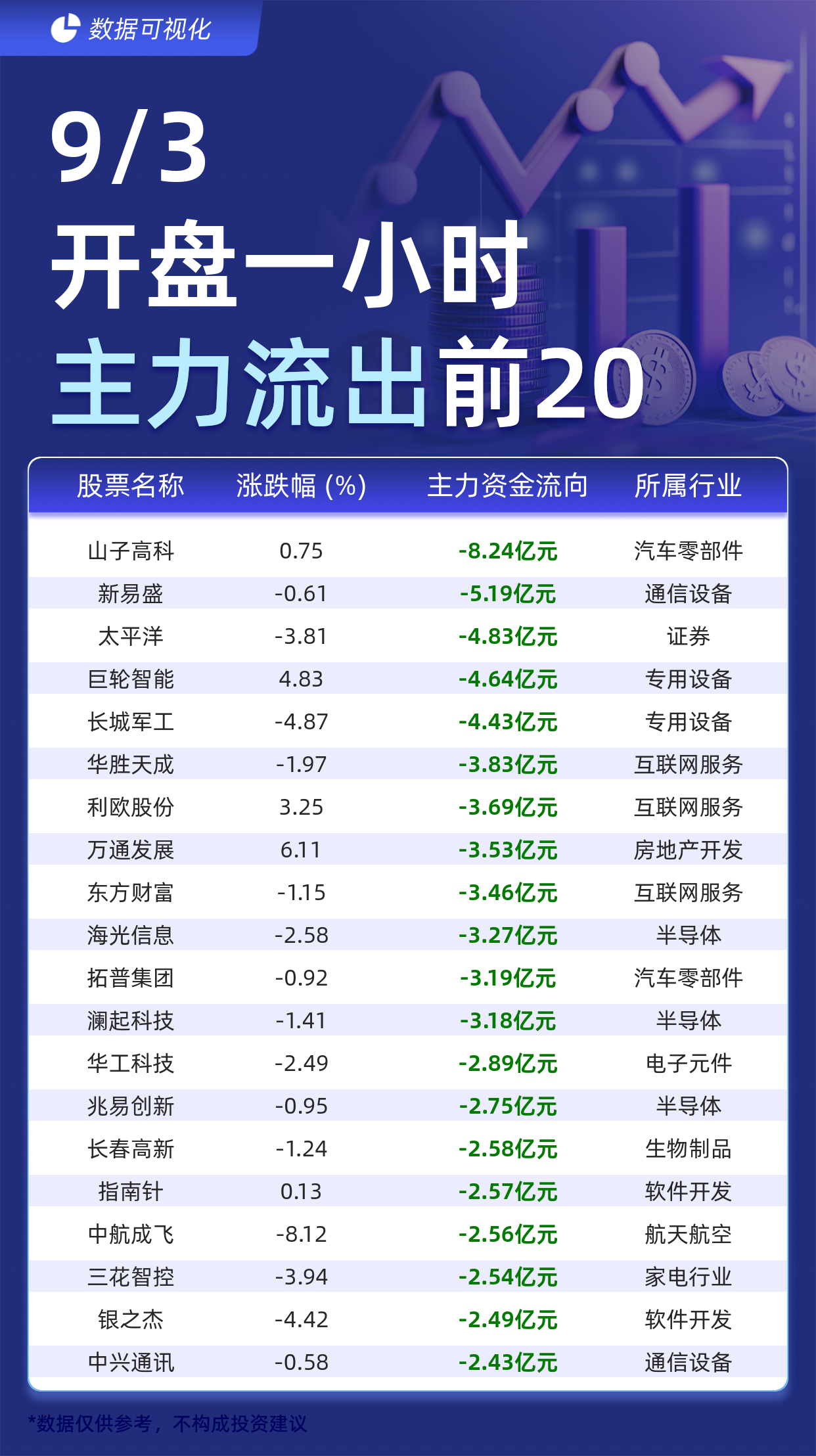
主力个股资金流出前20:山子高科流出8.24亿元、新易盛流出5.19亿元
Jin Rong Jie· 2025-09-03 02:40
Group 1 - The main stocks with significant capital outflow include Shanzi Gaoke (-8.24 billion), Xinyi Sheng (-5.19 billion), and Pacific (-4.83 billion) [1][2] - The sectors affected by the capital outflow include automotive, telecommunications, securities, and internet services [2][3] - Notable stock performances show that Shanzi Gaoke had a slight increase of 0.75%, while Longcheng Military Industry and Zhonghang Chengfei experienced declines of -4.87% and -8.12% respectively [2][3] Group 2 - The total capital outflow from the top 20 stocks indicates a trend of investors pulling back from certain sectors, particularly in specialized equipment and internet services [1][2] - Companies like Wan Tong Development and Liou Shares saw positive stock performance despite significant capital outflow, indicating potential resilience in the real estate and internet service sectors [2][3] - The data reflects a broader market sentiment where certain stocks are under pressure, leading to strategic shifts in investment focus [1][2]


14个行业获融资净买入 37股获融资净买入额超1亿元
Zheng Quan Shi Bao Wang· 2025-09-03 01:35
Group 1 - On September 2, among the 31 first-level industries tracked by Shenwan, 14 industries experienced net financing inflows, with the non-bank financial sector leading at a net inflow of 1.468 billion yuan [1] - Other industries with significant net financing inflows included pharmaceuticals and biotechnology, non-ferrous metals, chemicals, and oil and petrochemicals, each exceeding 100 million yuan in net inflow [1] Group 2 - A total of 1,658 individual stocks received net financing inflows on September 2, with 96 stocks having net inflows exceeding 50 million yuan [1] - Among these, 37 stocks had net financing inflows exceeding 100 million yuan, with Shenghong Technology leading at a net inflow of 1.367 billion yuan [1] - Other notable stocks with significant net inflows included Dongfang Wealth, Top Group, BeiGene, Data Port, Pacific, Sanhua Intelligent Control, Kunlun Wanwei, and Huahong Semiconductor, each with net inflows exceeding 200 million yuan [1]



半年报看板 | 机器人板块午后异动拉升 龙头企业中报给出乐观指引
Xin Hua Cai Jing· 2025-09-02 14:20
Group 1: Market Overview - On September 2, A-shares experienced a collective pullback, with the Shanghai Composite Index closing down 0.45%, while market trading remained active with a turnover exceeding 2.87 trillion yuan [1] - The robotics sector saw significant movement in the afternoon, with several stocks including Top Group, Zhejiang Rongtai, Qin Chuan Machine Tool, and Longxi Co. quickly hitting the daily limit, and Aowei New Materials achieving a 20% limit up [1] Group 2: Company Performance - According to Xinhua Finance, leading companies in the robotics sector by market capitalization include Huichuan Technology, Sanhua Intelligent Control, and Top Group, all with market values exceeding 100 billion yuan [1] - In the first half of 2025, Sanhua Intelligent Control reported revenue of 16.3 billion yuan, a year-on-year increase of 18.91%, and a net profit of 2.11 billion yuan, up 39.31% year-on-year [2] - Top Group achieved revenue of 12.9 billion yuan in the first half of 2025, reflecting a year-on-year growth of 5.83%, while net profit decreased by 11.08% [3] Group 3: Business Focus and Strategy - Sanhua Intelligent Control is leveraging its expertise in motor manufacturing to enter the robotics electromechanical actuator market, aiming for a new growth trajectory [2] - The company has established a dedicated robotics division and is optimistic about the development prospects of robotics as a major application of AI [2] - Top Group is focusing on the robotics actuator business, emphasizing its competitive advantages and rapid project progress in developing various robotic components [3] Group 4: Future Outlook - Sanhua Intelligent Control's humanoid robot business is expected to significantly enhance its performance, with plans to achieve a target of 1 million units in five years [2] - Top Group is developing a dual industry model combining smart automotive and robotics components, with plans for new production lines for electric drive systems [3]

75家机器人上市公司2025半年报总结:营收5821亿,盈利301亿,传统巨头与AI新锐谁能最终胜出?
机器人圈· 2025-09-02 10:32
Core Viewpoint - The Chinese robotics and artificial intelligence industry is experiencing a bifurcation, with leading companies like Cambricon and Orbbec achieving explosive growth driven by generative AI and 3D vision, while traditional firms like Geling Deep Vision and Jiangsu Beiren face significant losses [2][4]. Market Performance Overview - The overall industry is in a high prosperity phase, with 75 listed companies reporting total revenue of 582.994 billion yuan and a combined net profit of 30.097 billion yuan. 53 companies achieved year-on-year revenue growth, and 53 companies reported an increase in net profit [4][5]. Revenue and Profit Rankings - The top revenue-generating company, Industrial Fulian, reported 360.76 billion yuan, significantly outpacing the other nine companies combined. Other notable companies include Hikvision, Huichuan Technology, and Sanhua Intelligent, which not only have substantial net profits but also impressive growth rates of 36%-60% [9][11]. Losses and Challenges - Companies like SenseTime, Black Sesame Intelligence, and Unibot are showing trends of revenue growth and narrowing losses, indicating potential for value reassessment with technological breakthroughs. However, companies like Efort and Xinsong are facing dual declines, reflecting intense market competition and rapid technological changes [12][13]. Performance Growth Leaders - The top performers in terms of growth include companies like Cambricon, which reported a staggering revenue growth rate of 4347.82%, and a profit growth rate of 295.85%, highlighting the significant impact of global investments in AI technologies [11][13].






建银国际:升三花智控(02050)目标价至37.5港元 评级“跑赢大市”
智通财经网· 2025-09-02 08:59
Core Viewpoint - The report from Jianyin International highlights the strong mid-term performance of Sanhua Intelligent Control, with significant increases in revenue and profit metrics [1] Financial Performance - Sanhua Intelligent Control's revenue increased by 18.9% year-on-year in the first half of the year [1] - Net profit rose by 39.3% year-on-year [1] - Core profit saw a year-on-year increase of 31.7% [1] - The gross margin for the two main business segments improved by 0.7 percentage points, reaching approximately 28% [1] - The expense ratio improved by 1.5 percentage points, now at 11.8% [1] Business Outlook - The HVAC (Heating, Ventilation, and Air Conditioning) business is expected to accelerate growth with a compound annual growth rate (CAGR) of about 20% from fiscal years 2025 to 2027 [1] - Earnings forecasts for Sanhua Intelligent Control for the years 2025 to 2027 have been raised by 8% to 12% [1] Target Price and Rating - The target price for Sanhua Intelligent Control's H-shares has been increased from HKD 26.8 to HKD 37.5 [1] - The rating for the company is set at "outperform" [1]