
SANHUA(002050)

Search documents
科技股领跌,主线换了吗?
Guo Ji Jin Rong Bao· 2025-11-11 14:45
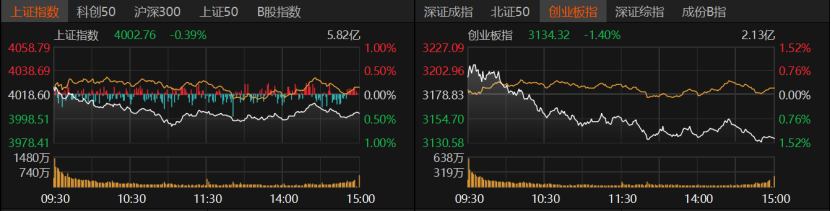
Market Overview - A-shares experienced a downturn with consumer stocks providing support while technology stocks fell sharply, leading to a decline in the ChiNext Index by over 1% [1][2] - The Shanghai Composite Index closed at 4002.76 points, down 0.39%, while the ChiNext Index fell 1.4% to 3134.32 points [2] - A total of 2785 stocks rose, while 2504 stocks fell, indicating a mixed market sentiment [3] Sector Performance - Technology sectors, particularly communication and electronics, led the declines, with significant drops in stocks like Zhongji Xiangchuang and Tianshu Communication, which fell over 4% [4][5] - The consumer sector continued its upward trend, with retail stocks showing resilience, as evidenced by the strong performance of companies like China Duty Free, which rose 4.19% [3][6] - Defensive sectors such as retail and real estate outperformed, with notable gains in the commercial retail sector [7] Investment Sentiment - Market participants are cautious due to a dense sell-off pressure above the 4000-point mark, with technical resistance observed [11] - The ongoing adjustment in technology stocks is attributed to profit-taking by institutions as year-end assessments approach, leading to capital outflows from crowded positions in the TMT sectors [1][12] - Despite the current volatility, the technology sector, particularly AI-related stocks, is expected to remain a focal point for future investment opportunities [13][14] Trading Strategies - Investors are advised to maintain stable positions, dynamically taking profits on high-valued technology stocks while gradually building positions in lower-valued stocks [15] - The focus should be on sectors supported by policy, such as new energy and photovoltaic industries, as well as traditional sectors with strong defensive characteristics [15] - Recommendations include prioritizing investments in low-valuation blue-chip stocks and sectors with strong profit certainty, while avoiding high-valuation hardware equipment [15]






科技股大降温,A股新主线曝光
21世纪经济报道· 2025-11-11 11:14
Core Viewpoint - The A-share market is experiencing significant differentiation, with consumer stocks showing strong performance while AI computing and robotics sectors are under pressure [1][2][3]. Group 1: Consumer Stocks Performance - Consumer stocks such as Huanlejia (300997.SZ) and Sanyuan (600429.SH) have seen substantial gains, with Huanlejia rising by 19.99% to a price of 26.23 [2]. - Other notable consumer stocks include Baolingbao (002286.SZ) and Zhongliang Sugar Industry (600737.SH), both achieving a 9.99% increase [2]. - The rise in consumer stocks is attributed to supportive policies and positive macroeconomic data, indicating a potential recovery in consumer spending [3]. Group 2: Policy and Macroeconomic Data - The Ministry of Finance has announced continued efforts to boost consumption, including financial subsidies for personal consumption loans [3]. - October's CPI data shows a 0.2% month-on-month increase and a 0.2% year-on-year increase, with core CPI rising by 1.2%, marking the sixth consecutive month of growth [3]. - PPI has decreased by 2.1% year-on-year but shows signs of improvement, with a 0.1% month-on-month increase, the first rise this year [3]. Group 3: Market Outlook and Sector Analysis - Economic expert Pan Helin suggests that the active consumer sector is a response to policy support and previous underperformance, indicating a potential rebound [3][4]. - Despite the current pullback in AI and technology sectors, they remain the main focus of the ongoing bull market, with high demand for computing power from companies like OpenAI [4]. - Analysts from various securities firms suggest that while the market may experience short-term fluctuations, the overall trend remains bullish, with a focus on defensive and consumer sectors in the near term [4].



A股机器人“订单荒”?相关公司回应
财联社· 2025-11-11 10:47
Core Viewpoint - Goldman Sachs conducted a field research report on the supply chain of humanoid robots in China, revealing that companies are planning significant production capacity expansions despite a lack of confirmed large orders [1][2]. Group 1: Research Findings - The report surveyed nine companies in the Chinese robotics industry, including Sanhua Intelligent Control, Top Group, and Shuanghuan Transmission, indicating a planned annual production capacity ranging from 100,000 to 1,000,000 robot equivalents [1]. - Goldman Sachs predicts a global shipment of 1.38 million units by 2035, highlighting an optimistic outlook for the supply chain's growth potential [1]. - None of the surveyed companies confirmed receiving substantial orders or provided a clear mass production timeline, raising concerns about potential "overcapacity" in the robotics supply chain [1]. Group 2: Industry Insights - Despite the current contrast between the vacuum of orders and the expansion of production capacity, industry insiders caution against prematurely concluding "overcapacity," as proactive planning is often characteristic of emerging industries on the rise [2].



高盛调研发现A股机器人“订单荒”?产业链上市公司:静待订单落地
第一财经· 2025-11-11 10:11
Core Viewpoint - The article discusses the contrasting expectations and realities in the humanoid robot sector, highlighting a recent Goldman Sachs report that indicates a lack of confirmed large orders despite optimistic production capacity plans from several companies [4][12]. Group 1: Market Sentiment and Capacity Planning - Goldman Sachs conducted a survey of nine Chinese robot supply chain companies, revealing that while they are planning annual production capacities ranging from 100,000 to 1 million units, none have confirmed large orders or clear timelines for mass production [4][6]. - Companies like Top Group and Sanhua Intelligent Control are actively planning production facilities in Thailand and Mexico, with Top Group's Thai factory projected to have an annual capacity of 1 million units and an investment of 7-8 billion yuan [7][8]. - Despite the current lack of orders, industry insiders suggest that the proactive capacity planning is typical for emerging industries and does not necessarily indicate an impending oversupply [5][12]. Group 2: Company Responses and Market Dynamics - Several companies, including Sanhua Intelligent Control and Top Group, have acknowledged the absence of confirmed orders but emphasize that their capacity planning is based on guidance from major clients [10][11]. - The article notes that the current "order vacuum" should not be hastily interpreted as a sign of oversupply, as the industry is still in its early development stages, and the demand-supply mismatch is common in new sectors [13]. - Companies like Minth Group and Double Ring Transmission are expanding their production capabilities in anticipation of future demand, with Minth expecting humanoid robot-related revenue to reach 5 billion yuan by 2030 [8][12]. Group 3: Long-term Industry Outlook - The report suggests that the current lack of orders does not negate the long-term growth potential of humanoid robots, as the industry is still exploring specific applications and technological paths [13]. - Goldman Sachs maintains a positive outlook on the long-term trends in humanoid robot technology, although it emphasizes the need to monitor key product performance and specific end-use applications to assess potential technological breakthroughs [12][13].
高盛调研发现A股机器人订单荒?产业链公司回应
Di Yi Cai Jing· 2025-11-11 09:17
Core Viewpoint - The human-shaped robot sector is experiencing a clash between optimistic expectations and the current reality, as highlighted by a Goldman Sachs report indicating that nine surveyed supply chain companies have not confirmed any significant mass production timelines or large orders [2][3]. Group 1: Survey Findings - Goldman Sachs conducted a survey from November 3 to 6, covering nine companies in the Chinese robot supply chain, including prominent firms like Sanhua Intelligent Control and Top Group [2][3]. - The surveyed companies are planning annual production capacities ranging from 100,000 to 1,000,000 robot equivalents, reflecting a positive outlook on industry growth despite the absence of confirmed large orders [3][4]. - Companies like Top Group and Sanhua Intelligent Control are actively establishing production lines in Thailand and Mexico, with Top Group's Thai factory projected to have an annual capacity of 1,000,000 units and an investment of approximately 7 to 8 billion yuan [4]. Group 2: Production Capacity and Market Response - Despite the ambitious production plans, none of the surveyed companies have confirmed receiving substantial orders, leading to concerns about potential overcapacity in the robot supply chain [3][6]. - Companies are preparing for future demand based on guidance from major clients, even though they currently lack confirmed orders [6][7]. - Analysts suggest that the current lack of orders should not be interpreted as a sign of overcapacity, as proactive capacity planning is typical in emerging industries [8]. Group 3: Industry Outlook - The optimism surrounding production capacity expansion is driven by the belief in the long-term potential of the human-shaped robot market, with companies like Minth Group projecting revenues of 5 billion yuan from related businesses by 2030 [5][8]. - The current phase of order scarcity is viewed as a natural part of the industry's early development, with significant uncertainties regarding future demand and technological evolution [8]. - Goldman Sachs maintains a positive long-term outlook on human-shaped robot technology, emphasizing the need to monitor key product performance and applications to assess potential technological breakthroughs [8].

高盛调研发现A股机器人“订单荒”?产业链上市公司:静待订单落地
Di Yi Cai Jing· 2025-11-11 08:40
Core Insights - The human-shaped robot sector is experiencing a clash between optimistic expectations and the current reality of order shortages, as highlighted by a recent Goldman Sachs report on the Chinese supply chain [1][2] Industry Overview - Goldman Sachs conducted a survey from November 3 to 6, involving nine Chinese companies in the robot supply chain, revealing that none confirmed receiving large orders or clear mass production timelines [2][3] - The surveyed companies are planning annual production capacities ranging from 100,000 to 1,000,000 units, indicating a positive outlook on industry growth despite the lack of confirmed orders [2][3] Company Responses - Companies like Top Group and Sanhua Intelligent Control have stated that their production capacity planning is based on guidance from major clients, despite not having received specific orders [5][6] - Sanhua Intelligent Control is focusing on technological improvements and product development, while Top Group is preparing capacity in anticipation of future demand [5][6] Capacity Expansion Plans - Top Group plans to establish production lines in Thailand, Mexico, and the U.S., with a projected annual capacity of 1,000,000 units and an investment of approximately 7 to 8 billion yuan [3] - Sanhua Intelligent Control has acquired land in Thailand for assembling humanoid robot actuators and has initiated capacity for humanoid robots [3] - Minth Group has completed a production line with an annual capacity of 10,000 sets for head and facial assemblies, expecting to achieve mass production by Q1 2026 [4] Market Sentiment - There are concerns about potential overcapacity in the robot supply chain due to the aggressive capacity expansion without confirmed demand [2][6] - Industry analysts suggest that the current order vacuum should not lead to premature conclusions about overcapacity, as it is typical for emerging industries to experience initial trial and error phases [7]
家电零部件板块11月11日跌1.23%,三花智控领跌,主力资金净流出8.1亿元
Zheng Xing Xing Ye Ri Bao· 2025-11-11 08:37
Market Overview - The home appliance components sector experienced a decline of 1.23% on November 11, with Sanhua Intelligent Control leading the drop [1] - The Shanghai Composite Index closed at 4002.76, down 0.39%, while the Shenzhen Component Index closed at 13289.0, down 1.03% [1] Stock Performance - Notable gainers in the home appliance components sector included: - Hanyu Group (300403) with a closing price of 16.31, up 10.88% and a trading volume of 1.1355 million shares, totaling 1.794 billion yuan [1] - Shunwei Co. (002676) closed at 9.68, up 10.00% with a trading volume of 559,300 shares, totaling 520 million yuan [1] - Conversely, Sanhua Intelligent Control (002050) saw a decline of 3.54%, closing at 43.90 with a trading volume of 2.1567 million shares, totaling 9.592 billion yuan [2] Capital Flow - The home appliance components sector saw a net outflow of 810 million yuan from institutional investors, while retail investors contributed a net inflow of 869 million yuan [2] - The capital flow for specific stocks indicated: - Hanyu Group had a net inflow of 210 million yuan from institutional investors, while retail investors had a net outflow of 136 million yuan [3] - Shunwei Co. experienced a net inflow of 108 million yuan from institutional investors, with a net outflow of 92.85 million yuan from retail investors [3]

鹏辉能源、阿特斯大涨超6%!电池50ETF(159796)跳空高开,盘中大举吸金超1.8亿元!固态电池产业化加速,26年有何期待?
Xin Lang Cai Jing· 2025-11-11 03:44
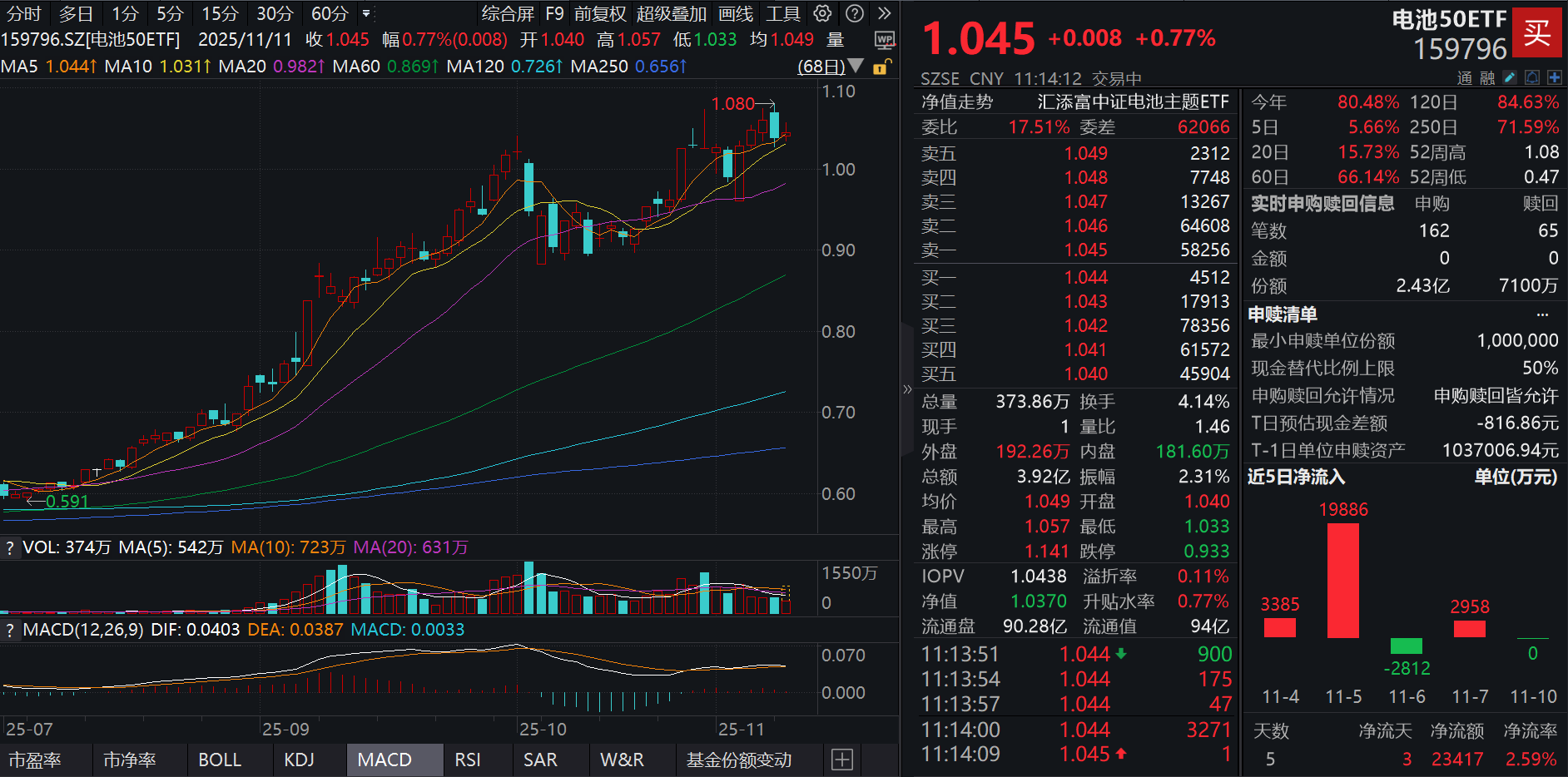
Core Viewpoint - The A-share market is experiencing fluctuations with a notable performance in the building materials and electric new energy sectors, particularly highlighted by the Battery 50 ETF (159796) which has seen significant inflows and trading activity [1][3]. Market Performance - As of 11:14, the Battery 50 ETF (159796) opened higher but slightly retreated, showing a trading volume increase of 0.77% with a transaction value of 400 million yuan [1]. - The ETF recorded a net subscription of 171 million units, resulting in a net inflow of 180 million yuan based on the average transaction price [1]. Component Stock Performance - The performance of the underlying index component stocks of the Battery 50 ETF varied, with notable gains from companies like Penghui Energy and Canadian Solar, while others like Sanhua Intelligent Control and Tianci Materials saw declines [2][3]. Key Component Stocks - The top ten component stocks of the Battery 50 ETF include: 1. Sunshine Power (16.82%) 2. CATL (7.41%) 3. Yiwei Lithium Energy (6.46%) 4. Sanhua Intelligent Control (6.14%) 5. Leading Intelligent (3.52%) 6. Tianci Materials (3.47%) 7. XWANDA (2.95%) 8. Songying Calligraphy (2.92%) 9. Greeenme (2.58%) 10. Capacity An (2.54%) [4]. Technological Developments - Penghui Energy has announced a 30 million yuan investment in the Jinshi Fengying Industrial Fund, aiming for innovation in the new energy industry chain. Their second-generation solid-state battery has achieved an energy density of over 320 Wh/kg, showcasing unique advantages in compact applications [5]. - The solid-state battery industry is accelerating, with projections indicating that global shipments will exceed 700 GWh by 2030, with a significant portion being all-solid-state batteries [6]. Demand and Supply Dynamics - The demand for power batteries is experiencing high growth, with China's new energy vehicle sales reaching 11.196 million units in the first nine months of 2025, a year-on-year increase of 34.55% [6]. - The storage battery sector is also witnessing explosive growth, with a 99.07% year-on-year increase in shipments for the first three quarters of 2025 [6]. Price Trends in the Industry - The lithium battery industry chain is seeing a stable increase in prices, with lithium carbonate and electrolyte prices experiencing significant rises due to supply-demand imbalances [6]. Investment Strategy - The Battery 50 ETF (159796) is positioned to benefit from the explosive growth in the storage sector and the breakthroughs in solid-state battery technology, making it a compelling investment option [7][9].





主力资金丨尾盘10股获资金爆买!
Zheng Quan Shi Bao Wang· 2025-11-10 11:06
Core Insights - The main point of the articles is the analysis of capital flow in various industries, highlighting the sectors that experienced significant inflows and outflows of funds on November 10, 2023. Group 1: Industry Performance - A total of 23 industries saw an increase, with the beauty care and food & beverage sectors leading with gains exceeding 3% [1] - Among the 8 declining industries, the power equipment sector had the largest drop at 1.09% [1] - The food & beverage and retail sectors received the highest net inflows, each exceeding 1.1 billion [1] Group 2: Capital Inflows - Ten industries experienced net inflows, with food & beverage and retail sectors leading with inflows over 1.1 billion each [1] - The real estate sector saw a net inflow of 700 million, while light industry manufacturing and pharmaceutical sectors each had inflows exceeding 400 million [1] Group 3: Capital Outflows - The power equipment sector had the highest net outflow, amounting to 6.88 billion [2] - Other sectors with significant outflows included electronics, mechanical equipment, automotive, and computer industries, each exceeding 2 billion [2] Group 4: Individual Stock Performance - Notable stocks with significant net inflows included Cambridge Technology with 758 million, marking the highest inflow since June 12, 2023 [4] - Wuliangye, a leading liquor company, saw a net inflow of 652 million, emphasizing its commitment to shareholder returns with a projected cash dividend rate of 70% for 2024 [4] - Other companies with notable inflows included BYD, Fushikong, and China Duty Free, among others [5] Group 5: End-of-Day Capital Flow - At the end of the trading day, there was a net inflow of 1.165 billion across the markets, with the ChiNext board contributing 928 million [10] - Individual stocks with significant end-of-day inflows included Tianfu Communication with 316 million [11]





人形机器人概念震荡走弱 浙江荣泰跌超9%
Shang Hai Zheng Quan Bao· 2025-11-10 10:46
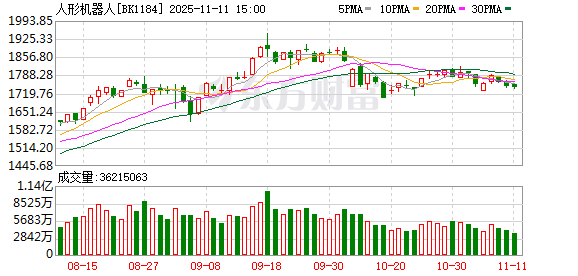
Core Viewpoint - The humanoid robot concept is experiencing a downturn, with significant declines in stock prices of related companies as of November 10 [1] Company Performance - Zhejiang Rongtai has seen a drop of over 9% in its stock price [1] - Other companies in the sector, including Top Group, Hanyu Group, Lixing Co., Sanhua Intelligent Control, and Haon Electric, are also experiencing declines [1]


