Bank of Ningbo(002142)

Search documents
浙系银行“三国杀”:陈海强能否带领浙商银行重夺“一哥”地位?
凤凰网财经· 2025-11-26 12:56
Core Viewpoint - The article discusses the recent leadership changes at Zheshang Bank and highlights the challenges faced by the bank in comparison to its competitors, particularly Ningbo Bank and Hangzhou Bank, which have surpassed it in key financial metrics [3][5][7]. Group 1: Leadership Changes - On November 17, Zheshang Bank announced the nomination of Chen Haiqiang as the new chairman, marking the first internal promotion to this position in the bank's 21-year history [3]. - Chen Haiqiang has rapidly ascended through the ranks, moving from Chief Risk Officer to President and now to Chairman within a few months [3][5]. Group 2: Financial Performance Comparison - Zheshang Bank has fallen behind in several key financial indicators, including total assets, operating income, net profit attributable to shareholders, non-performing loan ratio, and provision coverage ratio, compared to Ningbo Bank and Hangzhou Bank [5][7]. - In 2019, Ningbo Bank's net profit was 137.14 billion yuan, while Zheshang Bank's was 129.25 billion yuan. By 2024, the gap had widened to 119.41 billion yuan, with a 107.77 billion yuan deficit reported in the first three quarters of this year [7][8]. - As of the first quarter of this year, Ningbo Bank's operating income surpassed that of Zheshang Bank for the first time, and by June, its total assets reached 3.47 trillion yuan, also exceeding Zheshang Bank [9]. Group 3: Profitability and Asset Quality - Zheshang Bank's net profit has declined by 9.59% in the first three quarters of this year, with a significant drop of 18.45% in the third quarter alone, while both Ningbo Bank and Hangzhou Bank have maintained steady growth [10]. - The bank's non-performing loan ratio has decreased from 1.53% in 2021 to 1.36% in the third quarter of 2025, but its provision coverage ratio has dropped to 159.56%, significantly lower than its competitors [12]. Group 4: Internal Control and Reputation Challenges - Zheshang Bank has faced a series of corruption scandals involving high-ranking officials, which have tarnished its reputation. The bank has received 20 regulatory fines this year, totaling over 46 million yuan [15][16]. - Chen Haiqiang's immediate tasks include optimizing internal controls and restoring the bank's reputation, alongside addressing existing risk assets [14][16].





浙系银行“三国杀”:陈海强能否带领浙商银行重夺“一哥”地位?
Feng Huang Wang Cai Jing· 2025-11-26 09:51
Core Viewpoint - The appointment of Chen Haiqiang as the new chairman of Zheshang Bank marks a significant internal promotion, but the bank faces substantial challenges as it has fallen behind competitors in key financial metrics [1][3][4]. Group 1: Leadership Changes - Chen Haiqiang has been nominated as the new chairman of Zheshang Bank, becoming the first internal candidate to hold this position in the bank's 21-year history [1]. - He has rapidly ascended through the ranks, moving from Chief Risk Officer to President and now to Chairman within a few months [1]. Group 2: Financial Performance - Zheshang Bank's total assets, operating income, and net profit have all lagged behind those of Ningbo Bank and Hangzhou Bank, with the latter surpassing Zheshang Bank in net profit by 4.217 billion yuan [3][4]. - In 2019, Ningbo Bank's net profit was 137.14 billion yuan compared to Zheshang Bank's 129.25 billion yuan, and by 2024, the gap had widened to 119.41 billion yuan [4]. - For the first three quarters of 2025, Zheshang Bank reported a net profit of 11.668 billion yuan, down 9.59% year-on-year, with a significant quarterly decline of 18.45% [7][8]. Group 3: Asset Quality and Risk Management - Zheshang Bank has made significant progress in reducing non-performing loans, with the non-performing loan ratio decreasing from 1.53% in 2021 to 1.36% in Q3 2025 [8]. - Despite improvements in asset quality, the bank still faces challenges with a growing balance of non-performing loans and an increase in loans under scrutiny [9]. Group 4: Internal Control and Reputation Issues - The bank has been plagued by a series of corruption scandals involving high-ranking officials, which have tarnished its reputation [11]. - In 2023, Zheshang Bank received 20 regulatory fines totaling over 46 million yuan, indicating significant internal control issues [12]. - Chen Haiqiang's immediate tasks include optimizing internal controls and restoring the bank's reputation while also addressing existing risks [9][12]. Group 5: Competitive Landscape - The competitive dynamics among Zhejiang banks have shifted from a focus on scale to a focus on quality and differentiation, posing additional challenges for Zheshang Bank [12].

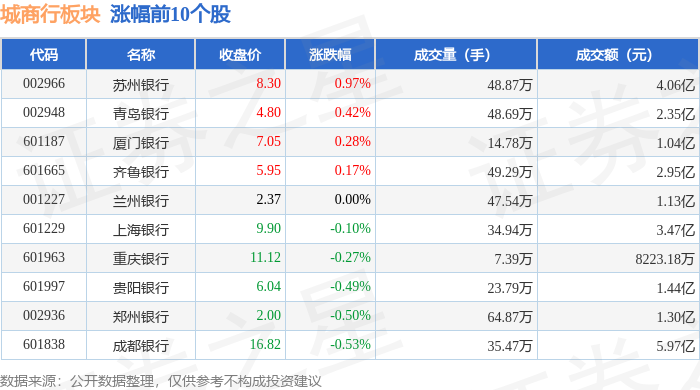
城商行板块11月26日跌0.59%,南京银行领跌,主力资金净流出1.47亿元
Zheng Xing Xing Ye Ri Bao· 2025-11-26 09:05
Market Performance - The city commercial bank sector declined by 0.59% on November 26, with Nanjing Bank leading the drop [1] - The Shanghai Composite Index closed at 3864.18, down 0.15%, while the Shenzhen Component Index rose by 1.02% to 12907.83 [1] Individual Stock Performance - Suzhou Bank closed at 8.30, up 0.97% with a trading volume of 488,700 shares and a transaction value of 406 million yuan [1] - Nanjing Bank closed at 11.49, down 1.29% with a trading volume of 514,300 shares and a transaction value of 592 million yuan [2] - Chengdu Bank closed at 16.82, down 0.53% with a trading volume of 354,700 shares and a transaction value of 597 million yuan [2] Capital Flow Analysis - The city commercial bank sector experienced a net outflow of 147 million yuan from institutional investors, while retail investors saw a net inflow of 152 million yuan [2] - Among individual stocks, Suzhou Bank had a net outflow of 31.27 million yuan from institutional investors, while Nanjing Bank saw a net inflow of 27.56 million yuan [3]



外汇展业改革参与银行增至26家 三季度工行等4家入列
2 1 Shi Ji Jing Ji Bao Dao· 2025-11-26 07:00
Core Insights - The foreign exchange business reform has been positively received by commercial banks and the public, with 26 banks participating as of September 2025, covering various types of banks across the country [1][2] Group 1: Reform Implementation and Participation - As of September 2025, 26 banks are involved in the foreign exchange business reform, including 5 large banks, 9 joint-stock banks, 4 city commercial banks, and 8 foreign banks [1] - The newly added banks in the third quarter include Industrial and Commercial Bank of China, Deutsche Bank, Mizuho Bank, and Mitsubishi UFJ Financial Group [2] Group 2: Benefits of the Reform - The reform has reduced the burden on enterprises, allowing them to handle foreign exchange transactions more efficiently, with some businesses experiencing a significant reduction in processing time from days to minutes [3] - Banks have improved their customer identification and service capabilities, leading to a reduction in average processing time for transactions by over 50% [3] - The reform has enhanced regulatory quality, with banks establishing risk monitoring systems to better track cross-border transactions and identify abnormal activities early [3] Group 3: Future Directions - The State Administration of Foreign Exchange plans to further enhance the foreign exchange management system, focusing on convenience, openness, security, and intelligence [4] - Future efforts will include expanding the coverage of the reform to benefit more enterprises and integrating various facilitation policies [4] - The application of new technologies such as artificial intelligence and big data will be encouraged to improve efficiency in foreign exchange services [4]




宁波银行(002142) - 2025年11月25日投资者关系活动记录表
2025-11-25 07:14
Group 1: Competitive Advantages - The company adopts a differentiated business strategy to adapt to changes in the operating environment and accumulate unique advantages [2] - Key strategies include deepening operational focus, enhancing professional management, accelerating technological transformation, and maintaining risk management to ensure stable operations [2] Group 2: Capital Growth and Financing - The company emphasizes the long-term relationship between dividends and internal capital growth, ensuring a solid capital foundation for sustainable business development [2] - Internal capital is expected to create greater value for the company's development, with a commitment to improving performance and maintaining steady internal capital growth for shareholder returns [2] Group 3: Loan Growth and Economic Support - The company has focused on supporting key sectors such as small and micro enterprises, manufacturing, import-export businesses, and consumer services, leading to steady loan growth [2] - Future loan growth is anticipated to be supported by ongoing policy benefits aimed at expanding domestic demand and promoting consumption, effectively meeting the financing needs of the real economy [2] Group 4: Compliance and Communication - During the investor relations activity, the company ensured thorough communication with investors while adhering to disclosure regulations, with no significant undisclosed information leaks reported [2]
长三角6家上市城商行的韧性增长:息差承压之下营收净利双增,对公业务成信贷投放“主引擎”
Mei Ri Jing Ji Xin Wen· 2025-11-25 06:00
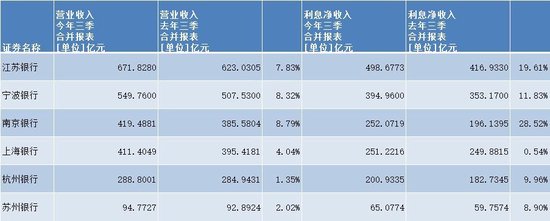
Core Viewpoint - The six A-share listed city commercial banks in the Yangtze River Delta region are demonstrating resilient growth, achieving increases in both revenue and net profit despite the pressure of narrowing interest margins [1][2]. Revenue and Profit Growth - All six city commercial banks reported year-on-year growth in both revenue and net profit for the first three quarters, with five banks achieving profits exceeding 10 billion yuan, except for Suzhou Bank, which is relatively smaller [2]. - Jiangsu Bank led with a revenue of 67.183 billion yuan and a net profit of 30.583 billion yuan, ranking first among A-share city commercial banks [2]. Interest Income Performance - Despite the overall pressure on interest margins, all six banks achieved year-on-year growth in net interest income, with Nanjing Bank and Jiangsu Bank showing significant increases of 28.52% and 19.61%, respectively [3]. - Nanjing Bank attributed its growth in net interest income to increased credit investment and optimized asset allocation strategies, alongside a reduction in deposit costs [3]. Asset Expansion - The six banks are steadily expanding their asset scales, with Jiangsu Bank holding the largest total assets of 4.93 trillion yuan, marking a 24.68% increase from the beginning of the year, the fastest growth among A-share listed banks [6]. - All banks exhibited strong growth in both deposits and loans, with Jiangsu Bank's total deposits reaching 2.54 trillion yuan, a 20.22% increase, and total loans growing by 17.87% to 2.47 trillion yuan [6]. Corporate Lending Growth - Corporate lending has become the main driver of credit expansion for these banks, with significant growth in loans for technology finance, inclusive finance, and green finance [9]. - For instance, Nanjing Bank's corporate loans increased by 14.63%, with notable growth in green finance (33.03%), technology finance (17.47%), and inclusive finance (16.16%) [9]. Asset Quality - The asset quality of the six banks remains stable, with non-performing loan (NPL) ratios either holding steady or declining. Jiangsu Bank's NPL ratio decreased by 0.05 percentage points to 0.84% [10]. - Nanjing Bank's NPL ratio remained stable at 0.83%, reflecting effective risk management and asset disposal strategies [10]. Capital Adequacy - Shanghai Bank reported a high core Tier 1 capital adequacy ratio of 10.52%, up 0.17 percentage points from the beginning of the year, supported by improved profitability and capital management [11]. - Both Hangzhou Bank and Nanjing Bank completed convertible bond conversions, with their core Tier 1 capital ratios rising to 9.64% and 9.54%, respectively [11]. Dividend Distribution - Several banks, including Shanghai Bank and Suzhou Bank, have completed mid-term dividend distributions, with Jiangsu Bank and Ningbo Bank also advancing their mid-term dividend plans [12]. - Hangzhou Bank has consistently increased its cash dividend ratio, with a projected mid-term dividend of 2.755 billion yuan for 2025, reflecting a commitment to enhancing shareholder returns [13].


24家A股银行将现金分红超2600亿元
2 1 Shi Ji Jing Ji Bao Dao· 2025-11-24 12:56
Core Viewpoint - The recent surge in stock prices of major Chinese banks is driven by their mid-term dividend announcements, with a total cash dividend amounting to 2637.90 billion yuan for 2025, indicating significant investment potential in the banking sector [2][4]. Dividend Announcements - As of November 24, 2025, 24 A-share listed banks have disclosed their mid-term dividend plans, with a total cash dividend of 2638 billion yuan [4]. - Notably, seven banks, including Industrial Bank, Changsha Bank, and Ningbo Bank, are implementing mid-term dividends for the first time since their listings [2]. - The six major state-owned banks are expected to distribute over 2046 billion yuan in dividends [5]. Dividend Yield - The average dividend yield for listed banks as of November 24 is 4.48%, with 12 banks yielding over 5% and 26 banks exceeding 4% [6]. - Specific banks like Bank of Communications and China Construction Bank have dividend yields of 4.18% and 3.93%, respectively [6]. Shareholder and Executive Buybacks - There has been a notable increase in share buybacks by major shareholders and executives of listed banks, signaling positive market sentiment [8]. - For instance, Chengdu Bank's major shareholders have collectively bought approximately 34.25 million shares, investing 6.11 billion yuan from August 27 to November 21 [8]. - Nanjing Bank reported that foreign shareholder BNP Paribas increased its stake by over 128 million shares, raising its ownership to 18.06% [9]. Overall Market Sentiment - The banking sector has seen a net increase in holdings exceeding 9 billion yuan, with significant buybacks from shareholders and executives across multiple banks [10]. - The proactive buyback activities reflect confidence in the banks' future strategies and growth prospects, with the banking sector ranking second in shareholder buybacks this year, only behind the transportation sector [10].


24家A股银行将现金分红超2600亿元
21世纪经济报道· 2025-11-24 12:38
Core Viewpoint - The recent surge in stock prices of major banks in China is driven by their mid-term dividend announcements, with a total cash dividend amounting to 2638 billion yuan for 2025, indicating significant value potential in the banking sector [2][3][4]. Dividend Announcements - As of November 24, 2025, 24 A-share listed banks have disclosed their mid-term dividend plans, with a total cash dividend of 2638 billion yuan, including first-time mid-term dividends from seven banks [2][4]. - Notably, Wuxi Bank announced a cash dividend of 0.11 yuan per share, totaling 2.41 billion yuan, with the ex-dividend date on November 25, 2025 [4]. - Hangzhou Bank plans to distribute a cash dividend of 0.38 yuan per share, amounting to 27.55 billion yuan, reflecting a 24.10% increase from the previous year [4]. Dividend Yields - The average dividend yield for listed banks as of November 24 is 4.48%, with 12 banks yielding over 5% and 26 banks over 4% [5]. - Major banks like Bank of Communications and Agricultural Bank of China have lower yields, ranging from 3% to 4.18% [5]. Shareholder and Executive Buybacks - There has been a notable increase in share buybacks by major shareholders and executives, signaling positive market sentiment [7][8]. - For instance, Chengdu Bank's major shareholders increased their holdings by approximately 34.24 million shares, investing 611 million yuan [7]. - The banking sector has seen a total of 126.30 billion yuan in buybacks this year, ranking second among industry sectors [8]. Market Performance and Outlook - The banking sector has experienced a net increase in holdings exceeding 90 billion yuan, with significant support for stock prices from shareholder buybacks [6][9]. - Analysts suggest that the upcoming long-term capital allocation period at year-end will further enhance the market performance of bank stocks [9].




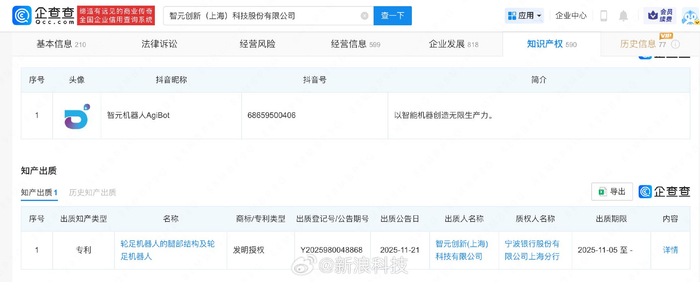
智元机器人出质轮足机器人专利
Qi Cha Cha· 2025-11-24 10:06
Core Insights - The article highlights a new patent announcement by Zhiyuan Innovation (Shanghai) Technology Co., Ltd. for a "Leg Structure of Wheel-legged Robot and Wheel-legged Robot" [1] - The patent is secured by Ningbo Bank Co., Ltd. Shanghai Branch, indicating a financial backing for the innovation [1] Summary by Categories - **Patent Details** - The newly announced patent utilizes a motor-driven mechanism, which eliminates the need for lubrication or closed protection compared to existing gear structures [1] - This innovation addresses the wear issues associated with gears, thereby enhancing the reliability of wheel-legged robots [1] - **Financial Implications** - The involvement of Ningbo Bank as the pledgee suggests potential financial support and investment interest in the technology [1]

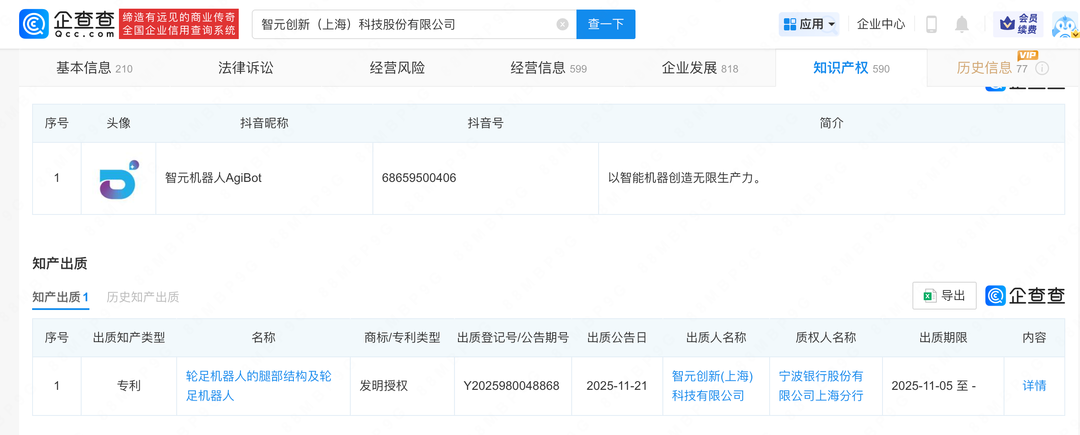
智元机器人出质轮足机器人专利予宁波银行上海分行
Xin Lang Ke Ji· 2025-11-24 03:11
Core Insights - The article discusses a recent patent announcement by Zhiyuan Innovation (Shanghai) Technology Co., Ltd. regarding a "leg structure of a wheeled-foot robot" [1] - The patent is secured by Ningbo Bank Co., Ltd. Shanghai Branch, indicating a financial backing for the innovation [1] Summary by Categories Patent Details - The newly announced patent focuses on a wheeled-foot robot, specifically its leg structure [1] - The technology utilizes motor-driven mechanisms, eliminating the need for lubrication or protective sealing, which is a common requirement in existing gear structures [1] Technical Advantages - The absence of gears in the design reduces wear and tear, thereby enhancing the reliability of the wheeled-foot robot [1] - This innovation represents a significant improvement over traditional technologies, potentially leading to broader applications in robotics [1]