
Bank of Ningbo(002142)

Search documents
银行业2025年半年报业绩综述:营收净利润增速转正,负债端成本普遍改善
Dongguan Securities· 2025-09-05 05:14
Investment Rating - The report maintains an "Overweight" rating for the banking industry [1][3][5] Core Insights - The banking sector has shown signs of performance recovery, with operating revenue and net profit growth turning positive in the first half of 2025. Total operating revenue reached CNY 2.92 trillion, a year-on-year increase of 1.04%, while net profit attributable to shareholders grew by 0.80% [3][14][24] - The average return on equity (ROE) for listed banks remains above 10%, standing at 10.99%, although it has decreased by 0.56 percentage points year-on-year [3][26] - The report highlights a shift in loan demand, with corporate loans showing strength while retail loans remain weak. The total loan amount increased by 7.96% year-on-year, with corporate loans accounting for 66.74% of new loans [3][39] - The net interest margin decline has slowed, with the weighted average net interest margin at 1.43%, down 13 basis points year-on-year, indicating reduced pressure on funding costs [3][50] Summary by Sections 1. Performance Recovery and Non-Interest Income - The banking sector's revenue growth turned positive, driven by a recovery in the bond market, with non-interest income increasing by 10.76% year-on-year in the first half of 2025 [3][20] - The second quarter saw a significant improvement in revenue growth, with a year-on-year increase of 3.91%, marking a turnaround from negative growth [15][20] - Individual banks showed varied performance, with some achieving substantial revenue growth, while others lagged behind [21][25] 2. Loan and Deposit Trends - The total assets of listed banks grew by 9.60% year-on-year, with city commercial banks leading in asset expansion [3][31] - The proportion of demand deposits has declined to a historical low, with a shift towards time deposits [3][50] - The report notes a cautious approach to retail lending due to rising credit risks, with banks focusing on corporate lending to support economic transformation [39][47] 3. Interest Margin and Cost of Liabilities - The average net interest margin has shown a reduced rate of decline, indicating improved conditions for banks [3][50] - The cost of liabilities has generally decreased, contributing to a more favorable operating environment for banks [3][50] 4. Asset Quality and Provision Coverage - The average non-performing loan (NPL) ratio for listed banks was stable at 1.23%, with a slight year-on-year improvement [3][4] - The provision coverage ratio has decreased slightly, reflecting some banks' decisions to release provisions to boost profits [3][4] 5. Investment Recommendations - The report suggests focusing on three main investment lines: high dividend, low valuation banks such as ICBC, ABC, BOC, and CCB; banks with regional advantages and strong performance certainty like Chengdu Bank and Hangzhou Bank; and banks benefiting from retail business recovery like China Merchants Bank and Industrial Bank [5][5]






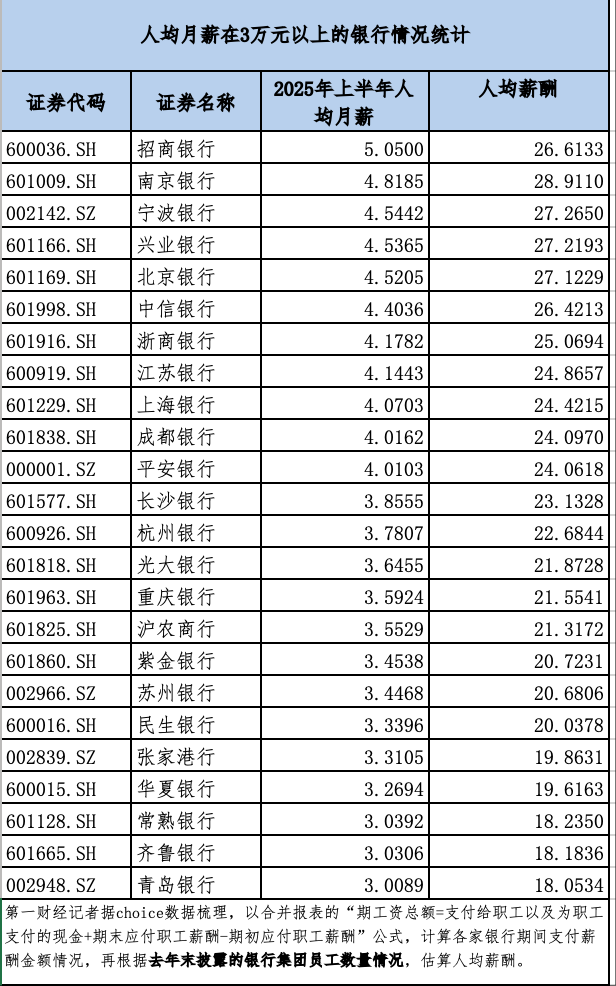
揭秘银行薪酬:24家银行上半年人均月薪超3万,高管降薪成趋势
Di Yi Cai Jing· 2025-09-04 22:49
Core Viewpoint - The banking sector in A-shares has regained its position as the largest sector with a market value of 11.31 trillion yuan, surpassing the electronics sector, while the salary situation of banking employees has also drawn attention [1] Salary Overview - The average monthly salary in the banking industry for the first half of 2025 is 30,200 yuan, a slight increase of 1,300 yuan year-on-year, reversing a trend of a 5,300 yuan decrease in the same period last year [2][4] - The top tier of banks, including joint-stock banks and strong city commercial banks in eastern regions, have an average monthly salary exceeding 45,000 yuan, with specific banks like China Merchants Bank and Nanjing Bank reporting 50,500 yuan and 48,185 yuan respectively [2][3] Salary Distribution - The second tier consists of state-owned banks with average monthly salaries ranging from 25,000 to 30,000 yuan, with Bank of China at 28,200 yuan and China Construction Bank at 26,200 yuan [3] - The third tier includes some rural and city commercial banks in remote areas, with average salaries below 25,000 yuan, such as Zhengzhou Bank and Xi'an Bank at 24,700 yuan and 22,800 yuan respectively [4] Management Salary Trends - A significant trend in the banking industry is the reduction of executive salaries, with 33 out of 42 A-share listed banks reporting a decrease in management compensation, with the highest drop reaching 82.4% [5][6] - For instance, Zhengzhou Bank's key management compensation fell from 103.88 million yuan to 59.57 million yuan year-on-year [5] Salary Reform and Mechanisms - Many banks are emphasizing salary structure reforms, focusing on value creation and incentivizing younger employees to work in grassroots positions [6][7] - The implementation of a reverse salary mechanism is becoming more common, allowing banks to reclaim performance-related pay in cases of misconduct or excessive risk exposure [7] Industry Context - It is important to note that the salary levels of listed banks do not represent the overall banking industry, as many smaller banks and rural credit cooperatives have significantly lower average salaries due to various factors affecting their profitability [8]





“把脉”A股42家上市银行中期资产质量:对公贷款不良率持续向好,零售贷款仍处风险暴露期
Mei Ri Jing Ji Xin Wen· 2025-09-04 14:35
Group 1: Overall Asset Quality - As of August 31, 2023, the asset quality of 42 listed banks in A-shares shows a stable improvement, with some banks experiencing a slight increase in non-performing loan (NPL) ratios compared to the end of the previous year [1] - The overall NPL ratio for commercial banks was 1.49% at the end of Q2 2023, improving by 0.02 percentage points from the end of Q1 [3] - The provision coverage ratio for state-owned banks and rural commercial banks increased to 249.16% and 161.87%, respectively, while the ratios for joint-stock banks and city commercial banks decreased [4] Group 2: Non-Performing Loan Trends - The NPL ratio for corporate loans is improving, while the NPL ratio for retail loans is on the rise, indicating a structural change in asset quality [5][6] - For example, Industrial and Commercial Bank of China (ICBC) reported a decrease in corporate loan NPL ratio from 1.58% to 1.47%, while the personal loan NPL ratio increased from 1.15% to 1.35% [5] - The rise in retail loan NPLs is attributed to factors such as market conditions, increased flexible employment, and changes in industry environments affecting borrower income [6] Group 3: Real Estate Loan Performance - The real estate sector remains a significant source of NPLs, with some banks reporting an increase in real estate loan NPL ratios, while others have seen improvements [7][8] - For instance, Qingnong Commercial Bank's real estate NPL ratio rose to 21.32%, an increase of 14.15 percentage points from the end of the previous year [7] - The overall decline in real estate sales and the high leverage of real estate companies are fundamental reasons for the rising NPL ratios in this sector [8]



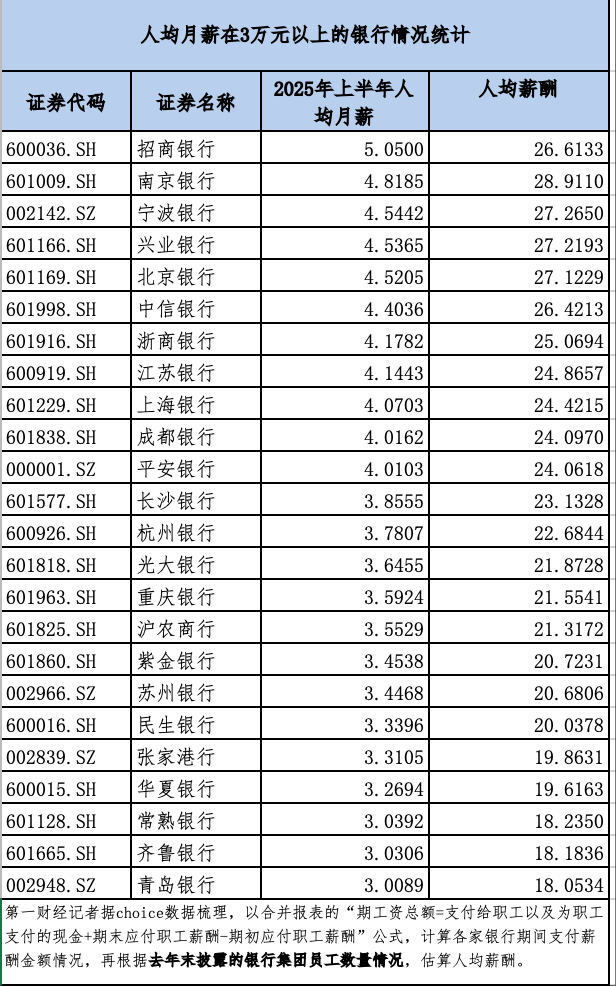
揭秘银行薪酬:24家银行上半年人均月薪超3万元,高管降薪成趋势
Di Yi Cai Jing· 2025-09-04 13:04
Core Insights - The banking sector's compensation reform has shifted from "controlling high" to a dual focus on "lowering" and "risk constraints" [1] - The average monthly salary for bank employees in the first half of 2025 was 30,200 yuan, a slight increase of 1,300 yuan year-on-year [2][5] - A total of 42 banks reported a decline in management salaries, with the highest drop reaching 82.4% [6][8] Salary Structure - The banking industry has formed a salary tier system, with leading joint-stock banks and strong city commercial banks in the first tier, averaging over 45,000 yuan per month [2][4] - Major state-owned banks fall into the second tier, with average monthly salaries ranging from 25,000 to 30,000 yuan [4][5] - Some rural and city commercial banks in remote areas are in the third tier, with average salaries below 25,000 yuan [5] Management Salary Trends - Key management salaries have seen significant reductions, with 33 out of 42 listed banks reporting a decrease in total management compensation [6][8] - For example, Zhengzhou Bank's management compensation dropped from 10,388 million yuan to 5,957 million yuan year-on-year [6] - The trend of management salary cuts is becoming a new norm in the industry, with banks emphasizing value creation and risk management in their compensation structures [7][8] Compensation Reform Mechanisms - Many banks are implementing reverse salary recovery mechanisms to enhance performance accountability [8] - For instance, Zhengzhou Bank has established a mechanism for deferred payment and performance salary recovery to mitigate operational risks [8] - The overall direction of salary distribution is shifting towards grassroots employees, reducing the previous "averaging" phenomenon [8][9] Industry Context - The salary levels of listed banks do not represent the overall banking industry's compensation situation, as many smaller banks have significantly lower average salaries [9] - The banking sector consists of over 4,000 financial institutions, with listed banks being a small fraction of the total [9]
国信证券(香港):银行板块业绩筑底 关注顺周期标的宁波银行等
Zhi Tong Cai Jing· 2025-09-04 09:15
Core Viewpoint - The report from Guosen Securities (Hong Kong) indicates that 2025 marks the end of the current downcycle for the banking sector, with expectations for improvement in the industry fundamentals next year, maintaining an "outperform" rating for the sector [1] Group 1: Overall Review - In the first half of 2025, listed banks reported total operating income of 2.92 trillion yuan, a year-on-year increase of 1.0%, and a net profit attributable to shareholders of 1.10 trillion yuan, up 0.8% year-on-year [1] - The growth in income and net profit accelerated compared to the first quarter, primarily due to a decline in market interest rates in the second quarter, which reduced the drag from bond investment losses and other non-interest income on net profit growth [1] Group 2: Net Interest Margin - The overall net interest margin for listed banks decreased by 14 basis points year-on-year to 1.41%, a decline similar to the 13 basis points drop in the first quarter, but narrower than the 17 basis points decline in 2024 [2] - On a quarterly basis, the net interest margin fell by 4 basis points from the first to the second quarter [2] - The outlook for the year suggests that the net interest margin will continue to narrow due to LPR cuts and weak credit demand, although the decline is expected to be slightly lessened by the drop in deposit rates in May [2] Group 3: Asset Quality - The pressure on asset quality is marginally increasing, characterized by rising overdue rates and an increase in the non-performing loan generation rate, primarily in the retail sector [3] - Provisioning efforts have intensified, with the ratio of loan loss provisions to non-performing loan generation rising to 106%, although this remains at a historically low level [3] Group 4: Asset Scale - As of the end of the second quarter of 2025, the total assets of listed banks grew by 9.6% year-on-year, with a notable rebound in growth rates from the six major banks and city commercial banks [4] Group 5: Non-Interest Income - After three years of adjustment, net fee income has rebounded in the first half of this year [5] - Other non-interest income saw a significant decline in growth in the first quarter due to rising market interest rates, but rebounded in the second quarter as market rates fell again [5] Group 6: Industry Outlook - The current banking fundamentals are under pressure, with net interest margin being the primary source of stress and a slight increase in asset quality pressure [6] - With policy support for net interest margins and the impact of the May deposit rate cuts, the decline in net interest margin is expected to narrow next year, and a turning point for retail loan non-performing generation may be seen in 2026 [6] - Overall, 2025 is viewed as a year of bottoming out, with potential for revenue and profit growth to turn upward in 2026 [6]
国信证券(香港):银行板块业绩筑底 关注顺周期标的宁波银行(002142.SZ)等
智通财经网· 2025-09-04 09:09
Core Viewpoint - The report from Guosen Securities (Hong Kong) indicates that 2025 marks the end of the current cycle of declining bank performance, with expectations for improvement in the industry fundamentals next year, maintaining an "outperform" rating for the sector [1] Group 1: Overall Review - In the first half of 2025, listed banks reported total operating income of 2.92 trillion yuan, a year-on-year increase of 1.0%, and a total net profit attributable to shareholders of 1.10 trillion yuan, up 0.8% year-on-year [1] Group 2: Net Interest Margin - The overall net interest margin for listed banks decreased by 14 basis points year-on-year to 1.41%, a decline similar to the 13 basis points drop in the first quarter, but narrower than the 17 basis points decline in 2024 [2] - The second quarter saw a quarter-on-quarter decrease of 4 basis points in net interest margin [2] Group 3: Asset Quality - There is a slight increase in asset quality pressure, indicated by rising overdue rates and an increase in the non-performing loan generation rate, primarily in the retail sector [3] - The provision coverage ratio for non-performing loans has increased to 106%, although it remains at a historically low level [3] Group 4: Asset Scale - By the end of the second quarter of 2025, the total assets of listed banks grew by 9.6% year-on-year, with a notable recovery in growth rates for the six major banks and city commercial banks [4] Group 5: Non-Interest Income - After three years of adjustment, net fee income has rebounded in the first half of this year [5] - Other non-interest income saw a significant decline in growth in the first quarter due to rising market interest rates, but rebounded in the second quarter as market rates fell again [5] Group 6: Industry Outlook - The current banking fundamentals are under pressure, with net interest margin being the largest source of pressure and a slight increase in asset quality pressure [6] - With policy support for net interest margins and the impact of the May deposit rate cuts, the decline in net interest margin is expected to narrow next year, with a potential turning point for retail loan non-performing generation in 2026 [6]
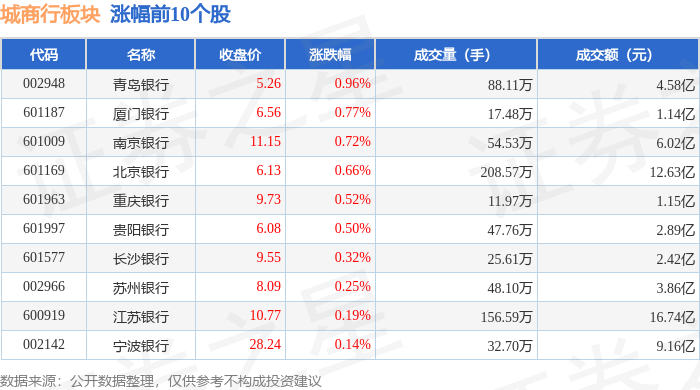
城商行板块9月4日涨0.14%,青岛银行领涨,主力资金净流入1.04亿元
Zheng Xing Xing Ye Ri Bao· 2025-09-04 08:48
Group 1 - The city commercial bank sector saw a slight increase of 0.14% on September 4, with Qingdao Bank leading the gains [1] - The Shanghai Composite Index closed at 3765.88, down 1.25%, while the Shenzhen Component Index closed at 12118.7, down 2.83% [1] - Key stocks in the city commercial bank sector showed varied performance, with Qingdao Bank closing at 5.26, up 0.96%, and Xiamen Bank at 6.56, up 0.77% [1] Group 2 - The city commercial bank sector experienced a net inflow of 1.04 billion yuan from institutional investors, while retail investors contributed a net inflow of 1.27 billion yuan [2] - The sector saw a net outflow of 2.31 billion yuan from speculative funds [2] - Individual stock performance varied, with Beijing Bank showing a net inflow of 1.52 million yuan from institutional investors, while Xiamen Bank had a net outflow of 730.79 million yuan [3]


威星智能: 关于使用闲置自有资金进行委托理财到期赎回的公告
Zheng Quan Zhi Xing· 2025-09-04 08:16
Core Viewpoint - Zhejiang Weixing Intelligent Instrument Co., Ltd. has approved the use of idle self-owned funds for entrusted wealth management, with a single investment limit of up to RMB 100 million, which can be rolled over within one year from the date of approval by the shareholders' meeting [1]. Group 1: Wealth Management Activities - The company signed an agreement with Ningbo Bank to purchase structured deposit products using RMB 50 million of idle self-owned funds, with an annualized yield ranging from 1.00% to 2.30% [1]. - The principal of RMB 50 million from the structured deposit product was redeemed on September 4, 2025, along with the investment returns [2]. - The company has utilized a total of RMB 30 million in cash management products that are still outstanding, ensuring that all investments remain within the authorized limits set by the shareholders' meeting [4]. Group 2: Financial Performance - The company has successfully recovered the principal and returns from all matured wealth management products as of the date of the announcement [4]. - The company has engaged in various wealth management products with different banks, including structured deposits with varying annualized yields, demonstrating a diversified approach to cash management [2][3].

二季度新进重仓股超800只,QFII调仓瞄准这几个方向
第一财经· 2025-09-04 06:21
Core Viewpoint - The article discusses the significant movements of foreign institutional investors (QFII) in the A-share market as of the end of Q2 2025, highlighting their investment strategies and sector preferences [3][4]. Summary by Sections QFII Holdings Overview - As of the end of Q2 2025, QFII held shares in 1,145 A-share companies, with a total market value exceeding 1,400 billion yuan [4]. - In Q2, QFII initiated positions in 813 new stocks, increased holdings in 173 stocks, reduced holdings in 126 stocks, and maintained positions in 33 stocks [5][11]. Sector Distribution and Adjustments - QFII showed notable adjustments in sectors such as machinery, hardware equipment, chemicals, and electrical equipment, while increasing holdings in banking, textiles, and non-ferrous metals [5][12]. - New investments were made in the industrial trade and telecommunications sectors, whereas coal and building materials saw overall reductions [12]. Top QFII Holdings - The top ten QFII holdings by market value include: - Ningbo Bank (361.63 billion yuan) - Nanjing Bank (231.94 billion yuan) - Shengyi Technology (95.50 billion yuan) - Shanghai Bank (45.22 billion yuan) - Zijin Mining (33.83 billion yuan) [9][10]. - The highest number of QFII holdings were in banking stocks, with Nanjing Bank and Ningbo Bank seeing increases in Q2 [7][10]. New Entrants and Market Movements - Among the new QFII heavyweights, the top three by market value were: - Haowei Group (1.45 billion yuan) - Jianghuai Automobile (675 million yuan) - Guai Bao Pet (493 million yuan) [11]. - QFII's new heavyweights included companies like Tianfeng Securities and Shengyi Technology, with significant movements in their stock values [8][11]. Sector Performance - Over 60% of QFII's heavy stocks were concentrated in machinery, hardware equipment, chemicals, electrical equipment, automotive parts, pharmaceuticals, and software services [13]. - The hardware equipment sector had the highest new investment value at 40.79 billion yuan, followed by machinery at 30.07 billion yuan and chemicals at 27.65 billion yuan [14][15].





银行研究框架及25H1业绩综述:营收及利润增速双双转正
GOLDEN SUN SECURITIES· 2025-09-04 06:14
Investment Rating - The report indicates a positive outlook for the banking industry, with overall revenue and net profit growth rates turning positive in the first half of 2025, at 1.0% and 0.8% respectively, showing improvements from the previous quarter [4]. Core Insights - The banking sector's net interest margin for the first half of 2025 is reported at 1.42%, a decrease of 10 basis points compared to the previous year, but the decline is narrowing due to improved cost management on the liability side [5]. - Non-interest income, particularly from fees and commissions, has increased by 3.1% year-on-year, driven by a recovery in wealth management and a more active market environment [5]. - The asset quality remains stable, with a non-performing loan ratio of 1.23% and a provision coverage ratio of 239%, indicating a solid credit environment [5]. Summary by Sections Financial Performance Overview - The overall revenue and net profit growth for listed banks in the first half of 2025 were 1.0% and 0.8%, respectively, with both metrics showing improvement from the first quarter [4][22]. - The total assets of listed banks reached 321.3 trillion yuan, growing by 6.35% year-to-date, with loans and advances totaling 179.4 trillion yuan, accounting for 55.84% of total assets [21][24]. Income Sources - Net interest income decreased by 1.3% year-on-year, but the decline rate has slowed, reflecting better management of funding costs [5]. - Fee and commission income grew by 3.1% year-on-year, benefiting from a recovering market and the gradual impact of regulatory changes [5]. - Other non-interest income saw a significant increase of 10.7%, primarily due to favorable market conditions in the bond market [5]. Asset Quality and Management - The non-performing loan ratio remained stable at 1.23%, with a provision coverage ratio of 239%, indicating a robust asset quality [5]. - The credit cost for the first half of 2025 was 0.81%, a decrease of 5 basis points year-on-year, suggesting manageable credit risks [5]. Loan Growth and Composition - Loan growth was primarily driven by corporate lending, with significant contributions from infrastructure and manufacturing sectors [20]. - Personal loan growth was weaker, with a year-on-year increase of only 3.6%, reflecting a cautious approach to consumer lending amid rising risks [20]. Investment and Market Conditions - The investment asset proportion decreased to 34% as banks adjusted their strategies in response to market volatility [20]. - The overall yield on bonds fluctuated significantly, prompting banks to engage in tactical trading to enhance returns [20].
