
GANFENG LITHIUM(002460)

Search documents
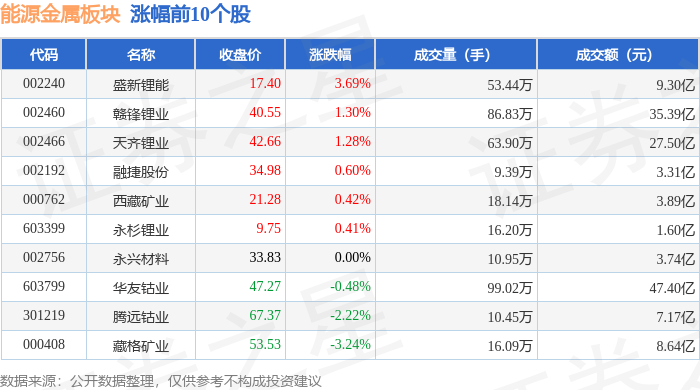
能源金属板块9月4日跌0.94%,盛屯矿业领跌,主力资金净流入1.38亿元
Zheng Xing Xing Ye Ri Bao· 2025-09-04 08:50
Market Overview - On September 4, the energy metals sector declined by 0.94%, with Shengtu Mining leading the drop [1] - The Shanghai Composite Index closed at 3765.88, down 1.25%, while the Shenzhen Component Index closed at 12118.7, down 2.83% [1] Stock Performance - Notable stock performances included: - Shengxin Lithium Energy (002240) rose by 3.69% to close at 17.40, with a trading volume of 534,400 shares and a turnover of 930 million yuan [1] - Ganfeng Lithium (002460) increased by 1.30% to 40.55, with a trading volume of 868,300 shares and a turnover of 3.539 billion yuan [1] - Tianqi Lithium (002466) saw a 1.28% increase to 42.66, with a trading volume of 639,000 shares and a turnover of 2.750 billion yuan [1] - Other stocks like Huayou Cobalt (603799) and Tengyuan Mining (301219) experienced declines of 0.48% and 2.22%, respectively [1] Capital Flow Analysis - The energy metals sector experienced a net inflow of 138 million yuan from institutional investors, while retail investors saw a net inflow of approximately 86.95 million yuan [2] - Notable capital flows included: - Ganfeng Lithium had a net inflow of 2.92 billion yuan from institutional investors, but a net outflow of 1.37 billion yuan from speculative funds [3] - Tianqi Lithium recorded a net inflow of 1.86 billion yuan from institutional investors, with a net outflow of 1.35 billion yuan from speculative funds [3] - Huayou Cobalt had a net inflow of 72.96 million yuan from institutional investors, while speculative funds saw a net outflow of 85.87 million yuan [3]





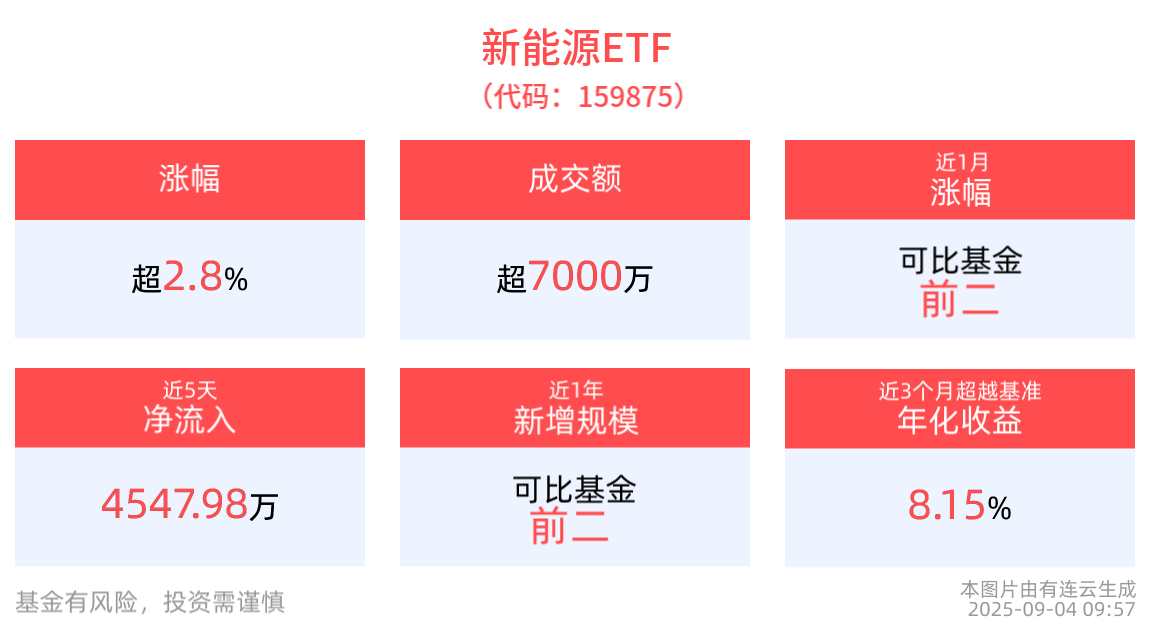
“反内卷”政策下光伏板块基本面向好,新能源ETF(159875)盘中一度涨近4%
Sou Hu Cai Jing· 2025-09-04 02:29
Group 1: ETF Performance - The New Energy ETF has a turnover rate of 7.38% with a transaction volume of 76.73 million yuan [3] - Over the past week, the average daily transaction volume of the New Energy ETF was 108 million yuan [3] - The New Energy ETF's net asset value increased by 15.55% over the past six months [3] Group 2: Historical Returns - Since its inception, the New Energy ETF achieved a highest monthly return of 25.07% and a longest consecutive monthly gain of 4 months with a total increase of 31.31% [3] - The average return during the months of increase is 8.03% [3] - Over the past three months, the New Energy ETF outperformed its benchmark with an annualized return of 8.15% [3] Group 3: Industry Insights - The photovoltaic industry chain has seen significant price recovery driven by the "anti-involution" policy [5] - Huaxi Securities suggests that the polysilicon industry may consolidate excess capacity through mergers and acquisitions [5] - The "anti-involution" policy is a potential main theme, with varying effects across different industries, particularly strong in the photovoltaic sector [5] Group 4: Financial Performance - Huachuang Securities reported a 9.7% year-on-year decline in core revenue for the photovoltaic sector in the first half of 2025, but a recovery in operating rates and revenue was noted in the second quarter [6] - The sector experienced losses in the first half, but the loss margin decreased in the second quarter, with a potential turnaround after adjusting for impairment losses [6] - The main pressure on the sector comes from the pricing within the supply chain, with negative gross margins reported for silicon wafers in the second quarter [6] Group 5: Major Stocks - The top ten weighted stocks in the CSI New Energy Index include Ningde Times, Sunshine Power, Longi Green Energy, and others, accounting for a total of 42.78% of the index [6]






有色ETF基金(159880)上涨近1%,美联储强降息预期推动有色金属走强
Sou Hu Cai Jing· 2025-09-04 01:57
Group 1 - The core viewpoint is that the non-ferrous metal sector is experiencing a rise due to expectations of interest rate cuts by the Federal Reserve, leading to increased prices for metals like cobalt, copper, and rare earths [1] - As of September 4, 2025, the non-ferrous metal industry index (399395) increased by 0.80%, with significant gains in stocks such as Yunnan Zhenye (3.71%) and Ganfeng Lithium (3.60%) [1] - The Pacific Securities report indicates that the prices of most non-ferrous metals were strong in the first half of 2025, resulting in improved performance for many companies in the sector [1] Group 2 - As of August 29, 2025, the top ten weighted stocks in the non-ferrous metal industry index accounted for 50.35% of the index, including companies like Zijin Mining and Northern Rare Earth [2] - The non-ferrous ETF fund (159880) closely tracks the non-ferrous metal industry index and reflects the overall performance of listed companies in this sector [1][3]




有色ETF基金(159880)开盘涨0.07%,重仓股紫金矿业跌0.56%,洛阳钼业跌0.37%
Xin Lang Cai Jing· 2025-09-04 01:41
Core Viewpoint - The article discusses the performance of the Nonferrous ETF Fund (159880) and its major holdings, highlighting the fund's recent returns and the performance of its key stocks [1] Group 1: Fund Performance - The Nonferrous ETF Fund (159880) opened with a slight increase of 0.07%, priced at 1.509 yuan [1] - Since its establishment on March 8, 2021, the fund has achieved a return of 51.22%, with a recent one-month return of 23.01% [1] Group 2: Major Holdings - Key stocks in the Nonferrous ETF Fund include: - Zijin Mining: down 0.56% - Luoyang Molybdenum: down 0.37% - Northern Rare Earth: down 1.30% - China Aluminum: down 0.51% - Shandong Gold: down 0.16% - Huayou Cobalt: down 0.36% - Zhongjin Gold: down 0.06% - Ganfeng Lithium: down 0.05% - Chifeng Jilong Gold: up 0.39% - Yun Aluminum: down 0.31% [1] Group 3: Management Information - The fund is managed by Penghua Fund Management Co., Ltd., with Yan Dong as the fund manager [1]
有色金属强势反弹,这八大龙头公司名单值得关注
Sou Hu Cai Jing· 2025-09-03 16:29
Market Overview - The non-ferrous metal sector has seen a strong rebound, with the Shenwan Non-Ferrous Metal Index rising by 8.59% over the past two weeks, ranking fifth among 31 primary industries [7] - The market has shown significant structural differentiation, with small metals, precious metals, and new materials performing particularly well, while rare earths, copper, and aluminum have attracted substantial capital [1][2] Precious Metals - Gold and silver prices have strengthened, with COMEX gold closing at $3,516 per ounce, reflecting a year-to-date increase of 31.63%, while silver has risen by 35.88% [1][17] - The demand for gold from global central banks continues to rise, enhancing its financial attributes, leading to increased investment in companies like Shandong Gold, Zhongjin Gold, and Hunan Gold [1][17] Industrial Metals - Copper prices have shown a strong upward trend, with LME copper settling at $9,805 per ton, up 12.89% year-to-date, driven by expectations of increased infrastructure investment and demand from the renewable energy sector [2][23] - Aluminum prices are constrained by production capacity limits, with domestic electrolytic aluminum capacity reaching 44 million tons, while demand from the new energy sector remains robust [2][27] Rare Earths - The rare earth sector has experienced a strong performance, with the rare earth price index rising by 6.39% over the past two weeks and 37.44% year-to-date [2][41] - Recent policy changes have tightened supply controls, benefiting companies like China Rare Earth, Northern Rare Earth, and Shenghe Resources [2][41][55] Small Metals - The small metals sector has seen significant price increases, with black tungsten concentrate prices rising by 24.26% over the past two weeks and 75.52% year-to-date [3][30] - Tin prices have also increased due to raw material shortages and recovering semiconductor demand, benefiting companies like Tin Industry Co., Huaxi Nonferrous Metals, and Xingye Silver Tin [3][31] Energy Metals - The energy metals sector has shown mixed performance, with electrolytic cobalt prices rising by 1.33% over the past two weeks and 86.71% year-to-date, while lithium carbonate prices have decreased by 3.69% in the short term but remain positive year-to-date [3][47][49] - Companies like Zijin Mining, Ganfeng Lithium, and Huayou Cobalt are positioned well across multiple supply chains, benefiting from low inventory and downstream replenishment demand [3][47] Fund Flow and Market Sentiment - The non-ferrous metal ETF has seen record trading volumes, with significant inflows into rare earth and copper sectors, indicating strong market sentiment and recognition of the sector's growth potential [3][56] - The market is shifting towards low-valuation, high-growth segments, with leading companies benefiting from favorable conditions [3][56]




能源金属研究方法论
2025-09-03 14:46
Summary of Key Points from the Conference Call Industry Overview - The lithium industry is primarily concentrated in Australia, South America, and China, with Australia being the largest supplier of spodumene, mainly managed by foreign investments, while Chinese companies participate through equity investments [1][2] - African lithium mining, led by Chinese investments, has seen significant progress and cost reductions, becoming a major supply source, which has changed market perceptions regarding its legitimacy and cost-effectiveness [1][4][6] Key Insights and Arguments - African lithium mining costs have been decreasing, moving into the middle range of the cost curve, despite lithium extraction from salt lakes still holding a cost advantage [1][6] - The lithium carbonate price has reached a temporary bottom, with potential for a 50% increase in the future, suggesting a long-term investment perspective is advisable [3][14] - The lithium industry is expected to grow at a compound annual growth rate (CAGR) of over 20% until 2025, driven by demand from solid-state batteries, robotics, and low-altitude economies [3][12] Regional Supply Dynamics - In South America, Argentina's lithium extraction projects are fragmented, with few companies in production due to high-altitude challenges, while Chile relies on SQM's Salar de Atacama project, which has a capacity of 240,000 tons of lithium carbonate equivalent but lacks short-term expansion plans [7] - China's lithium supply is heavily reliant on overseas sources, with 70% coming from abroad. Domestic production is primarily from Jiangxi, Sichuan, and Qinghai, facing various challenges such as permit changes and slow expansion [8][9][10] Cost and Production Challenges - Different extraction methods impact costs significantly, with spodumene being the most viable, while lepidolite and clay remain unprofitable under current market conditions [4] - The extraction of lithium from African mines has shown resilience despite geopolitical risks, with ongoing operations in Mali and new projects in Hainan [6] Future Trends and Recommendations - The supply-demand balance is expected to improve over the next three years, even with a potential oversupply in 2026, as many mines are not operating at full capacity [13] - Investors are advised to focus on companies with growth potential and operational flexibility, such as Ganfeng Lithium and Zhongjin Lingnan Nonfemet Company [14][23] Additional Considerations - The impact of government policies in the Democratic Republic of Congo on cobalt prices could indirectly affect lithium market dynamics, as cobalt is a critical component in battery production [20][22] - The long-term outlook for lithium prices suggests a potential revisit to lower levels in 2026, but with limited downside risk due to constrained supply [22] This summary encapsulates the critical insights and trends discussed in the conference call, providing a comprehensive overview of the lithium industry's current state and future outlook.
它,产业催化密集!
摩尔投研精选· 2025-09-03 10:35
Market Overview - The A-share market experienced fluctuations on September 3, with the Shanghai Composite Index briefly falling below 3,800 points, while the ChiNext Index turned positive due to the support of certain large-cap technology stocks [1] - Overall market sentiment is cautious, but structural opportunities still exist [2] Market Adjustment Reasons - Recent adjustments in the market are attributed to the rapid rise driven by large-cap technology leaders, leading to a high volatility phase and accelerated sector rotation [3] - The significant gains over the past months have led to profit-taking by investors, resulting in a regression to the mean [3] Key Issues Facing A-share Market - The three core issues currently facing the A-share market include the transfer of deposits, regulatory attitudes, and investor expectations regarding policies [4] - There is a theoretical excess of 6 trillion to 7 trillion RMB in term deposits available for reallocation, but large-scale inflows into the stock market depend on sustained market momentum and improvements in fundamentals [4] - Regulatory bodies are committed to the long-term healthy development of the capital market, focusing on new rounds of reform and opening up, which will provide appropriate incentives for long-term investment [4] - Investors are looking for potential policy catalysts and sustainable measures to boost domestic demand [4] Solid-State Battery Industry - The solid-state battery sector is identified as one of the most promising and explosive growth areas in the market, with several stocks experiencing limit-up gains [5] - The industrialization process of solid-state batteries is accelerating, with clear trends emerging [6] - Key milestones include the establishment of pilot lines in 2025, mass production breakthroughs in 2026, and the start of demonstrative operations in 2027 [7] Investment Opportunities in Solid-State Batteries - Companies that strategically position themselves in solid-state batteries and key materials and equipment are expected to have significant growth potential [8] - Different technological routes for solid-state batteries are primarily distinguished by the type of solid electrolyte used, including polymer, oxide, and sulfide electrolytes [9][10] Company Developments in Solid-State Battery Technology - Major companies like CATL, BYD, and others are focusing on sulfide technology routes for solid-state batteries, aiming for mass production by 2027 [11][12] - Sulfide electrolytes are recognized for their high ionic conductivity and compatibility with electrodes, leading industry leaders to shift focus from oxide/polymer routes to sulfide [13] Material Demand in Solid-State Battery Production - The demand for solid-state battery materials is expected to increase significantly, with the largest changes anticipated in solid electrolytes, anodes, and cathodes [17] - Companies are ramping up production capabilities for key materials such as lithium sulfide and other components essential for solid-state batteries [18]



赣锋锂业:公司在电池业务控本方面采取的措施包括优化生产流程、降低生产成本等
Zheng Quan Ri Bao· 2025-09-03 10:15
Group 1 - The company, Ganfeng Lithium, is implementing measures to control costs in its battery business, including optimizing production processes and reducing production costs [2] - The introduction of intelligent and automated technologies is aimed at improving efficiency [2] - Increased investment in research and development is intended to enhance product added value [2] Group 2 - In response to the short-term rise in lithium prices, the company is adopting a diversified strategy and refined operational management to ensure stable business development and avoid performance drag [2]
赣锋锂业:公司固态电池已形成全链路布局
Zheng Quan Ri Bao Wang· 2025-09-03 10:13
Core Viewpoint - Ganfeng Lithium has established a comprehensive layout for solid-state batteries, covering key areas such as sulfide electrolytes, oxide electrolytes, and metallic lithium anodes, with energy densities reaching 420Wh/kg and samples of 500Wh/kg passing safety tests [1] Group 1 - The company has achieved a cycle life exceeding 800 times for its solid-state batteries [1] - The first 500Wh/kg level 10Ah product has entered small-scale production [1] - Ganfeng Lithium is advancing applications in sectors such as new energy vehicles and low-altitude economy [1]
赣锋锂业:公司固态电池项目持续推进
Zheng Quan Ri Bao Wang· 2025-09-03 10:13
证券日报网讯赣锋锂业(002460)9月3日在互动平台回答投资者提问时表示,公司固态电池项目持续推 进,研发进展顺利,已形成全链路布局,覆盖硫化物电解质、氧化物电解质、金属锂负极等关键环节。 能量密度达420Wh/kg,500Wh/kg样品通过针刺及200℃热箱等安全测试,循环寿命突破800次。首款 500Wh/kg级10Ah产品实现小批量量产。 ...