GANFENG LITHIUM(002460)

Search documents
大和:一举升赣锋锂业(01772)评级至“跑赢大市” 目标价大幅上调至85港元
智通财经网· 2026-03-30 05:54
Group 1 - The core viewpoint of the article is that Daiwa has upgraded Ganfeng Lithium's investment rating from "underperform" to "outperform" due to improvements in the global lithium supply-demand landscape, with a target price increase from HKD 53 to HKD 85 [1] - Daiwa anticipates a global lithium supply shortage in 2026, primarily due to the early implementation of Zimbabwe's lithium mine export ban and slower-than-expected recovery of CATL's lithium mica mines [1] - The brokerage has raised its earnings per share forecast for Ganfeng Lithium for 2026-2027 by 213% to 583%, reflecting an increase in lithium prices [1] Group 2 - Daiwa has adopted a price-to-earnings (P/E) valuation method, assigning a target P/E of 17.3 times, which is lower than the 20 times for Ganfeng Lithium's A-shares, to account for lower liquidity in H-shares [1] - The firm predicts lithium prices for 2026-2027 to be between RMB 130,000 and RMB 145,000 per ton, which is conservative compared to the market's optimistic expectation of RMB 200,000 per ton, mainly due to concerns over rising production in Africa and China [1]

大行评级丨大和:全球锂供需格局改善,大幅上调赣锋锂业目标价至85港元
Ge Long Hui· 2026-03-30 05:28
Group 1 - The core viewpoint of the report is that due to the improvement in the global lithium supply-demand balance, the investment rating for Ganfeng Lithium has been upgraded from "Underperform" to "Outperform" with a target price raised from HKD 53 to HKD 85, marking the first positive outlook since the previous pessimistic view for 2023 to 2025 [1] - The report anticipates a global lithium supply shortage in 2026, primarily due to the early implementation of Zimbabwe's lithium mine export ban and the slower-than-expected recovery of CATL's lithium mica mines [1] - The earnings per share forecast for Ganfeng Lithium for 2026 to 2027 has been increased by 213% to 583%, reflecting the rise in lithium prices, and a price-to-earnings ratio of 17.3 times has been assigned, which is lower than the 20 times for Ganfeng's A-shares, to account for the lower liquidity of H-shares [1] Group 2 - The forecast for lithium prices in 2026 to 2027 is set at CNY 130,000 to CNY 145,000 per ton, which is conservative compared to the market's optimistic expectation of CNY 200,000, mainly due to concerns over increased production in Africa and China [1]
上调 2026 年全球储能系统及电池出货量预测;中东局势催生储能需求-Lift ‘26 Global BESS forecast & battery shipment; ME tension leads to ESS demand
2026-03-30 05:15
Summary of Key Points from Conference Call Records Industry Overview - **Battery Energy Storage System (BESS) Market**: The global BESS market is projected to grow significantly, with new installations expected to reach 425 GWh in 2026 and 533 GWh in 2027, representing a year-over-year growth of 39% and 25% respectively. This growth is driven by favorable policies, renewable energy curtailment pressures, and increased demand from artificial intelligence data centers (AIDC) [1][9] - **China's BESS Installation**: In 2025, China's BESS installations reached 183 GWh, an increase of 80% year-over-year. For 2026, new installations are forecasted at 264 GWh, a 44% increase, and 320 GWh in 2027, a 21% increase [1][8][10] Key Companies and Recommendations - **Sungrow**: Recommended as a top pick due to its leading global market share in ESS, strong brand image, and expected earnings growth of 41% and 17% in 2025 and 2026 respectively. The company is expected to benefit from the global ESS growth, with 54% of its gross profits coming from ESS by 2026 [1][10] - **CATL**: Projected to ship 850 GWh of ESS batteries in 2026, with a year-over-year growth of 55%. The company is recognized for its solid market position and stable margin outlook [2][11] - **CALB**: Expected to achieve over 180 GWh in battery shipments in 2026, with a robust demand outlook from ESS and expansion into new EV models [2][12] - **Ganfeng**: Identified as a leading integrated lithium player, with expected lithium sales volume growth of 30% year-over-year in 2026. The company is recommended for its self-sufficiency and growth potential [3][33] Market Dynamics - **Lithium Supply and Demand**: The lithium market is experiencing a supply deficit of approximately 3% in Q1 2026, with prices holding steady at RMB 140,000–150,000 per ton. Demand for lithium is strong, driven by battery production, with consumption expected to reach 431 kt, a 47% increase year-over-year [3][30] - **Geopolitical Factors**: The interruption of oil and gas supply chains due to tensions in the Middle East is expected to accelerate the global energy transition and increase demand for ESS [1][7] Pricing and Margins - **Battery Pricing**: The average selling price (ASP) for batteries is expected to rise as manufacturers pass on increased costs from rising lithium prices to consumers. The reduction of export tax rebates on battery products in China is also anticipated to impact pricing [2][8] - **Separator Market**: The separator market is showing signs of recovery after a period of oversupply, with expectations of price hikes in 2026 as battery production accelerates [40][41] Long-term Projections - **CAGR for BESS**: The global BESS market is projected to grow at a compound annual growth rate (CAGR) of 29% from 2024 to 2030, with significant growth expected in both China and Europe [1][14] - **European Market Dynamics**: The European BESS market is expected to see accelerated deployments, with increasing opportunities for power arbitrage and ancillary grid services [1][9][43] Conclusion The BESS and lithium markets are poised for significant growth driven by favorable policies, geopolitical factors, and strong demand from various sectors. Key players like Sungrow, CATL, and Ganfeng are well-positioned to capitalize on these trends, making them attractive investment opportunities.




锂行业推荐-重视供给端扰动
2026-03-30 05:15
Summary of Key Points from the Conference Call on the Lithium Industry Industry Overview - The lithium industry is currently facing significant supply disruptions, with 45% of global lithium resource capacity affected. Key disruptions include Zimbabwe's ban on lithium concentrate exports starting February 2026, delays in the resumption of production in Jiangxi Yichun, and potential diesel shortages in Australia threatening 26% of global supply [1][4]. Core Insights and Arguments - **Supply-Demand Balance Shift**: The supply-demand balance for lithium is expected to shift from a tight balance to a clear shortage by 2026. Initial expectations were for supply of 2.13 million tons versus demand of 2.05 million tons. However, due to the Zimbabwe ban and production delays in Jiangxi, the balance has been disrupted, and a 20% reduction in Australian output could lead to severe shortages [1][4]. - **Strong Demand Growth**: Demand for lithium is robust, with lithium battery production increasing by 42.6% year-on-year in January-February, and energy storage battery production surging by 84%. The average battery capacity for new energy vehicles reached 64.29 kWh, up 32.3% year-on-year, effectively offsetting fluctuations in sales [1][5]. - **Low Inventory Levels**: The entire lithium supply chain's inventory has dropped to historical lows, from 140,000 tons to 99,000 tons, sufficient for only 25-30 days of usage. This low buffer level means that supply disruptions will significantly amplify price volatility [1][5]. - **Severe Supply-Demand Mismatch Expected in Q2**: Major battery manufacturers are expected to ramp up production capacity in Q2, leading to a preemptive stockpiling. This, combined with the depletion of short-term inventory from Chile, is likely to create a severe supply-demand mismatch [1][5]. Additional Important Insights - **Macroeconomic Factors**: The Iranian oil crisis, while suppressing commodity prices, is accelerating the transition to electric vehicles and stimulating energy storage demand. As lithium carbonate serves as a substitute for oil, this situation may lead to an upward revision in demand forecasts [2][6]. - **Short-Term Supply Dynamics**: Despite tightening fundamentals, there is a temporary increase in supply due to Chile's concentrated shipments in early 2026. This is expected to lead to a short-term surplus in lithium carbonate imports to China, although this is not sustainable in the long term [6]. Investment Opportunities - In the context of ongoing supply tightness and rising prices, investment focus should be on companies with flexible production capacities, such as Zhongjin Lingnan Nonfemet Company and Guocheng Mining. Additionally, leading firms like Tianqi Lithium, Ganfeng Lithium, and Salt Lake Industry are also worth monitoring. Companies with resource capacities affected by the Zimbabwe export ban, such as Huayou Cobalt, Zhongjin Lingnan, and Shengxin Lithium Energy, should be watched for potential recovery [7].

赣锋锂业等成立绿能船务新公司
Xin Lang Cai Jing· 2026-03-30 03:37
企查查APP显示,近日,江西绿能船务有限公司成立,注册资本8000万元,经营范围包含:非金属矿及 制品销售,金属矿石销售,装卸搬运,国内船舶代理等。企查查股权穿透显示,该公司由赣锋锂业旗下 江西赣锋锂电科技股份有限公司等共同持股。 ...
能源金属行业周报:中东冲突下高油价持续性预期走强,“白色石油”锂有望受益能源替代下的需求超预期
HUAXI Securities· 2026-03-30 00:55
Investment Rating - The industry rating is "Recommended" [4] Core Views - The report highlights that high oil prices driven by Middle Eastern conflicts are expected to strengthen the demand for lithium as an energy alternative, indicating a potential upside for lithium prices [2] - Nickel prices are supported by supply uncertainties due to delays in the approval process for nickel mining quotas in Indonesia, which may lead to a tight supply situation [2][17] - Cobalt prices are anticipated to rise due to ongoing supply uncertainties from the Democratic Republic of Congo, with expectations of structural tightness in cobalt supply [3][18] - The report notes a significant increase in carbonated lithium prices, driven by supply disruptions and rising demand expectations, particularly in the context of the electric vehicle market [21] - The tungsten market is expected to see continued price increases due to long-term supply tightness and strategic importance in global supply chains [24] Summary by Sections Nickel and Cobalt Industry - As of March 27, LME nickel spot price was $17,010 per ton, up 1.43% from March 20, with total LME nickel inventory at 281,574 tons, down 0.68% [2] - Cobalt prices are under pressure but are expected to rise due to supply constraints from the DRC, with the current electrolytic cobalt price at 430,500 CNY per ton [3][18] Lithium Industry - Domestic carbonate lithium futures closed at 168,400 CNY per ton, up 17.09% from March 20, indicating strong demand and supply constraints [21] - The report emphasizes the impact of geopolitical tensions on lithium demand, particularly in the context of energy security [21] Tungsten Industry - The report indicates that tungsten prices are expected to continue rising due to supply constraints and strategic importance, with white tungsten concentrate prices at 1,001,000 CNY per ton [24] Antimony Industry - Antimony prices have seen a slight decline, but supply constraints are expected to provide support for future prices, with average antimony ingot prices at 165,500 CNY per ton [7][19] Uranium Industry - The report notes that uranium supply is expected to remain tight, supporting prices, with the global uranium market price at $71.3 per pound [15][25]


电力设备行业跟踪周报:油价高企新能源受益,锂电需求和盈利有望超预期
Soochow Securities· 2026-03-30 00:24
Investment Rating - The report maintains an "Overweight" rating for the power equipment industry, indicating a positive outlook for investment opportunities [1]. Core Insights - High oil prices are benefiting the renewable energy sector, with expectations for increased demand and profitability in lithium batteries [1]. - The report highlights significant growth in energy storage and electric vehicle markets, driven by government policies and technological advancements [4][5]. Industry Trends - The energy storage sector is experiencing robust growth, with countries like Croatia and Spain investing heavily in solar and storage projects. The report anticipates a global energy storage installation growth of over 60% in 2026, with a compound annual growth rate of 30-50% from 2027 to 2029 [4][5]. - In the electric vehicle market, there was a notable decline in retail sales in early March, but expectations for recovery are set for April, with a projected annual growth of around 3% [4][5]. - The report also notes a significant increase in lithium prices, with battery-grade lithium carbonate reaching 158,000 CNY/ton, reflecting a 4.8% increase [4]. Company Performance - Notable company performances include: - Ningde Times: 2025 revenue of 804 billion CNY, a 4% year-on-year increase, with a net profit of 32.6 billion CNY, down 19% [4]. - BYD: 2025 revenue of 804 billion CNY, with a net profit of 32.6 billion CNY, reflecting a 19% decrease [4]. - Other companies like Ganfeng Lithium and CATL are also highlighted for their strong market positions and growth potential [4][5]. Investment Strategy - The report suggests a focus on companies leading in energy storage and lithium battery production, such as Ningde Times, Ganfeng Lithium, and others, due to their strong growth prospects and market leadership [4][5]. - It emphasizes the importance of technological advancements and government policies in driving the growth of the renewable energy sector, particularly in energy storage and electric vehicles [4][5].


一周个股动向:最牛股周涨超50% 赣锋锂业获主力加仓居首
Sou Hu Cai Jing· 2026-03-29 17:36
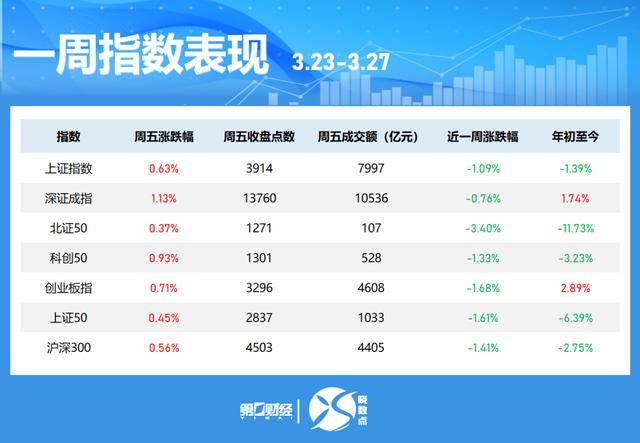
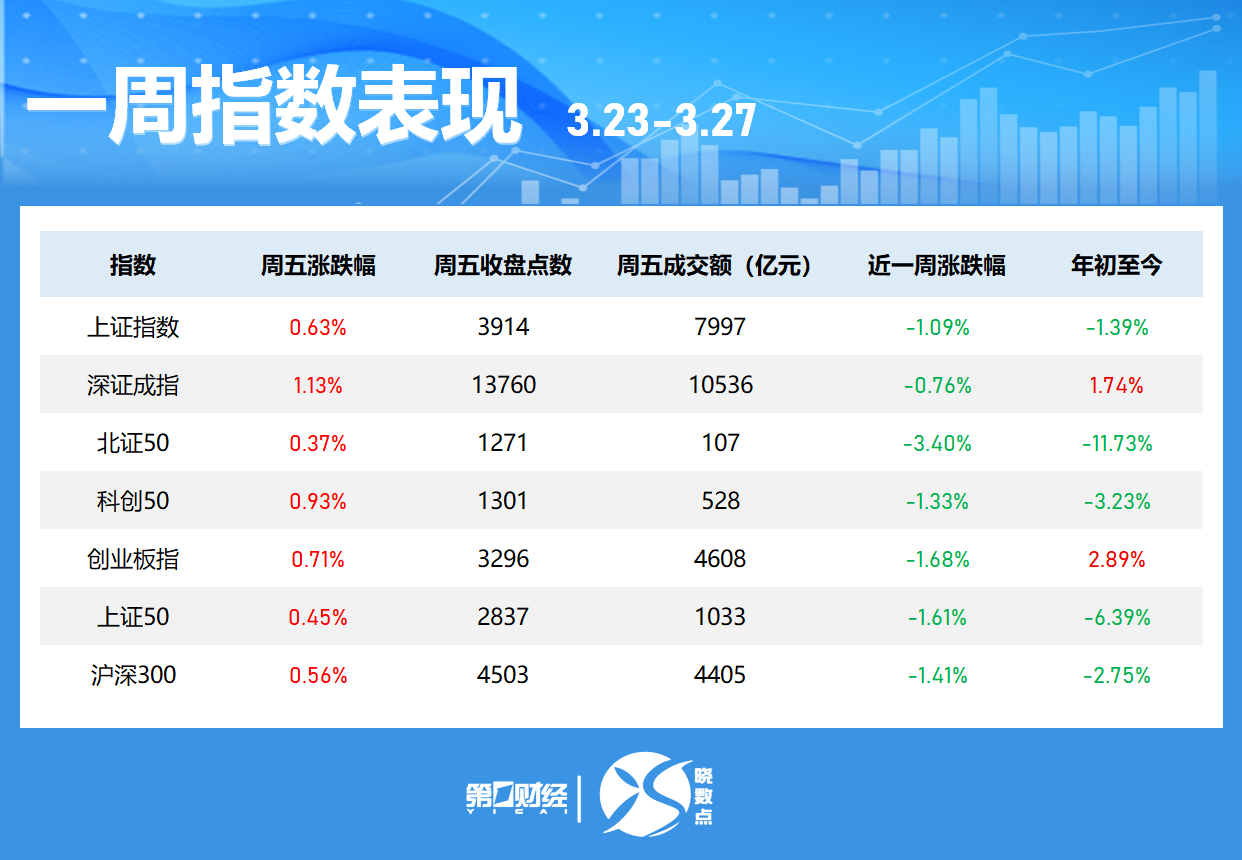
Market Performance - A-shares indices collectively declined during the week of March 23 to 27, with the Shanghai Composite Index down 1.09%, the Shenzhen Component Index down 0.76%, the ChiNext Index down 1.68%, and the Sci-Tech Innovation Index down 0.43% [1][2]. Index Details - The Shanghai Composite Index closed at 3914 points with a weekly trading volume of 799.7 billion yuan, reflecting a year-to-date decline of 1.39% [2]. - The Shenzhen Component Index closed at 13760 points with a weekly trading volume of 1053.6 billion yuan, showing a year-to-date increase of 1.74% [2]. - The ChiNext Index closed at 3296 points with a weekly trading volume of 460.8 billion yuan, with a year-to-date increase of 2.89% [2]. Stock Performance - Seven stocks saw a weekly increase of over 40%, with Haike Xinyuan leading at 51.02%, followed by Lianxiang Co. at 48.26% and Rongjie Co. at 46.95% [3][4]. - On the downside, 30 stocks experienced a decline of over 20%, with Huada Technology leading the drop at 32.34% [3][4]. Trading Activity - A total of 47 stocks had a turnover rate exceeding 100%, with Shouhang New Energy at the top with a turnover rate of 236.08% [5][6]. - The majority of stocks with high turnover rates were in the electric power equipment, public utilities, and basic chemicals sectors [5]. Fund Flows - The sectors that attracted significant capital inflows included non-ferrous metals, basic chemicals, and building materials, while the electronics sector faced a net outflow exceeding 25 billion yuan [7][8]. - Ganfeng Lithium received the highest net inflow of 2.72 billion yuan, with a weekly increase of 18.15% [7][8]. Margin Trading - Lixun Precision received the highest net buy amount in margin trading at 1.094 billion yuan, with a weekly increase of 4.96% [9][10]. - Other notable net buys included China Ping An and Demingli, while NIO and Zijin Mining faced significant net sell amounts [9][10]. Institutional Research - A total of 163 listed companies were researched by institutions, with Sanhua Intelligent Control receiving the most attention from 284 institutions [11][12]. - The focus of institutional research was primarily on industrial machinery, electronic components, and automotive parts and equipment [11]. New Institutional Interests - Institutions showed first-time interest in 51 stocks, with seven stocks receiving target prices [14][15]. - Notable mentions include Kaige Precision Machine with a target price of 207.84 yuan and Daqin Railway with a target price of 5.95 yuan [15].

晓数点丨一周个股动向:最牛股周涨超50% 赣锋锂业获主力加仓居首
Di Yi Cai Jing· 2026-03-29 13:55
Market Overview - The A-share indices collectively declined during the week from March 23 to March 27, with the Shanghai Composite Index down by 1.09%, the Shenzhen Component Index down by 0.76%, the ChiNext Index down by 1.68%, and the Sci-Tech Innovation Index down by 0.43% [1][2]. Stock Performance - A total of 7 stocks saw gains exceeding 40%, with Haike Xinyuan leading at a weekly increase of 51.02%. Other notable gainers included Lianxiang Co. (48.26%), Rongjie Co. (46.95%), and Huadian Liaoning Energy (43.61%) [3][4]. - Conversely, 30 stocks experienced declines over 20%, with Huada Technology leading the drop at 32.34%, followed by Zhonghuan Hailu (29.59%) and Shenhua Fa A (28.03%) [3][4]. Trading Activity - 47 stocks had a turnover rate exceeding 100%, with Shouhang New Energy at the top with a turnover rate of 236.08%, followed by Nabichuan (199.27%) and Jiuzhou Group (177.88%) [5][6]. - The majority of stocks with high turnover rates were from the electric equipment, public utilities, and basic chemicals sectors [5]. Capital Flow - The sectors that attracted significant capital inflow included non-ferrous metals, basic chemicals, and building materials, while the electronics sector faced a net outflow exceeding 250 billion yuan [8]. - Ganfeng Lithium received the highest net inflow of 27.20 billion yuan, with a weekly increase of 18.15%. Other stocks with notable inflows included Demingli (15.88 billion yuan) and Yunnan Zhiye (14.20 billion yuan) [8][9]. Margin Trading - A total of 1399 stocks received net margin purchases, with 582 stocks having net purchases exceeding 10 million yuan. Luxshare Precision topped the list with a net purchase of 10.94 billion yuan, while NIO and Zijin Mining faced significant net sell-offs [10][11]. Institutional Research - During the week, 163 listed companies were researched by institutions, with Sanhua Intelligent Control receiving the most attention from 284 institutions. Other companies like Yuanjie Technology and Yuntianhua also attracted significant institutional interest [12][14]. Analyst Ratings - Several companies received new ratings from analysts, including Kaige Precision Machinery with a "Buy" rating and a target price of 207.84 yuan, and Daqin Railway with an "Overweight" rating and a target price of 5.95 yuan [15][16].


A股开始交易锂电反转
虎嗅APP· 2026-03-29 03:51
Core Viewpoint - The lithium battery sector is experiencing renewed investor interest, with significant stock price increases observed in companies like Rongjie Co., Ganfeng Lithium, and others, despite a broader market decline [2][3]. Demand Side Signals - The demand for lithium batteries is showing clear signs of growth, driven by the transition from vehicle power batteries to energy storage batteries as the main growth driver by the second half of 2025 [5][10]. - The expected shipment volume of lithium batteries in China for 2024 is projected to be 1175 GWh, a year-on-year increase of 32.6%, with energy storage batteries expected to grow by 64% [10]. - By 2025, the total shipment volume is anticipated to reach 1875 GWh, with energy storage battery shipments soaring to 630 GWh, reflecting an 85% year-on-year growth [10]. Supply Side Dynamics - The supply side is becoming increasingly critical, with a notable dependency on lithium ore imports from countries like Australia and Zimbabwe, which together account for 82% of China's lithium ore imports [19]. - Zimbabwe's recent policy to suspend all lithium ore and concentrate exports could impact over 10% of China's lithium carbonate supply [22]. - Australia's lithium mining operations are also facing uncertainties due to the ongoing geopolitical tensions in the Middle East, which could lead to reduced production capacity [24]. Market Implications - The combination of unexpected demand growth and supply disruptions could lead to a significant shift in the lithium market from slight oversupply to a phase of supply shortage [25]. - As supply gaps emerge, lithium prices are expected to rise, which will affect the entire lithium battery supply chain [25]. - The current market dynamics suggest that the lithium sector is being reassessed by investors, with a focus on the implications of supply constraints rather than just demand improvements [25].