
RSPC(002493)

Search documents
荣盛石化股价涨5.03%,华泰柏瑞基金旗下1只基金位居十大流通股东,持有5197.43万股浮盈赚取3586.22万元
Xin Lang Cai Jing· 2026-01-28 03:04
1月28日,荣盛石化涨5.03%,截至发稿,报14.42元/股,成交5.07亿元,换手率0.39%,总市值1440.48 亿元。 华泰柏瑞沪深300ETF(510300)成立日期2012年5月4日,最新规模4222.58亿。今年以来收益1.73%, 同类排名4579/5549;近一年收益26.46%,同类排名2873/4285;成立以来收益119.93%。 华泰柏瑞沪深300ETF(510300)基金经理为柳军。 截至发稿,柳军累计任职时间16年243天,现任基金资产总规模5509.28亿元,任职期间最佳基金回报 193.73%, 任职期间最差基金回报-45.64%。 从基金十大重仓股角度 资料显示,荣盛石化股份有限公司位于浙江省杭州市萧山区金城路358号蓝爵国际写字楼,成立日期 1995年9月15日,上市日期2010年11月2日,公司主营业务涉及各类化工品、油品、聚酯产品的研发、生 产和销售。主营业务收入构成为:化工40.87%,炼油35.26%,PTA10.60%,聚酯化纤薄膜7.49%,贸易 及其他5.79%。 数据显示,华泰柏瑞基金旗下1只基金重仓荣盛石化。油气基金(561570)四季度持有股数5.3 ...

ETF盘中资讯|暴力拉升!化工ETF(516020)盘中涨超2%,资金持续加码!机构:化工有望开启新一轮高成长
Sou Hu Cai Jing· 2026-01-28 02:58
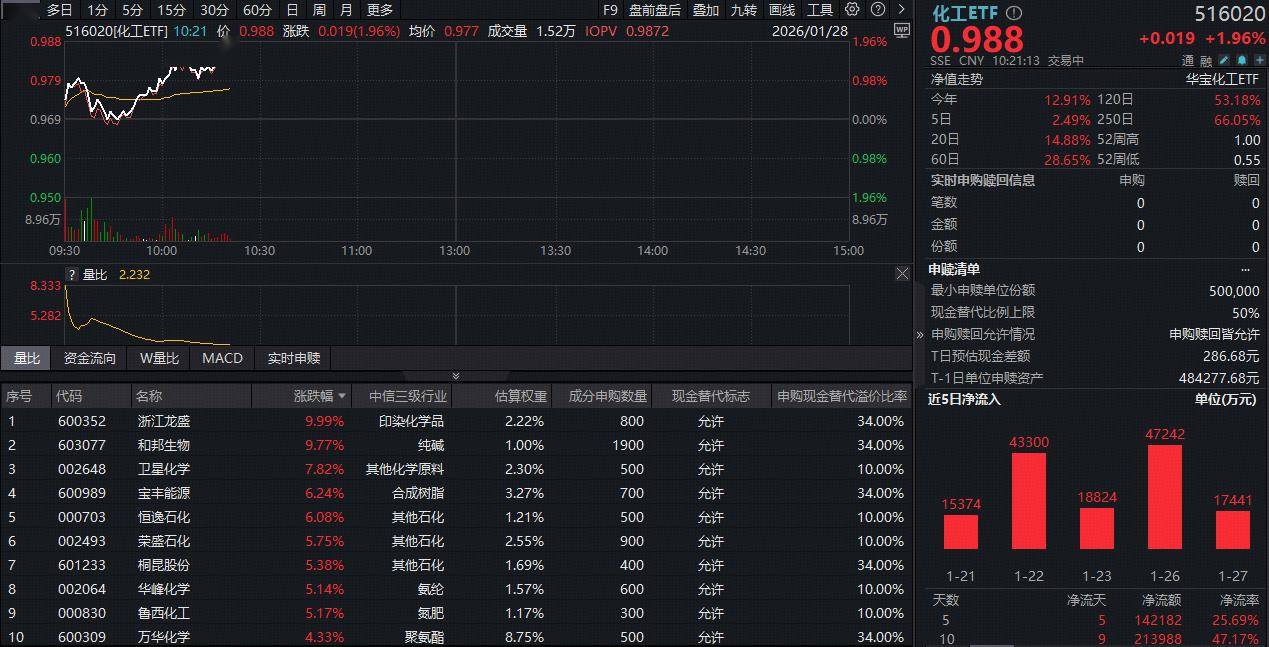
Group 1 - The chemical sector has regained momentum, with the chemical ETF (516020) experiencing a rise of 1.96% after a brief fluctuation at the opening [1][2] - Key stocks in the sector include Zhejiang Longsheng, which hit the daily limit, and other notable gainers such as Hebang Biotechnology, Satellite Chemical, Baofeng Energy, and Hengyi Petrochemical, all showing significant increases [1][2] - The chemical ETF (516020) has attracted substantial investment, with net subscriptions of 1.422 billion yuan over the past five days and 2.14 billion yuan over the past ten days [1][2] Group 2 - Recent advancements in the basic chemical industry include breakthroughs in green refrigeration technology and key technologies for the industrialization of high-performance liquid crystal polyarylate fibers [3] - Looking ahead, the chemical industry is expected to experience low prosperity in 2025, with potential recovery in profitability driven by measures against "involution" and rapid growth in new materials due to downstream demand [3] - Investment opportunities in the large chemical sector are viewed positively, particularly in leading companies and sub-industries facing supply changes or significant pressure [3]


芳烃产业链迎来强劲涨价潮 荣盛石化炼化一体化优势将获超额收益
Sou Hu Cai Jing· 2026-01-28 02:56
PX方面,据中国石油和化工网数据,1月26日海南炼化、扬子石化PX优等品出厂价均为7300元/吨,呈 现稳中有升态势。PTA方面,生意社数据显示,截至1月26日华东地区PTA现货价格上涨至5341元/吨, 较1月19日涨幅达6.63%。PTA加工费也稳步回升至400元/吨。总体PX与PTA形成协同上涨态势。 从价格走势来看,纯苯和苯乙烯价格表现更为强势。纯苯方面,据生意社数据显示,截至1月26日,国 内主流厂商纯苯报价在5200-6000元/吨区间,其中齐鲁石化报价6000元/吨,较月初显著上涨。而作为纯 苯最主要的下游产品,苯乙烯同样表现强势。本月以来苯乙烯期货2603合约价格从7124元/吨涨至7708 元/吨,涨幅8.19%,持仓量攀升至42.34万手,创下阶段性高位。有市场分析人士指出,当前纯苯及苯 乙烯价格已摆脱前期低位震荡区间,进入新一轮上行通道。 多重因素共振驱动芳烃板块上涨 对于本轮芳烃系列产品集体上涨,机构普遍认为并非单一因素驱动,而是成本支撑、供应扰动与宏观情 绪共振的结果。 据生意社数据显示,1月26日,PTA期货主力合约逼近5500元/吨,创下阶段新高。而纯苯期货主力合约 自1月初的5 ...
国信证券:供给长期收缩叠加成本下行 炼油炼化利润迎来中期修复
智通财经网· 2026-01-28 02:15
在新能源汽车替代燃油车、运输"以铁替公"战略等影响下,我国汽柴油需求整体呈现增长放缓趋势。但 在供给端有炼油产能红线限制与炼厂"减油增化"的结构性优化,成本端原油价格处于炼油舒适区、叠加 OSP升水下调改善,国内成品油整体裂差中枢逐步上移。此外,海外成品油裂差在俄罗斯炼厂遇袭、美 国炼厂开工率下行背景下走高。我国头部炼厂炼油端利润将实现改善,炼厂可利用成品油出口配额获 利。 智通财经APP获悉,国信证券发布研报称,炼油化工板块在供给端存在政策限制及结构优化,需求端存 在SAF等新兴油品快速增长,成本端油价与OSP官价已调整至炼厂成本舒适区,成品油裂差中枢、化工 品芳烃PTA价差、硫磺价格率先启动,有望在中期维度带动炼厂盈利持续修复,重点推荐国内炼油、炼 化产能及技术领先企业。重点推荐中国石油(601857.SH)、荣盛石化(002493.SZ)、桐昆股份 (601233.SH)。 国信证券主要观点如下: 工信部印发石化化工行业稳增长方案,行业"减油增化"稳步推进 2025年9月,工业和信息化部等七部门印发《石化化工行业稳增长工作方案(2025 —2026年)》,提出了 石化化工行业稳增长的总体要求、主要目标、 ...


炼油化工专题:给长期收缩叠加成本下行,炼油炼化利润迎来中期修复
Guoxin Securities· 2026-01-27 08:52
Investment Rating - The report maintains an "Outperform" rating for the refining and chemical industry [10] Core Views - The refining and chemical industry is expected to experience a mid-term profit recovery due to long-term supply contraction and declining costs [1] - The Ministry of Industry and Information Technology has issued a growth stabilization plan for the petrochemical industry, emphasizing the "reduce oil and increase chemicals" strategy [1][19] - The global oil price is projected to fluctuate within a comfortable range for refineries, with Brent crude oil expected to stabilize between $55 and $65 per barrel by 2026 [2] - The sustainable aviation fuel (SAF) market is anticipated to grow significantly, becoming a new source of demand after the peak of traditional oil products [4] Summary by Sections Industry Growth and Policy - The petrochemical industry is a crucial pillar of the national economy, with a target of over 5% annual growth in value added from 2025 to 2026 [19] - The industry is approaching a policy control line of 1 billion tons in refining capacity, leading to the gradual consolidation and elimination of smaller capacities [20][21] - The focus is on optimizing the structure of the industry, with support for the transformation of aging facilities and the demonstration of new technologies [1][19] Cost and Profitability - Recent adjustments in oil prices and the reduction of official Saudi oil prices (OSP) are expected to alleviate cost pressures on domestic refineries [2] - Despite a slowdown in demand growth for refined oil products, the profit margins for refineries are expected to improve due to structural optimization and cost reductions [2][8] Chemical Products and Market Dynamics - The supply-demand structure for PX and PTA is improving, with no new PX capacity expected until 2026, leading to increased profitability in the refining and chemical sectors [3] - The SAF market is projected to have a demand space exceeding 40 million tons by 2050, with significant capacity development expected in China [4][8] Key Companies and Recommendations - Key companies recommended for investment include China Petroleum, Rongsheng Petrochemical, and Tongkun Co., with strong positions in refining and chemical production [9][10] - China Petroleum is noted for its extensive refining capacity and integrated operations across the oil and gas value chain [9] - Rongsheng Petrochemical leads in PX and PTA production, benefiting from improved profitability in the aromatic and polyester chains [9]
炼油化工专题:供给长期收缩叠加成本下行,炼油炼化利润迎来中期修复
Guoxin Securities· 2026-01-27 08:50
证券研究报告 | 2026年01月27日 炼油化工专题 优于大市 供给长期收缩叠加成本下行,炼油炼化利润迎来中期修复 工信部印发石化化工行业稳增长方案,行业"减油增化"稳步推进。2025 年 9 月,工业和信息化部等七部门印发《石化化工行业稳增长工作方案(2025 —2026 年)》,提出了石化化工行业稳增长的总体要求、主要目标、工作举 措和保障措施,促进石化化工行业平稳运行和结构优化升级。《方案》指出, 严控新增炼油产能,合理确定乙烯、对二甲苯新增产能规模和投放节奏,防 范煤制甲醇行业产能过剩风险。石化领域严格执行新建炼油项目产能减量置 换要求,重点支持石化老旧装置改造、新技术产业化示范以及现有炼化企业 "减油增化"项目。我国炼油产能逼近 10 亿吨政策红线,未来规模以下中 小产能逐步整合淘汰,千万吨级以上炼厂占比提升,行业格局不断优化;成 品油需求增量有限,"减油增化"将成为炼厂转型必由之路。 国际油价窄幅波动,沙特 OSP 升水下调,炼化成本端逐步改善。近期,全球 外部环境急剧变化,同时俄乌、美伊存在较大不确定性,但考虑到 OPEC+的 财政平衡油价成本,以及美国页岩油较高的新井成本,预计 2026 年 ...
化工行业开启强势反转 荣盛石化站上行业超级周期风口
Quan Jing Wang· 2026-01-27 05:33
Group 1: Industry Overview - The chemical industry is experiencing a strong and sustainable price increase for products, marking a clear upward turning point after four years of stagnation, driven by supply-side policies and recovering domestic and international demand [1] - The current market conditions are seen as a signal of a new phase characterized by stable volume and rising prices, benefiting high-quality companies with integrated advantages, technological barriers, and cost control capabilities [1] Group 2: Company Performance - Rongsheng Petrochemical is the world's largest producer of PX and PTA, with a PX capacity of 10.4 million tons per year, accounting for 24% of China's total capacity, and a PTA capacity of 2.15 million tons, making it the largest PTA producer globally [2] - The company is positioned to benefit significantly from the current price increases in various chemical products due to its comprehensive product layout across the entire industrial chain [1][2] Group 3: Product-Specific Insights - PX and PTA prices continue to rise, with processing fees increasing to $350/ton and 400 RMB/ton, respectively, and PTA futures approaching 5,500 RMB/ton, indicating strong profitability potential in the PX industry chain [1] - Sulfur prices have reached new highs, with expectations to exceed 5,000 RMB/ton in 2026, and Rongsheng Petrochemical's capacity of 1.21 million tons positions it among the top three in the country, potentially generating significant profits [3] - The price of butadiene has surged to over 10,000 RMB/ton, a 28% increase from December 2025, benefiting Rongsheng Petrochemical, which has a design capacity of 700,000 tons per year, the largest in China [4] - The pure benzene market is experiencing a bullish trend, with Rongsheng Petrochemical's capacity of 2.8 million tons making it the leading private refining company in China, poised to benefit from price increases [5] - The domestic PC market is robust, with Rongsheng Petrochemical's capacity of 520,000 tons ranking fourth globally, utilizing advanced production methods that align with green chemical production strategies [6] - The polyester filament market is seeing price increases due to production cuts, with Rongsheng Petrochemical's capacity of 1.6 million tons ranking sixth in the country, benefiting from upstream PTA support [7] - The PET bottle chip market has seen a significant price increase, with Rongsheng Petrochemical's capacity of 5.3 million tons making it the largest producer in China, leveraging its integrated supply chain to reduce costs [8] Group 4: Future Outlook - Analysts suggest that Rongsheng Petrochemical is well-positioned to capitalize on the chemical supercycle, with its extensive integrated refining and chemical production capabilities expected to enhance profitability during the current price surge [8]

未知机构:天风能源紧扣芳烃副产品主线石化迎来涨价潮1芳烃和副产品-20260127
未知机构· 2026-01-27 02:05
Summary of Conference Call Notes Industry Overview - The petrochemical industry is experiencing a price surge driven by aromatics and by-products, with significant improvements in price differentials since early December. Key price changes include: - PX price differential improved by $81/ton - Pure benzene price differential improved by $98/ton - PTA price differential improved by 190 RMB/ton - Styrene price differential improved by 866 RMB/ton - Butadiene increased by 3650 RMB/ton - Sulfur increased by 325 RMB/ton, reaching a new high [1][1][1] Key Points and Arguments 1. **Aromatics and By-products as Price Drivers**: The surge in prices is attributed to the early end of production and a decline in supply for aromatics and by-products, indicating a long-term supply-demand imbalance. Exports exceeding expectations are also a significant catalyst for this price increase [1][1][1]. 2. **Olefins Rebalancing**: The year 2025 is projected to be a significant year for olefin production, which may lead to severe price impacts. The ethylene/propylene price differential is currently below the 20th percentile of the last decade. The market is in a rebalancing phase, with expectations of increased maintenance and exit plans for overseas ethylene in 2026, leading to a potential recovery of 600-700 RMB/ton in PP/PE futures from recent lows [1][1][1]. 3. **Tightening of Olefin Approvals**: Although olefin approvals have significantly tightened, existing capacity will need time to be absorbed, with a potential rebound in 2026, though a reversal is not yet assured [2][2][2]. 4. **Impact of Carbon Neutrality Goals**: The "dual carbon" goals are reshaping the long-term pricing logic in the industry. The tightening of carbon indicators during the 14th Five-Year Plan and the difficulty in approving new petrochemical capacities suggest that supply-demand improvements are a long-term trend. The elimination of older facilities may accelerate, benefiting leading companies that have expanded capacity in recent years, thereby strengthening their cost and carbon emission advantages [2][2][2]. Recommendations - The petrochemical sector is a key focus area for national macroeconomic regulation. The recent price increases in the sector are not merely valuation adjustments but are driven by the sequential price increases of key products. Recommended companies include: - Rongsheng Petrochemical - Hengli Petrochemical - Dongfang Shenghong - Hengyi Petrochemical - Huajin Co., Ltd. - Qixiang Tengda [2][2][2].


石油化工行业周报:供给增量上调,EIA预计今年全球原油有283万桶、天的供应过剩-20260125
Shenwan Hongyuan Securities· 2026-01-25 13:13
Investment Rating - The report maintains a positive outlook on the petrochemical industry, indicating a favorable investment environment [4]. Core Insights - Three major institutions have raised their oil supply forecasts, with the EIA predicting a global surplus of 2.83 million barrels per day for this year [6][16]. - The EIA has adjusted its 2026 oil price forecast upward to an average of $56 per barrel, while lowering the natural gas price forecast to $3.46 per million British thermal units [7][11]. - The IEA expects a demand increase of 930,000 barrels per day in 2026, while OPEC and EIA have slightly reduced their demand forecasts [11][16]. Supply and Demand Summary - The EIA has raised its global oil supply forecast for this year by 120,000 barrels per day, while the IEA has increased its forecast by 100,000 barrels per day [13][16]. - The EIA anticipates that global oil production will rise by 1.37 million barrels per day in 2026, with OPEC+ contributing approximately 1.13 million barrels per day [15][16]. - The IEA projects a global oil supply increase of 2.5 million barrels per day in 2026, reaching 108.7 million barrels per day [16]. Price Trends Summary - The price of butadiene has surged over 28% since the beginning of the year, driven by a narrowing price spread between naphtha and ethylene [17]. - As of January 23, the spot price of butadiene reached 10,700 yuan per ton [17]. Investment Recommendations - The report recommends focusing on high-quality companies in the polyester sector, such as Tongkun Co. and Wankai New Materials, due to tightening supply and improving market conditions [21]. - It suggests monitoring major refining companies like Hengli Petrochemical, Rongsheng Petrochemical, and Dongfang Shenghong, as refining margins are expected to improve [21]. - The report also highlights the potential of offshore oil service companies like CNOOC Services and Haiyou Engineering, given the high capital expenditure in offshore exploration [21].
石油化工行业研究:伊朗成能源市场风暴眼
SINOLINK SECURITIES· 2026-01-25 07:50
Investment Rating - The report indicates a positive outlook for the petrochemical sector, with the oil and petrochemical index outperforming the Shanghai Composite Index by 6.87% this week [10]. Core Insights - The report highlights that geopolitical risks are the primary drivers of oil price fluctuations, with current prices reflecting a rebound due to tensions involving Iran and production delays in Kazakhstan [15][16]. - The report notes that while supply fundamentals remain weak, geopolitical factors are currently dominating market sentiment, suggesting that unless there is a miscalculation regarding Iran, price increases driven by geopolitical conflicts may not be sustainable [15]. Market Overview - The oil and petrochemical sector indices showed significant weekly gains, with the petrochemical index rising by 8.16% and the refining and chemical index increasing by 7.58% [10]. - As of January 23, WTI crude oil was priced at $61.07 per barrel, up by $1.63, while Brent crude was at $68.73, up by $0.95 [16]. - The EIA reported a weekly increase in commercial crude oil inventories by 3.602 million barrels, with gasoline inventories also rising [16]. Oil Sector Analysis - The report indicates that U.S. crude oil production is at 13.732 million barrels per day, with a slight decrease in net imports [16]. - The active oil rig count in the U.S. increased by one to 411 rigs as of January 23 [16]. Refining Sector Insights - The average operating rate of domestic refineries increased to 78.78%, while independent refineries in Shandong saw a slight decrease in operating rates [16]. - The average refining margin for major refineries was reported at 761.48 yuan per ton, reflecting a slight decrease from the previous period [14]. Petrochemical Sector Insights - The PX-Naphtha spread has decreased to $330 per ton, while PTA processing fees have increased to 402 yuan per ton [15]. - The report notes that polyester production margins are showing signs of recovery, with POY150D average profit levels rising significantly [15]. Olefins Market Overview - The average price of ethylene decreased to 5,788 yuan per ton, while propylene prices in Shandong increased to 6,175 yuan per ton [15].

