
BANK OF SUZHOU(002966)

Search documents
银行股三季报陆续披露 多家银行业绩均有改善 银行业净息差或企稳(附概念股)
Zhi Tong Cai Jing· 2025-10-27 02:12
Core Viewpoint - The A-share listed banks are expected to show overall revenue and net profit growth in the third quarter of 2025, with improvements in asset quality and a narrowing decline in net interest margins [1][2][3]. Group 1: Financial Performance - Huaxia Bank reported operating income of 64.881 billion yuan, a year-on-year decrease of 8.79%, and net profit attributable to shareholders of 17.982 billion yuan, down 2.86%, with a narrowing decline of 5.09 percentage points compared to the first half of the year [1]. - Chongqing Bank achieved operating income of 11.740 billion yuan, a year-on-year increase of 10.40%, and net profit of 5.196 billion yuan, up 10.42% [2]. - Ping An Bank reported operating income of 100.668 billion yuan, a year-on-year decrease of 9.8%, and net profit of 38.339 billion yuan, down 3.5%, with a narrowing decline compared to the first half of the year [2]. Group 2: Market Trends - Ten banks have seen shareholding increases from shareholders and executives this year, indicating a positive outlook for the banking sector amid macroeconomic stabilization and easing monetary policy [3]. - Analysts expect cumulative revenue and net profit for listed banks in the first three quarters of 2025 to grow by 0.4% and 1.1% year-on-year, respectively, driven by a narrowing decline in net interest margins and reduced credit costs [3]. Group 3: Interest Margin Outlook - Zhongtai Securities suggests that the net interest margin for banks may stabilize in the third quarter due to reduced re-pricing pressure on assets and a greater decline in deposit rates compared to the Loan Prime Rate (LPR) [4]. - The projected increase in net interest margin for the third and fourth quarters is 0.7 basis points and 0.3 basis points, respectively, indicating stability in the banking sector [4]. Group 4: Related Stocks - Goldman Sachs reported that the A-shares and H-shares of major banks have recorded absolute returns of 12% and 21% year-to-date, driven by improvements in asset quality and narrowing declines in net interest margins [5]. - Ping An Insurance increased its stake in Postal Savings Bank, acquiring 6.416 million shares at an average price of 5.3638 HKD per share [6].





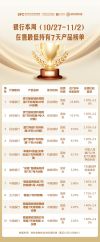
银行渠道本周在售最低持有期产品榜单(10/27-11/2)
2 1 Shi Ji Jing Ji Bao Dao· 2025-10-27 01:20
Core Insights - The article emphasizes the abundance of bank wealth management products with similar names and vague characteristics, urging investors to carefully select and differentiate among them [1] - The South Finance Wealth Management team aims to reduce investors' selection costs by focusing weekly on the performance of wealth management products available through various distribution channels [1] Summary by Category Performance Rankings - The current focus is on the performance of public offering products with a minimum holding period in RMB, categorized by holding periods of 7 days, 14 days, 30 days, and 60 days, with annualized returns as the performance metric [1] - The ranking includes 28 distribution institutions such as Industrial and Commercial Bank of China, Bank of China, Agricultural Bank of China, and others [1] Product Availability - The list of products is based on their "on-sale" status, which is determined by their investment cycle; however, actual availability may vary due to factors like sold-out quotas or differences in product listings for different customers [1] - Investors are advised to refer to the actual display on the distribution bank's app for the most accurate information [1] Weekly Updates - The article provides a weekly update on the performance of wealth management products, with specific attention to the lowest holding period products for the week of October 27 to November 2 [5][8][11]





本周聚焦:黄金波动下的机遇与挑战:银行贵金属业务有望成重要增长极
GOLDEN SUN SECURITIES· 2025-10-27 00:58
Investment Rating - The report maintains an "Accumulate" rating for the banking sector, indicating a positive outlook despite challenges in the gold market in 2025 [1]. Core Insights - The gold market is expected to present both opportunities and challenges for banks, with a trend towards deepening precious metal business driven by central bank purchases [1][2]. - The demand for gold bars and coins has increased significantly, reflecting a growing need for gold as a hedge and store of value among residents [4]. - The establishment of a market-making system for gold trading is anticipated to enhance market liquidity and stability, positioning listed banks as key players [3][4]. Summary by Sections 1. Policy and Market Environment - As of September 2025, China's official gold reserves reached 74.06 million ounces, marking an increase for 11 consecutive months [2]. - In Q2 2025, global central banks added 166 tons of gold to their reserves, with 95% of surveyed central banks expecting further increases in the next 12 months [2]. - New policies allowing insurance funds to invest in gold are expected to create new opportunities for banks to provide services to insurance institutions, enhancing their intermediary income [2]. 2. Business Dynamics and Revenue Contribution - In the first half of 2025, China's gold consumption was 505.205 tons, a year-on-year decrease of 3.54%, with significant growth in gold bar and coin consumption by 23.69% [4]. - The decline in gold jewelry consumption is prompting banks to shift focus from traditional jewelry sales to investment-oriented precious metal businesses [4]. - The growth in investment demand for gold bars and coins is expected to stabilize income from investment-related businesses, enhancing the profitability of the precious metals segment for banks [4]. 3. Industry Trends - The report highlights a structural shift in gold consumption, with investment demand rising while jewelry demand declines, indicating a need for banks to adapt their business strategies [4]. - The performance of the banking sector is expected to benefit from expansionary policies aimed at stabilizing the economy, with specific banks like Ningbo Bank and Jiangsu Bank recommended for investment due to positive fundamental changes [8]. 4. Key Data Tracking - The report includes various financial metrics, such as average daily trading volume and margin financing balances, which are essential for assessing market conditions [9][10].




关注信贷需求修复:银行业周报-20251026
Xiangcai Securities· 2025-10-26 14:50
Investment Rating - The industry investment rating is maintained at "Overweight" [4][7]. Core Insights - The new policy financial tools have been implemented to boost credit demand, with over 330 billion yuan allocated by three policy banks [3][27]. - A total of 500 billion yuan in new policy financial tools has been initiated, with 250 billion yuan already invested in 12 major economic provinces, focusing on infrastructure, foreign trade, and emerging sectors like digital economy and AI [4][5]. - The expected leverage effect of the 500 billion yuan policy financial tools could generate approximately 5 trillion yuan in investments and 4 trillion yuan in loans [4][29]. - The rapid deployment of these financial tools is anticipated to enhance credit demand in the fourth quarter, particularly benefiting regional banks due to the demonstration effect from major economic provinces [5][29]. Summary by Sections Market Review - The banking index increased by 1.40% during the period from October 20 to October 26, 2025, underperforming the CSI 300 index by 1.84 percentage points [9]. - The performance of major banks was relatively strong, with Agricultural Bank of China leading with a 4.86% increase [9]. Financial Market - The central bank's net injection in the open market was 198.1 billion yuan, maintaining a loose monetary environment [18]. - The average issuance rates for one-year interbank certificates of deposit were 1.68% for state-owned banks and 1.74% for regional banks, with a notable increase in net financing of 425.3 billion yuan in October [22][26]. Industry Dynamics - The policy financial tools are expected to support long-term public loans and improve loan term structures, with a focus on sustainable credit demand release during project operation cycles [29]. - Investment in emerging industries, particularly AI, is projected to maintain strong financing demand, with technology innovation loans expected to grow rapidly [5][29]. Investment Recommendations - The report suggests focusing on state-owned banks for their stable high dividend yields and potential valuation recovery opportunities for joint-stock and regional banks amid improving economic expectations [7][30].


城商行板块10月24日跌0.76%,厦门银行领跌,主力资金净流出1.42亿元
Zheng Xing Xing Ye Ri Bao· 2025-10-24 08:27
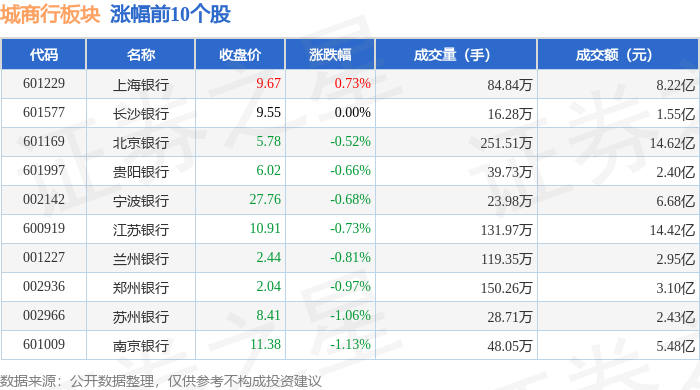
Core Insights - The city commercial bank sector experienced a decline of 0.77% on October 24, with Xiamen Bank leading the drop [1] - The Shanghai Composite Index closed at 3950.31, up 0.71%, while the Shenzhen Component Index closed at 13289.18, up 2.02% [1] Stock Performance - Shanghai Bank closed at 9.67, up 0.73% with a trading volume of 848,400 shares and a transaction value of 822 million [1] - Xiamen Bank closed at 6.68, down 1.76% with a trading volume of 153,100 shares and a transaction value of 103 million [2] - The majority of city commercial bank stocks showed negative performance, with notable declines in Beijing Bank (-0.52%) and Guizhou Bank (-0.66%) [1][2] Capital Flow - The city commercial bank sector saw a net outflow of 142 million from institutional investors, while retail investors contributed a net inflow of 55.9 million [2] - Jiangsu Bank had a net inflow of 70.84 million from institutional investors, while Shanghai Bank experienced a net outflow of 78.96 million from retail investors [3] Individual Stock Analysis - Chengdu Bank had a slight negative net flow from institutional investors of 19.75 million, but a positive inflow from retail investors of 596.99 million [3] - Lanzhou Bank saw a net inflow of 13.36 million from institutional investors, while it faced a net outflow of 1.48 million from retail investors [3]

银行发力双11!24期免息+满减返现 国有行城商行齐放大招
Bei Ke Cai Jing· 2025-10-24 03:16
Group 1 - Major state-owned banks and city commercial banks are launching various promotional offers such as card binding discounts, interest-free installments, and cashback in collaboration with e-commerce platforms ahead of the "Double 11" shopping festival [1][2][10] - The promotional activities are designed to attract consumers and stimulate consumption growth, with consumer loans and installment products being key tools due to their small amounts and convenience [1][15] - China Bank has partnered with Alipay to offer a consumption discount activity for users who bind their savings cards, providing random discounts for purchases during the promotional period [3][4] Group 2 - Various banks, including China Bank and Ping An Bank, are offering credit card payment discounts, with China Bank's "Installment Enjoy Discount" program providing up to 300 yuan in discounts and interest-free installments for up to 24 months [5][8] - City commercial banks like Suzhou Bank and Guiyang Bank are also participating in the promotional activities, offering discounts for credit card users and collaborating with Alipay for additional benefits [9][10] - Alipay has introduced a "Daily Discount for Bank Cards" program, allowing users to enjoy discounts for a specified number of days after registration, with participation from several major banks [10][14] Group 3 - The competitive landscape includes traditional banks facing off against popular payment options like Huabei and JD Pay, with banks leveraging their lower financing costs and broader customer base as competitive advantages [17] - However, banks face challenges in convenience and user data accumulation compared to online payment platforms, which offer quicker approval processes and targeted marketing [18] - The banking sector is experiencing pressure on net interest margins, with the average net interest margin reported at 1.42% as of the second quarter, indicating ongoing challenges in profitability [19]



靠降薪2亿维持体面增长,苏州银行之忧何解
Sou Hu Cai Jing· 2025-10-23 13:42
Core Viewpoint - The performance of Suzhou Bank has significantly declined, with its growth relying on cost-cutting measures rather than genuine business expansion, raising concerns about its long-term sustainability and profitability [3][4][7]. Financial Performance - In the first half of 2025, Suzhou Bank reported operating income of approximately 65.04 billion yuan, a year-on-year increase of only 1.81%, and a net profit attributable to shareholders of 31.34 billion yuan, up 6.15% year-on-year, marking the lowest growth rate in five years [5][6]. - The bank's net profit growth is largely superficial, achieved through salary reductions, as employee costs decreased by 2.11 billion yuan despite an increase in employee numbers [8][9][10]. Business Segments - Suzhou Bank's business is primarily divided into corporate, personal, and funding segments, with corporate business contributing over 50% of revenue. However, both corporate and personal business segments are currently underperforming [12]. - The bank's corporate business profit share rose to 72.12%, while personal and funding business profits declined significantly [12][16]. Loan and Asset Management - As of June 30, 2025, Suzhou Bank's total assets reached 754.97 billion yuan, an increase of 8.83% from the previous year, but still significantly smaller compared to its peers [12][19]. - The bank's personal loan principal has been consistently declining, with a notable drop of 2.52% in the first half of 2025 [13][14]. Challenges and Goals - Suzhou Bank aims to reach a total asset scale of 1 trillion yuan by 2026, but achieving this goal poses significant challenges given the current growth trajectory and market competition [17][19][21]. - The bank faces intense competition from larger state-owned banks and regional financial institutions, complicating its expansion efforts [21]. - Internal control issues have also been highlighted, with regulatory warnings issued due to various compliance failures [22].
城商行板块10月22日涨0.48%,长沙银行领涨,主力资金净流出2.69亿元
Zheng Xing Xing Ye Ri Bao· 2025-10-22 08:20
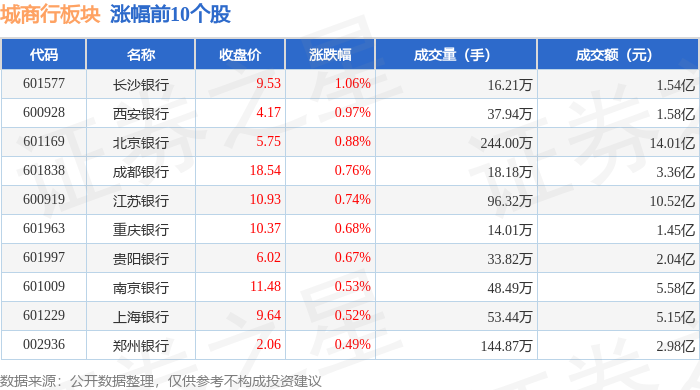
Market Performance - The city commercial bank sector increased by 0.48% on October 22, with Changsha Bank leading the gains [1] - The Shanghai Composite Index closed at 3913.76, down 0.07%, while the Shenzhen Component Index closed at 12996.61, down 0.62% [1] Individual Stock Performance - Changsha Bank closed at 9.53, up 1.06% with a trading volume of 162,100 shares and a transaction value of 154 million [1] - Other notable performers include: - Xi'an Bank: closed at 4.17, up 0.97% [1] - Beijing Bank: closed at 5.75, up 0.88% [1] - Chengdu Bank: closed at 18.54, up 0.76% [1] - Jiangsu Bank: closed at 10.93, up 0.74% [1] Capital Flow Analysis - The city commercial bank sector experienced a net outflow of 269 million from institutional investors, while retail investors saw a net inflow of 165 million [2] - The overall capital flow indicates a mixed sentiment among different investor types [2] Detailed Capital Flow for Selected Banks - Shanghai Bank had a net outflow of 34.67 million from institutional investors, with a retail net inflow of 41.06 million [3] - Qilu Bank saw a net inflow of 22.48 million from institutional investors, while retail investors had a net inflow of 9.09 million [3] - Changsha Bank recorded a net inflow of 2.31 million from institutional investors and a net inflow of 1.55 million from retail investors [3]

苏州银行:关于2025年二级资本债券(第一期)发行完毕的公告
Zheng Quan Ri Bao Zhi Sheng· 2025-10-21 14:13
Core Points - Suzhou Bank has successfully issued the "Suzhou Bank Co., Ltd. 2025 Tier 2 Capital Bonds (First Phase)" in the national interbank bond market, with an issuance scale of RMB 4.5 billion [1] - The bonds have a fixed interest rate of 2.45% and a maturity period of 10 years, with a conditional redemption option for the issuer at the end of the fifth year [1] Company Summary - The issuance was approved by the People's Bank of China and the Jiangsu Regulatory Bureau of the National Financial Supervision Administration [1] - The bond subscription was completed on October 16, 2025, and payment was finalized on October 20, 2025 [1]
厦门金龙汽车集团股份有限公司关于2025年7-9月份委托理财情况的公告
Zhong Guo Zheng Quan Bao - Zhong Zheng Wang· 2025-10-21 10:42
Core Viewpoint - The company aims to enhance the efficiency of fund utilization and reduce financial costs through entrusted wealth management while ensuring the safety of funds [5][4]. Group 1: Overview of Entrusted Wealth Management - The total amount for entrusted wealth management is 498,900 million yuan [3]. - The entrusted wealth management products include various structured deposits linked to gold and exchange rates from multiple banks [3]. - The duration for entrusted wealth management is within one year [4]. Group 2: Purpose and Source of Funds - The purpose of the entrusted wealth management is to ensure fund safety while improving fund utilization efficiency and obtaining certain investment returns [5]. - The source of funds for the entrusted wealth management is the temporarily idle self-owned funds of the company and its subsidiaries [6]. Group 3: Risk Control and Management - The company will conduct strict evaluations and selections of wealth management products, focusing on high safety, good liquidity, and low-risk principal-protected products [7]. - The company aims to avoid investment risks associated with policy changes by selecting short-term bank wealth management products [8]. Group 4: Impact on the Company - The wealth management activities are designed to improve the efficiency of idle funds without affecting the company's main business operations, thus benefiting the overall returns for the company and its shareholders [12]. - The accounting treatment for the wealth management products will be reported under "trading financial assets" according to the new financial instrument standards issued by the Ministry of Finance [12]. Group 5: Decision-Making Process - The decision to conduct wealth management was approved by the company's board of directors and the annual general meeting, emphasizing the importance of fund safety and efficiency [14]. - Independent directors believe that using temporarily idle self-owned funds for low-risk financial institution products aligns with the interests of the company and all shareholders [14].

