
CATL(300750)

Search documents
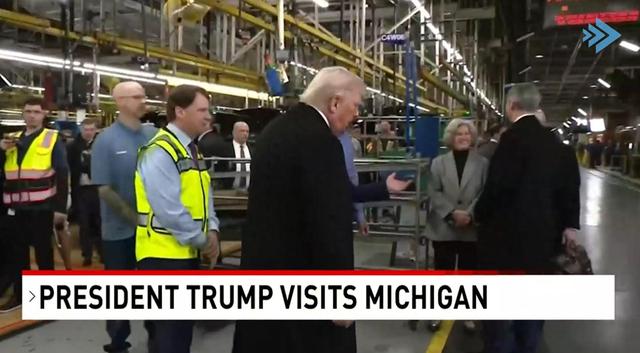
当朝剑斩不了前朝官?福特“沿用”中企技术,把美议员整不会了
Guan Cha Zhe Wang· 2026-01-29 01:55
Core Viewpoint - Ford Motor Company is deepening its collaboration with CATL, the world's largest battery manufacturer, to produce energy storage batteries in the U.S., amidst rising concerns from U.S. lawmakers regarding potential threats from China [1][3]. Group 1: Collaboration Details - Ford is the first company to collaborate with CATL through a technology licensing agreement, aiming to produce low-cost lithium iron phosphate electric vehicle batteries at a factory in Marshall, Michigan, expected to start production this year [3]. - Ford announced the establishment of a new subsidiary, Ford Energy, to focus on battery storage, leveraging CATL's technology [3][6]. - The company is repurposing a battery factory in Kentucky to produce storage batteries, which will supply energy storage for large AI data center projects and offset losses from its electric vehicle transition [3][6]. Group 2: Political and Competitive Pressures - U.S. lawmakers, particularly from the "China Committee," are pressuring Ford for more details on its collaboration with CATL, citing concerns over supply chain independence and economic security [1][5]. - Some competitors in Detroit are worried that Ford's existing agreements with CATL may provide it with an unfair competitive advantage, especially in light of the "Inflation Reduction Act" which limits new agreements with "restricted foreign entities" [6][7]. - Ford maintains that its battery production in Kentucky and Michigan will comply with federal tax credit requirements and is confident in the legality of its operations under existing agreements [7][8]. Group 3: Industry Context - Ford's CEO, Jim Farley, has expressed intentions to reduce reliance on Chinese components to mitigate supply chain risks while acknowledging the competitive landscape posed by Chinese automakers [8]. - The American automotive industry, represented by associations including Ford, has previously raised alarms about the perceived threats from Chinese automotive and battery manufacturers [8][9].



西部证券晨会纪要-20260129
Western Securities· 2026-01-29 01:37
Group 1: Fund Analysis - The public FOF fund scale increased in Q4 2025, with a new issuance scale of 458.54 billion yuan, primarily in bond-type funds [6][7] - The proportion of positive returns for FOF was 49%, with the top performer being CITIC Securities' selected fund [6][8] - Fund managers are optimistic about the market outlook, focusing on structural opportunities with technology and cyclical sectors as the main themes [6][11] Group 2: Electric Vehicle Market - The European electric vehicle market is entering a new phase, with a projected penetration rate of 29% in 2025 and 35% in 2026 due to supply-side drivers and supportive policies [14][15] - The introduction of affordable electric models by European automakers is expected to stimulate consumer demand significantly [15] - Chinese lithium battery companies are positioned to capitalize on the growth of the European market, enhancing their competitive landscape [14][16] Group 3: Construction and Decoration Industry - The construction state-owned enterprises are expected to benefit from strategic and professional restructuring policies initiated by the state [18][19] - The market share of major construction state-owned enterprises remains relatively low, with significant competition and operational pressure evident [19][20] - Recommendations include companies like China Communications Construction, China Railway, and China Chemical, which are likely to enhance their competitiveness through restructuring [21] Group 4: Beauty and Personal Care - The beauty industry in China is transitioning from incremental expansion to competitive positioning, with domestic brands gaining market share [23][24] - The company aims to achieve 30 billion yuan in sales by 2030, driven by research and development, brand expansion, and global operations [25] - The application of AI in production and marketing is expected to enhance operational efficiency and support long-term growth [25] Group 5: Basic Chemicals - The price of hafnium has surged by 21.64% since the beginning of 2026, driven by high demand in sectors like semiconductors and aerospace [27][28] - The company is advancing its zirconium-hafnium separation project, which is expected to significantly contribute to future earnings [29] - Hafnium's unique properties make it essential in high-tech applications, indicating strong future demand [28] Group 6: Electronics - The company is set to benefit from the high demand for PCB and packaging substrates, with projected net profits for 2025 expected to increase by 68% to 78% [31][32] - The expansion of production capacity is ongoing, with new facilities in Thailand and South China expected to enhance growth potential [33] - The company is recognized as a leading provider of electronic circuit technology, with a positive outlook for future performance [33]





研判2026!中国锂电池制造设备行业产业链、发展现状、出海规模及未来发展趋势分析:出海拓局开辟增量蓝海,海外市场规模有望达到1266.5亿元[图]
Chan Ye Xin Xi Wang· 2026-01-29 01:08
Core Insights - The lithium battery manufacturing equipment industry in China has established a complete industrial chain, with upstream components and materials, midstream equipment R&D and manufacturing, and downstream battery production and applications [1][6] - The industry has experienced rapid growth since 2020, with expected shipments reaching 1888.6 GWh by 2025, accounting for 82.8% of global shipments [1][8] - Domestic investment in the lithium battery industry is projected to exceed 820 billion yuan by 2025, with over 282 investment projects [1][9] - The overseas market is emerging as a new growth area, with the overseas lithium battery equipment market expected to reach 1266.5 billion yuan by 2030 [1][12] Industry Overview - Lithium battery manufacturing equipment is essential for producing lithium-ion battery cells and includes various specialized machinery for different production processes [1][3] - The equipment can be categorized based on production processes (front-end, mid-end, back-end), functionality, automation level, and battery type [3][4] Industrial Chain - The industrial chain consists of upstream core components and materials (40-60% of total equipment cost), midstream equipment R&D and manufacturing, and downstream battery production [6] - Key downstream customers include major battery manufacturers like CATL and BYD, with demand driven by the rapid growth of electric vehicles and energy storage [6][8] Market Dynamics - The domestic lithium battery equipment market has shown phase fluctuations, with a projected market size of 660 billion yuan in 2024 and a rebound to 850 billion yuan by 2027 [11] - The export value of lithium batteries from China reached 69.2 billion USD in the first 11 months of 2025, with an expected total of over 76 billion USD for the year [9][10] Development Trends - The industry is expected to focus on technological iteration, supply chain localization, and global expansion, leading to high-quality development [12][13] - Equipment will evolve to accommodate new battery technologies, integrating advanced technologies like AI and digital twins for improved production efficiency [12][13] - The localization of core components is crucial for enhancing supply chain resilience and reducing costs [13] - The global market competition is shifting towards technology and service capabilities, with leading companies enhancing their market positions through overseas expansions [14]


王宁,宁王
3 6 Ke· 2026-01-29 00:30
Core Insights - The article discusses the contrasting yet complementary roles of two prominent figures in the Chinese market: Wang Ning of Pop Mart and Zeng Yuqun of CATL, highlighting their contributions to consumer culture and technology respectively [2][21]. Group 1: Company Overview - Pop Mart, founded by Wang Ning, specializes in emotional consumer products, particularly blind box toys that allow consumers to project their feelings onto unbranded characters [3][4]. - CATL, led by Zeng Yuqun, focuses on the production of electric vehicle batteries, emphasizing technical specifications such as energy density and charging speed [5][6]. Group 2: Business Models - CATL operates on a B2B model, primarily serving major automotive manufacturers and aligning its success with the broader trends in the electric vehicle industry [10][11]. - Pop Mart employs a D2C model, directly engaging with consumers and relying on their emotional responses to drive sales [11]. Group 3: Competitive Advantages - CATL's competitive edge lies in its technological advancements and significant investment in R&D, creating high barriers to entry for competitors [9][18]. - Pop Mart's strength is rooted in its cultural IP and community engagement, allowing it to create a unique brand identity that resonates with consumers [9][18]. Group 4: Market Trends and Future Outlook - Both companies are positioned to expand globally, with CATL establishing factories in Europe and Pop Mart opening stores in major international cities, reflecting their respective strengths in technology and cultural appeal [13][14]. - The article suggests that both companies have successfully identified and capitalized on emerging market trends, with Zeng Yuqun recognizing the potential of electric vehicles early on and Wang Ning tapping into the demand for emotional consumer products [20][21].

公募FOF四季度加仓了哪些基金?【国信金工】
量化藏经阁· 2026-01-29 00:09
Overview of Public FOF Funds in Q4 2025 - As of Q4 2025, there are 549 FOF products in the market with a total scale of 244.188 billion yuan, an increase of 26.20% compared to Q3 2025 [1][2] - FOFs are categorized into three types based on the proportion of equity assets: bond-type FOFs (less than 30%), balanced FOFs (30% to 60%), and equity-type FOFs (more than 60%) [3] - The scale of bond-type FOFs reached 161.113 billion yuan, accounting for 65.98% of the total market FOF scale, which has been increasing since Q1 2024 [4] FOF Fund Manager Preferences - The top three actively managed equity funds with the most FOF holdings are: 1. Fuquan Stable Growth A (31 FOFs) 2. Boda Jiuhang C (22 FOFs) 3. Zhongou Dividend Enjoyment A (21 FOFs) [20] - The largest FOF holdings by scale are: 1. Xingquan Business Model Preferred A (4.77 billion yuan) 2. Yifangda Information Industry Selected C (3.65 billion yuan) 3. Yifangda Kerong (3.59 billion yuan) [20] Changes in FOF Fund Manager Allocations - In Q4 2025, the most net increased actively managed equity funds by FOFs are: 1. Yifangda Reform Dividend (4 FOFs) 2. Jingshun Longcheng Stable Return C (3 FOFs) 3. Zhongou Small Cap Growth C (3 FOFs) [33] - The largest net increase in scale for actively managed equity funds is for Jingshun Longcheng Stable Return C (0.66 billion yuan) [34] FOF Stock Investment Situation - By Q4 2025, 168 FOFs directly invested in stocks, with the highest proportion in balanced FOFs, followed by equity-type FOFs [1] - The top three stocks held by FOFs are: 1. Zijin Mining 2. Ningde Times 3. Hanwujing-U [1] Performance of Different Types of FOFs - In Q4 2025, the median returns for different types of FOFs are: - Bond-type FOFs: 0.33% - Balanced FOFs: -0.64% - Equity-type FOFs: -1.21% [13] - The top-performing bond-type FOFs in Q4 2025 are: 1. Tianhong Pension Target 2030 One-Year Holding (2.92%) 2. Ping An Yingyue Stable Return One-Year Holding A (1.81%) 3. Guotai Ruiyue Three-Month Holding (1.80%) [15][16] FOF Configuration by Fund Managers - The top three fund managers with the most FOF configurations in Q4 2025 are: 1. Yang Meng 2. Fan Yan 3. Liu Jianwei [1] - The most configured bond-type fund is Guangfa Pure Bond A, held by 32 FOFs [27]




公募顶流四季报揭秘 科技冲锋与价值深蹲下的业绩分野
2 1 Shi Ji Jing Ji Bao Dao· 2026-01-28 23:23
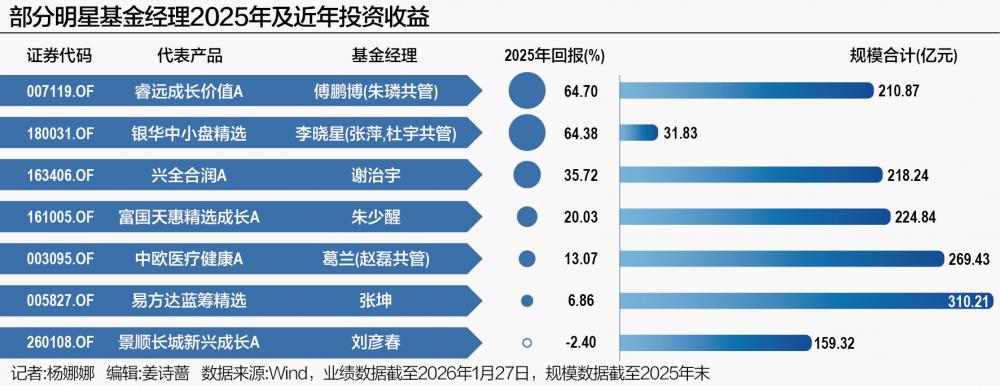
Core Viewpoint - The fourth quarter of 2025 saw increased market volatility, with A-shares and Hong Kong stocks ending the year amidst structural market trends. Major indices showed mixed performance, while sectors like AI computing and semiconductors thrived, contrasting with weaker performances in real estate, pharmaceuticals, and computing [1][2]. Group 1: Performance of Funds - Star fund managers like Fu Pengbo and Li Xiaoxing achieved significant excess returns in 2025, with their funds rising over 60% for the year, primarily due to heavy investments in AI computing and semiconductors [1]. - Balanced funds, such as Zhu Shaoxing's, demonstrated stable performance with a yearly increase of over 20%, benefiting from diversified holdings across various sectors [2][11]. - Traditional value-focused funds faced considerable net value pressure, with notable losses in the fourth quarter, particularly in sectors like consumption and pharmaceuticals [2][10]. Group 2: Investment Strategies - Funds focusing on technology growth, such as Fu Pengbo's and Li Xiaoxing's, increased allocations to data center cooling and semiconductor-related companies, reflecting a shift in their top holdings [5][6]. - Zhu Shaoxing's balanced approach, which included investments in banking and consumer sectors, effectively mitigated market volatility, leading to a net value increase [11]. - Fund managers emphasized the importance of stock selection in a concentrated market, with a focus on companies with core technological advantages and strong performance metrics [16]. Group 3: Sector Insights - The technology sector, particularly AI and semiconductors, remains a key focus for fund managers, with expectations of continued growth driven by domestic advancements [6][12]. - The pharmaceutical sector is undergoing positive changes, with improved policy environments and innovation capabilities, although some funds still faced challenges due to market adjustments [9][10]. - The consumer market is viewed positively, with strong domestic demand expected to support technological innovation and economic growth [8][10].



中国储能年度十大科技领袖(2025)|独家
24潮· 2026-01-28 23:03
Industry Overview - China is playing a crucial role in the global energy storage sector, with a significant share of green low-carbon patent applications, accounting for 48.28% of the total [2] - The energy storage field is identified as the strongest growth engine, with a projected 29.9% year-on-year increase in global patent applications in 2024 [2] - Technological innovation is a key driver for the sustainable development of the energy storage industry and the broader renewable energy sector [2] Company Achievements - CATL has invested a total of 868.84 billion yuan in R&D from 2014 to the first three quarters of 2025, representing 5.20% of its revenue, leading the industry in R&D investment [7] - As of June 2025, CATL has over 49,347 patents, with 29,709 in China and 19,638 overseas, showcasing its strong technological foundation [8] - CATL has announced the mass production of a 587Ah large-capacity energy storage cell and the world's first 9MWh super-large energy storage system solution, significantly enhancing performance metrics [8] Technological Innovations - Huawei has launched the FusionSolar 9.0 intelligent string-type energy storage solution, which supports various operational capabilities and enhances grid stability [12] - The company has also developed an AI-driven energy management system that optimizes the entire lifecycle of power plants, improving operational efficiency by 50% [13] - BYD's new energy storage product "Hao Han" features the world's largest 2710Ah blade battery, achieving over 300% capacity improvement compared to conventional batteries [16] Emerging Leaders - The "Top Ten Technology Leaders in China's Energy Storage" initiative aims to recognize influential figures in the energy storage sector, highlighting their contributions to the industry [4] - The focus is on showcasing the achievements of these leaders and their role in advancing China's energy storage capabilities [4] Market Trends - The energy storage market is witnessing a shift towards larger capacity solutions, with companies like EVE Energy and Gotion High-Tech introducing innovative products that enhance energy efficiency and reduce costs [26][29] - The trend towards integrated energy solutions is evident, with companies developing systems that combine energy storage with advanced management technologies to meet diverse market needs [20][24]
US lawmaker scrutinizes Ford battery partnership with Chinese company CATL
Yahoo Finance· 2026-01-28 18:23
Core Viewpoint - The U.S. House committee is examining Ford's strategy to repurpose its battery manufacturing facilities for lithium iron phosphate cells and energy storage systems in collaboration with CATL, raising concerns about licensing agreements and potential partnerships with Chinese companies [1][2][3]. Group 1: Ford's Business Strategy - Ford plans to repurpose its existing battery plants in Kentucky and Michigan to produce energy storage system batteries, with initial capacity expected to be operational within 18 months [4]. - The company announced a significant $19.5 billion writedown and the discontinuation of several electric vehicle models as part of its revised business strategy [4]. - Ford is confident that its expanded production of lithium iron phosphate (LFP) batteries will meet tax credit eligibility requirements, emphasizing the investment in American workers and local economies [5]. Group 2: Regulatory and Partnership Concerns - Representative John Moolenaar has raised questions regarding whether Ford's licensing terms with CATL have been modified in light of new eligibility restrictions under recent legislation [2][3]. - Moolenaar is also inquiring about a potential joint venture between Ford and Chinese automaker BYD, expressing concerns over vulnerabilities in the auto supply chain due to China's actions [6]. Group 3: Investment and Production Plans - Ford announced plans to build a $3 billion battery plant in Michigan, utilizing technology from CATL, with production expected to start this year [7]. - The new factory in Marshall, Michigan, will also manufacture batteries for Ford's upcoming $30,000 midsize electric vehicle truck [7].
热门主题集结:机器人、eVTOL、商业航天、轻量化功能化、固态电池、热管理、先进半导体
DT新材料· 2026-01-28 16:04
Core Viewpoint - The 2026 Future Industries New Materials Expo (FINE 2026) aims to lead global innovation in new materials, emphasizing their critical role in the transformation of high-tech industries and the future economy [1][2]. Group 1: Event Overview - FINE 2026 will take place from June 10 to 12, 2026, at the Shanghai New International Expo Center, featuring a total exhibition area of 50,000 square meters and over 800 exhibitors [12][34]. - The expo will include more than 300 strategic and cutting-edge technology reports, showcasing innovations applicable to various industries such as AI, aerospace, smart vehicles, and renewable energy [2][20]. Group 2: Focus Areas - The event will concentrate on five common demands of future industries: advanced semiconductors, advanced batteries, lightweight functional materials, low-carbon sustainability, and thermal management [2][10]. - Six thematic exhibition areas will be established, including advanced semiconductors, advanced batteries and energy materials, thermal management, lightweight and sustainable materials, new materials technology innovation, and future smart terminals [12][15]. Group 3: Participation and Audience - The expo is expected to attract over 100,000 professional visitors, including industry leaders and investors, facilitating precise connections between enterprises and industry resources [34][35]. - A targeted invitation will be extended to over 5,000 industry investors to support quality startups and enhance resource accumulation [10][35]. Group 4: Supporting Organizations - The event is organized by DT New Materials, in collaboration with various associations and institutions, including the China Productivity Promotion Center and the Ningbo New Materials Industry Association [4][5]. - The organizing body has a decade of experience in the new materials sector, with extensive connections across industries such as semiconductors, robotics, and renewable energy [10][44]. Group 5: Historical Context and Expectations - The previous editions of the expo, including the 2025 International Carbon Materials Expo and the 2025 Thermal Management Expo, achieved record attendance and participation, indicating a strong foundation for FINE 2026 [7][34]. - The event is positioned as a pivotal opportunity for businesses to engage in technology transfer and innovation integration, aiming to solidify the material foundation for the next decade of high-tech industry development in China [2][10].

指数基金产品研究系列报告之二百六十七:华夏中证科创创业50ETF投资价值分析
Shenwan Hongyuan Securities· 2026-01-28 15:35
Group 1: Report's Investment Rating - No information provided about the industry investment rating. Group 2: Core Viewpoints of the Report - The core driving force of China's economic development is undergoing profound changes, and technological innovation is crucial for driving new - quality productivity. The investment in the Sci - Tech Innovation and Entrepreneurship 50 Index aligns with the national key technological directions. The index focuses on leading companies in the STAR Market and ChiNext, making it a core tool for investing in China's technological innovation [3][10][11]. Group 3: Summary According to the Table of Contents 1. Macro - background: Leading the Development of New - quality Productivity with High - level Scientific and Technological Self - reliance - China is shifting its economic driving force, with technological innovation as the key to promoting industrial transformation and cultivating new economic growth points. The country aims to achieve scientific and technological self - reliance and will take extraordinary measures to make breakthroughs in key fields during the 15th Five - Year Plan period. The Sci - Tech Innovation and Entrepreneurship 50 Index highly covers relevant key industries [10]. - The country is reforming its institutional mechanisms to strengthen the role of enterprises in technological innovation. The STAR Market and ChiNext have gathered innovative enterprises, and the index focuses on their leading companies [11]. 2. China Securities Sci - Tech Innovation and Entrepreneurship 50 Index 2.1 Index Compilation Plan - The index was launched by China Securities Index Co., Ltd. on June 1, 2021, with a base date of December 31, 2019, and a base point of 1000. It selects 50 large - market - cap emerging - industry listed securities from the STAR Market and ChiNext to reflect the overall performance of representative emerging - industry listed securities [12]. - The sample space includes stocks and depositary receipts that meet certain listing time and non - ST requirements. The selection method involves choosing emerging - industry securities and then ranking them by average daily total market capitalization in the past year, selecting the top 50 [12][13][14]. 2.2 Concentrated Weight of Heavy - weight Stocks, Focusing on Emerging Technology Fields - As of January 16, 2026, the index has 50 constituent stocks with an average total market cap of 193.221 billion yuan. The top ten constituent stocks account for about 64.61% of the total weight, with Zhongji Innolight, Xinyisheng, and Contemporary Amperex Technology Co., Limited being the top three [15][18]. - The index covers multiple technology sectors, with the semiconductor industry having the highest weight of 34%, and other sectors like communication equipment, photovoltaic equipment, medical devices, and consumer electronics also having significant weights [22]. 2.3 Heavy - weight Stocks: Zhongji Innolight and Xinyisheng - Zhongji Innolight and Xinyisheng have a combined weight of over 20% in the index. They are core beneficiaries of the global AI - driven computing power demand in the communication equipment industry, driving the index's performance [25]. - Zhongji Innolight is a global leader in high - speed optical modules, with its performance growth driven by the demand for high - rate optical modules in large - scale cloud data centers. Xinyisheng has achieved significant customer expansion and high performance elasticity through technological breakthroughs and is also deploying in next - generation technologies [27]. - In 2023 - 2024, both companies showed significant growth. Zhongji Innolight had strong comprehensive strength, while Xinyisheng had higher performance elasticity, especially with a net profit growth of over 300% in 2024 [28]. 3. Analysis of the Index's Historical Performance 3.1 Long - term Risk - Return Characteristics: High Return and High Volatility - Based on historical price data from December 31, 2019, to January 16, 2026, the Sci - Tech Innovation and Entrepreneurship 50 Index had a cumulative return of 110.76% and an annualized return of 13.12%, ranking second only to the ChiNext 50 among the four comparison indexes, indicating strong long - term growth ability [31][33]. 3.2 Annual Performance: Highly Consistent with Market Style and Outstanding Explosiveness - Since 2020, the index has shown distinct return characteristics among major growth - style indexes. It has significant explosiveness in good market conditions and obvious volatility in market adjustments [34]. - The index's performance is highly synchronized with the market growth style. It achieved high annual returns in 2020 and 2025, leading other similar indexes. It also showed certain resilience in 2024 after a decline in 2022 - 2023 [35]. - In 2025, the index rose by over 60%, and as of January 16, 2026, it continued to gain 5.65%, outperforming the ChiNext Index and ChiNext 50 [37]. 4. Product Analysis of Huaxia China Securities Sci - Tech Innovation and Entrepreneurship 50 ETF (159783) - The ETF was established on June 24, 2021. As of the end of 2025, its scale was 5 billion yuan, and the management fee rate was 0.15%. It is managed by Xu Meng and Wang Xinwei [3][38]. - Xu Meng has 20 products under management, and Wang Xinwei has 7 products under management [39].

