
CATL(300750)

Search documents
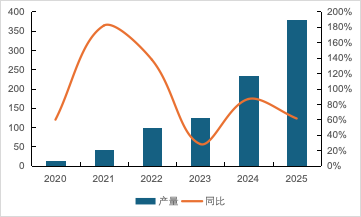
安泰科:2025年中国磷酸铁锂正极材料产量约379万吨 同比增加61.9%
智通财经网· 2026-01-20 22:45
Core Viewpoint - The lithium iron phosphate (LFP) cathode material production in China is expected to reach approximately 3.79 million tons by 2025, marking a year-on-year increase of 61.9%, with significant growth anticipated in the second half of the year due to surging energy storage demand [1] Group 1: Production and Market Dynamics - In 2025, the top ten companies in the LFP industry are projected to produce around 3 million tons, accounting for 79.2% of total production, indicating a slight decrease in market concentration compared to 2024 [2] - Hunan Youneng is leading the production with over 1 million tons, followed by Hubei Wanrun and Fulian Precision, which are competing at the 300,000-ton level [2] - The industry is experiencing a surge in orders, with over 240 billion yuan in contracts locked in over the past year, primarily from major battery manufacturers like CATL and BYD [7] Group 2: Export Trends - From January to November 2025, China is expected to export 28,300 tons of LFP cathode materials, a 12.5-fold increase compared to the same period in 2024, with total exports projected to exceed 33,000 tons for the year [3] Group 3: Future Outlook and Competitive Landscape - By 2026, the total production of LFP cathode materials in China is estimated to reach 5.8 million tons, reflecting a year-on-year growth of approximately 53%, driven by new capacity expansions [7] - The industry is facing structural oversupply, particularly in second and third-generation materials, while high-end materials remain in short supply [7] - The competitive landscape is shifting towards "head concentration and small-scale elimination," with leading companies focusing on high-end product development and production capabilities [7]






FINE2026丨智能终端×新材料:六大主题展集结,洞见未来产业新机遇
DT新材料· 2026-01-20 16:05
Core Viewpoint - The 2026 Future Industries New Materials Expo (FINE 2026) aims to showcase innovations in new materials, positioning China as a leader in global new material innovation and development, with a focus on future industries and technological advancements [1][2]. Group 1: Event Overview - FINE 2026 will take place from June 10 to 12, 2026, at the Shanghai New International Expo Center, featuring a total exhibition area of 50,000 square meters and over 800 exhibitors [12][34]. - The expo will include more than 300 strategic and cutting-edge technology reports, covering applications in various industries such as AI, aerospace, smart vehicles, and renewable energy [2][20]. Group 2: Focus Areas - The event will emphasize five common needs of future industries: advanced semiconductors, advanced batteries, lightweight functional materials, low-carbon sustainability, and thermal management [2][10]. - Six thematic exhibition areas will be set up, including advanced semiconductors, advanced batteries and energy materials, thermal management, lightweight and sustainable materials, new material technology innovation, and future smart terminals [12][15]. Group 3: Participation and Audience - The expo is expected to attract over 100,000 professional visitors, including industry leaders and investors, facilitating connections between startups and industry resources [34][35]. - A targeted invitation will be extended to over 5,000 industry investors to support quality startups and enhance resource accumulation [10][35]. Group 4: Supporting Organizations - The event is organized by DT New Materials, in collaboration with various associations and institutions, including the China Productivity Promotion Center and the Ningbo New Materials Industry Association [4][5]. - The organizing body has a decade of experience in the new materials sector, with extensive connections across industries such as semiconductors, robotics, and renewable energy [10][44]. Group 5: Historical Context and Expectations - The previous editions of the expo, including the 2025 International Carbon Materials Expo and the 2025 Thermal Management Expo, achieved record attendance and participation, indicating strong interest and growth in the sector [7][34]. - FINE 2026 is positioned as a significant opportunity for businesses to engage in technology transfer and innovation, aligning with China's strategic focus on high-tech industries [2][10].

中高端磷酸铁锂产品供不应求 近一年超2400亿元磷酸铁锂订单锁定
Xin Lang Cai Jing· 2026-01-20 14:19
Core Insights - The lithium iron phosphate (LFP) market is experiencing significant growth, with major battery manufacturers aggressively purchasing LFP materials [1] - The total procurement of LFP materials by companies such as CATL, BYD, EVE Energy, Sunwoda, and Chuangneng New Energy has reached 6 million tons, with an order value exceeding 240 billion yuan [1] - There is a high demand for mid-to-high-end LFP products, leading to full-capacity operations at various companies including Longpan Technology, Wanrun New Energy, Fulian Precision, Fengyuan Co., and Rongbai Technology [1]
【新能源周报】新能源汽车行业信息周报(2026年1月12日-1月18日)
乘联分会· 2026-01-20 13:41
Industry Information - The EU-China Chamber of Commerce welcomes the soft landing of the electric vehicle agreement between China and the EU, which is expected to boost market confidence and foster cooperation in the electric vehicle industry [7][9] - The second Intelligent Driving Competition concluded in Wenzhou, with the Star Epoch ES winning first place, followed by Momenta's solution-equipped vehicles [8] - Gotion High-Tech's Ganzhou base was recognized as an innovative small and medium-sized enterprise in Jiangxi, contributing to the upgrade of the new energy industry [9] - Honeycomb Energy launched the world's largest 80 kWh plug-in hybrid battery, featuring a 6% increase in energy density and rapid charging capabilities [10] - China aims to accelerate breakthroughs in solid-state batteries and advanced autonomous driving technologies in 2026 [11] - Shenzhen successfully implemented the first billing for electric vehicle discharging to the grid, with a user earning approximately 15 yuan for discharging 20 kWh [12] - A new sodium-sulfur battery developed by a Chinese research team achieved an energy density of 2021 Wh/kg, significantly surpassing existing lithium-ion batteries [14] - The Trump administration approved the export of NVIDIA's H200 chips to China, which may enhance AI capabilities in the region [15] - A meeting was held by three departments to address the issue of chaotic price wars in the electric vehicle industry, emphasizing the need for fair competition [19] - Honeycomb Energy introduced a new 3.5 generation pulse charging technology that reduces charging time by 25% without additional costs [20] - The State Council reported a 25.4% increase in exports of direct current charging piles and energy storage batteries to the EU by 2025 [21] - The city of Qingyuan in Guangdong will issue 1.8172 million yuan in charging subsidies by 2025 [22] - In December 2025, electric vehicle sales in Australia surpassed those of fuel vehicles for the first time, with a total of 35,058 electric vehicles sold [23] - The General Administration of Customs reported a 26.2% increase in lithium battery exports in 2025 [24] - The China Automobile Association released a report indicating that nearly 80% of the market share for self-developed NOA solutions in passenger vehicles is held by domestic manufacturers [25] - The Market Supervision Administration is establishing a national standardization committee for the recycling and utilization of power batteries [26] - The domestic power battery installation volume is projected to reach 769.7 GWh in 2025, a year-on-year increase of 40.4% [27] - The coverage rate of charging and swapping stations in Hanzhong County increased from 35% to 82% [28] - By the end of 2025, Guizhou Province plans to build over 250,000 charging facilities and 59 swapping stations [29] - Canada has reduced tariffs on electric vehicles imported from China to 6.1%, significantly benefiting Chinese manufacturers [30] - The first cross-province iron-sea intermodal transport of new energy vehicles through Xiamen Port took place in 2026 [31] - Huawei announced upgrades to its ADS 4.1 system, enhancing safety and user experience features [32] Policy Information - The Guangxi Energy Bureau issued guidelines for the construction and operation management of electric vehicle charging infrastructure [33] - Zhengzhou's Commerce Bureau announced a subsidy program for replacing old vehicles and appliances in 2026 [34] - The National Development and Reform Commission plans to introduce a comprehensive management approach for the recycling of power batteries [35]
1200亿元订单存疑,容百科技被证监会立案调查背后
3 6 Ke· 2026-01-20 13:26
Core Viewpoint - The procurement agreement between Rongbai Technology and CATL has a total sales amount exceeding 120 billion yuan, raising market concerns about the feasibility and implications of the contract [1]. Group 1: Procurement Agreement Details - Rongbai Technology signed a procurement cooperation agreement with CATL to supply 3.05 million tons of lithium iron phosphate cathode materials from Q1 2026 to 2031, with a total sales amount exceeding 120 billion yuan [1]. - The Shanghai Stock Exchange issued an inquiry letter to Rongbai Technology regarding the procurement agreement, leading to a temporary suspension of the company's stock [1]. - Upon resuming trading on January 19, 2026, Rongbai Technology's stock opened at a limit-down price of 29.88 yuan per share and closed at 33.18 yuan, a drop of 11.16% [1]. Group 2: Capacity and Financial Implications - Rongbai Technology acknowledged that the 120 billion yuan contract amount is an estimate, and the actual sales scale and amount are uncertain [2]. - The company currently has a production capacity of only 60,000 tons per year from its newly acquired subsidiary, Guizhou Xinren New Energy Technology, which is significantly lower than the contract's requirements [2]. - The estimated order value is equivalent to eight years of Rongbai Technology's projected revenue for 2024, which is 15.1 billion yuan, indicating a substantial gap between current capacity and contract obligations [2]. Group 3: Expansion Plans - To meet the contract requirements, Rongbai Technology plans to expand its production capacity through investments and acquisitions, with an estimated capital expenditure of 8.7 billion yuan over the next three years [3]. - The expected capital investments for 2026, 2027, and 2028 are 3.6 billion yuan, 3.3 billion yuan, and 1.8 billion yuan, respectively [3]. - The company has established a lithium iron phosphate division to integrate R&D efforts and enhance production capabilities [3]. Group 4: Regulatory and Investor Concerns - Rongbai Technology is under investigation by the China Securities Regulatory Commission for potentially misleading disclosures related to the 120 billion yuan procurement agreement [4]. - Investors have expressed concerns regarding the company's production capacity and the implications of the regulatory investigation on its operations [5]. - The actual controller of Rongbai Technology, Bai Houshan, has a background in the lithium battery materials sector and has previously founded another listed company, indicating a strong industry presence [5]. Group 5: Financial Performance - In the first three quarters of 2025, CATL accounted for approximately 45% of Rongbai Technology's revenue, making it the company's largest customer [7]. - Rongbai Technology projected a net loss of between 150 million yuan and 190 million yuan for the full year of 2025, attributing the loss to a decline in sales volume [7]. - The company reported a significant improvement in performance in the fourth quarter, achieving profitability and indicating a recovery in operational results [7].

动力电池年度榜单出炉:一线电池厂份额遭蚕食,新玩家登场 | 动力电池排名①
Xin Lang Cai Jing· 2026-01-20 11:45
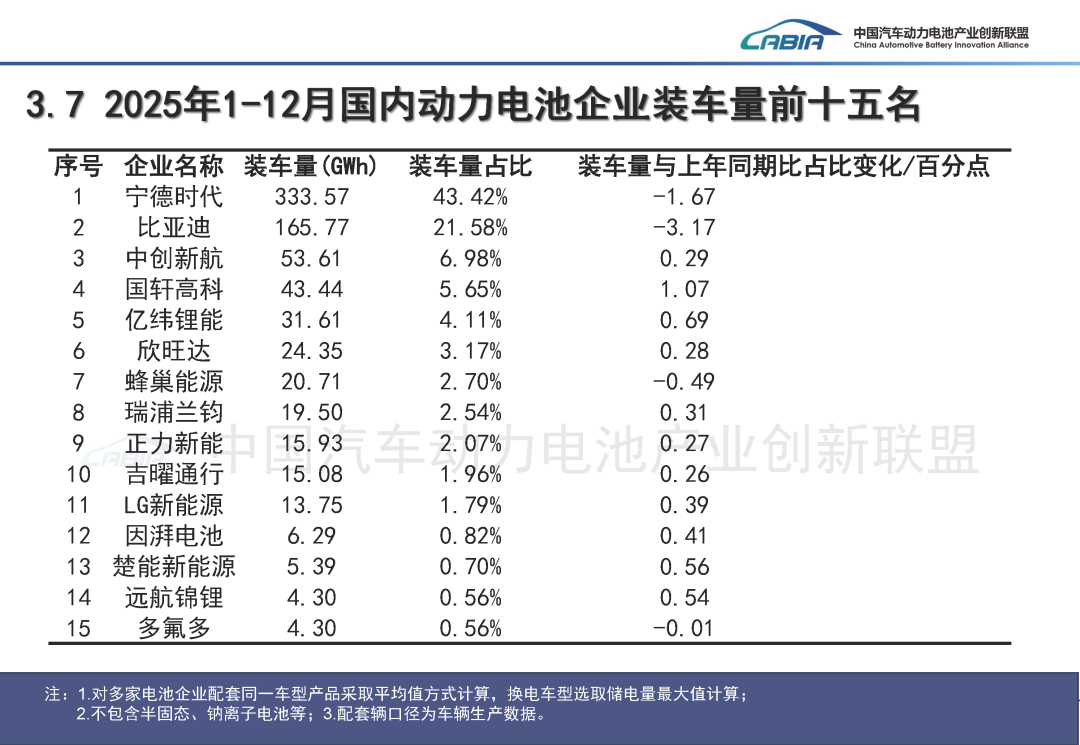
Core Viewpoint - The market share of leading battery manufacturers CATL and BYD has declined in 2025, with a combined drop of nearly 5 percentage points compared to the previous year [1][3]. Group 1: Market Performance - In 2025, the cumulative installed capacity of domestic power batteries is projected to reach 769.7 GWh, representing a year-on-year growth of 40.4% [2]. - Among the total installed capacity, ternary batteries account for 144.1 GWh (18.7%) with a year-on-year growth of 3.7%, while lithium iron phosphate batteries dominate with 625.3 GWh (81.2%) and a year-on-year growth of 52.9% [2]. - CATL leads the market with an installed capacity of 333.57 GWh, holding a market share of 43.42%, while BYD follows with 165.77 GWh and a market share of 21.58% [2][4]. Group 2: Market Share Changes - Both CATL and BYD experienced a decline in market share in 2025, with CATL down by 1.67 percentage points and BYD down by 3.17 percentage points, marking the largest declines among the top fifteen battery manufacturers [3][4]. - In contrast, the majority of second and third-tier battery manufacturers saw an increase in market share, indicating a competitive shift in the industry [5][6]. Group 3: Emerging Competitors - Guoxuan High-Tech recorded the highest market share growth among the top fifteen, achieving an installed capacity of 43.44 GWh and a market share increase of 1.07 percentage points [6][7]. - The rankings for the top five battery manufacturers remained unchanged, while the positions from sixth to fifteenth experienced significant reshuffling, with several new entrants making their debut [8][10]. - New companies like Jiyao Tongxing and Choneng New Energy have entered the top fifteen list, reflecting the growing trend of automakers developing their own battery solutions [11][14]. Group 4: Overall Industry Trends - The total production of power and other batteries in China reached 778.1 GWh in the previous year, with a year-on-year growth of 42.5% [15]. - The cumulative sales of power and energy storage batteries amounted to 1,700.5 GWh, with power batteries accounting for 1,200.9 GWh (70.6%) and energy storage batteries for 499.6 GWh (29.4%) [16]. - The export of power batteries reached 189.7 GWh, representing 62.2% of total exports, with a year-on-year growth of 41.9% [17].
电池板块承压,阳光电源跌超5%,电池50ETF(159796)跌超2%,四连涨后首度回调,固态电池催化密集落地,产业化进程提速!
Xin Lang Cai Jing· 2026-01-20 11:44
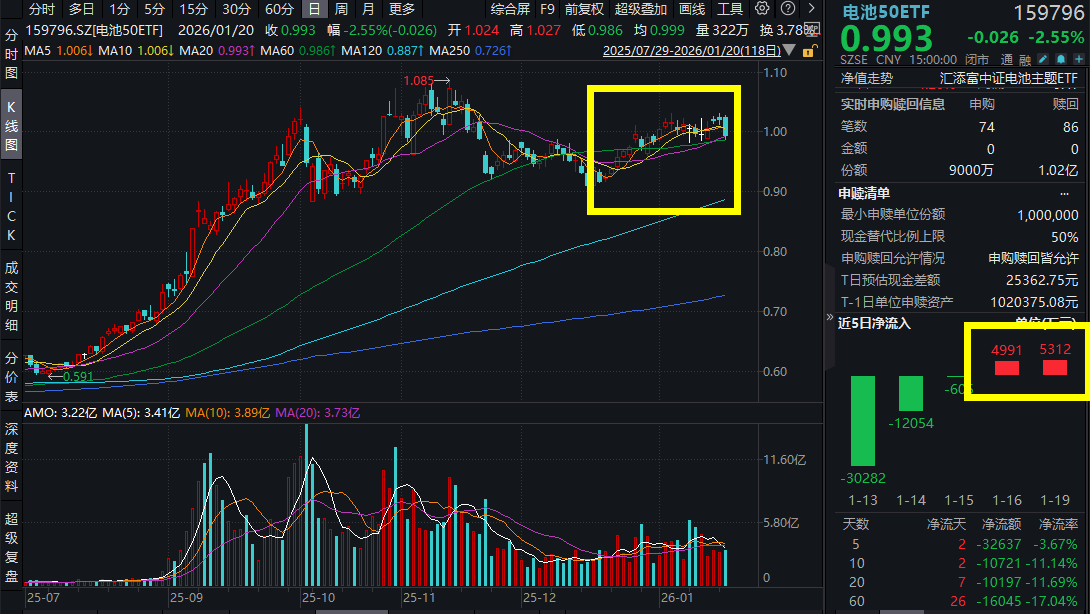
Core Viewpoint - The A-share market experienced fluctuations with the battery sector under pressure, as evidenced by the decline of the Battery 50 ETF (159796) by 2.55% after four consecutive days of gains, with a trading volume of 322 million yuan [1]. Group 1: Market Performance - The Battery 50 ETF (159796) saw most of its constituent stocks decline, with significant drops including Sunshine Power down over 5%, and others like Xian Dao Intelligent and Multi-Fluorine down over 4% [3]. - The top ten constituent stocks of the Battery 50 ETF include major players such as Sunshine Power and Ningde Times, with varying declines in their stock prices [4]. Group 2: Project Announcements - On January 19, China Energy Construction announced the procurement results for a 153 MW battery storage project in South Africa, with Sunshine Power winning the bid for a total project capacity of 742.22 MWh and a contract value of 528 million yuan (approximately 0.86 yuan/Wh) [5]. Group 3: Industry Trends - The battery sector is expected to recover due to multiple catalysts, including a surge in demand for energy storage, rising material prices, and accelerated solid-state battery technology [6]. - Global demand for large-scale energy storage is projected to exceed expectations, with a forecasted growth of over 60% by 2026, driven by various market factors including the U.S. Inflation Reduction Act [7]. - Prices of upstream raw materials have generally increased, with battery-grade lithium carbonate rising by 64.4% to 157,000 yuan/ton, and lithium hydroxide up by 77.51% to 150,000 yuan/ton as of January 16, 2026 [8]. Group 4: Technological Developments - The solid-state battery sector is witnessing rapid advancements, with significant policy support and market catalysts enhancing industry prospects [9]. - Major automotive manufacturers are accelerating the integration of solid-state batteries, with companies like FAW Hongqi and GAC Group making substantial progress towards mass production by 2027 [9]. Group 5: Investment Opportunities - The Battery 50 ETF (159796) is positioned to benefit significantly from the energy storage sector, with a storage component of 18.7%, and a solid-state battery component of 45%, indicating strong growth potential [10]. - The ETF's focus on energy storage and power batteries, along with its low management fee of 0.15% per year, makes it an attractive investment option for capturing opportunities in the battery sector [16].



包揽锂电全球灯塔工厂,中国企业如何改写全球制造规则?
高工锂电· 2026-01-20 10:42
Core Viewpoint - The article highlights the transformation of China's lithium battery manufacturing industry, emphasizing its recognition as a global leader in smart and sustainable manufacturing through the achievement of "lighthouse factory" status by key companies [2][3][15]. Group 1: Lighthouse Factory Recognition - Three Chinese lithium battery companies, EVE Energy, Hicharge Energy, and CATL, were recognized as global lighthouse factories by the World Economic Forum, marking a significant milestone for China's lithium battery sector [2][3]. - This recognition reflects China's advancements in digitalization and green transformation within the lithium battery manufacturing industry, positioning it among the world's top tier [2][3]. Group 2: Criteria for Lighthouse Factory Certification - The lighthouse factory certification evaluates companies based on five core dimensions: production efficiency, supply chain resilience, customer-centricity, sustainability, and talent development [3]. - Companies must achieve over a 20% improvement in Overall Equipment Efficiency (OEE) and meet stringent sustainability criteria, including a 30% reduction in carbon emissions per unit of output compared to industry benchmarks [4]. Group 3: Industry Trends and Innovations - The article identifies four key trends in lithium battery manufacturing: extreme automation and AI integration, zero-carbon manufacturing, customized production for specific segments, and collaborative ecosystem development [9][10]. - EVE Energy focuses on cylindrical batteries with a "smart + circular" approach, while Hicharge Energy specializes in long-duration energy storage solutions, and CATL emphasizes a zero-carbon production process [8][9]. Group 4: Policy Alignment and Industry Ecosystem - The recognition of these companies aligns with China's national policy on zero-carbon factory construction, which aims to enhance carbon management and promote green energy structures [13][14]. - The collaboration between lighthouse factory initiatives and national policies fosters a synergistic effect, driving digital transformation and sustainability across the lithium battery supply chain [14]. Group 5: Future Outlook - The article concludes that the achievements of Chinese lithium battery companies in obtaining lighthouse factory status not only redefine the global landscape of manufacturing but also set a precedent for future developments in the renewable energy sector [15].
驰宏锌锗:截至目前,公司尚未与宁德时代进行锗、钴材料的合作
Ge Long Hui· 2026-01-20 10:16
Core Viewpoint - Chihong Zn & Ge Co., Ltd. has not yet established a partnership with CATL for the cooperation on germanium and cobalt materials as of the latest update [1] Company Summary - Chihong Zn & Ge Co., Ltd. is currently in discussions regarding potential collaboration but has confirmed no agreements with CATL [1]

驰宏锌锗(600497.SH):截至目前,公司尚未与宁德时代进行锗、钴材料的合作
Ge Long Hui· 2026-01-20 10:07
Core Viewpoint - Chihong Zn & Ge Co., Ltd. has not yet established a partnership with CATL for the cooperation on germanium and cobalt materials as of the latest update [1] Group 1 - The company confirmed that there is currently no collaboration with CATL regarding germanium and cobalt materials [1]