
CATL(300750)

Search documents
睿远基金旗下产品最新重仓股曝光:傅鹏博加仓寒武纪,赵枫买回美的
Sou Hu Cai Jing· 2026-01-21 03:57
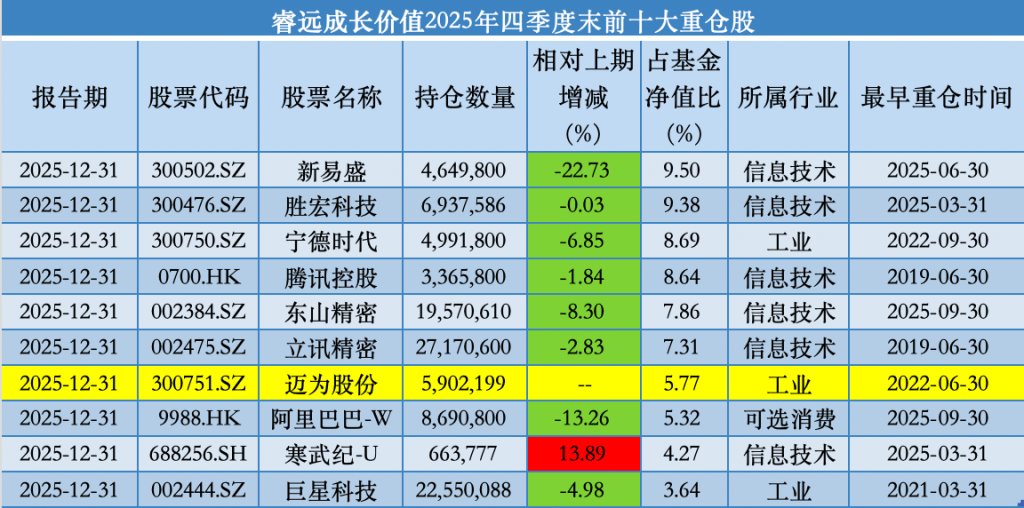
Core Viewpoint - The report highlights significant changes in the investment strategies of Ruiyuan Fund's star fund managers, with notable adjustments in stock holdings and performance metrics for the fourth quarter of 2025. Group 1: Fund Performance and Adjustments - Ruiyuan Growth Value Mixed Fund experienced a net redemption of 136.2 million shares, marking the second-highest redemption in its history, with total net assets decreasing from 23.629 billion yuan to 21.087 billion yuan [3][4] - The fund's stock allocation increased slightly from 89.93% to 90.48%, while the proportion of Hong Kong stocks in the fund's net value decreased from 27.92% to 20.14% [3][4] - Ruiyuan Balanced Value Three-Year Holding Fund's stock allocation reached a three-year high of 90.66%, with a slight increase in the proportion of Hong Kong stocks to 41.99% [10] Group 2: Stock Holdings and Changes - The top ten holdings of Ruiyuan Growth Value Mixed Fund included New Yisheng, Shenghong Technology, and Ningde Times, with New Yisheng seeing a 22.73% reduction in holdings [4][5] - Ruiyuan Balanced Value Three-Year Holding Fund saw significant changes, with the re-entry of Midea Group into the top ten holdings and reductions in holdings of companies like Lixun Precision and China Ping An [10][12] - The fund managers noted a shift in focus towards sectors like photovoltaic and semiconductor high-end equipment manufacturing, while reducing exposure to companies with weak fundamentals [6][10] Group 3: Future Outlook and Strategy - The fund managers expressed optimism about the market, anticipating that the return on equity assets will remain attractive compared to other asset classes, with potential returns exceeding 10% for leading companies [11][13] - They plan to focus on companies with strong fundamentals and competitive advantages, particularly those expanding overseas, as this is expected to drive future growth [13][14] - The report indicates a structural market environment with limited risks of significant downturns, while opportunities for excess returns remain [8][13]







外资车企,史诗级加仓中国
3 6 Ke· 2026-01-21 03:34
Core Viewpoint - The narrative of "decoupling from China" in the automotive industry is countered by significant investments and strategic shifts by foreign automakers, indicating a deeper integration into the Chinese market driven by market and technological needs rather than solely political pressures [2][12][25]. Group 1: Foreign Automakers' Strategies in China - Toyota has transferred decision-making authority for its models in China from Japan to local teams [2]. - Volkswagen has established a €2.5 billion smart connected vehicle R&D center in Hefei, known as "Oriental Wolfsburg" [2]. - Mercedes-Benz and BMW have announced plans to invest over 100 billion RMB in R&D in China over the coming years [2]. Group 2: Historical Context and Market Dynamics - In the 1980s, foreign automakers entered China through joint ventures with local companies, dominating the market for decades [3][4]. - The "smile curve" illustrates that while foreign companies controlled R&D and profits, local partners were confined to low-end manufacturing [5][6]. - The U.S.-China trade war initiated a wave of domestic substitution, leading to significant changes in the automotive landscape, including the rise of new players like Tesla and local startups [6][7]. Group 3: Shifts in Consumer Preferences - Chinese consumers are increasingly prioritizing advanced technologies over traditional brand prestige, leading to a shift in competitive dynamics [7][8]. - The rapid evolution of electric and smart vehicles has created a new competitive landscape where innovation speed is crucial [8][11]. Group 4: Localized Innovation and R&D - Foreign automakers are now decentralizing decision-making, with many appointing local executives to lead their China operations [13][15]. - Companies like Volkswagen and BMW are establishing R&D centers in China to focus on local market needs and global trends [15][16]. - The integration of local engineers into core development processes is transforming foreign R&D centers from mere adaptation units to hubs of original innovation [15][16]. Group 5: Supply Chain and Manufacturing Evolution - Foreign automakers are increasingly relying on Chinese manufacturing capabilities, viewing local factories as benchmarks for global production standards [17][19]. - The shift from "made in China" to "designed in China" is evident, with Chinese innovations being exported globally [20][24]. Group 6: Standardization and Global Influence - China is actively working to establish global standards in the automotive industry, aiming for a significant increase in the international standard conversion rate [26][27]. - The push for standardization is supported by government initiatives, enhancing China's role in shaping future industry norms [26][27]. Group 7: Future Outlook and Strategic Opportunities - The trend of "reverse localization" presents a strategic opportunity for the Chinese automotive industry to lead in the next era of automotive innovation [25][29]. - The focus is shifting from merely being a part of the global supply chain to becoming a rule-maker in the smart electric vehicle era [29].




锂矿股领涨两市 碳酸锂涨势迅猛
Xin Hua Cai Jing· 2026-01-21 03:31
Group 1 - The A-share lithium mining stocks surged significantly, with the sector rising nearly 4%, ranking second only to precious metals in the market [1] - Key stocks such as Shengxin Lithium Energy reached the daily limit, while Tianhua New Energy and Zhongmin Resources increased by over 7%, and industry leaders like Ganfeng Lithium and Tianqi Lithium also saw notable gains [1] - The main contract for lithium carbonate in the commodity futures market rose by over 5%, with a cumulative increase of over 35% since the beginning of 2026 [1] Group 2 - The price range for high-quality lithium carbonate on January 21 was reported between 155,800 and 159,500 yuan per ton, with an increase of 4,150 yuan from the previous trading day [1] - Battery-grade lithium carbonate prices ranged from 154,800 to 159,500 yuan per ton, up by 4,200 yuan, while industrial-grade prices were between 152,000 and 156,500 yuan per ton, increasing by 4,550 yuan [1] - The recent rise in lithium carbonate prices is primarily driven by concerns over supply tightening, particularly due to the publication of the "Solid Waste Comprehensive Treatment Action Plan," which emphasizes tailings management in lithium production [1] Group 3 - Two main reasons for the recent surge in lithium carbonate prices include progress in the environmental assessment of the Jiangxia Mine by CATL, although production resumption may take at least two more months [2] - Additionally, there are reports that some mines in Jiangxi may halt production due to tailings encroaching on river channels, aligning with the timing of environmental inspections [2]




宁德时代在临汾成立动力科技公司,注册资本2000万
Zhong Guo Neng Yuan Wang· 2026-01-21 03:14
Group 1 - The establishment of Times Qiji Power Technology (Linfen) Co., Ltd. has been officially registered, with a legal representative named Zhang Yan and a registered capital of 20 million RMB [1] - The company's business scope includes operations related to electric vehicle charging infrastructure, battery leasing, recycling and repurposing of used power batteries from new energy vehicles, rental of charging control equipment, energy storage technology services, battery sales, and sales of battery accessories [1] - Times Qiji Power Technology is wholly owned by Times Qiji New Energy Technology (Shenzhen) Co., Ltd., which is a subsidiary of CATL (Contemporary Amperex Technology Co., Ltd.) [1]
底座坚实、数字为翼,济宁以雄心破局数字强市
Qi Lu Wan Bao· 2026-01-21 03:14
Core Viewpoint - Jining is positioning itself as a "digital strong city" by leveraging digital infrastructure and industry integration to achieve a trillion-yuan economy by 2026 [1][4] Group 1: Digital Infrastructure Development - The launch of the Lunan Computing Power Network Center by China Mobile enhances the computing power landscape in Jining and surrounding cities, injecting core energy into new productive forces [3] - Jining has implemented over 5,543 industrial projects with investments exceeding 500 million yuan, achieving a 50% deep transformation rate in digitalization among large-scale industrial enterprises [3] - The city has established a communication network with 18,000 5G base stations, serving as a "digital artery" for continuous digital iteration and expansion [3] Group 2: Industrial Cluster and Economic Growth - Luoshi Robotics has emerged as a leading enterprise, becoming the first domestic industrial robot brand to enter Xiaomi's YU7 welding workshop, attracting over 20 upstream and downstream companies to settle in Jining [3] - The first products from the Shandong Times New Energy Base are set to be exported, with expectations for Jining to become the largest and most advanced production base for energy storage and power batteries in Northern China by 2025 [3] - The core revenue of Jining's digital economy is projected to exceed 70 billion yuan by 2025, doubling from 2021, with automotive electronics and digital terminals becoming provincial benchmarks [3] Group 3: Strategic Initiatives and Future Goals - The 2026 government work report emphasizes a dual-engine strategy of "data elements ×" and "artificial intelligence +" to promote the integration of the real economy and digital economy [4] - Jining is advancing its industrial strategy by establishing a provincial-level digital economy innovation development pilot zone and attracting high-end manufacturing and AI industries [4] - The city aims to create over 50 application scenarios across manufacturing, cultural tourism, and government sectors, empowering various industries through comprehensive digitalization [4]


融资资金“加仓”特变电工、中际旭创、新易盛等个股丨资金流向日报
2 1 Shi Ji Jing Ji Bao Dao· 2026-01-21 03:07
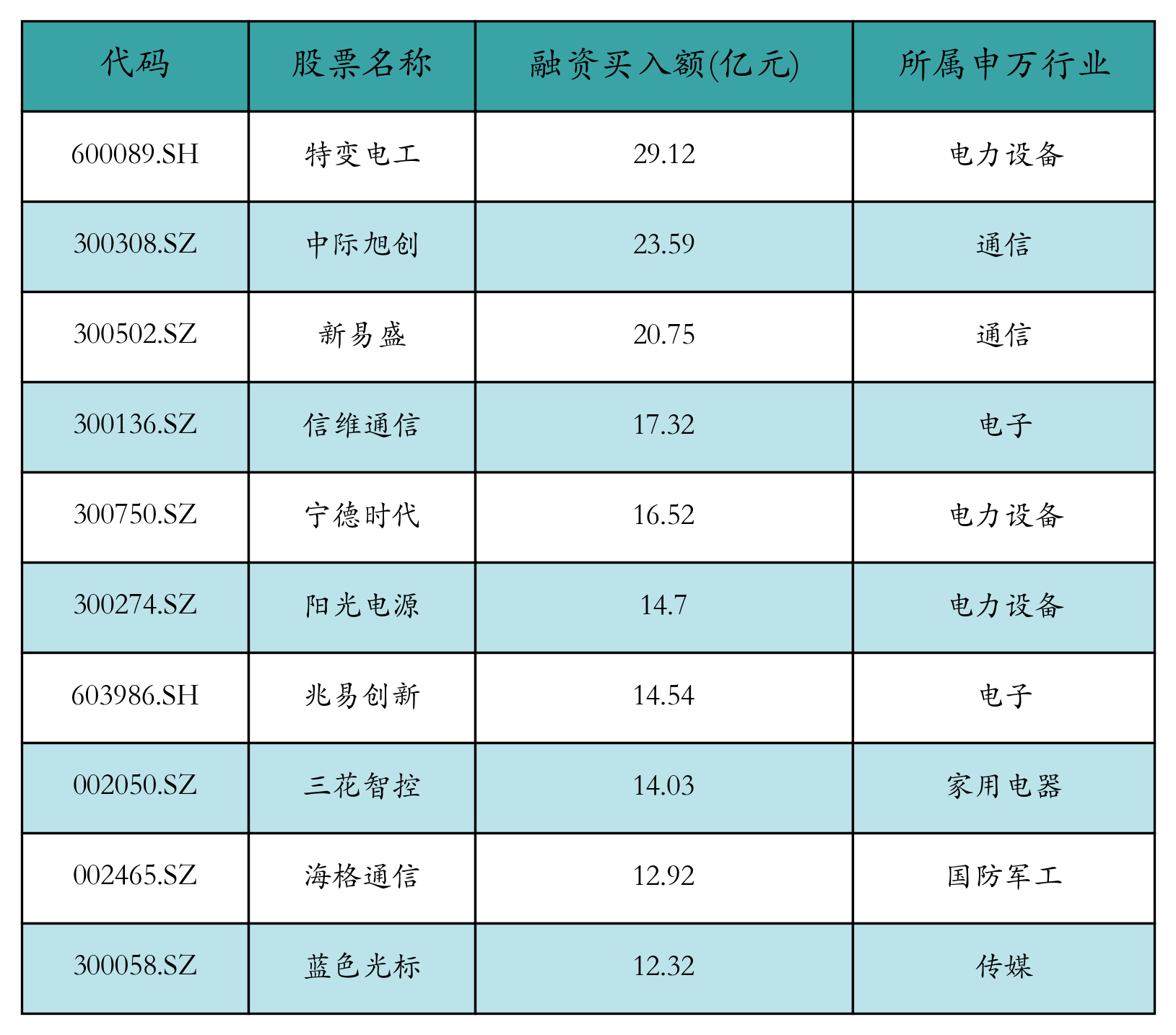
Market Overview - The Shanghai Composite Index fell by 0.01% to close at 4113.65 points, with a daily high of 4128.93 points [1] - The Shenzhen Component Index decreased by 0.97% to 14155.63 points, reaching a high of 14337.12 points [1] - The ChiNext Index dropped by 1.79% to 3277.98 points, with a peak of 3347.94 points [1] Margin Trading and Securities Lending - The total margin trading and securities lending balance in the Shanghai and Shenzhen markets was 27003.83 billion yuan, with a financing balance of 26830.44 billion yuan and a securities lending balance of 173.39 billion yuan [2] - The margin trading and securities lending balance decreased by 136.8 billion yuan compared to the previous trading day [2] - The Shanghai market's margin trading balance was 13644.95 billion yuan, down by 76.94 billion yuan from the previous day, while the Shenzhen market's balance was 13358.87 billion yuan, a decrease of 59.87 billion yuan [2] Top Margin Buying Stocks - The top three stocks by margin buying amount were: - TBEA Co., Ltd. (特变电工) with 29.12 billion yuan [3] - Zhongji Xuchuang (中际旭创) with 23.59 billion yuan [3] - Xinyisheng (新易盛) with 20.75 billion yuan [3] Fund Issuance - Two new funds were issued yesterday: Wanjiayuanli Bond C (万家元利债券C) and Wanjiayuanli Bond A (万家元利债券A) [4][5] Top Net Buying on Dragon and Tiger List - The top ten net buying amounts on the Dragon and Tiger list were: - Hunan Silver (湖南白银) with 12554.74 million yuan [6] - Jiayun Technology (佳云科技) with 12306.17 million yuan [6] - Jiangtian Chemical (江天化学) with 12254.26 million yuan [6]


破解城配续航焦虑 全新版本东风睿立达V8E搭载53.58kw·h电池
Yang Shi Wang· 2026-01-21 02:52
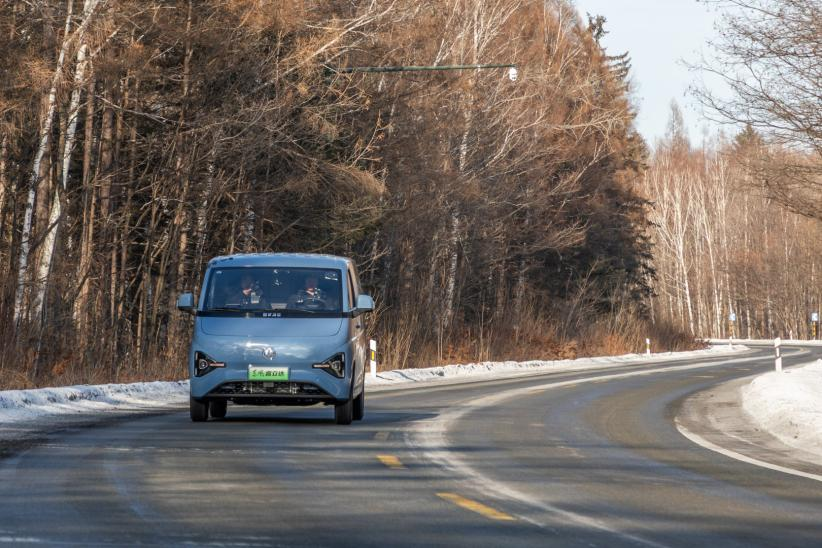
Core Insights - The competitive landscape of the multifunctional VAN market emphasizes product strength as a key differentiator. The Dongfeng Ruida V8E has gained market recognition since its launch in October 2025 due to its comprehensive performance [1] - A new power version of the Ruida V8E has been introduced, featuring a battery from CATL, which represents a complete upgrade of the power system [1] Group 1 - The new version of the Dongfeng Ruida V8E is equipped with a 53.58 kWh battery, achieving a CLTC range of 355 kilometers, suitable for daily urban delivery needs [3] - The vehicle can charge from 20% to 80% in just 24.1 minutes under extreme cold conditions, addressing user concerns about charging speed [3] - The rear-wheel drive system of the Ruida V8E demonstrates strong load-bearing and climbing capabilities, able to navigate a 15° snowy slope while carrying 1.2 tons of cargo, showcasing its robust traction and driving stability [3] Group 2 - The vehicle offers an 8m³ cargo space, complemented by a 270-degree tailgate design and a low floor, facilitating easier loading and unloading of goods [3] - Designed for commercial operation users, the Ruida V8E aims to provide efficient and reliable transportation solutions by enhancing endurance, refueling, and load capacity [3]

德国电动车补贴利好锂电产业链
HTSC· 2026-01-21 02:50
Investment Rating - The report maintains a "Buy" rating for several companies in the lithium battery supply chain, including Ningde Times, Yiwei Lithium Energy, and others, while recommending "Overweight" for companies like Dongsheng Technology [8][11]. Core Insights - The German government announced a €3 billion subsidy program for electric vehicle purchases, providing up to €6,000 per household to stimulate the electric vehicle industry, particularly benefiting pure electric vehicles and low-income families [1][2]. - The policy is expected to drive new electric vehicle demand between 0 to 800,000 units, translating to an additional battery demand of 0 to 48 GWh, which represents approximately 0 to 1.7% of the global battery demand in 2026 [3]. - The report highlights the potential for increased lithium battery demand, particularly benefiting companies with significant exposure to the European market, such as Ningde Times and Yiwei Lithium Energy [3]. Summary by Sections Policy Objectives - The policy emphasizes the environmental benefits and economic viability of electric vehicles, aiming to promote their adoption and support the automotive industry in Germany and Europe [10]. - Households with an annual income below €90,000 can apply for subsidies, which vary based on income and number of children, with higher subsidies for pure electric vehicles [10]. Expected Impact - The subsidy program is anticipated to enhance the penetration rate of pure electric vehicles, with the government expecting to allocate funds for the purchase of 800,000 vehicles [10]. - The report forecasts that the demand for lithium batteries will increase, leading to performance growth for companies in the lithium battery supply chain [3][10]. Company Recommendations - **Ningde Times (300750 CH)**: Target price of 566.18, rated "Buy" due to strong performance and market demand [11]. - **Yiwei Lithium Energy (300014 CH)**: Target price of 96.96, rated "Buy" based on expected volume and profit growth [11]. - **Dongsheng Technology (300073 CH)**: Target price of 75.57, rated "Overweight" due to positive developments in product lines [11]. - **Hunan Youneng (301358 CH)**: Target price of 112.98, rated "Buy" due to strong earnings forecast [11]. - **Shangtai Technology (001301 CH)**: Target price of 130.32, rated "Buy" based on anticipated demand growth [11].




30股获融资净买入额超1亿元 宁德时代居首
Zheng Quan Shi Bao Wang· 2026-01-21 01:16
个股方面,1月20日,有1630股获融资净买入,净买入金额在5000万元以上的有70股。其中,30股获融 资净买入额超1亿元。宁德时代获融资净买入额居首,净买入8.11亿元;融资净买入金额居前的还有海 格通信、世纪华通、浙文互联、通富微电、人民网、紫金矿业、视觉中国、贵州茅台等股。 Wind统计显示,1月20日,申万31个一级行业中有4个行业获融资净买入,其中,电力设备行业获融资 净买入额居首,当日净买入8.05亿元;获融资净买入居前的行业还有传媒、食品饮料等。 ...
当锂价冲上高位 钠电“备胎”火速上位
3 6 Ke· 2026-01-21 01:04
Core Viewpoint - The sodium battery industry in China is entering a commercialization phase, with annual shipments expected to exceed 3.7 GWh by 2025, marking a significant milestone despite being far behind lithium battery giants [1][2]. Industry Overview - The sodium battery industry is poised for growth, driven by rising lithium carbonate prices, which have surged to as high as 179,000 yuan/ton, prompting interest in sodium batteries as a cost-effective alternative [3][5]. - The industry is characterized by a dual structure, with established lithium battery leaders like CATL and BYD alongside emerging sodium battery companies such as Zhongke Haina and Sodium Innovation Energy [3][7]. Market Dynamics - The year 2026 is being marked as the "year of sodium battery industrialization," with companies ramping up production lines and securing orders in response to market demand [3][5]. - The sodium battery's advantages include abundant raw materials, stable pricing of sodium carbonate, and superior low-temperature performance and safety features compared to lithium batteries [1][3]. Challenges and Pressures - The sodium battery industry faces significant challenges, including capacity bottlenecks, performance gaps compared to lithium batteries, and an immature supply chain [3][9]. - Current sodium battery energy densities range from 100 to 160 Wh/kg, while lithium iron phosphate batteries achieve 160 to 200 Wh/kg, indicating a need for technological advancements [9]. Standardization Efforts - The establishment of a comprehensive standardization framework is underway, with the Ministry of Industry and Information Technology guiding the development of national and industry standards for sodium batteries [4][15]. - Existing standards are insufficient, particularly in areas such as safety, performance requirements, and testing methods for specific sodium battery applications [14][16]. Future Outlook - The sodium battery industry is expected to see increased investment and development, with major players like CATL and BYD committing to large-scale applications in various sectors [7][8]. - The industry's growth will depend on overcoming current challenges, including production capacity, cost competitiveness, and the establishment of a robust standardization system [9][12].

