Mindray(300760)

Search documents
机构调研、股东增持与公司回购策略周报(20250915-20250919)-20250922
Yuan Da Xin Xi· 2025-09-22 12:02
Group 1: Institutional Research on Popular Companies - The top twenty companies with the highest number of institutional research visits in the past 30 days include Mindray Medical, Huichuan Technology, Crystal Optoelectronics, Jing Sheng Machinery, and United Imaging Medical [13][15] - In the last five days, the most popular companies for institutional research include Jepu Te, Gan Li Pharmaceutical, Shiji Information, Guangri Co., and Nenghui Technology [13][14] - Among the top twenty companies in the past 30 days, 18 companies had ten or more rating agencies, with significant profit growth expected for Lankai Technology, Desai Xiwei, and Huichuan Technology in their 2025 mid-year reports compared to 2024 [13][16] Group 2: Shareholder Increase in A-Share Listed Companies - From September 15 to September 19, 2025, three listed companies announced significant shareholder increases, including Sierte, Qilu Bank, and Wuzhou Transportation, with Wuzhou Transportation's planned increase amount exceeding 1% of the market value on the announcement date [20][21] - From January 1 to September 19, 2025, a total of 271 companies announced shareholder increases, with 83 of them having ten or more rating agencies. Among these, 22 companies had planned increase amounts exceeding 1% of their market value [22][23] Group 3: Share Buyback Situations in A-Share Listed Companies - From September 15 to September 19, 2025, 69 companies announced buyback progress, with 25 of them having ten or more rating agencies. Five companies, including Jian Sheng Group, Huafa Co., Ninebot Inc., Wens Foodstuff Group, and Jiayi Co., had buyback amounts exceeding 1% of their market value [27][29] - From January 1 to September 19, 2025, a total of 1,739 companies announced buyback progress, with 420 having ten or more rating agencies. Among these, 107 companies had buyback amounts exceeding 1% of their market value [28][30]





9月22日医疗健康R(480016)指数涨0.05%,成份股甘李药业(603087)领涨
Sou Hu Cai Jing· 2025-09-22 10:20
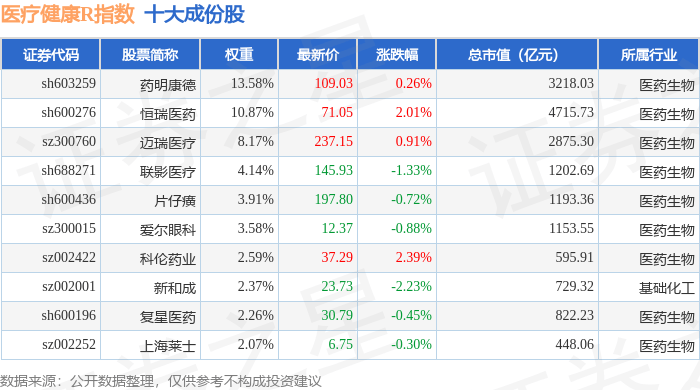
Core Insights - The Medical Health R Index (480016) closed at 8194.9 points on September 22, with a slight increase of 0.05% and a trading volume of 32.204 billion yuan, indicating a turnover rate of 1.01% [1] Index Performance - Among the index constituents, 18 stocks rose while 32 stocks fell, with Ganli Pharmaceutical leading the gainers at a 3.76% increase, and Prologis Pharmaceutical leading the decliners with a 3.21% decrease [1] Top Constituents - The top ten constituents of the Medical Health R Index are as follows: - WuXi AppTec (sh603259) holds a weight of 13.58% and closed at 109.03 yuan, with a 0.26% increase [1] - Heng Rui Medicine (sh600276) has a weight of 10.87% and closed at 71.05 yuan, with a 2.01% increase [1] - Mindray Medical (sz300760) has a weight of 8.17% and closed at 237.15 yuan, with a 0.91% increase [1] - United Imaging Healthcare (sh688271) has a weight of 4.14% and closed at 145.93 yuan, with a 1.33% decrease [1] - Pianzai Shou (sh600436) has a weight of 3.91% and closed at 197.80 yuan, with a 0.72% decrease [1] - Aier Eye Hospital (sz300015) has a weight of 3.58% and closed at 12.37 yuan, with a 0.88% decrease [1] - Kelun Pharmaceutical (sz002422) has a weight of 2.59% and closed at 37.29 yuan, with a 2.39% increase [1] - Xinhecheng (sz002001) has a weight of 2.37% and closed at 23.73 yuan, with a 2.23% decrease [1] - Fosun Pharma (sh600196) has a weight of 2.26% and closed at 30.79 yuan, with a 0.45% decrease [1] - Tenzhuaosi (sz002252) has a weight of 2.07% and closed at 6.75 yuan, with a 0.30% decrease [1] Capital Flow - The Medical Health R Index constituents experienced a net outflow of 559 million yuan from institutional investors, while retail investors saw a net inflow of 583 million yuan [1] - Detailed capital flow for key stocks includes: - WuXi AppTec saw a net inflow of 27.8 million yuan from institutional investors [2] - Mindray Medical had a net inflow of 7.942 million yuan from institutional investors [2] - Heng Rui Medicine experienced a net outflow of 64.014 million yuan from institutional investors [2] - Ganli Pharmaceutical had a net inflow of 58.156 million yuan from institutional investors [2] - Kelun Pharmaceutical saw a net inflow of 42.940 million yuan from institutional investors [2]




深圳南山冲出一家IPO,估值82亿,迈瑞医疗前高管创办,高瓴押注
3 6 Ke· 2025-09-22 09:22
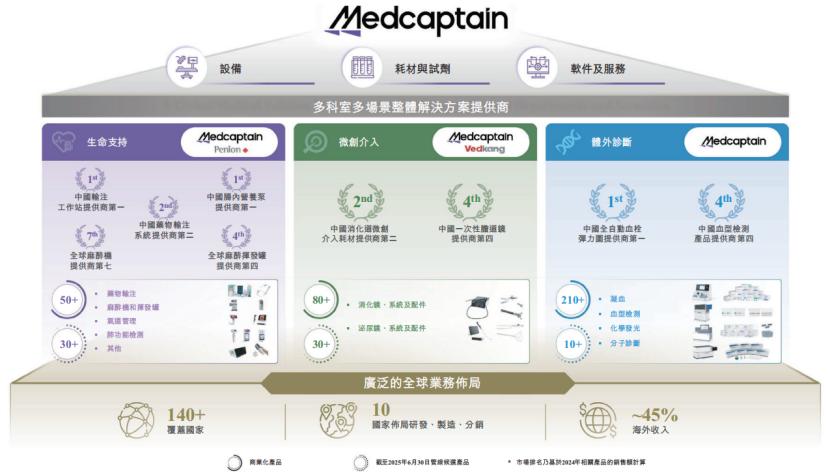
Core Viewpoint - Shenzhen Maikedian Biomedical Technology Co., Ltd. has submitted its IPO application to the Hong Kong Stock Exchange, aiming to expand its presence in the medical device industry, despite facing challenges such as consecutive net losses and high sales expenses [1][5]. Company Overview - Maikedian was established on April 26, 2011, originally named Shenzhen Yusheng Medical Technology Co., Ltd., and is located in Nanshan District, Shenzhen [2]. - The company is led by Liu Jie, who has over 20 years of experience in the healthcare industry, including significant roles at Johnson & Johnson and Mindray Medical [3][4]. Financial Performance - The company has reported net losses for three consecutive years before 2024, totaling approximately 387 million yuan [15][16]. - Revenue has shown growth, with figures of 917 million yuan in 2022, 1.31 billion yuan in 2023, and 1.4 billion yuan in 2024, alongside an increase in gross margin from 43.7% in 2022 to 52.9% in the first half of 2025 [16][17]. Product Portfolio - Maikedian's product offerings include over 50 life support products, 80 minimally invasive intervention products, and 210 in vitro diagnostic products, with a presence in over 140 countries [6][10][13]. - The company ranks first in the infusion workstation market and has a strong position in the minimally invasive intervention market in China [11][12]. Sales and Distribution - The majority of Maikedian's products are sold through a network of over 2,500 distributors, with more than 80% of sales coming from this channel [18][21]. - The company has established a comprehensive distribution network, covering over 6,000 hospitals in China, including about 90% of tier-three hospitals [6][18]. Research and Development - The internal R&D team consists of over 500 members, accounting for 25.1% of the total workforce, with R&D expenses totaling approximately 934 million yuan over the reporting period [21][22]. - The company has invested heavily in R&D, but sales expenses have consistently exceeded R&D expenses, indicating a focus on market expansion [22][23]. Market Context - The global market for life support medical devices is projected to reach $75.1 billion by 2024, with significant growth opportunities in China [6]. - The medical device industry is influenced by regulatory policies, including centralized procurement, which may impact pricing strategies and future performance [23].
研报掘金丨西部证券:维持迈瑞医疗“增持”评级,公司保持业绩稳健增长
Ge Long Hui A P P· 2025-09-22 08:13
Group 1 - The core viewpoint of the article indicates that Mindray Medical's net profit attributable to shareholders for H1 2025 is 5.069 billion yuan, a year-on-year decrease of 32.96%, with Q2 net profit at 2.440 billion yuan, down 44.55% [1] - International business revenue for H1 2025 reached 8.332 billion yuan, showing a year-on-year growth of 5.39%, accounting for 49.76% of total revenue [1] - Domestic business revenue for H1 2025 was 8.411 billion yuan, reflecting a year-on-year decline of 33.37%, primarily due to the impact of last year's bidding decline and high revenue base from the previous year [1] Group 2 - The company has further consolidated its leading market share in the life information and support equipment sector, with a widening gap from competitors [1] - The business progress is in line with the company's expectations, and international business growth is anticipated to accelerate in H2 2025, particularly in the international in vitro diagnostics product line [1] - The company maintains steady performance growth and aims to share development results with investors, sustaining an "overweight" rating [1]

麦科田冲击IPO,迈瑞医疗前高管创办,3年累计亏损3.87亿元
Ge Long Hui· 2025-09-22 02:19
Core Viewpoint - Shenzhen Maikotian Biomedical Technology Co., Ltd. has submitted its IPO application to the Hong Kong Stock Exchange, aiming to expand its product lines and sales networks in the medical device sector, despite facing three consecutive years of net losses before 2024 [1][4]. Company Overview - Maikotian was established on April 26, 2011, previously known as Shenzhen Yusheng Medical Technology Co., Ltd. The company is headquartered in Nanshan District, Shenzhen [3]. - The company is led by Liu Jie, who has over 20 years of experience in the healthcare industry, including significant roles at Johnson & Johnson and Mindray Medical [3][4]. - The company has received multiple rounds of financing from various institutional investors, with a valuation of approximately 8.245 billion yuan in 2023 [4]. Product Portfolio - Maikotian's product offerings include life support, minimally invasive intervention, and in vitro diagnostics, with a total of over 350 commercialized products [6][7][10]. - The company has established a comprehensive distribution network, covering over 6,000 hospitals in China, including about 90% of tier-3 hospitals [6][19]. Financial Performance - The company's revenue has shown growth, with figures of 917 million yuan in 2022, 1.313 billion yuan in 2023, and 1.399 billion yuan in 2024, while the gross profit margins have improved from 43.7% in 2022 to 52.9% in the first half of 2025 [15][17]. - Despite revenue growth, the company reported net losses of 2.26 billion yuan in 2022, 645 million yuan in 2023, and 966 million yuan in 2024, primarily due to significant investments in R&D and marketing [15][22]. Market Position - The global market for life support medical devices is projected to reach 75.1 billion USD in 2024, with the Chinese market expected to reach 55.7 billion yuan [6]. - Maikotian ranks first in the infusion workstation market in China from 2018 to 2024 and holds a strong position in the minimally invasive intervention market [11][12][14]. R&D and Sales Strategy - The company has a dedicated R&D team of over 500 members, accounting for 25.1% of its total workforce, with R&D expenses amounting to approximately 934 million yuan over the reporting period [21][22]. - Sales expenses have consistently exceeded R&D expenses, indicating a strong focus on market penetration and distribution [22][23]. Distribution Network - Maikotian relies heavily on distributors for sales, with over 80% of its products sold through this channel. The company has a network of 1,959 domestic and 607 overseas distributors [19].
西部证券晨会纪要-20250922
Western Securities· 2025-09-22 01:58
Group 1: Guangdong Hongda (002683.SZ) - The company is a leader in the civil explosives industry, with growth rates exceeding the industry average, and military business is poised for expansion [7][8] - Expected net profits for 2025-2027 are projected at 1.196 billion, 1.415 billion, and 1.772 billion yuan, respectively, with a target price of 47.2 yuan based on a 30x PE for 2025, rated as "Accumulate" [7][8] - Revenue from the domestic regions of Northwest, Southwest, and North China for 2024 is expected to be 2.69 billion, 1.14 billion, and 2.34 billion yuan, respectively, with significant year-on-year growth [8] Group 2: Yangnong Chemical (600486.SH) - The company is positioned as a leader in the pesticide industry, benefiting from an upward trend in industry conditions and a recovery in the market [11][12] - Projected revenues for 2025-2027 are 11.484 billion, 12.325 billion, and 13.536 billion yuan, with net profits of 1.443 billion, 1.654 billion, and 1.884 billion yuan, respectively, rated as "Accumulate" [11][12] - The company is expected to transition from a generic pesticide manufacturer to a CDMO for innovative drugs, enhancing its growth potential [12] Group 3: China Communications Construction Company (601800.SH) - The company holds a leading position in transportation infrastructure and is expected to benefit from increased domestic infrastructure projects and international expansion [14][15] - The company is the largest international engineering contractor in China, with a strong historical presence in overseas markets, contributing to growth [14][15] - A dividend plan has been announced, ensuring stable returns for investors, with a target price of 11.78 yuan based on an 8x PE for 2025, rated as "Buy" [14][15] Group 4: Xinzhou Bang (300037.SZ) - The company is focused on a comprehensive layout in the lithium battery and fluorochemical sectors, with clear growth in demand for fluorochemicals [18][19] - Expected net profits for 2025-2027 are projected at 1.130 billion, 1.501 billion, and 1.859 billion yuan, with significant year-on-year growth rates [18][19] - The company is enhancing its vertical integration and global layout, with ongoing projects in Malaysia and the US expected to boost profitability [18][19] Group 5: Haian Home (600398.SH) - The main brand has shown improvement, with revenue for the first half of 2025 reaching 11.566 billion yuan, a year-on-year increase of 1.73% [21][22] - The company is expanding its direct sales while reducing franchise operations, with a focus on new retail formats [21][22] - Projected net profits for 2025-2027 are 2.421 billion, 2.700 billion, and 2.947 billion yuan, with a growth rate of 12.2%, 11.5%, and 9.1% respectively, rated as "Buy" [24] Group 6: Xtep International (01368.HK) - The main brand has shown steady growth, with revenue for the first half of 2025 reaching 6.838 billion yuan, a year-on-year increase of 7.1% [26][27] - The company is focusing on the running segment, with strong performance in its professional sports line [26][27] - Projected net profits for 2025-2027 are 1.379 billion, 1.516 billion, and 1.664 billion yuan, with growth rates of 11.3%, 9.9%, and 9.8% respectively, rated as "Buy" [28] Group 7: Mindray Medical (300760.SZ) - The company reported total revenue of 16.743 billion yuan for the first half of 2025, a year-on-year decrease of 18.45% [30][31] - International business showed resilience with revenue of 8.332 billion yuan, a year-on-year increase of 5.39%, while domestic revenue declined significantly [30][31] - The company plans to distribute a total of 3.298 billion yuan in cash dividends for 2025, representing 65.06% of its net profit for the first half of the year [31]





迈瑞医疗(300760):业绩短期承压,下半年有望回暖
Western Securities· 2025-09-21 12:58
Investment Rating - The investment rating for the company is "Accumulate" [5][11]. Core Views - The company experienced a decline in revenue and net profit in the first half of 2025, with total revenue of 16.743 billion yuan, down 18.45% year-on-year, and net profit of 5.069 billion yuan, down 32.96% year-on-year. The gross margin decreased by 4.98 percentage points [1][5]. - International business showed resilience with revenue of 8.333 billion yuan in H1 2025, up 5.39% year-on-year, accounting for 49.76% of total revenue. Domestic revenue, however, fell to 8.411 billion yuan, down 33.37% year-on-year [1][2]. - The company plans to distribute a total cash dividend of 3.298 billion yuan for 2025, which represents 65.06% of the net profit for the first half of the year [2]. Summary by Sections Financial Performance - In Q2 2025, the company reported revenue of 8.506 billion yuan, a decrease of 23.77% year-on-year, and a net profit of 2.440 billion yuan, down 44.55% year-on-year, with a gross margin decline of 5.66 percentage points [1][5]. - The medical imaging business generated revenue of 3.312 billion yuan, down 22.51% year-on-year, with international revenue accounting for 62% [2]. - The life information and support business reported revenue of 5.479 billion yuan, down 31.59%, with international revenue share increasing to 67% [2]. Future Projections - Revenue projections for 2025-2027 are 36.730 billion yuan, 41.909 billion yuan, and 48.457 billion yuan, with year-on-year growth rates of 0.0%, 14.1%, and 15.6% respectively. Net profit projections are 12.219 billion yuan, 14.156 billion yuan, and 16.633 billion yuan, with growth rates of 4.7%, 15.8%, and 17.5% respectively [3][10].
84家“独角兽—聪明公司—超级企业” 串起“深圳创新长廊”
2 1 Shi Ji Jing Ji Bao Dao· 2025-09-20 03:24
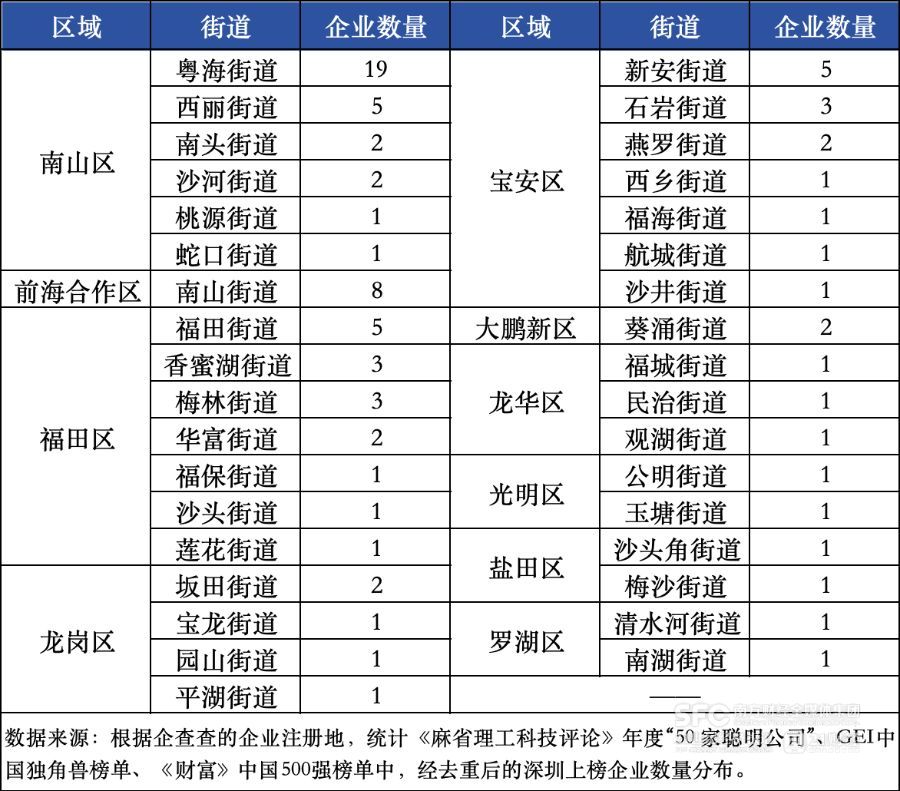
Core Insights - Shenzhen has shown remarkable performance in various prestigious company rankings, with at least 84 companies listed across multiple reports, indicating its strength in innovation and technology [1][6] - The concentration of these companies is not uniform but is highly focused in specific districts such as Nanshan, Futian, Bao'an, and Qianhai, forming a clear "Shenzhen Innovation Corridor" [1][6][9] - This corridor represents a new innovation paradigm that integrates urban development, industrial ecology, and corporate leadership, paving a high-quality development path for the Greater Bay Area and China [2] Company Highlights - Among the "50 Smart Companies," Shenzhen has 9 representatives, including major players like Huawei and BYD, as well as emerging tech stars such as Thunderbird Innovation and Tuo Bamboo Technology [3][4] - Huawei reported a historical revenue of 862.1 billion RMB last year, with over 1.2 trillion RMB invested in R&D over the past decade, while BYD continues to lead in the global new energy vehicle market [3][4] - The listed companies span various sectors, with a focus on AI, robotics, chips, and life sciences, showcasing Shenzhen's technological prowess [3] Regional Distribution - Nanshan District is the primary hub for innovation, hosting 30 of the listed companies, with Yuhai Street alone accounting for 19 companies, including industry giants like Tencent and ZTE [7][8] - The concentration of high-tech firms in Yuhai Street contributes approximately 11% of Shenzhen's GDP, despite occupying less than 0.6% of the city's land [8] - Futian and Bao'an districts also host significant numbers of innovative companies, with Futian's unicorns valued at over 49 billion USD, contributing 31% to the district's total valuation [8][9] Innovation Ecosystem - Shenzhen's innovation ecosystem is supported by a robust mechanism for discovering and nurturing innovative companies, focusing on finance, innovation, talent, and market resources [11][12] - The city has established a comprehensive service system to support strategic emerging industries, including the establishment of the "20+8" industrial cluster fund [11] - Shenzhen is also pioneering regulations in emerging fields like smart connected vehicles and artificial intelligence, fostering a flexible regulatory environment to encourage innovation [12]




9月19日医疗健康(980016)指数跌1.08%,成份股长春高新(000661)领跌
Sou Hu Cai Jing· 2025-09-19 10:34
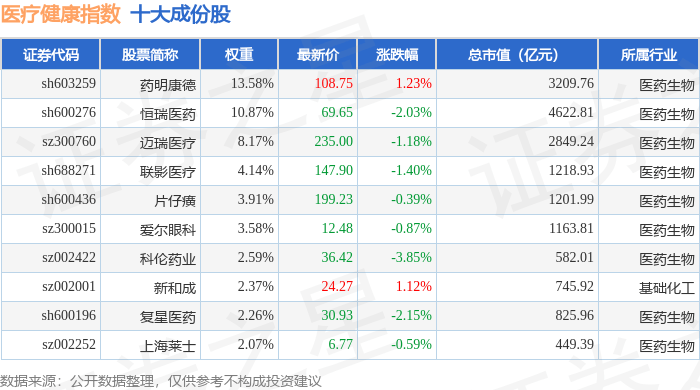
Market Performance - The Medical Health Index (980016) closed at 7021.34 points, down 1.08%, with a trading volume of 33.906 billion yuan and a turnover rate of 1.07% [1] - Among the index constituents, 5 stocks rose while 45 stocks fell, with Yirui Technology leading the gainers at 1.82% and Changchun High-tech leading the decliners at 3.91% [1] Key Constituents - The top ten constituents of the Medical Health Index include: - WuXi AppTec (13.58% weight) at 108.75 yuan, up 1.23% with a market cap of 320.976 billion yuan - Hengrui Medicine (10.87% weight) at 69.65 yuan, down 2.03% with a market cap of 462.281 billion yuan - Mindray Medical (8.17% weight) at 235.00 yuan, down 1.18% with a market cap of 284.924 billion yuan - United Imaging Healthcare (4.14% weight) at 147.90 yuan, down 1.40% with a market cap of 121.893 billion yuan - Other notable constituents include Pianzai Shou, Yier Eye Hospital, Kelun Pharmaceutical, Xinhecheng, Fosun Pharma, and Yixiao Aoshi [1] Capital Flow - The Medical Health Index constituents experienced a net outflow of 2.29 billion yuan from institutional investors, while retail investors saw a net inflow of 2.013 billion yuan [3] - Notable capital flows include: - Mindray Medical with a net inflow of 98.789 million yuan from institutional investors and a net outflow of 10.5 million yuan from speculative funds - Changchun High-tech with a net inflow of 67.986 million yuan from institutional investors and a significant net outflow from speculative funds [3]



出海新变量|医疗器械“卷出海”!超百款创新设备欲走向全球如何铺路?
Di Yi Cai Jing· 2025-09-19 10:26
Core Viewpoint - Companies should not blindly follow the trend of "going overseas," as this strategy may not be suitable for most Chinese medical device companies still in the growth stage, which should focus on domestic market opportunities until they mature [1][3]. Group 1: Domestic Market Focus - Shanghai has set a high-quality development action plan for the high-end medical device industry, aiming to approve over 500 new domestic Class III medical device registrations and over 100 overseas market approvals by 2027 [1]. - The focus areas for high-end medical devices include medical imaging, implantable devices, surgical systems, in vitro diagnostics, radiation therapy, rehabilitation, artificial intelligence medical devices, and innovative new devices [1]. - Nearly 30% of companies listed on the Sci-Tech Innovation Board have overseas business accounting for more than 30% of their revenue, with a year-on-year revenue growth of 9% and a net profit growth of 3% in the first half of the year [1]. Group 2: Challenges of Going Overseas - The number of approved innovative medical devices in China has reached a new high this year, with the National Medical Products Administration introducing 10 measures to support high-end medical device innovation [3]. - Companies should be cautious about entering overseas markets, as it is a battleground for strong players rather than a refuge for weaker ones, emphasizing the need to excel in the domestic market first [3][4]. - The landscape for medical device companies going overseas has changed significantly over the past 20 years, with increased complexities such as international regulations and legal challenges [4]. Group 3: Internationalization Strategy - Mindray Medical, a leading Chinese medical device company, has seen its international business exceed 50% for the first time in the first half of the year, indicating a successful global presence [5]. - The acquisition of a stake in Huatai Medical by Mindray has led to a more cautious approach towards internationalization, suggesting that companies should align their international strategies with their development stages [5]. - Companies should leverage their comparative advantages in high-end manufacturing and innovation, establishing a strong foothold in the domestic market before expanding globally [6].