Three Squirrels(300783)

Search documents
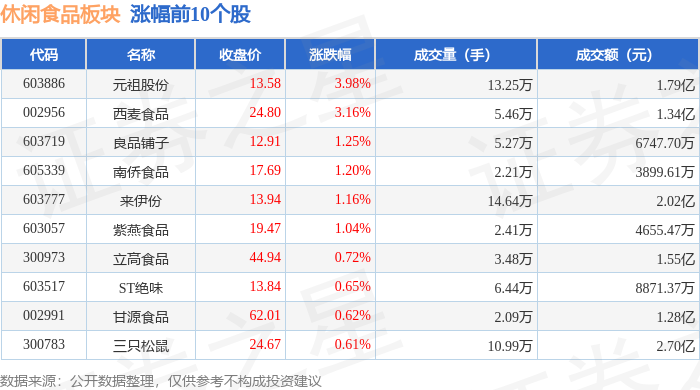
休闲食品板块11月13日涨0.21%,元祖股份领涨,主力资金净流出1.54亿元
Zheng Xing Xing Ye Ri Bao· 2025-11-13 08:44
Market Overview - The leisure food sector increased by 0.21% on November 13, with Yuanzi Co. leading the gains [1] - The Shanghai Composite Index closed at 4029.5, up 0.73%, while the Shenzhen Component Index closed at 13476.52, up 1.78% [1] Individual Stock Performance - Yuanzi Co. (603886) closed at 13.58, up 3.98% with a trading volume of 132,500 shares and a turnover of 179 million yuan [1] - Ximai Food (002956) closed at 24.80, up 3.16% with a trading volume of 54,600 shares and a turnover of 134 million yuan [1] - Other notable performers include: - Liangpinpuzi (603719) at 12.91, up 1.25% [1] - Nanjiao Food (605339) at 17.69, up 1.20% [1] - Laiyifen (603777) at 13.94, up 1.16% [1] Capital Flow Analysis - The leisure food sector experienced a net outflow of 154 million yuan from institutional investors, while retail investors saw a net inflow of 248 million yuan [2] - The capital flow for individual stocks shows: - Yuanzi Co. had a net inflow of 16.71 million yuan from institutional investors [3] - Salted Fish (002847) had a net inflow of 7.79 million yuan from institutional investors [3] - Purple Onion Food (603057) had a net inflow of 5.88 million yuan from institutional investors [3] Summary of Trading Data - The trading data for the leisure food sector indicates varied performance among stocks, with some experiencing significant gains while others faced declines [1][2] - The overall market sentiment appears positive, as indicated by the rise in major indices and the performance of leading stocks in the leisure food sector [1]




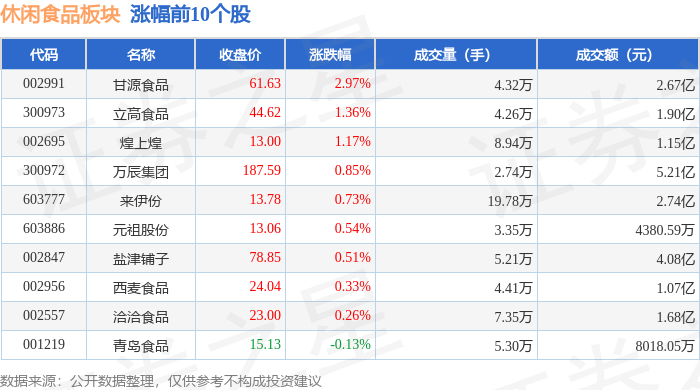
休闲食品板块11月12日跌0.01%,桂发祥领跌,主力资金净流出1.71亿元
Zheng Xing Xing Ye Ri Bao· 2025-11-12 08:42
Market Overview - The leisure food sector experienced a slight decline of 0.01% on November 12, with Gui Faxiang leading the drop [1] - The Shanghai Composite Index closed at 4000.14, down 0.07%, while the Shenzhen Component Index closed at 13240.62, down 0.36% [1] Stock Performance - Notable gainers in the leisure food sector included: - Ganyuan Food: closed at 61.63, up 2.97% with a trading volume of 43,200 lots and a transaction value of 267 million [1] - Lihai Food: closed at 44.62, up 1.36% with a trading volume of 42,600 lots and a transaction value of 206.1 million [1] - Major decliners included: - Gui Faxiang: closed at 14.30, down 2.26% with a trading volume of 273,100 lots and a transaction value of 394 million [2] - Ziyan Food: closed at 19.27, down 2.18% with a trading volume of 29,900 lots and a transaction value of 58.19 million [2] Capital Flow - The leisure food sector saw a net outflow of 171 million from institutional investors, while retail investors contributed a net inflow of 249 million [2] - Specific stock capital flows included: - Ganyuan Food: net inflow of 17.70 million from institutional investors, with a net outflow of 12.58 million from speculative funds [3] - Lihai Food: net inflow of 10.29 million from institutional investors, with a net outflow of 7.30 million from speculative funds [3]


三只松鼠涨2.02%,成交额1.19亿元,主力资金净流入317.25万元
Xin Lang Cai Jing· 2025-11-10 02:54
Core Viewpoint - The stock price of Three Squirrels has experienced a significant decline of 35.20% year-to-date, with recent trading showing slight fluctuations in both directions, indicating potential volatility in the market [1][2]. Group 1: Stock Performance - As of November 10, Three Squirrels' stock price increased by 2.02% to 23.73 CNY per share, with a trading volume of 119 million CNY and a turnover rate of 1.81%, resulting in a total market capitalization of 9.532 billion CNY [1]. - The stock has seen a net inflow of 3.1725 million CNY from main funds, with large orders contributing to both buying and selling activities [1]. - Over the past five trading days, the stock has risen by 0.59%, but it has decreased by 0.84% over the last 20 days and by 7.49% over the last 60 days [1]. Group 2: Financial Performance - For the period from January to September 2025, Three Squirrels reported a revenue of 7.759 billion CNY, reflecting a year-on-year growth of 8.22%, while the net profit attributable to shareholders decreased by 52.91% to 161 million CNY [2]. - Since its A-share listing, Three Squirrels has distributed a total of 553 million CNY in dividends, with 265 million CNY distributed over the past three years [3]. Group 3: Shareholder Information - As of September 30, 2025, the number of shareholders for Three Squirrels increased by 12.02% to 51,200, while the average number of circulating shares per person decreased by 10.71% to 5,471 shares [2]. - Among the top ten circulating shareholders, Hong Kong Central Clearing Limited is the fourth largest, holding 3.7502 million shares, an increase of 32,900 shares from the previous period [3].

三只松鼠困于流量归母净利骤降53% 章燎源频繁试错200亿营收目标难期
Chang Jiang Shang Bao· 2025-11-10 00:00
Core Viewpoint - The company reported an increase in revenue but a significant decline in net profit for the first three quarters of 2025, indicating financial pressure and challenges in maintaining profitability despite sales growth [1][6]. Revenue and Profit Summary - For the first three quarters of 2025, the company achieved a revenue of 7.759 billion yuan, representing an approximate 8% year-on-year increase [1][6]. - The net profit attributable to shareholders was 161 million yuan, showing a year-on-year decline of about 53% [1][6]. - Excluding government subsidies, the adjusted net profit was approximately 57.14 million yuan, reflecting a substantial year-on-year decrease of 78.57% [6]. Expense Analysis - Sales expenses reached 1.605 billion yuan, up over 24% year-on-year, significantly outpacing revenue growth [3][8]. - A large portion of sales expenses, over 60%, was allocated to platform services and promotions, indicating a heavy reliance on traffic costs [4][8]. - Management expenses also increased by 50%, further impacting profitability [8]. Cash Flow and Debt Situation - The company's operating cash flow turned negative at -506 million yuan, a drastic decline of 1690.52% compared to the previous year [9][10]. - As of September 2025, the company had short-term borrowings of 576 million yuan, a year-on-year increase of 284% [11]. Strategic Direction and Market Position - The company has been exploring various business models, including snacks, pet food, and pre-packaged meals, but these efforts have not led to significant growth in operating performance [5][17]. - The company aims to achieve a revenue target of 20 billion yuan by 2026, but current growth rates suggest a shortfall of 8.5 billion yuan from this goal [17]. Transformation Efforts - The company has been adjusting its offline channel strategy, with a notable reduction in the number of stores in recent years [14]. - In 2023, the company introduced a new community snack store model, but later shifted focus to national snack stores and alliance stores [14][15]. - The company has faced criticism for frequent strategic shifts, which are perceived as trial-and-error attempts [15][16].
休闲食品板块11月6日跌0.13%,ST绝味领跌,主力资金净流出1.26亿元
Zheng Xing Xing Ye Ri Bao· 2025-11-06 08:51
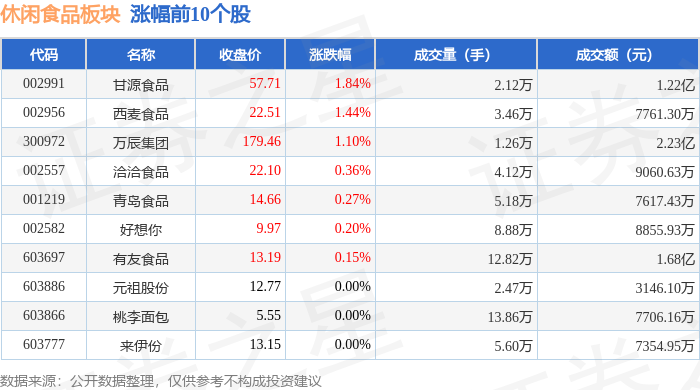
Market Overview - The leisure food sector experienced a slight decline of 0.13% on November 6, with ST Juewei leading the drop [1] - The Shanghai Composite Index closed at 4007.76, up 0.97%, while the Shenzhen Component Index closed at 13452.42, up 1.73% [1] Individual Stock Performance - Notable gainers in the leisure food sector included: - Ganyuan Food (002991) with a closing price of 57.71, up 1.84% and a trading volume of 21,200 lots [1] - Ximai Food (002956) closed at 22.51, up 1.44% with a trading volume of 34,600 lots [1] - Wancheng Group (300972) closed at 179.46, up 1.10% with a trading volume of 12,600 lots [1] - Conversely, ST Juewei (603517) saw a decline of 1.52%, closing at 13.64 with a trading volume of 91,600 lots [2] - Other notable decliners included: - Yanjinpuzi (002847) down 1.38% to 71.33 [2] - Three Squirrels (300783) down 1.02% to 23.32 [2] Capital Flow Analysis - The leisure food sector saw a net outflow of 126 million yuan from institutional investors, while retail investors contributed a net inflow of 100 million yuan [2] - The overall capital flow for individual stocks showed mixed results, with Ganyuan Food experiencing a net inflow of over 3.89 million yuan from institutional investors [3] - Other stocks like Ziyan Food (603057) had a net inflow of 1.55 million yuan from institutional investors, while stocks like ST Juewei and Lihai Food (300973) faced significant net outflows [3]




研报掘金丨国海证券:下调三只松鼠至“增持”评级,毛利率改善,费率上行拖累盈利表现
Ge Long Hui A P P· 2025-11-06 07:31
Core Insights - The report from Guohai Securities indicates that Three Squirrels' net profit attributable to shareholders for Q1-Q3 2025 is 161 million yuan, a year-on-year decrease of 52.91% [1] - In Q3 2025, the net profit attributable to shareholders is 22 million yuan, reflecting a year-on-year decline of 56.79% [1] - The improvement in gross margin is offset by rising expenses, impacting overall profitability [1] Revenue and Profit Forecast - The company has adjusted its online operational strategy, leading to a slowdown in online channel revenue [1] - In terms of offline channels, the company is focusing on distribution channels, which are expected to continue contributing to revenue growth [1] - The company is making progress in its reforms under the "high-end cost performance" strategy, establishing a "D+N" all-channel collaborative system [1] - Revenue forecasts for 2025-2027 are projected at 11.47 billion, 12.62 billion, and 14.01 billion yuan, representing year-on-year growth of 8%, 10%, and 11% respectively [1] - Net profit forecasts for the same period are 187 million, 252 million, and 420 million yuan, with a year-on-year change of -54%, +34%, and +67% respectively [1] - Earnings per share (EPS) are expected to be 0.47, 0.63, and 1.05 yuan, with corresponding price-to-earnings (PE) ratios of 50, 38, and 23 times [1] Strategic Initiatives - The company is expected to continue focusing on distribution channels and exploring its own brand lifestyle stores, which may gradually improve its offline weaknesses [1] - The product strategy is shifting towards differentiation and quality enhancement, which is anticipated to boost profitability [1] - The company has downgraded its profit forecast due to ongoing expense investments [1]

食品饮料2025年三季报总结:白酒主动释放压力,速冻迎来行业拐点,软饮、零食量贩高景气维持
China Post Securities· 2025-11-06 05:06
Industry Investment Rating - The investment rating for the food and beverage industry is "Outperform" [1] Core Insights - The report highlights that the liquor sector is actively releasing pressure on financial statements, with the industry gradually bottoming out. The frozen food sector is witnessing a turning point, while the soft drink and snack sectors maintain high levels of prosperity [3][4][30] Summary by Sections 1. Liquor - The liquor sector's total revenue for the first three quarters of 2025 was CNY 319.23 billion, a year-on-year decrease of 5.76%, with net profit down 6.85% to CNY 122.67 billion. In Q3 alone, revenue fell 18.38% to CNY 78.48 billion, and net profit dropped 22.00% to CNY 28.09 billion [14][28] - High-end liquor brands like Moutai showed stable growth, while others like Wuliangye and Luzhou Laojiao faced significant declines. Moutai's revenue grew by 9.28% year-on-year, while Wuliangye's fell by 10.26% [17][19] - The second-tier liquor brands, such as Fenjiu, showed resilience with a revenue increase of 5.00%, while others like Shui Jing Fang and Shede experienced declines [26][22] 2. Soft Drinks - The soft drink sector saw significant growth, with companies like Dongpeng Beverage reporting a 34.13% increase in revenue year-on-year. The energy drink segment, particularly, showed robust growth [30][31] - The introduction of new flavors and products, such as Dongpeng's summer limited edition, contributed to the sustained high growth rates in this sector [30] 3. Dairy Products - The dairy sector, led by Yili, maintained stable performance despite high base effects, with significant growth in milk powder and cold drink products. New Dairy's low-temperature products continued to show double-digit growth [4][31] 4. Frozen Foods - The frozen food industry is experiencing a turning point, with companies noting that the price war has peaked. The focus is shifting towards rational competition and value [7][30] 5. Snacks - The snack sector is undergoing strategic adjustments, with member stores and instant retail becoming key growth channels. The overall consumption environment remains weak, but the snack sector is adapting with targeted strategies [7][30]




晨会纪要:2025年第189期-20251106
Guohai Securities· 2025-11-06 01:31
Key Insights - The report highlights significant year-on-year revenue growth in Q3, driven by advancements in the semiconductor and AR/VR testing sectors, particularly for companies like Maolai Optics and Junsheng Electronics [4][7] - Companies such as Amazon and Yudong Network have shown resilience in their revenue streams, with Amazon's Q3 revenue reaching $180.2 billion, a 13% increase year-on-year, and Yudong Network's revenue growing by 84.04% in the same period [21][27] - The report indicates a structural shift in the secondary market, with new infrastructure sectors experiencing a favorable market environment despite overall market pressure [18] Group 1: Company Performance - Maolai Optics reported a revenue of 503 million yuan in the first three quarters of 2025, a 34.05% increase year-on-year, with a net profit of 46 million yuan, up 86.57% [4] - Junsheng Electronics achieved a revenue of approximately 154.97 billion yuan in Q3 2025, reflecting a 10.25% year-on-year increase, with a net profit of about 4.13 billion yuan, up 35.4% [7] - Concept Electronics reported a net profit increase of 173.46% year-on-year, with a revenue of 315 million yuan in the first three quarters of 2025 [12] Group 2: Industry Trends - The semiconductor sector is experiencing robust growth, with Maolai Optics reporting that 58.80% of its revenue comes from this field [5] - The report notes a significant increase in new business orders for Junsheng Electronics, with a total of 714 billion yuan in new orders accumulated in the first three quarters of 2025 [9] - The e-commerce sector, particularly Amazon, continues to show resilience, with various revenue streams exceeding expectations, including a 24% increase in advertising service revenue [23][24] Group 3: Future Outlook - Forecasts for Maolai Optics suggest revenues of 673 million yuan, 871 million yuan, and 1.07 billion yuan for 2025-2027, with corresponding net profits of 63 million yuan, 97 million yuan, and 139 million yuan [6] - Junsheng Electronics is expected to achieve revenues of 625.64 billion yuan, 673.16 billion yuan, and 726.56 billion yuan from 2025 to 2027, with net profits projected at 15.39 billion yuan, 18.54 billion yuan, and 21.65 billion yuan [11] - Amazon's revenue is projected to reach $711 billion, $800 billion, and $900 billion for 2025-2027, with net profits of $76.5 billion, $87.9 billion, and $108.9 billion [26]




三只松鼠(300783):毛利率改善,费率上行拖累盈利表现
Guohai Securities· 2025-11-05 15:19
Investment Rating - The investment rating for the company is upgraded to "Accumulate" [1][7]. Core Views - The report highlights that the gross profit margin has improved, but rising costs are dragging down profitability [2][4]. - The company achieved a revenue of 7.759 billion yuan in Q1-Q3 2025, representing a year-on-year increase of 8.22%, while the net profit attributable to shareholders was 161 million yuan, down 52.91% year-on-year [4][6]. - The report anticipates that the company's revenue growth will be supported by offline distribution channels, despite a slowdown in online revenue due to increased traffic costs [4][6]. Financial Performance Summary - In Q3 2025, the company reported revenue of 2.281 billion yuan, a year-on-year increase of 8.91%, but the growth rate has slowed compared to Q2 [4][6]. - The gross profit margin in Q3 2025 increased by 1.25 percentage points to 25.71%, despite rising nut costs, attributed to product upgrades and improved supply chain capabilities [4][6]. - The report notes that the sales expense ratio increased by 2.25 percentage points due to higher platform and promotional costs, while the management expense ratio rose by 0.65 percentage points due to increased depreciation and amortization [4][6]. Future Outlook - The company is expected to continue its transformation towards differentiated and high-quality products, enhancing profitability [4][6]. - The report projects revenues of 11.470 billion yuan, 12.618 billion yuan, and 14.012 billion yuan for 2025, 2026, and 2027, respectively, with year-on-year growth rates of 8%, 10%, and 11% [6][7]. - The net profit attributable to shareholders is forecasted to be 187 million yuan, 252 million yuan, and 420 million yuan for the same years, with a significant recovery expected in 2026 and 2027 [6][7].
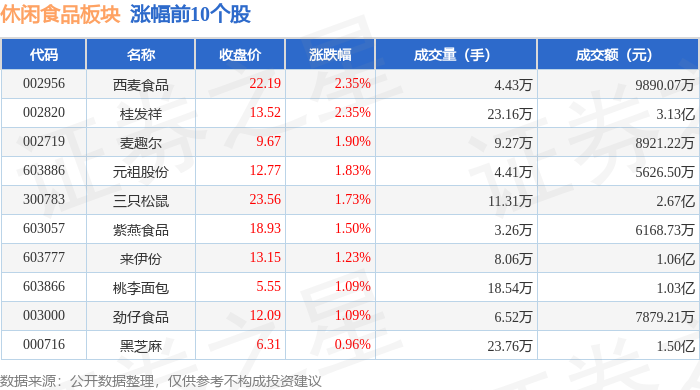
休闲食品板块11月5日涨0.08%,西麦食品领涨,主力资金净流出367.26万元
Zheng Xing Xing Ye Ri Bao· 2025-11-05 08:42
Market Overview - The leisure food sector increased by 0.08% on November 5, with Ximai Food leading the gains [1] - The Shanghai Composite Index closed at 3969.25, up 0.23%, while the Shenzhen Component Index closed at 13223.56, up 0.37% [1] Stock Performance - Ximai Food (002956) closed at 22.19, up 2.35% with a trading volume of 44,300 shares and a transaction value of 98.90 million [1] - Guifaxiang (002820) also rose by 2.35% to 13.52, with a trading volume of 231,600 shares and a transaction value of 313 million [1] - Other notable performers include Maiqu'er (002719) up 1.90% to 9.67, and Sanzhi Songshu (300783) up 1.73% to 23.56 [1] Capital Flow - The leisure food sector experienced a net outflow of 3.67 million from institutional investors, while retail investors saw a net outflow of 43.58 million [2] - Conversely, speculative funds recorded a net inflow of 47.25 million [2] Individual Stock Capital Flow - Sanzhi Songshu (300783) had a net inflow of 20.74 million from institutional investors, but a net outflow of 30.54 million from retail investors [3] - Guifaxiang (002820) saw a net inflow of 9.29 million from institutional investors, with a net outflow of 13.02 million from retail investors [3] - Other stocks like Jinzai Food (003000) and Yuanzi Food (603886) also showed mixed capital flows, with significant retail outflows [3]