YKA(300999)

Search documents
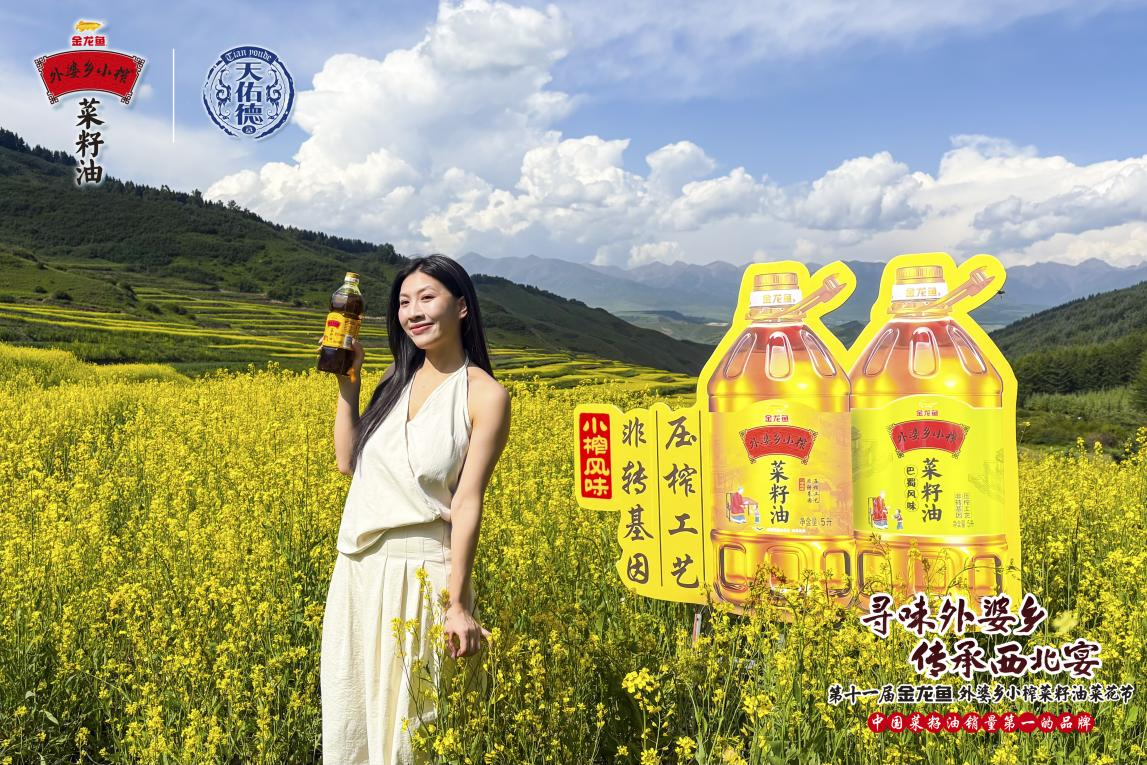
“彩虹故乡”的油菜花开了!金龙鱼外婆乡小榨菜籽油走进青海互助县开启高原寻味之旅
Zhong Guo Shi Pin Wang· 2025-07-14 03:14
Core Viewpoint - The 11th Jinlongyu Waipo Village Small-pressed Rapeseed Oil Cauliflower Festival showcased the integration of local culture, cuisine, and craftsmanship, emphasizing the brand's innovative narrative of "food + wine" to break traditional marketing barriers [1][3][7]. Group 1: Event Highlights - The festival took place in the unique setting of Huzhu Tu Autonomous County, known for its rich ethnic culture and natural beauty, featuring a theme of "Searching for the Taste of Waipo Village, Inheriting the Northwest Banquet" [1][3]. - The event included performances of traditional dances and culinary demonstrations, highlighting the local Tu culture and the use of Waipo Village small-pressed rapeseed oil in regional dishes [3][5]. Group 2: Culinary Significance - The use of Waipo Village small-pressed rapeseed oil enhances the flavors of Northwest cuisine, particularly in dishes like Huanyuan pork, which benefits from the oil's ability to bring out the aroma of spices and improve the overall taste [5][7]. - The collaboration between Waipo Village small-pressed rapeseed oil and local Qingke wine brand Tianyoude emphasizes the cultural significance of pairing food with wine in Northwest dining traditions [7][8]. Group 3: Marketing and Outreach - The festival served as a launchpad for a promotional campaign, including the distribution of 180,000 bottles of Waipo Village small-pressed rapeseed oil in major cities to enhance brand visibility and consumer engagement [9][10]. - The brand aims to leverage social media influencers and live streaming to create immersive content that resonates with consumers, thereby driving both brand awareness and sales [9][10].

十年爱心浇灌结硕果,益海嘉里集团“蔚县一对一助学”项目托起30余个乡村孩子的未来
Hua Xia Shi Bao· 2025-07-10 13:12
Core Viewpoint - The article highlights the success and impact of the "One-on-One Assistance Program" initiated by Yihai Kerry, which has transformed the lives of underprivileged students in Weixian County over the past ten years, emphasizing the importance of education and community support in poverty alleviation [2][4][18]. Group 1: Project Overview - The "One-on-One Assistance Program" was launched in 2015 to provide financial and emotional support to impoverished students in Guozhuangzi Primary School, Weixian County [3][4]. - The program has seen significant participation from Yihai Kerry employees, with a focus on ensuring quality support by involving only those in managerial positions who can provide stable assistance [6][18]. - Over the past decade, the initiative has not only supported students academically but has also contributed to community development through tree planting and infrastructure improvements [6][18]. Group 2: Impact on Students - The program has successfully helped over 30 students, with 6 having completed their studies and entered universities or the workforce, showcasing the program's effectiveness in changing lives [7][18]. - Personal stories of students like Liru and Jin Gai illustrate the profound impact of mentorship and financial support, highlighting their growth and aspirations [7][9][14]. - The program has fostered long-term relationships between sponsors and students, creating a supportive community that extends beyond financial assistance [7][9][17]. Group 3: Community and Environmental Initiatives - Yihai Kerry has engaged in extensive tree planting efforts, with a total of 160,000 trees planted, contributing to environmental restoration and education [6][18]. - The company has also invested in local infrastructure, including the establishment of Yihai Primary School and an assistance center for orphans and underprivileged children [18]. - The dual approach of "industrial assistance + public charity" has been recognized as a unique model for rural revitalization, benefiting both the community and the company [18][19].

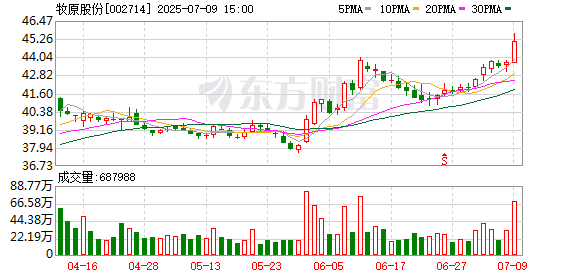
农林牧渔行业资金流出榜:牧原股份、国联水产等净流出资金居前
Zheng Quan Shi Bao Wang· 2025-07-09 09:29
Market Overview - The Shanghai Composite Index fell by 0.13% on July 9, with 17 out of the 28 sectors rising, led by Media and Agriculture, Forestry, Animal Husbandry, and Fishery, which increased by 1.35% and 0.65% respectively [2] - The sectors with the largest declines were Non-ferrous Metals and Basic Chemicals, which dropped by 2.26% and 0.85% respectively [2] Capital Flow Analysis - The main capital outflow from the two markets totaled 38.536 billion yuan, with only three sectors experiencing net inflows: Media (1.055 billion yuan), Retail (864 million yuan), and Construction Decoration (40.34 million yuan) [2] - The Electronic sector saw the largest net outflow, amounting to 7.789 billion yuan, followed by Non-ferrous Metals with 5.412 billion yuan [2] Agriculture, Forestry, Animal Husbandry, and Fishery Sector - The Agriculture, Forestry, Animal Husbandry, and Fishery sector rose by 0.65% despite a net capital outflow of 437 million yuan [3] - Out of 103 stocks in this sector, 40 stocks increased, with one hitting the daily limit, while 55 stocks declined [3] - The top three stocks with net inflows were Xinwufeng (31.4665 million yuan), Haida Group (28.3706 million yuan), and Juxing Agriculture (21.9941 million yuan) [3][4] Top Gainers and Losers in Agriculture, Forestry, Animal Husbandry, and Fishery - **Top Gainers**: - Xinwufeng: +0.65%, 4.20% turnover, 31.4665 million yuan inflow [4] - Juxing Agriculture: +0.76%, 4.49% turnover, 21.9941 million yuan inflow [4] - **Top Losers**: - Muyuan Foods: -3.27%, 1.81% turnover, 71.5922 million yuan outflow [5] - Guolian Aquatic Products: -1.76%, 8.74% turnover, 45.2607 million yuan outflow [5]


【干货】2025年食用油产业链全景梳理及区域热力地图
Qian Zhan Wang· 2025-07-09 03:12
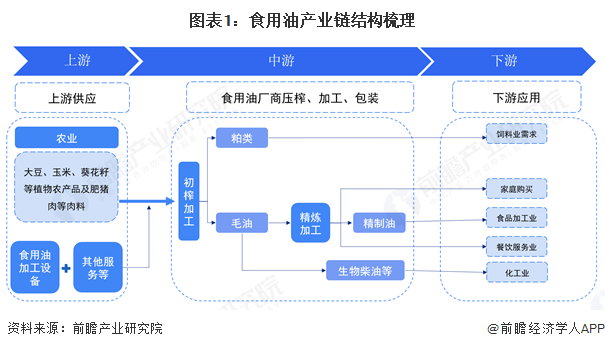
Core Insights - The article provides a comprehensive overview of the edible oil industry chain in China, detailing its various segments including oilseed cultivation, pressing, refining, packaging, and sales channels [1][5]. Industry Overview - The edible oil industry in China comprises numerous companies, with key producers including Jinlongyu, Shandong Luhua, Shanghai Liangyou, Jingliang Holdings, Jinjian Rice Industry, Xiwang Food, Daodaoquan, and COFCO Technology [2][5]. - The upstream raw materials are sourced from various agricultural enterprises, while downstream consumers include restaurants and e-commerce platforms like JD.com and Alibaba [2]. Regional Distribution - As of May 30, 2025, there are 60,329 registered companies in the edible oil industry chain in China, with Shandong province having the highest number at 5,946, followed by Hunan (5,269), Henan (4,519), and Sichuan (3,762), collectively accounting for 32.3% of the total [5][6]. - The geographical distribution of edible oil companies is closely linked to transportation convenience and agricultural production capabilities [5]. Listed Companies - Among the listed companies in the edible oil sector, 10 have disclosed revenue data related to edible oil, with a concentration in coastal regions. Notable companies include Xiwang Food and Jiahua in Shandong, Daodaoquan and Jinjian Rice Industry in Hunan, and Jinlongyu in Shanghai [6][10]. Industrial Parks - There are nearly 40 industrial parks related to edible oil production in China, primarily located in Sichuan (6 parks), followed by Henan and Zhejiang (4 parks each). Despite Shandong having the most companies, it has only 3 industrial parks, indicating a dispersed nature of edible oil enterprises in the province [10].



趋势研判!2025年中国玉米加工行业产业链、发展现状、细分市场产品结构及未来趋势分析:高附加值产品开发成为核心,生物制造技术引领行业转型升级[图]
Chan Ye Xin Xi Wang· 2025-07-07 01:05
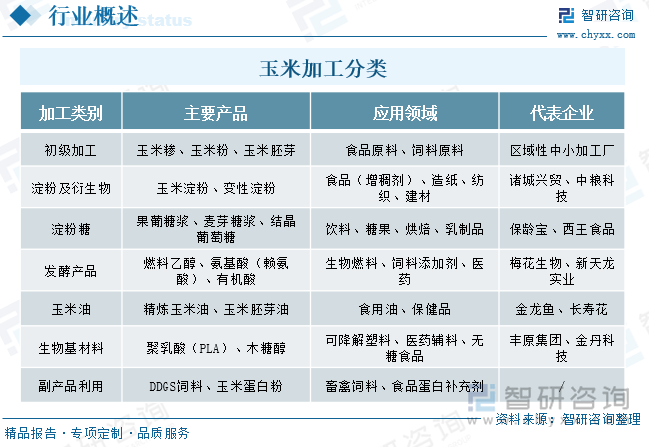
Core Viewpoint - The corn industry is a strategic pillar for China's food security, with significant growth in planting area, yield, and total production expected in 2024, despite short-term market adjustments due to international price fluctuations and rising costs [1][8][14]. Group 1: Industry Overview - The corn processing industry in China has developed a complete industrial chain, from primary processing to modern biobased material research, becoming a key hub for agricultural production and industrial manufacturing [1][5][14]. - Corn processing can be categorized into primary processing and deep processing, producing various products for food, feed, and industrial applications [2][3][5]. Group 2: Current Development Status - In 2024, China's corn planting area is projected to reach 44.74 million hectares, a year-on-year increase of 1.18%, with a yield of 439.4 kg/mu, contributing to a total production of 294.92 million tons, a 2.1% increase from the previous year [1][8][10]. - The total corn consumption in 2024 is expected to reach 31.78 million tons, with industrial consumption growing by 3.07% to 7.94 million tons, driven by innovations in deep processing [12][14]. Group 3: Market Trends - The corn deep processing market size is expected to adjust to 190 billion yuan in 2024, down 6.4% from its peak in 2022, but the long-term growth trend remains solid [1][14]. - The corn processing industry is transitioning towards green and low-carbon practices, focusing on high-value product development such as polylactic acid and functional sugars [24][25][26]. Group 4: Competitive Landscape - The corn deep processing industry in China has a tiered competitive structure, with leading companies like COFCO Technology and Meihua Biological occupying the top tier, focusing on high-value products [20][22]. - The market for corn starch is highly concentrated, with top companies holding over 44% market share, and there is a trend towards differentiation and expansion into biobased materials and other emerging fields [22][24].


以营养价值和功能特性为导向 中国花生油行业步入高品质竞争新阶段
Zhong Guo Chan Ye Jing Ji Xin Xi Wang· 2025-07-06 07:22
Core Insights - The Chinese edible oil industry is entering a high-level competitive phase driven by health consumption upgrades and stricter regulatory policies [1] - The market is experiencing structural changes with a focus on nutritional value and functional characteristics [1] Market Trends - The peanut oil market in China showed a steady growth trend from 2018 to 2024, with market size increasing from 46.52 billion yuan in 2018 to 52.96 billion yuan in 2020, reflecting a cumulative growth of 13.8% [2] - The market is expected to stabilize with sizes of 53.56 billion yuan, 54.46 billion yuan, 54.59 billion yuan, and 53.93 billion yuan from 2021 to 2024, indicating a mature and stable market despite competitive pressures [2] Price Structure - The peanut oil market exhibits clear consumption stratification, with products priced below 100 yuan per 5L accounting for 26.2% and those above 100 yuan per 5L making up 73.8% of the market [3] - Leading brands like Lu Hua and Jin Long Yu dominate the high-end market, reflecting consumer preferences for quality and health [3] Regulatory Environment - Strict food safety regulations, particularly concerning aflatoxin limits, are driving industry consolidation and pushing out smaller players [4] - The main detoxification technologies include physical adsorption, refining detoxification, irradiation, and biochemical methods, with advanced detoxification technology becoming a core competitive advantage for leading companies [4][5] Health Trends - The demand for healthier products is driving structural expansion in the market, with high oleic acid peanut oil emerging as a popular choice due to its health benefits [6][7] - The market is shifting towards high-quality products, with high oleic acid peanut oil containing over 75% oleic acid, appealing to health-conscious consumers [7]
2025年中国食用油行业龙头企业分析:益海嘉里行业龙头地位巩固【组图】
Qian Zhan Wang· 2025-07-03 04:13
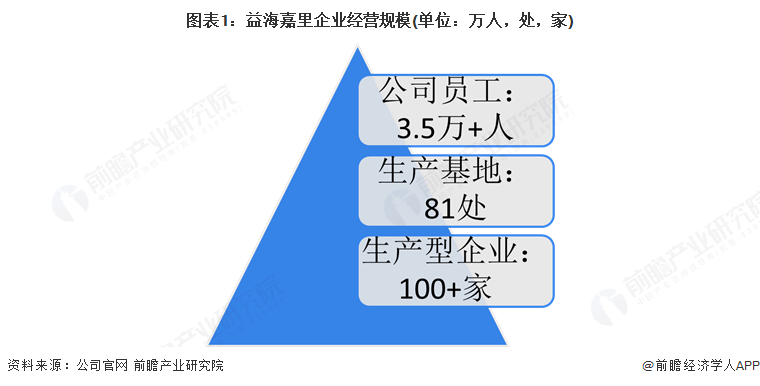
Core Insights - Yihai Kerry is a major player in China's agricultural and food processing industry, with a vast operational scale and a comprehensive product layout [1][3] - The company's recent performance shows improvement, with a revenue of 59.079 billion yuan in Q1 2025, marking a 3.15% year-on-year increase, and a net profit of 0.981 billion yuan, up 11.23% [3] - Yihai Kerry focuses heavily on the edible oil business, with a significant presence in the domestic market, generating 97.23% of its revenue from domestic operations [9][12] Company Overview - Yihai Kerry has over 35,000 employees and operates 81 production bases across China, engaging in various sectors including oilseed crushing, oil refining, and food ingredient production [1] - The company has established a wide marketing network covering retail, catering, and food industrial channels, offering a diverse range of products [6] Financial Performance - In 2024, Yihai Kerry's kitchen food business generated 145.423 billion yuan, accounting for 60.88% of total revenue, while feed raw materials and oil technology contributed 91.639 billion yuan, or 38.36% [6] - The company reported a total revenue of 2322.54 billion yuan from domestic operations in 2024, with only 2.77% coming from overseas [9] Market Position - Yihai Kerry holds a significant market share in the domestic edible oil market, with a share of 37.7% in 2024, although this is a slight decrease from 39.3% in 2019 due to the rise of local brands [12]
果然财经|鲁花集团股改完成,估值达209亿元,剑指上市?
Sou Hu Cai Jing· 2025-07-02 07:24
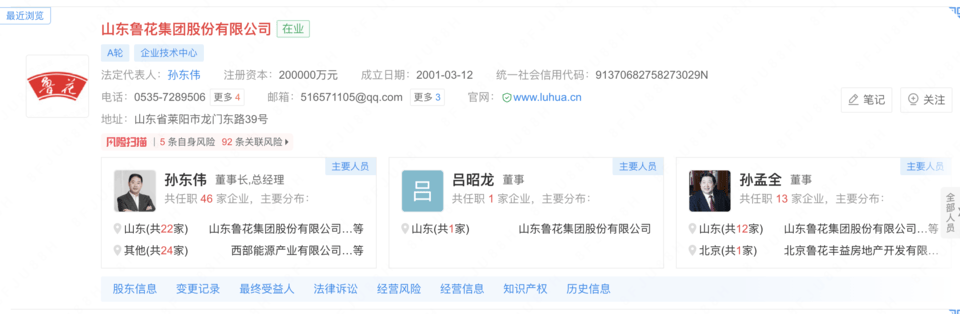
Group 1 - Shandong Luhua Group has completed its shareholding reform and changed its name to Shandong Luhua Group Co., Ltd, with registered capital increasing from approximately 1.091 billion to 2 billion yuan, an increase of 83% [1] - The company is speculated to be preparing for a capital market entry following the restructuring and capital increase [1][8] - The new shareholder structure shows Shandong Luhua Holding Group Co., Ltd as the largest shareholder with a 64.19% stake, controlled by the founder's family [2] Group 2 - Luhua Holding has integrated several family-controlled asset platforms and established a wholly-owned subsidiary for investment and private equity management, enhancing its capital layout [4] - In late 2024, strategic investors including Jinlongyu and Hong Kong Jiayin invested 5.5 billion yuan for a 26.64% stake, raising Luhua's valuation to 20.9 billion yuan [4] - The management team has undergone significant changes, with key personnel leaving and new members joining, possibly linked to legal issues faced by a former executive [4] Group 3 - Founded in 1983, Luhua has grown from a local factory to a leading brand in high-end edible oils, particularly in the peanut oil sector [5] - The company has an annual production capacity of 1.5 million tons for edible oils, 300,000 tons for condiments, and 500,000 tons for rice and flour, supported by a nationwide marketing network [7] - Luhua holds a 6.7% market share in the packaged edible oil industry, ranking third behind Yihai Kerry and COFCO, and leads the high oleic peanut oil segment with a 34% market share [7] Group 4 - The recent restructuring and capital increase indicate Luhua's intent to prepare for an IPO amidst intense competition in the edible oil industry [6] - The competitive landscape includes established players like Jinlongyu and COFCO, with Luhua's potential listing expected to enhance industry concentration [6] - Challenges remain for Luhua, including raw material price fluctuations and the need for effective strategies to maintain growth and competitiveness post-IPO [8]
中国品牌力指数排名发布 金龙鱼“霸榜”食用油品牌排行榜
Zheng Quan Ri Bao Zhi Sheng· 2025-07-02 06:45
Group 1 - The core viewpoint of the news is that Yihai Kerry Group's brand, Jinlongyu, has maintained its leading position in the edible oil market for fifteen consecutive years, achieving a score of 698.5 in the 2025 China Brand Power Index (C-BPI) [1][2] - Jinlongyu also ranked first in the flour and rice categories, showcasing the company's strong positioning across the entire grain and oil industry chain [1] - The report highlights the strong brand matrix of Yihai Kerry Group, with its sub-brands, Hu Jihua and Xiang Manyuan, also performing well in the edible oil category, indicating a synergistic effect within the brand portfolio [1] Group 2 - Yihai Kerry Group ranked 32nd in the 2025 China Listed Companies Brand Value List, with a brand value of 153.608 billion yuan, reflecting its strong brand influence [2] - The company has successfully maintained its leadership in the edible oil sector while making new breakthroughs in the flour and rice markets through brand focus and product innovation [2] - The resilience of the brand and diversified layout is expected to create greater market opportunities for the company amid the trend of consumer upgrades [2]
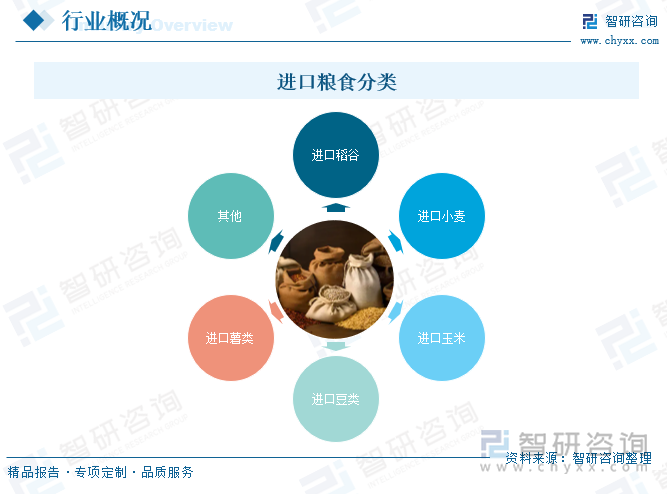
2025年中国进口粮食行业市场政策、产业链图谱、供需现状、竞争格局及发展趋势研判:豆类依然是占比最大的进口品种,占比高达66.67%[图]
Chan Ye Xin Xi Wang· 2025-06-26 01:38
Overview - China, as a populous country, has a massive demand for food, with grain demand projected to reach 861.77 million tons in 2024, while production is only expected to be 706.5 million tons, necessitating significant imports [1][9]. - The demand for feed grains such as corn and soybeans has surged due to increased consumption of livestock products as living standards rise [1][9]. Market Policies - The Chinese government emphasizes food security and has implemented various policies to control import scales and ensure the quality of imported grains [4][6]. - Recent policies include support for cross-border e-commerce and measures to stabilize foreign trade growth, reflecting a commitment to enhancing the agricultural sector [4][6]. Industry Chain - The upstream of the imported grain industry includes overseas grain planting, ocean transportation, and cold chain logistics, while the downstream consists of oil extraction, flour processing, feed production, and food processing [7]. - Key products processed from imported grains include edible oils, various flours, and animal feed, which are essential for meeting domestic consumption needs [7]. Current Development - In 2024, China is expected to import 15.753 million tons of grain, a decrease of 2.3% year-on-year, with an import dependency rate of 18.28% [11]. - Soybeans remain the largest import category, accounting for 66.67% of total imports, followed by corn and wheat at 8.66% and 2.74%, respectively [11]. Competitive Landscape - The competitive landscape includes 344 companies applying for wheat import quotas and 1,453 for corn, with major state-owned enterprises like COFCO Group holding significant market influence due to their comprehensive logistics and storage capabilities [14][22]. - COFCO Group is a leading player in the grain import sector, with a global supply chain covering grain storage, logistics, processing, and trade [22]. Industry Representative Analysis - COFCO Group has established itself as a global leader in the agricultural sector, with operations spanning across six continents and an annual grain trading volume of 170 million tons [22]. - Jin Jian Rice Industry Co., Ltd. focuses on high-quality grain and oil products, with a revenue of 4.627 billion yuan in 2024, indicating a strong presence in the agricultural trade market [24]. Development Trends - Future trends indicate a diversification in imported grain types, with an expected increase in high-end edible oils, quality rice, and specialty grains [26]. - China aims to optimize its import structure and expand its sources of grain imports, reducing reliance on single markets and enhancing trade cooperation with countries along the Belt and Road Initiative [26].