Broadcom(AVGO)

Search documents
【美股盘前】中概股普涨,阿里巴巴涨超2%;核电股集体拉升,Oklo涨超6%;现货黄金升破4210美元续创新高;阿斯麦涨3.5%,Q3净利超预期,新增54...
Mei Ri Jing Ji Xin Wen· 2025-10-15 10:40
Group 1 - Major stock index futures are rising, with Dow futures up 0.30%, S&P 500 futures up 0.46%, and Nasdaq futures up 0.65% [1] - Chinese concept stocks are experiencing a pre-market rally, with Alibaba up 2.25%, Pinduoduo up 1.35%, JD.com up 1.53%, Baidu up 2.88%, and Li Auto up 1.58% [1] - TSMC shares rose over 4.5% as market expectations indicate a 26% year-on-year increase in Q3 net profit, reaching NT$410.58 billion, surpassing the previous quarter's record of NT$398.27 billion [1] Group 2 - Intel shares increased over 2% following the announcement of a new data center GPU, Crescent Island, featuring 160GB memory, as part of its AI strategy [2] - ASML shares rose 3.5% after reporting Q3 net profit of €2.13 billion, exceeding market expectations of €2.08 billion, with new orders totaling €5.4 billion (approximately $6.27 billion), doubling from €2.63 billion year-on-year [2] - Citigroup raised Broadcom's target price to $415 following a partnership announcement with OpenAI regarding a custom AI accelerator [2] Group 3 - Nuclear power stocks surged, with Oklo and Centrus Energy up over 6%, and NuScale Power up over 5%, following the U.S. military's announcement of the "Janus" plan to deploy small reactors at military bases to address energy demands [3]



解读OpenAI万亿布局:史上最大商业赌局
Hu Xiu· 2025-10-15 10:04
Core Viewpoint - A significant capital cycle is forming in Silicon Valley, involving major players like Nvidia, OpenAI, Oracle, and AMD, raising concerns about the sustainability of this capital game based on future revenue projections rather than actual demand [1] Group 1: Key Transactions - Nvidia invests in OpenAI, which subsequently purchases computing power from Oracle [1] - Oracle then buys chips from Nvidia, creating a closed loop of transactions among these companies [1] - OpenAI signs an agreement with AMD to purchase chips, acquiring a 10% stake in the company [1] - OpenAI also announces a similar agreement with Broadcom just before the video release [1] Group 2: Criticism and Concerns - Critics argue that these transactions resemble a capital performance based on imagined future revenues rather than genuine market demand [1] - The intricate relationships among Silicon Valley AI capital players may signal the beginning of a potential bubble [1]


AI行情到了第几层?
3 6 Ke· 2025-10-15 09:18
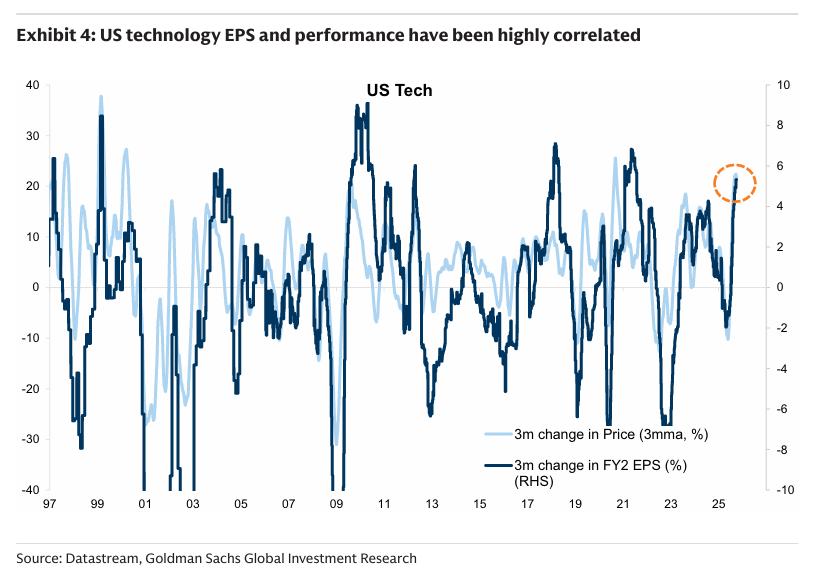
Group 1 - The market is experiencing a repetitive pattern of new highs, with investors focusing on themes such as the reshaping of the global monetary order and advancements in AI technology [1] - OpenAI has made significant investments, including a $100 billion deal with Oracle for cloud services and a partnership with AMD to deploy $100 billion worth of GPUs [1][2] - There is a growing debate about the sustainability of AI investments, with some optimistic about the commitment of tech giants, while others express concerns about potential market instability [2] Group 2 - Goldman Sachs published a report stating that AI has not yet formed a bubble, as key indicators such as rapid asset price increases, high valuations, and systemic risk from leverage have not reached critical levels [3][4] - The report highlights that the current rise in stock prices is more reflective of strong earnings growth rather than speculative behavior, with tech stock price changes closely aligned with EPS growth [3][4] - Current valuations of major tech companies are high compared to historical levels but are still below the peaks seen during the internet bubble, suggesting that as long as earnings continue to grow, a bubble is unlikely [4][8] Group 3 - Concerns have been raised about the sustainability of capital expenditures in the AI sector, with estimates suggesting that the industry may need $320 billion to $480 billion in revenue to balance current spending [12] - The rapid depreciation of data center assets and the need for significant revenue growth to justify capital investments could lead to a substantial funding gap in the future [12][13] - The AI sector is compared to historical infrastructure projects, where government support may not align with the economic returns expected from investments, raising concerns about potential financial instability [14] Group 4 - The emergence of "computing deflation" has not materialized as expected, leading to increased capital expenditures by tech companies in AI, indicating a competitive arms race for computing power [15][18] - The total market value of the largest five U.S. tech companies now exceeds that of major global indices, highlighting their significant influence on the stock market [15] - The AI industry's capital expenditures reflect a financing characteristic similar to that seen in other markets, raising questions about the potential for a bubble [18]

AI行情到了第几层?
远川研究所· 2025-10-15 09:07
Core Viewpoint - The article discusses the current state of the AI industry, highlighting significant investments and partnerships among major tech companies, while also addressing concerns about potential bubbles and the sustainability of capital expenditures in the sector [6][8][18]. Group 1: AI Investments and Partnerships - OpenAI announced a $100 billion investment in Oracle's cloud services, which led to Oracle investing $100 billion in NVIDIA, and NVIDIA subsequently investing $100 billion in building AI data centers [6]. - OpenAI and AMD reached a multi-billion dollar agreement for deploying AMD GPUs, with potential stock options valued at $96 billion if AMD's stock reaches $600 [7]. - OpenAI's collaboration with Broadcom for custom chips further emphasizes the involvement of major players in the AI ecosystem, with Broadcom's market cap at $1.5 trillion [7]. Group 2: Perspectives on AI Bubble - Goldman Sachs published a report asserting that the AI sector has not yet formed a bubble, citing the absence of rapid asset price increases, excessive valuations, and systemic risks driven by leverage [9][10]. - The report indicates that the current price increases reflect strong and sustained earnings growth rather than speculative behavior, with tech stock price changes closely aligned with earnings per share (EPS) growth [9][10]. - The valuation of major tech companies remains below the peak levels seen during the internet bubble, suggesting that as long as earnings continue to grow, a bubble is unlikely to form [10][14]. Group 3: Concerns and Critiques - Kuppys Korner raised concerns about the AI industry's revenue requirements, suggesting that the sector may need between $320 billion to $480 billion in revenue to balance current capital expenditures, while current monthly AI revenue is only around $10 billion [19][20]. - The article draws parallels between the current AI investments and historical infrastructure projects, suggesting that government support for AI may not yield immediate financial returns, similar to past railway projects [21][22]. - The potential for a financial panic is highlighted if data center expansions cease, which could lead to a reversal of wealth effects and impact the broader economy [22]. Group 4: Market Dynamics and Valuations - The article notes that the largest five tech companies now have a combined value exceeding that of major global indices, accounting for approximately 16% of the total global stock market value [24]. - The AI industry's capital expenditures are likened to a financing market, with significant market reactions to news events leading to substantial increases in company valuations [27]. - The discussion includes perspectives from industry leaders, with some expressing a sense of bubble-like conditions while refraining from shorting major tech stocks [29].

Broadcom Stock Investors Just Got Good News From OpenAI -- Is Nvidia Losing Its Edge in AI Chips?
The Motley Fool· 2025-10-15 08:15
Core Insights - Broadcom has entered a multiyear partnership with OpenAI to develop custom AI accelerators, enhancing its position in the AI market [1][4] - Broadcom is the second-largest supplier of AI accelerators, with a significant market share in Ethernet switching and high-end ASICs [1][6] - The partnership with OpenAI is expected to contribute to Broadcom's revenue growth, with projections of $60 billion to $90 billion by fiscal 2027 [2][7] Company Developments - Broadcom is currently building custom AI chips for three hyperscale companies, with an estimated annual revenue of $60 billion to $90 billion by fiscal 2027 [2] - A fourth significant customer has placed orders totaling $10 billion, speculated to be OpenAI [3] - The partnership will involve co-developing 10 gigawatts of custom AI accelerators, with deployment expected from the second half of 2026 through 2029 [4] Market Position and Projections - Broadcom's share of the AI accelerator market is projected to increase from 6% today to 14% by 2030, while Nvidia's share is expected to decrease from over 80% to 67% [6] - Broadcom is on track to earn $13 billion in custom AI accelerator revenue in fiscal 2025, with potential growth of 115% to 163% over the next two years [7] Valuation Concerns - Despite the growth potential, Broadcom's stock is trading at 91 times earnings, indicating a high valuation compared to its forecasted 30% annual earnings growth [8] - The price-to-earnings-to-growth (PEG) ratio exceeds 3, suggesting the stock may be overvalued [8] Competitive Landscape - Nvidia remains the dominant player in the AI accelerator market, with a lower total cost of ownership for its systems [10] - Broadcom collaborates with major companies like Google and Meta Platforms, but Nvidia's established ecosystem and R&D investment present significant competitive barriers [11][12]
博通获花旗看好:与OpenAI合作后目标价上调至415美元
Ge Long Hui· 2025-10-15 07:53
芯片制造商博通与微软支持的OpenAI于周一宣布就"10千兆瓦定制AI加速器"达成合作后,花旗随即将 该股目标价从350美元上调至415美元,并维持"买入"评级。 ...
博通(AVGO.US)获花旗看好:与OpenAI合作后目标价上调至415美元
智通财经网· 2025-10-15 07:48
智通财经APP获悉,芯片制造商博通(AVGO.US)与微软支持的OpenAI于周一宣布就"10千兆瓦定制AI加 速器"达成合作后,花旗随即将该股目标价从350美元上调至415美元,并维持"买入"评级。 模型显示,博通AI业务营收有望从2025年的约220亿美元(占总销售额33%)跃升至2027年的850亿美元(占 比65%),增长逾四倍。 花旗提到,OpenAI目前已公布总计26千兆瓦的AI基础设施规划;该行AI分析师Heath Terry测算,每千兆 瓦建设成本约500亿美元,意味着到2030年累计资本支出可达1.3万亿美元。Terry预计OpenAI收入将由 2025年的约125亿美元增至2030年的1,630亿美元。 Danely等人还认为,博通在第三财季财报中披露的那家"100亿美元客户"大概率是xAI。 Christopher Danely领衔的分析师团队指出,虽然博通未给出官方预测,但他们估算该交易未来数年有望 为公司带来约1000亿美元收入,并合计贡献每股8美元盈利。首批定制芯片将于2026年底开始发货,交 付周期将持续至2029年。 ...
AI行情到了第几层?
远川投资评论· 2025-10-15 07:05
Core Viewpoint - The article discusses the current state of the AI industry, highlighting significant investments and partnerships among major tech companies, while also addressing concerns about potential bubbles in the market and the sustainability of capital expenditures in AI [2][4][5]. Investment Activities - OpenAI announced a $100 billion investment in Oracle's cloud services, which was followed by Oracle's $100 billion investment in NVIDIA, and NVIDIA's $100 billion investment in OpenAI for building AI data centers [2]. - OpenAI and AMD reached a multi-billion dollar agreement for deploying AMD GPUs, with OpenAI able to purchase up to 160 million shares of AMD at $0.01 per share, potentially valuing the shares at $96 billion if AMD's stock reaches $600 [3]. Market Sentiment - Optimists view the commitment of tech giants to AI as a positive sign, while pessimists question the sustainability of such investments, likening it to a precarious structure that could collapse [4]. - Goldman Sachs published a report asserting that AI has not yet formed a bubble, citing the absence of rapid asset price increases, overvaluation, and systemic risks driven by leverage [6][7]. Valuation Analysis - Current valuations of tech stocks, while high, do not reach the peaks seen during the internet bubble, with the median forward P/E ratio for the "Big Seven" tech companies at 27 times, which is significantly lower than the late 1990s [7][11]. - The capital expenditure to sales ratio for major tech companies is increasing, but their capital expenditure to free cash flow ratio remains stable, indicating strong balance sheets [11]. Revenue Concerns - Kuppys Korner raised concerns about the AI industry's revenue requirements, suggesting that the industry may need between $320 billion to $480 billion in revenue to balance this year's capital expenditures, while current monthly AI revenue is only around $10 billion [16][17]. - The anticipated construction of numerous data centers could require up to $1 trillion in revenue to achieve balance, excluding the need for returns [17]. Historical Parallels - Kuppys Korner draws parallels between the current AI landscape and historical infrastructure projects, suggesting that government support for AI may not yield immediate financial returns, similar to past railway projects that faced financial turmoil despite strategic importance [18][19]. - The article concludes with a cautionary note that if data center expansions cease, it could lead to significant financial repercussions, echoing historical economic crises [19]. Market Dynamics - The AI industry has become a financial cycle, where market capitalization and revenue growth are interlinked, with large companies experiencing significant market value fluctuations based on news [24]. - The article references Ray Dalio's sentiment that there are signs of a bubble, yet he does not advocate shorting major tech companies [26].

与OpenAI深度绑定,博通在陪Altman进行一场“AI豪赌”
硬AI· 2025-10-15 06:56
Core Viewpoint - The collaboration between Broadcom and OpenAI represents a high-risk, high-reward gamble, with significant implications for both companies' futures [3][6]. Group 1: Partnership Dynamics - Broadcom is set to develop a large number of chips and computing systems for OpenAI, which has led to a nearly 10% surge in Broadcom's stock price [3]. - OpenAI plans to invest billions of dollars in filling data centers with hundreds of thousands of chips, with a total power consumption projected to reach 26 gigawatts, a figure that dwarfs New York City's peak summer electricity demand [3]. - OpenAI's CEO Sam Altman has indicated that this ambitious plan represents only one-tenth of their future eight-year construction strategy [3]. Group 2: Financial Considerations - OpenAI's expected revenue for the year is approximately $13 billion, which is insufficient to cover the substantial expenditures outlined by Altman, with profitability not anticipated until 2029 [4]. - Bernstein Research analyst Stacy Rasgon estimates that the deal could generate "well over $100 billion" in additional revenue for Broadcom over the next three to four years [7]. Group 3: Risks and Challenges - Broadcom's investment in OpenAI poses a significant risk, as it is heavily reliant on a single, uncertain client [5][7]. - The customized nature of the systems being developed for OpenAI means that if OpenAI encounters difficulties, the specialized systems will be challenging to repurpose for other clients [7]. - Broadcom's CEO Hock Tan acknowledged that while developing large AI systems could boost profitability, it would also dilute gross margins, although specific figures were not disclosed [7]. Group 4: Competitive Landscape - Broadcom faces increasing competition in the custom chip market, particularly from Nvidia and AMD, which could lead to price wars and further pressure on profit margins [10][11]. - Google, a core customer for Broadcom's custom chip business, has begun collaborating with MediaTek to develop custom AI chips, signaling potential shifts in client relationships [11]. - Broadcom's stock is currently valued at approximately 40 times its expected earnings for the next year, raising questions about its high valuation compared to Nvidia, which leads the AI chip market [11].